
Connect with us

Northeast

Pilot miraculously survives plane crash near New Hampshire home

Published

on

Pilot miraculously survives plane crash near New Hampshire home

Join Fox News for access to this content

Plus get unlimited access to thousands of articles, videos and more with your free account!

Please enter a valid email address.

By entering your email, you are agreeing to Fox News Terms of Service and Privacy Policy, which includes our Notice of Financial Incentive. To access the content, check your email and follow the instructions provided.

A small plane crashed in a wooded area behind a home in southern New Hampshire shortly after takeoff Friday morning, and the pilot — the sole occupant — was pulled alive from the wreckage, officials said. 

The aircraft, a Beechcraft Model 99 twin-engine turboprop cargo plane, went down at the edge of a backyard on Colonial Drive in Londonderry around 7:30 a.m. after departing Manchester-Boston Regional Airport, according to the Londonderry Fire Department and a spokesperson for the Federal Aviation Administration (FAA).

Advertisement

The pilot, who has not been identified, was pulled from the wreckage and transported to a local hospital and then to a hospital in Boston, Londonderry Fire Chief Bo Butler said at a press conference. 

Officials did not reveal the nature of the victim’s injuries, although the pilot was one of several people to call 911 for help and was conscious the entire time, Butler said. 

PILOT KILLED IN CRASH AFTER ALLEGEDLY STEALING PLANE FROM TEXAS FLIGHT SCHOOL

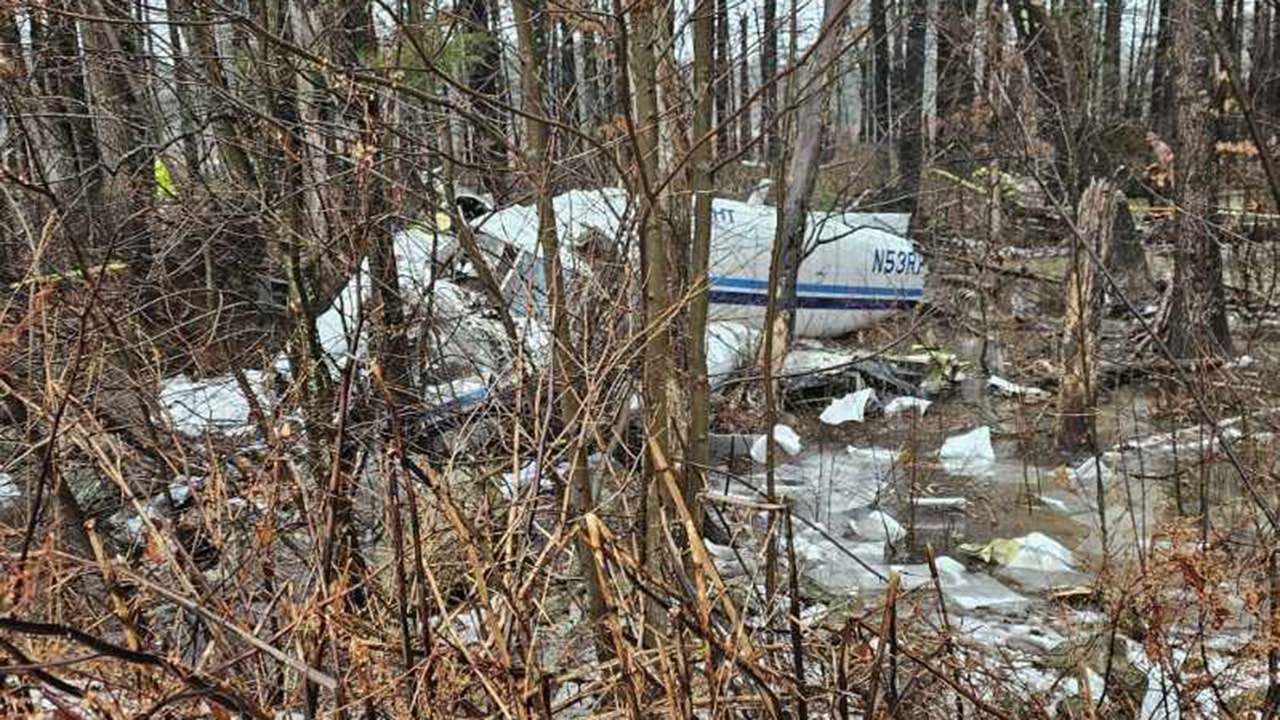
A small cargo plane crashed just feet from a home in southern New Hampshire Friday shortly after takeoff from Manchester-Boston Regional Airport. This photo shows the twisted metal of the wreckage between trees. The tail of the aircraft appears to have broken off.  (Londonderry Fire Dept.)

Photos from the scene show the twisted metal of the wreckage on the ground between trees, and the tail of the aircraft appears to have broken off. 

Advertisement

“He [the pilot] was probably about 70 feet from a residence, a single-family residence, where the line of the residence met the tree line of the woods,” Butler said.

“Very, very close.”

Wiggins Air Flight 1046 was on its way to Presque Isle International Airport in Maine when it crashed, the FAA said.

It is unclear what caused the aircraft to crash, although investigators said the pilot radioed for help shortly after takeoff.

“It was a challenging environment because, as you can imagine, the fuselage is very compromised and damaged,” Butler said. “So, getting access to the pilot himself through the crews and through the rescue tools was very, very difficult. But, ultimately, they pulled it off relatively quickly.”

Advertisement

The twin-engine turboprop cargo plane went down at the edge of a backyard in Londonderry at around 7:30 a.m.  (Londonderry Fire Dept.)

RUSSIAN TRANSPORT PLANE CRASHES NEAR UKRAINE WITH MORE THAN 60 UKRAINIAN PRISONERS OF WAR ABOARD

Butler said the pilot was lucky to survive.

“He ought to play the lottery, for sure. This was a very significant emergency response that we responded to, and a lot of things could have gone wrong further than the aircraft crashing itself. So, the mitigation efforts were very impactful and successful in this case.”

Butler praised his team for its quick response. A crew was on the scene eight minutes after receiving the 911 call, he said. 

Advertisement

The site where a Beechcraft 99 twin-engine turboprop cargo plane went down at the edge of a backyard on Colonial Drive in Londonderry. (Londonderry Fire Dept.)

“This was an incredibly high-risk, low-frequency event that was professionally and competently mitigated by members of the Londonderry Fire Department,” Butler said, noting there were downed power lines and the aircraft had around 250 gallons of fuel on board. A hazardous materials management (HAZMAT) team also responded, but there was no fire, he said.

Eddie Saktanaset, who owns the home near the crash site, told WBZ-TV that he and his wife heard a loud boom, and they started getting calls from their neighbors. 

Londonderry town officials hold a press briefing about a plane crash in a neighborhood.  (WFXT)

Advertisement

“We feel very blessed to be alive right now because it’s so close to our house,” Saktanaset said.

When they ran outside, they found the plane had crashed in the woods behind his house. 

“I was surprised to see a plane crash,” Saktanaset said. “It sounded more like trees falling down.”

The crash had no impact on other flights using Manchester-Boston Regional Airport.

A fire vehicle and police car at a plane crash in a neighborhood. (WFXT)

Advertisement

Read the full article from Here

Continue Reading
Click to comment

Leave a Reply

Your email address will not be published. Required fields are marked *

This site uses Akismet to reduce spam. Learn how your comment data is processed.

Pennsylvania

Pennsylvania company builds goals for US Soccer, FIFA World Cup matches

Published

on

Pennsylvania company builds goals for US Soccer, FIFA World Cup matches


QUAKERTOWN, Pa. (WPVI) — When the world’s top soccer players take the field in Philadelphia, the goals they aim for will have already been crafted in Pennsylvania.

Kwik Goal, a family-run company based in Quakertown, is the official goal maker for U.S. Soccer and supplies equipment for the FIFA World Cup.

Inside the company’s test area, workers check the strength of nets and frames.

President and CEO Anthony Caruso says the goal shown in the testing zone is the same model that will be used during the tournament.

Advertisement

Kwik Goal has been building soccer equipment for decades, but its story began far from Pennsylvania.

Caruso said the company started 30 years ago on Long Island, New York, when his uncle needed a portable goalpost for coaching.

“My uncle had the need for a portable goalpost. He was coaching my youngest cousin,” Caruso said.

His father stepped in to help.

“My father took out a tape measure. He went to a tube house, bought some pieces of aluminum, made this gold frame, and scrounged up a net somewhere,” he said. “And I was in welding school, and I could weld aluminum. So this prototype was built, and my uncle took it out to the field.”

Advertisement

The company later moved to Pennsylvania.

“Here we are today. We moved here in November of ’88 after being on Long Island from our inception. And we’ve been here ever since,” said Caruso.

Today, Kwik Goal operates out of four buildings and produces about 7,000 goals each year.

Its reputation for quality led to a partnership with the U.S. men’s national team three decades ago, followed by the U.S. women’s national team.

“We supply all their training sites, and actually, the new facility that they just built in Georgia, we did all the equipment for that,” Caruso said.

Advertisement

The World Cup, however, is the company’s biggest stage. In addition to manufacturing the FIFA game-day goals, Kwik Goal also produces the portable and pre-game models used throughout the tournament.

“This is a portable goal that mimics the game goals here, that are on the practice fields and what they’ll be using at the 60 training sites,” Caruso said. “And then this goal here that we have in the back is actually what we call a pre-game goal. So when they warm the teams up before the tournament, the day of the game on the field, before that, before the game, they actually bring this goal out.”

For employees, seeing their work on the global stage is a career highlight.

“Well, it is the pinnacle of my career,” one worker said.

“There’s a great amount of pride here at Quick Goal, and everybody who’s been here. We have a lot of long-term employees, and they’re just thrilled to be a part of this project,” said Caruso.

Advertisement

Copyright © 2026 WPVI-TV. All Rights Reserved.


Source link

Continue Reading

Rhode Island

Ethics Commission denies Shekarchi’s motion to dismiss high court bid ethics complaint

Published

on

Ethics Commission denies Shekarchi’s motion to dismiss high court bid ethics complaint


Former Rhode Island House Speaker Joseph Shekarchi loses an attempt to stop an ethics complaint against his bid for a seat on the state Supreme Court.

The state Ethics Commission voted Tuesday to deny Shekarchi’s motion to dismiss the complaint filed in May.

The Ethics Commission voted June 2 to further investigate the complaint.

The question is whether Shekarchi’s attempt for a lifetime spot on the bench violates Rhode Island’s anti-corruption revolving door law.

Advertisement

The law prevents sitting lawmakers from taking most other state jobs for at least a year after leaving office.

Shekarchi resigned as House Speaker on May 8 to seek nomination to the Supreme Court.

He kept his House seat.

That same day, Roger Williams University law professor Michael Yelnosky filed an ethics complaint.

Shekarchi argues a Supreme Court seat is an exemption from the revolving door law, like other constitutional offices including governor.

Advertisement
Comment with Bubbles

JOIN THE CONVERSATION (4)

The Ethics Commission’s prosecutor argues the high court seat is not exempt.


Source link

Advertisement
Continue Reading

Vermont

Commentary | Vermont Chamber: Vermont is in trouble

Published

on

Commentary | Vermont Chamber: Vermont is in trouble


Not someday in some distant future. Now.

We are aging, shrinking, and pricing out our own children, workers, and entrepreneurs. Schools face consolidation, taxes are climbing, and employers struggle to fill jobs. We’re too dependent on federal funding to support state spending. A housing shortage is driving up prices, slowing economic growth, and leaves young people feeling forced out.

Staying the course is not a viable option. It only gets worse from here if nothing changes.

Advertisement

The cost of scarcity

For decades, Vermont has treated growth as a threat to mitigate. We are living through the consequences of that mindset, and it hits marginalized communities hardest. True equity requires expanding supply rather than fighting over the crumbs of a shrinking economy. Otherwise, people lose hope and leave. This is already happening: Vermont experienced the nation’s largest percent decrease in population last year, becoming the only state losing population to both natural change and net migration.

The data are clear: Over the next decade, Vermont must add roughly 13,500 workers annually just to maintain economic stability. We need 7,500 new homes each year, yet we only permit about 2,500. When we fail to build, we aren’t “preserving” Vermont. We are pricing out multi-generational families, working-class neighbors, and Black, Indigenous, and People of Color Vermonters who represent our state’s fastest-growing demographic. Saying no to growth denies depopulated rural areas the chance to revitalize their communities. A shrinking tax base concentrates economic pressure on fewer people, creating a vicious cycle that erodes even the most resilient communities.

Most Vermonters support more housing and population growth, and policymakers keep saying they intend to follow the will of the people. However, intentions do not house families, fill classrooms, staff hospitals, or make life more affordable. Outcomes do. Right now, tangible outcomes are coming far too slowly or not at all.

It doesn’t have to be this way. We can choose a different path forward.

From roadmap to results

The planning is done. Between the Vermont Futures Project’s Economic Action Plan and the Vermont Business Roundtable’s Systems Innovation Framework, we have the data-informed roadmaps. We know where the hurdles are: a regulatory system that prizes “no” over “how,” and a fiscal trajectory where spending outpaces tax base growth, both exacerbated by unfunded mandates adding layers to an already inefficient system.

Advertisement

Process continues to overshadow results. It is time for outcomes. Future policymakers should focus on these four immediate shifts:

Regulatory Modernization: Move from a culture of “permission” to a culture of “production.” If a project meets established goals, it should be approved in months, not years. Start with “yes” as the default.

Fiscal Stewardship: Align our budget with economic reality. Vermont cannot tax its way out of a shrinking population and a constrained economy. Families and businesses need a predictable environment that allows them to plan, invest, stay, and grow.

Intentional Growth: Actively recruit and retain a diverse, working-age population. Growth funds our schools, supports our healthcare system and sustains our communities, benefiting the people already here.

Accountability: Ensure enacted policies achieve their goals. If the goal is housing, did we build the homes? If it is affordability, did we bring costs down sustainably? Revisit system design and policies if they fail to produce tangible results.

Advertisement

What comes next

Data is not destiny. Vermont’s future is a choice. Let’s choose abundance because Vermonters can no longer afford to choose scarcity. Here’s how you can help.

To the business community: Step forward to share your experiences with the downstream impacts of public policy. Your insights are crucial to modernizing our rules, regulations, and system design, and restoring Vermont’s competitiveness to build an economy where everyone can thrive.

To policymakers: We stand ready to be your partners. The data is clear, our organizations are aligned, and the roadmap is ready. We don’t need endless studies; we need your help to produce results. As the election cycle approaches, remember that accountability is measured by tangible outcomes for Vermonters, not intentions.

To our fellow Vermonters: Say “yes” to the possibilities in your own communities. Welcome new housing, support the local businesses, and champion a growing tax base over rising tax rates. But wanting change is not enough; you must participate to make it happen. Engage with your elected officials, serve on a local board, and turn out to vote for the future you want to see.

Finally, we must all reshape the narrative about Vermont. Share stories about why you love living and working here and why others should consider Vermont too. Your voice can help break the vicious cycle of scarcity. Speak openly about how growth can improve well-being and why you support it.

Advertisement

Growth is not a threat to Vermont; growth is what will save it.


Source link

Continue Reading
Advertisement

Trending
