The wait is almost over for former Arizona star freshmen Brayden Burries and Koa Peat. After leading the Wildcats to their first Final Four in 25 years, the duo are less than 48 hours away from achieving their dreams of joining the NBA.
West
Hawaii governor focuses on Maui recovery efforts, housing in State of the State address

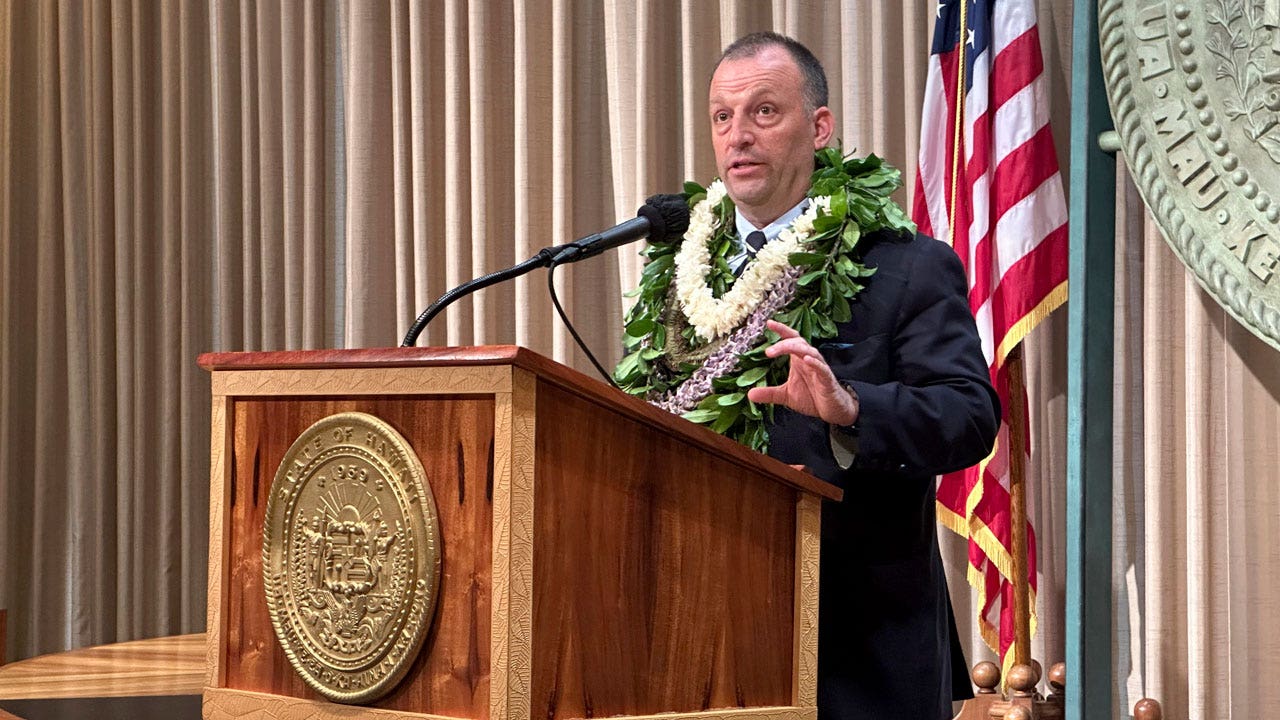
Hawaii Gov. Josh Green on Monday used his annual State of the State address to lead lawmakers and guests in a moment of silence for victims of the Lahaina wildfire and to propose aggressive steps to shift more vacation rentals into residential use to meet both Maui and the state’s acute housing needs.
Those gathered for the speech delivered a standing ovation to two Maui firefighters — Keahi Ho and Koa Bonnell — who traveled from Maui for the governor’s talk, which focused heavily on helping Maui recover from August’s deadly wildfires.
“The people of Maui have shown strength in the face of adversity,” said Green, a Democrat. “But the days ahead will not be easy and they will continue to need our support and we will be there for them as long as it takes.”
LAST HAWAIIAN PRINCESS LEAVES $100M OF HER ESTATE FOR NATIVE HAWAIIAN CAUSES
A wildfire fueled by hurricane-force winds raced through the historic coastal town of Lahaina on Aug. 8, killing 100 people and destroying thousands of homes and buildings.
Green’s acknowledgment of all those who rushed to Maui’s aid after the fire brought tears to the eyes of state Rep. Dee Morikawa, the House majority floor leader and a Democrat representing the western part of Kauai and Niihau.
“It’s just good to know that all of Hawaii is coming together for Maui,” Morikawa said after the address.
Hawaii Gov. Josh Green is seen here speaking to reporters at the Hawaii State Capitol in Honolulu on Jan. 22, 2024, after delivering his State of the State address. (AP Photo/Audrey McAvoy)
The most urgent unmet need on Maui is now stable long-term housing for some 5,000 residents who are staying in hotel rooms because they haven’t been able to find affordable places to rent on the island, one of the nation’s most expensive places to live.
Green aims for all 5,000 to move into long-term housing by March 1 in part by encouraging owners of vacation rentals to make their units available to wildfire evacuees. He told reporters authorities have about two-thirds of the needed housing units lined up so far. The Federal Emergency Management Agency and charitable organizations will be covering the rental costs.
More broadly and longer-term, Green proposed a two-year “tax amnesty” to encourage owners of vacation rentals around the state to sell to owner-occupants or long-term rental landlords. Participants would be exempt from capital gains, conveyance and general excise taxes under this two-year program.
Green told reporters afterward he was going to put “a lot of pressure” on short-term rentals because he didn’t believe they were appropriate.
HAWAII HIKERS RESCUED, CITED AFTER RUNNING OUT OF FOOD AND WATER ON MAUNA LOA VOLCANO AMID WINTER WEATHER
“I don’t want to be rude, but I do want people to realize that that market should be for our local families,” Green said. He noted that workers in a range of fields — including nurses now on strike at the state’s only pediatric hospital — are struggling because of Hawaii’s housing shortage and high housing costs.
In addition, Green said he’s asking the Legislature to put $373 million in the budget for infrastructure and housing.
“This remains our administration’s top statewide priority,” he said.
Green revisited the idea of imposing a fee on travelers to help pay for environmental upkeep after a proposal to do so died in committee last year. The governor suggested charging each family visiting Hawaii a $25 “climate impact fee” when they check in to their hotel or short-term rental. He said this would raise $68 million a year.
Democratic House leaders identified common priorities with the governor, particularly on affordable housing, mental health care and climate change.
The House Finance Committee’s chairperson, Rep. Kyle Yamashita, said he would have to look at the details of the governor’s tax amnesty plan but indicated he was open to the idea.
“At the end of the day, I think we have to look at every option to deal with this issue,” Yamashita said after the speech. “They are affecting residential areas throughout the state. And it’s something that we have to look into more deeply.”
House Speaker Scott Saiki said the House would cooperate with the governor.
“We need to solve problems in our state, and we need to find solutions that are going to be workable,” Saiki said.
Read the full article from Here

Continue Reading
Alaska
Juneau couple who helped change LGBTQ+ rights in Alaska reflect on living openly and joyfully

It’s Pride Month and Juneau joins other communities nationwide in celebrating LGBTQ+ people.
One couple in Juneau, Maureen Longworth and Lin Davis, have dedicated their lives to advocating for LGBTQ+ rights. They met on a late-night dog walk at the Oakland Rose Garden in California in 1987. That was nearly 40 years ago, though Longworth remembers it clear as day.
“I had just gotten off work and was walking my dog, but it was like near midnight, I think, and bumped into Lin walking her dogs,” Longworth said.
A lot has happened since that first walk. The pair moved to Juneau in 1992 and now live on Douglas Island, retired with their dog, Reilly Wryly Raven. It’s been more than two decades since the pair joined a lawsuit that would change LGBTQ+ rights for state and municipal workers in Alaska.
It started because Longworth needed intensive dental work, and her employer wouldn’t cover it. Davis worked for the state’s Department of Labor and Workforce Development at the time, where straight married people could share employment benefits – like health insurance – with their partners.
Davis was denied the same benefits for her partner.
“We had to pay for it out of pocket, but my coworkers out at the Department of Labor and Workforce Development, they would have automatically had their marriage partners covered,” she said.
The women couldn’t legally get married in Alaska back then — Alaska was actually the first state to ban gay marriage through a constitutional amendment in 1998. And, though they’d gotten married in other states and held a ceremony with friends and family, it wasn’t recognized by Alaska.
So, in 1999, they, alongside eight other gay and lesbian couples and the Alaska Civil Liberties Union, sued the state government and the Municipality of Anchorage.
The lawsuit demanded equal benefits for domestic partnerships. It was filed right after the state amended its constitution to define marriage as only between a man and a woman.
Longworth said it felt necessary to take a stance.
“There was no protection for people to take care of their families,” she said.
In 2005 — six years later — they won. The Alaska Supreme Court ruled that denying spousal benefits for gay couples was an equal protection violation. It meant that local governments and the state were required to make employment benefits accessible to people in domestic partnerships.
It was unbelievable. We started screaming, and I was screaming at work, and telling all my coworkers,” Davis said.
“You called me, and I was in the library garage downtown, and I just started crying. We just couldn’t even believe it,” Longworth said.
Since then, the pair have spent decades continuing to advocate for LGBTQ+ rights in Juneau and Alaska, even after Davis was diagnosed with leukemia a year and a half ago. They do that in part by unapologetically sharing their relationship with the world.
“We come out to people like six times a day, just sharing what this is, as wife and wife, going through a pretty fatal diagnosis,” Davis said.
Davis said fighting for LGBTQ+ rights opened the door for them to live their lives openly and joyfully.
“In Hamlet, there’s that line, ‘to thine own self be true.’ So that’s what we’re all about. To thine own self be true,” she said. “Go forward, be brave. You may have to be brave every day, but steady forward.”
“You can see why I married her. Isn’t that the kind of person you’d want to live with?” Longworth said, laughing.
And they commend and appreciate the young LGBTQ+ people who are taking up the torch — to advocate for their community and live bravely.

The 2026 NBA Draft takes place in New York City this week, with the first round being held on Tuesday and the second round on Wednesday. Burries and Peat are both locks to hear their names called. Three more Wildcats from this year’s team could be taken in the second round: Jaden Bradley, Tobe Awaka and Anthony Dell’Orso.
Burries, a projected lottery pick, could be one of the first dozen players taken on Tuesday, while Peat is slated to go as a mid-to-late first rounder. Here’s where the final NBA mock drafts have Burries and Peat going. Some mocks also include Bradley and Awaka.
Summaries of mock selections are italicized where provided.
Burries: No. 9 to the Mavericks
Burries has drawn a good amount of interest inside the top 10 but has not scheduled many workouts, appearing comfortable with his potential landing spots, including the Clippers, Hawks, Mavericks and Warriors. His predraft process has largely been under the radar. Any of those teams would give him an opportunity to contribute in a role in a competitive context right away.
The Mavericks are another team that appears open to moving back in the draft and have cast a wide net with first-round workouts, with Masai Ujiri taking over in May, and Dallas keeping its options open as it builds around Cooper Flagg.
Peat: No. 26 to the Nuggets
After opting to stay in the draft rather than return to Arizona, Peat seems to be trending toward the 20s, with teams continuing to express concern about his jump shot. His physicality and defensive versatility might appeal to a team like Denver, which has been able to creatively fit different skill sets around Nikola Jokic and needs to get more athletic along the frontline.
The Nuggets should be taking a best-available approach as they work to improve their depth. They are working with cap constraints as Peyton Watson hits restricted free agency, a situation that could lead to Denver moving a veteran player to enable added flexibility.
Bradley: No. 47 to the Suns
Awaka: No. 50 to the Raptors
Burries: No. 9 to the Mavericks
There’s not much new information out of Dallas since my previous mock draft. The Mavericks continue to conjure a lot of speculation among sources. They’ve explored trading this selection and are considering several different players and positions, from lead guards like Flemings, Wagler, Brown, Acuff and Christian Anderson to Ament to Yaxel Lendeborg.
Burries is the name I hear the most with Dallas, though, with sources around the lottery trying to determine why he’s not working out in as many places as you’d expect. There’s a lot of enthusiasm for Burries among teams who want to try to win next season, as he’s seen as a tough guard who can dribble, pass and shoot who will also defend at a high level with physicality.
Peat: No. 22 to the 76ers
Sources around the league are still trying to figure out what new head of basketball operations Mike Gansey’s type will be. So this pick might just be me wish-casting, but I can’t imagine a better fit for both Peat and an organization. With Joel Embiid playing more consistently on the perimeter, Peat could use his athleticism and strength to crash along the baseline and make smart plays while also providing tough defensive energy. The 76ers desperately need a four with some power to his game, and Peat brings that in a big way.
I have Peat higher than this on my personal board, but sources across the league are unsure where he slots into the class. His range seems to be quite wide, starting somewhere post-lottery and stretching into the back half of the first round.
Bradley: No. 51 to the Wizards
Burries: No. 8 to the Hawks
Burries has not scheduled many workouts, and it appears his range starts with the Clippers with the fifth pick, as I reported a few weeks ago, and ends with the Warriors at the 11th pick. Burries drops smack in the middle of that range in this mock with Atlanta. Burries arrived at Arizona as a top-10 recruit, started slow, and then erupted once conference play began, helping lead his team to the Final Four. He’s a physical, versatile scorer who can beat you from all three levels, rebounds like a forward, and competes hard on defense. But he’s a methodical creator rather than an explosive one, and his shooting history before Arizona gives scouts reason to wonder whether the efficiency is real or a blip.
Peat: No. 24 to the Knicks
Congratulations to Knicks fans for winning the championship! Mitchell Robinson grabbed a clutch offensive rebound in the closing moments of the game, but he’s a free agent this offseason so the Knicks may need to replace him. Peat’s bloodline is so loaded with offensive linemen that it’s almost funny he ended up playing basketball. His father played nine NFL seasons. His uncle was a Pro Bowl tackle. Two brothers played college ball on the line. And you can absolutely see it in how he plays: powerful, physical, relentless, and it genuinely takes something special to stop him from getting to where he wants to go. He opened the season with a 30-point game against defending champion Florida and backed it up as one of Arizona’s best players all year on its way to the Final Four. Since Peat can’t shoot yet, it’ll be important that he’s paired with a floor-spacing center like Karl-Anthony Towns. Or he could serve as a small-ball center in switchable lineups. So even though Peat entered the year with top-10 hopes, it might be a blessing in disguise for him to fall to the end of the first round.
Bradley: No. 45 to the Kings
Bradley is a combo guard with a strong frame, a calm demeanor, and a knack for clutch moments. After arriving in college as a McDonald’s All-American, he lost his starting spot as a freshman at Alabama then transferred to Arizona, where he got better every year and became the team’s trusted leader. As a senior, he won Big 12 Player of the Year, Big 12 Tournament MVP, and led the Wildcats to their first Final Four since 2001. There are questions about whether he can be a lead guard at the next level, but his connective passing, improved shooting, and gritty defense all give him the potential to play big minutes.
Awaka: No. 51 to the Wizards
Awaka was college basketball’s best rebounder and helped energize Arizona’s bully-ball style over the past two years. At 6-8 with a brickhouse frame and an unrelenting style of play, he set a tone off the bench and earned Big 12 Sixth Man of the Year. The problem is everything else. He doesn’t shoot. He doesn’t pass. And he doesn’t have a clearly defined position on defense. The team that drafts him is betting it can find enough of a defensive role to keep that elite rebounding and relentless motor on the floor.
Burries: No. 9 to the Mavericks
There are reports that Burries is trying to land in Dallas to play next to Cooper Flagg. I like the vision even if I’m a bit skeptical Burries has the shot-creation upside to eventually be a star. The Arizona guard is a well-rounded player who defends and rebounds better than your average two-guard, and he’s a really good three-point shooter. Flagg would have to stay in more of a shot-creator role if Burries is the pick, but maybe that’s what Dallas wants. I personally wouldn’t have him as the best player available in this scenario, but Burries’ lack of a glaring weakness makes him a malleable guard who should be able to hang in the playoffs. It’s easy to understand the appeal of that with the No. 9 pick.
Peat: No. 26 to the Nuggets
Peat had the toughest decision of the withdrawal deadline to make, but I actually think he made the right choice by staying in the draft. His money surely would have been bigger at Arizona for a hypothetical sophomore season, but he risked falling off the NBA radar completely if he didn’t improve in important areas. There should still be room for him at the end of the first round with much of the depth in this class getting drained by NIL dollars. His intersection of weight, passing, and offensive rebounding will be interesting even if his shot is completely busted right now.
Burries: No. 9 to the Mavericks
There’s a growing belief that this could be a scenario that both Burries and Dallas would be excited about, and even some speculation that’s why Burries is not working out for more teams. He is a strong and aggressive two-way guard who can get downhill with force, provide a formidable three-point shooter, and defend his position, all with an NBA ready frame, all of which would make him a nice complement to Cooper Flagg for the foreseeable future.
Peat: No. 22 to the 76ers
Peat is higher than this on the CBS Big Board, but his glaring lack of shooting is going to require a specific fit. The Sixers lack a long-term solution at the four, can get their floor-spacing from Embiid’s face-up skill set, and could benefit from Peat’s strength, physicality, intangibles, winning pedigree, and ability to get downhill.
Bradley: No. 48 to the Mavericks
The Big 12 Player of the Year is a downhill force, quality defender, and improved shooter. This could also reunite him with his former Arizona backcourt mate Brayden Burries.

California’s high school baseball season may be over, but that means football season is on the horizon.
In just a matter of weeks, California’s top programs will return to the field looking to make their mark in one of the nation’s most competitive high school football landscapes.
The 2025 season delivered plenty of memorable moments, from Santa Margarita’s CIF Open Division State Championship Bowl Game title and a No. 3 spot in USA TODAY Sports’ Super 25 football rankings to major offseason roster moves. Now, a new stage is set as teams look to earn their way to the top stages in high school football.
When do teams return to action for the 2026 season? Here are all the dates to know:
California high school football season start dates: CIF
First practice date: July 27, 2026
Date of first games: Aug. 21, 2026
High school football practices for teams competing within the CIF in “Week 0” games get underway on July 27, 2026, with the date of the first games set for Aug. 21. Teams who have a bye in their schedule will play on this timeline.
Teams that do not have a bye in their schedule, and therefore do not have a “Week 0” game, will kick off on Aug. 28 with their first practice date set for Aug. 3.
-

 Augusta, GA4 minutes ago
Boys & Girls Clubs of Greater Augusta showcases importance of summer programs
-

 Washington, D.C11 minutes ago
Alan Greenspan, the legendary former Federal Reserve chair, dies
-
 Cleveland, OH13 minutes ago
3 dead in Lakewood double murder-suicide
-

 Austin, TX18 minutes ago
POLL: Do you support proposed changes to Texas’ social studies curriculum?
-

 Alabama26 minutes ago
Crash Closes Crescent Ridge Road Early Monday Morning
-

 Alaska28 minutes ago
Juneau couple who helped change LGBTQ+ rights in Alaska reflect on living openly and joyfully
-

 Arizona34 minutes ago
Where Brayden Burries, Arizona players are projected to land in final NBA mock drafts
-

 Arkansas40 minutes ago
Arkansas Looking To Do Something it Hasn’t Done To LSU Since Nick Saban Was HC

