Politics
Concerned Veterans for America Action endorses Nikki Haley for president


FIRST ON FOX: The political arm of a veterans’ advocacy group is throwing its support behind GOP presidential primary contender Nikki Haley.
Concerned Veterans of America Action (CVA Action) endorsed Haley for the Oval Office on Tuesday, Fox News Digital has learned.
Haley, the former governor of South Carolina and United Nations ambassador under former President Trump, is the wife of a military man.
NIKKI HALEY TO PARTICIPATE IN FOX NEWS TOWN HALL AMID POLLING SURGE WITH 1 WEEK UNTIL IOWA CAUCUSES
The political arm of a veterans’ advocacy group is throwing its support behind GOP presidential primary contender Nikki Haley. (Reuters/Brian Snyder)
“Nikki Haley has distinguished herself as a strong and principled leader dedicated to securing the freedom and liberty our nation’s veterans have fought and sacrificed to defend,” CVA Action senior adviser Russ Duerstine said in a press release exclusively obtained by Fox News Digital.
“She has proven herself a lawmaker, governor, and ambassador to do the right thing for South Carolina and the United States,” he said.
Duerstine said that as “the spouse of a service member, Haley understands the struggles our nation’s heroes face when they come home after serving their country” and that is “why she has always stood for military families and veterans, working to honor our nation’s promise to those who served by removing red tape and empowering veterans to choose when and where they receive their health care.”
“A President Haley will also prioritize essential steps that improve America’s ability to sustainably fund a strong national defense, including revitalizing our economy by controlling spending, attacking our mounting debt, driving growth, and unleashing American energy abundance.”
Nikki Haley speaks at a town hall event in Manchester, New Hampshire, on Dec. 12, 2023. (AP Photo/Robert F. Bukaty)
“Americans need a leader like Nikki Haley to be their steady voice in a turbulent Washington, someone who brings Americans together instead of pitting them against each other,” Duerstein said. “CVA Action urges voters to vote Haley to represent them as the next president of the United States.”
Haley told Fox News Digital that as “the wife of a combat veteran, helping our service members and veterans is deeply personal” to her.
“It’s an honor to earn the support of Concerned Veterans for America Action,” Haley said. “As president, I’ll work every day to make sure we take care of those who take care of us.”
Haley’s endorsement comes as she is set to battle Florida Gov. Ron DeSantis, who is a veteran himself, on Wednesday’s debate stage as the 2024 GOP race goes into full swing.
In addition to DeSantis, Haley also faces the front-runner, former President Trump, for the GOP presidential nomination.
The veteran vote may prove to be a serious factor in the GOP primary election as well as 2024 amid a change in the military’s culture as well as the botched Afghanistan withdrawal.
Former President Trump remains the front-runner in the race, having a sizable lead over both Haley and DeSantis for the right to take on President Biden in November. (Scott Olson/Getty Images)
Trump remains the front-runner in the race, having a sizable lead over both Haley and DeSantis for the right to take on President Biden in November.
But Haley has surged in the polls as the race has narrowed and heads toward the Iowa caucus.
Haley also participated in a Fox News town hall discussion on Monday ahead of the Iowa caucus.
“Momentum is surging, Nikki’s message is resonating, and Americans are rallying behind our movement in droves,” the GOP White House candidate’s campaign wrote in an email to supporters on Monday ahead of the town hall.
Fox News Digital’s Paul Steinhauser contributed reporting.

Politics
Mamdani blasts ICE agents, Elon Musk and ‘supremacy’ in America 250 speech ahead of July 4 weekend

NEWYou can now listen to Fox News articles!
New York City Mayor Zohran Mamdani took aim at U.S. Immigration and Customs Enforcement (ICE) agents, Elon Musk and what he described as the “arena of supremacy” in the United States during an immigration-themed America 250 speech on Friday ahead of Fourth of July weekend.
Flanked by eight recently naturalized U.S. citizens, Mamdani invoked the Statue of Liberty, Ellis Island and America’s history of immigration before turning his rhetoric on elements of today’s U.S. Mamdani also blasted the “world’s first trillionaire” — a milestone Musk achieved with the long-awaited Initial Public Offering (IPO) of SpaceX last month.
“We see the wealthiest country in the history of the world, one where children go to sleep hungry while the world’s first trillionaire hungers for more,” Mamdani said, without naming Musk. “We see monopolies that dominate every industry, and oligarchs who buy elections. We see masked agents terrorizing our streets, eating food cooked by our undocumented neighbors before spiriting them away in unmarked vans.”
“We see a nation whose immense wealth has been built by those with calloused, dirt-streaked hands, those who toil on factory floors and chisel into stone. And we see a nation that has allowed so much of that wealth to be held instead in the soft hands of a precious few,” he added.
Mamdani, who was sitting at George Washington’s desk during the remarks, also praised the legacy of immigrants, claiming that they have overcome riots “aimed at their very existence,” to create lives in New York.
FETTERMAN WARNS MAMDANI RISKS ‘CONSTITUTIONAL CRISIS’ BY VOWING TO DEFY SCOTUS IMMIGRATION RULING
New York City Mayor Zohran Mamdani delivers a speech to mark the 250th anniversary of the United States of America at City Hall on July 3, 2026. (Anna Connors/Pool via REUTERS)
“Over the years that followed, despite laws enacted by the federal government to bar their entry, despite sweatshop fires that killed hundreds of women, despite riots aimed at their very existence, immigrants made homes here in New York City, and they helped to make New York City,” the mayor said.
“That legacy of every generation of Americans insisting that the right to life, liberty and the pursuit of happiness extends to them, too, is no relic of the past. It carried millions of Black Americans north during the Great Migration. It drew hundreds of thousands of Puerto Ricans to New York City after the Second World War. It invited countless others from the West Indies and South Asia and West Africa and across the world. And it is what brought my family to this city when I was seven years old,” he continued.
ZOHRAN MAMDANI PRAISED FOR ‘FANTASTIC’ QUESTION-DODGING ON PRESIDENTIAL ELIGIBILITY
Mamdani did not mention his own family’s wealth in the speech. His father was an elite Harvard academic, and his mother and acclaimed film director.
“My family did not arrive by boat, although we saw the Statue of Liberty from the window of the plane. Even from the air, we could make out the promise of America, the promise of the beautiful patriotic work of rendering America, year after year, a little more faithful to its founding ideals,” he said.
The Statue of Liberty stands in the foreground as Lower Manhattan is viewed at dusk, Sept. 8, 2016, in New York City. (Drew Angerer/Getty Images)
In his speech, Mamdani blasted those with “power and influence,” who he lamented have written American history.
“There is a term so often used to describe our nation and those who have shaped it. American exceptionalism. American exceptionalism, the conventional wisdom tells us, makes our freedom a little more free. It is how we dug the Erie Canal and irrigated the West. Is why children in faraway lands grow up dreaming of one day moving here. And yet, the irony is that the story of America has so often been written by those who were told by others with power and influence and wealth, that they were anything but exceptional,” Mamdani said. “For generation after generation, we have been told that when the world has sent its people to our shores, it has not sent its best.”
“It sent Puritans and Sikhs and Quakers and Muslims and Jewish people who were banished for praying the wrong way, worshiping the wrong gods, angering the wrong people. It sent peasants and serfs from slums and shuttles, who were treated as less because they hardly owned clothes, let alone land. It sent immigrants from whom power was something someone else had,” he continued. “We are told that America is exceptional because we are richer, stronger, more powerful than everyone else. The truth, my friends, is that America is exceptional because here nothing is fixed into place.”
New York City Mayor Zohran Mamdani delivers a speech to mark the 250th anniversary of the United States of America at City Hall on July 3, 2026. (Anna Connors/Pool via REUTERS)
Mamdani referenced how he became a naturalized U.S. citizen in 2018. Mamdani was born in Uganda in 1991 and moved to New York when he was 7. The mayor is a dual U.S.-Ugandan citizen.
“Nearly a decade ago, I too felt what you feel the joy of no longer being just a New Yorker, but an American too. You each hold a special power. The power to determine what America means,” the mayor said, speaking to the recently naturalized citizens by his side.
“The powerful have always known their answer. America, in their view, is an arena of supremacy where only a select few are allowed freedom,” Mamdani said. “Where not all are created equal. America, if you ask them, becomes less the more people it welcomes. America, they will tell you, belongs only to those with the right accent or the right shade of skin. The rest of us, they insist, should be grateful for merely being allowed to visit. How small they are, how weak, how unoriginal. At every moment in our past, those who led through exclusion and isolation have tried to win power and enrich themselves by turning us against one another.”
New York City Mayor Zohran Mamdani delivers a speech to mark the 250th anniversary of the United States of America at City Hall in New York on July 3, 2026. (Anna Connors/Pool via REUTERS)
CLICK HERE TO DOWNLOAD THE FOX NEWS APP
Mamdani also claimed ICE were invading New York neighborhoods.
“We see America each time neighbors link arms with neighbors without asking how long they have lived here or what papers they have as ICE invades our neighborhoods,” he added. “We see America each time those young and old stand in the beating rain or the stifling heat to cast their ballots. We see America each time working people demand more not just for themselves, but for their fellow Americans.”
“There are some who respond to those who ask for more from America with a simple refrain. ‘Love it or leave it,’ they say. But patriotism has never been about pretending our nation is without flaws. Patriotism is every act of righteous dissent,” Mamdani said. “It is every March led under the heavy sun. It is every protest held a decade before its time. It is precisely because we love this nation that we will not leave it.”
Mamdani ended his speech with a rousing call to America’s greatness.
“What power each of us holds to bring America ever closer to the greatness so many have seen when they looked upon these shores. The greatness that for 250 years has been America. Thank you. God bless America. God bless New York City. And happy Fourth of July,” he concluded.
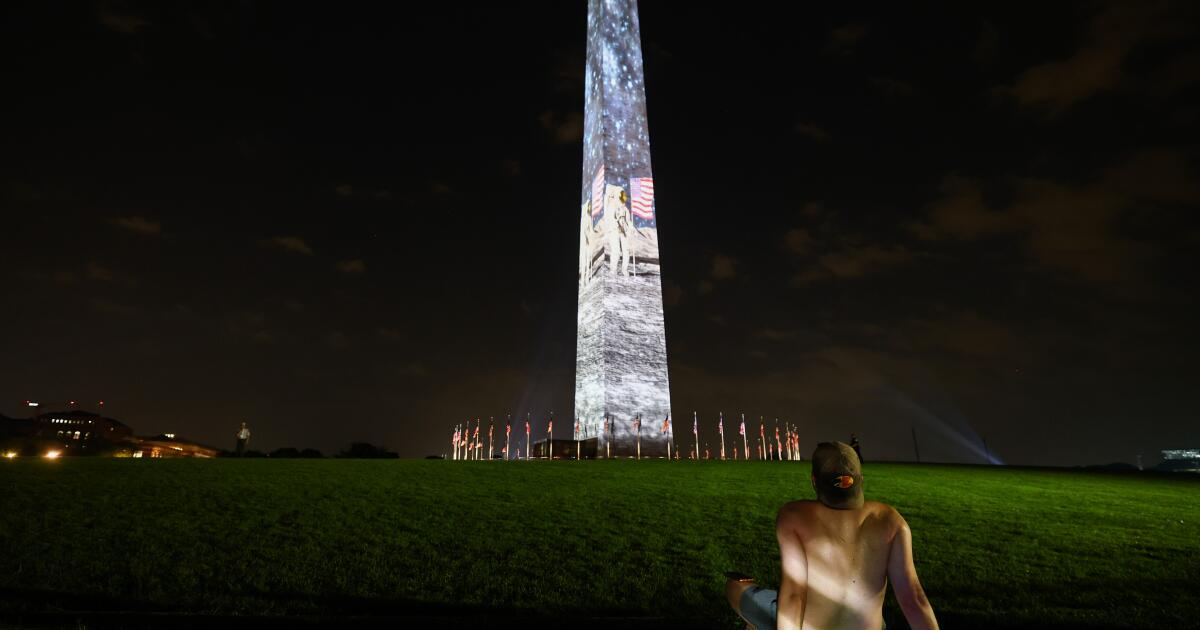
WASHINGTON — Small towns across America had big plans to celebrate the nation’s semiquincentennial this weekend. Local historical societies scheduled town square readings of the Declaration of Independence, hired bands to play patriotic tunes, organized parades and set up themed baking contests.
But many of their most ambitious plans were scrapped after the Trump administration cut $100 million in federal funding for humanities nonprofits and state councils at the start of its term. The decision severely hampered local planning for America’s 250th anniversary, disrupting history projects, museums and educational programs nationwide.
Instead, the Trump administration funneled tens of millions in federal dollars to Event Strategies, the firm behind Trump’s infamous rally at the Ellipse on Jan. 6, 2021, to organize anniversary events throughout the nation’s capital centered on President Trump.
The result, historians say, has become a centralized, more politicized spectacle, marking the national milestone as a celebration of an imperial presidency rather than a revolution from kingly rule.
The spectacular show that Americans will see features Trump at its center, culminating a year of concerted efforts by the president to put his face on passports and currency, national park passes and government buildings.
Members of the Dance4Life studio in Claymont, Del., prepares to march ahead of the Red, White, & Blue To-Do Pomp & Parade on July 2, 2026, in Philadelphia.
(Al Drago / Getty Images)
Yet, beyond the noise of the nation’s capital, historians and teachers, docents and curators, archivists, tour guides and reenactors have sustained the messy, organic discourse of the American story, less funded but no less vocal in their patriotism.
“The way history has been argued since Trump returned to office has been a reminder that governments and political figures have remarkable power to shape a society’s historical memory,” said David Ekbladh, a history professor at Tufts University and author of “Look at the World: The Rise of an American Globalism in the 1930s.”
Trump’s effort to control the anniversary narrative has reminded Ekbladh of one of George Orwell’s most famous quotes: “Who controls the past controls the future. Who controls the present controls the past.”
“The administration’s clear signals that it can and will restrict funding to institutions seems to have muted the way many institutions, like museums and universities, have approached the anniversary,” Ekbladh added. “With this said, Trump’s own direct, personal use of the 250th has been less about articulating a clear view of the nation’s history than using the moment itself to keep attention on him.”
The White House has taken a more active role in the festivities than initially planned, setting up its own Freedom 250 project to supplement America250, a bipartisan congressional effort to celebrate the occasion.

Fencing is seen around the Great American State Fair on the National Mall on Thursday.
(Kevin Dietsch / Getty Images)
The Trump administration has directed funding to events centered on the president’s attendance, primarily around Washington, and partnered with conservative organizations such as PragerU and Hillsdale College to present the country’s founding story through a conservative Christian lens.
Historians are in broad agreement that this year’s celebration has garnered far less attention than the bicentennial, marked in 1976, which generated blanket media coverage and widespread national excitement.
Andrew Rudalevige, a professor of government at Bowdoin College and author of “The New Imperial Presidency,” attributed the lack of enthusiasm this time in part due to a more fragmented media landscape than existed 50 years ago, denying the country a “core curriculum” and a shared story.
“I don’t think it’s a lack of patriotism, so much as a determination that no presidential administration should be able to center itself as the focus of that patriotism,” Rudalevige said.
“There’s a lot to celebrate in the text of the declaration. But that’s not where the focus of the Freedom 250 efforts has been,” Rudalevige said. “It would have been interesting to see what the bipartisan America250 initiative could have come up with if its funding and energies had not been diverted.”
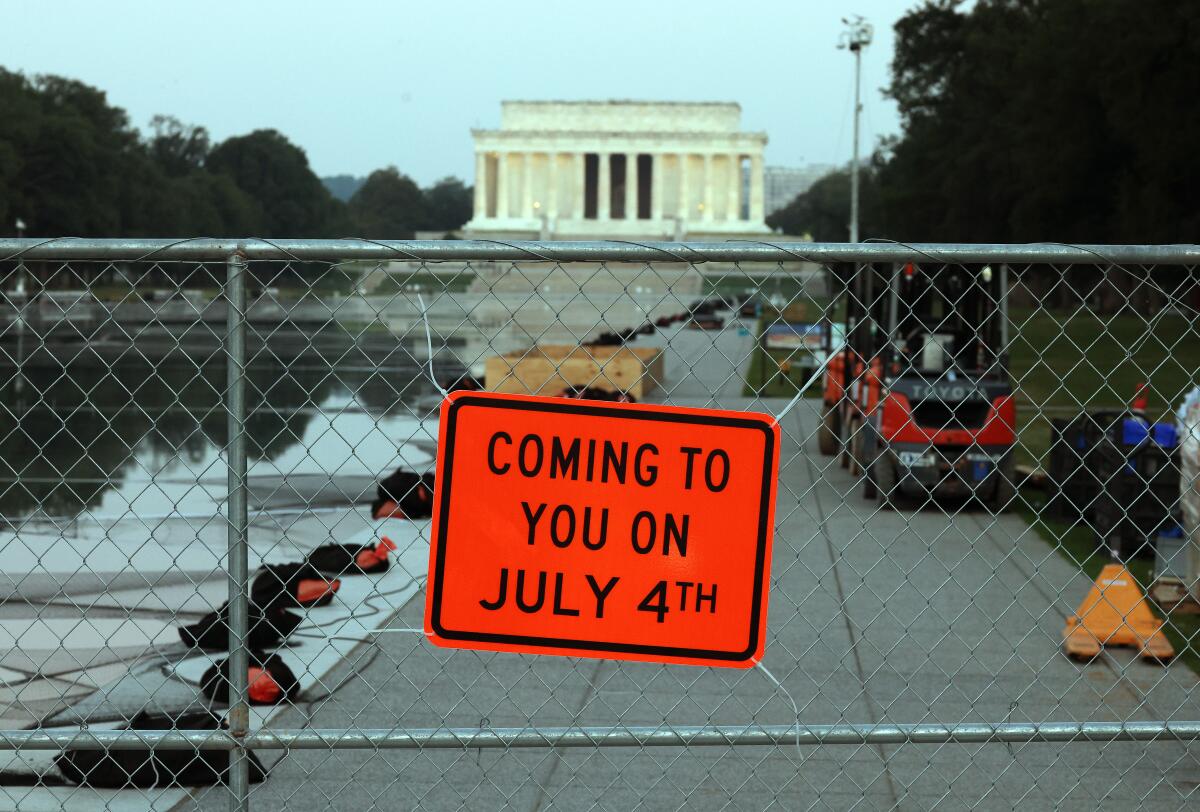
The Lincoln Memorial Reflecting Pool is fenced off in preparation for Fourth of July fireworks.
(Kevin Dietsch / Getty Images)
Trump has scheduled little national travel around the anniversary, visiting North Dakota this week for an event that allowed him to debut a new version of Air Force One, donated by Qatar and outfitted to the president’s tastes. Trump intends to keep the plane after leaving office for his personal use.
The jet will fly over the National Mall alongside the Defense Department’s most impressive equipment on Saturday, before the president delivers a speech in what is forecast to be a blistering heat wave. The evening will end, according to administration officials, with the largest fireworks display in U.S. history.
“The fundamental challenge that we face now is the fight between the historians — people who have been studying the past and who have been thinking about how to tell that story to the public — and government leaders over who gets to control that story,” said Peter Kastor, chair of the history department at Washington University in St. Louis.
“The people who are really on the front lines are museum professionals, the operators of historic sites and schoolteachers,” he said. “They face the responsibility for explaining the past to a general audience on a day-to-day basis, and they are the ones who most often face the backlash from people who want the story to be told differently.”

NEWYou can now listen to Fox News articles!
Lawmakers on Capitol Hill had split reactions to the Supreme Court’s ruling to strike down President Donald Trump’s bid to end birthright citizenship, further allowing children born in the United States to be recognized as U.S. citizens.
“It’s a terrible decision,” Rep. Byron Donalds, R-Fla., told Fox News Digital.
“Regulate folks before they come in — in terms of not coming here just to have a baby and leave,” Rep. Ro Khanna, D-Calif., said.
“In terms of the immigration process coming in, there should be regulation. Not that once you’re born here that we’re going to denaturalize you,” he continued.
REPUBLICAN ACCUSES SCOTUS OF BETRAYING US, PUSHES BILL RESTRICTING BIRTHRIGHT CITIZENSHIP, PREGNANT VISITORS
Rep. Ro Khanna, the U.S. Supreme Court and Rep. Byron Donalds weighed in after the high court rejected President Donald Trump’s bid to end birthright citizenship. (Shannon Finney/NBC via Getty Images; Li Rui/Xinhua via Getty Images; Nathan Posner/Anadolu via Getty Images)
The case, which left many Republicans and Democrats divided, challenged Trump’s executive order to detach birthright citizenship from the 14th Amendment. Most Democrats who Fox News Digital spoke to argued that if the ruling had gone the other way, it would have been considered unconstitutional.
“I think they got it right,” Rep. Christian Menefee, D-Texas said. “The Supreme Court said that the Constitution says what it says. That if anybody even has a question about what the 14th Amendment says, I think it’s a little embarrassing. So I’m glad they got it right.”
TRUMP SUFFERS MAJOR SUPREME COURT DEFEAT AS JUSTICES UPHOLD BIRTHRIGHT CITIZENSHIP
Rep. Christian Menefee (D-TX) speaks onstage during DJ Michael 5000 Watts King’s Day at The Bell Tower on 34th on February 16, 2026 in Houston, Texas. Watts passed away on January 30, 2026 at the age of 52. (Marcus Ingram/Getty Images)
“I believe in the Constitution,” Rep. James Clyburn, D-S.C., said when asked about the ruling.
“The Constitution is the Constitution. If you don’t like the Constitution, you can try to change it,” Rep. Seth Magaziner, D-R.I., said. “But honestly, I think we’ve got much bigger problems as a country than Americans trying to live their lives as birthright citizens.”
The 6-3 decision highlights a significant loss for Trump’s immigration agenda as he has criticized birthright citizenship as a “magnet for illegal immigration.”
ICE SURGES ENFORCEMENT, MAKES 10,000 ARRESTS IN FIVE DAYS AMID SUPREME COURT BIRTHRIGHT CITIZENSHIP DECISION
“I think the president has an obsession with immigrants in this country,” Rep. Sarah Elfreth, D-Md., said. “He’s hell bent on making it as uncomfortable as possible. We’ve seen that time and again with ICE, we’ve seen this with an attack on the 14th Amendment .”
Justice Clarence Thomas, Justice Neil Gorsuch and Justice Samuel Alito were the three to dissent — arguing the 14th Amendment does not guarantee birthright citizenship to all children born to parents who are unlawfully and temporarily in the country. Alito cited that the ruling fails to recognize the rise of “birth tourism,” the concept that foreigners come to America just to give birth, potentially opening the door to national security threats.
CLICK HERE TO DOWNLOAD THE FOX NEWS APP
Rep. Ilhan Omar, D-Minn., and Rep. Maxine Waters, D-Calif., declined to comment on the ruling to Fox News Digital.
“Americans should be happy, because the Constitution means more than one guy’s opinion,” Rep. Bennie Thompson, D-Miss., said.
-

 Ohio5 minutes ago
Where and when to see fireworks in Central Ohio
-

 Oklahoma12 minutes ago
The Under-the-Radar Oklahoma State Football Transfer Generating Preseason Buzz
-

 Oregon15 minutes ago
Oregon lawmakers pushed to secure sensitive data from ICE. How does the law work?
-

 Pennsylvania20 minutes ago
A rare albino bird was found in Pennsylvania. It was a
-

 Rhode Island27 minutes ago
Water worries mount, outdoor water use banned in some parts of RI
-

 South-Carolina30 minutes ago
Tennessee Football 2026 SEC Opponent Summer QnA Preview: South Carolina | Rocky Top Insider
-

 South Dakota35 minutes ago
Trump at Mount Rushmore: Speech time, how to watch live
-

 Tennessee42 minutes ago
Too hot to handle? Cool off at these Middle Tennessee ice cream shops

