Entertainment
Trace Lysette hopes her trans role in 'Monica' opens doors — and eyes

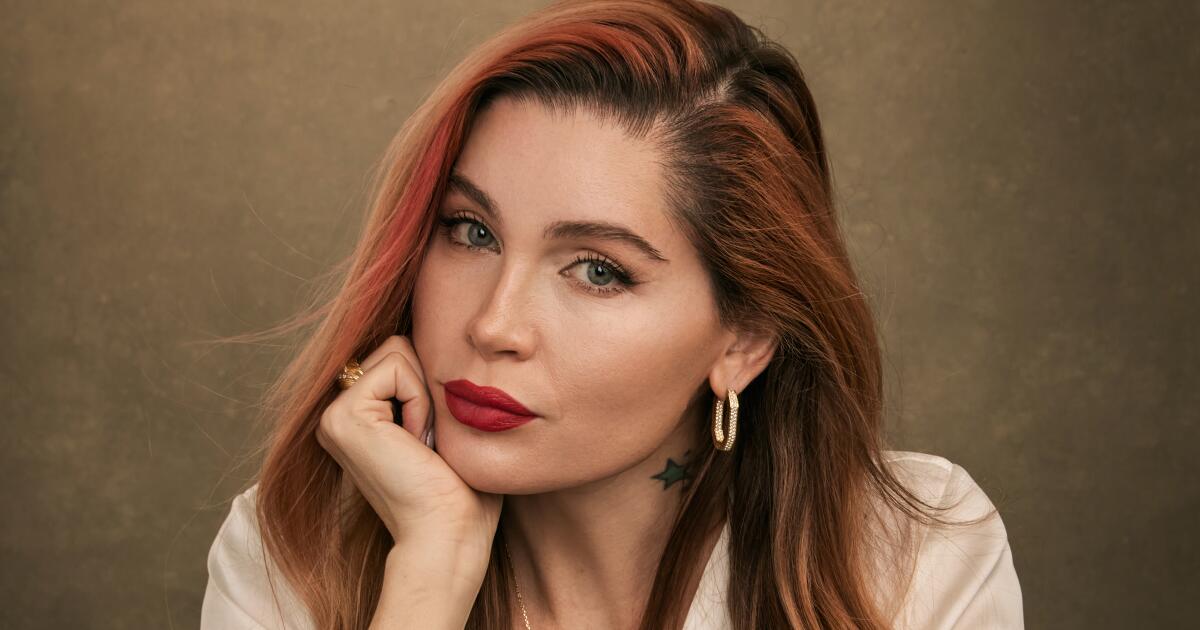
After more than a decade as a working actor, Trace Lysette has had her share of projects she was attached to that simply never saw the light of day. Those failed endeavors were painful enough that she smartly trained herself not to care about a gig until the cameras were actually rolling. In 2016, the “Transparent” series veteran was cast in the title role of Andrea Pallaoro’s captivating drama “Monica,” and Lysette says she was justifiably a little skeptical that this rare leading role for a trans woman would actually happen. That is until the first day of production was upon her.
“I felt maybe a little bit of relief because I saw how passionate the crew was,” Lysette says. “I saw how good the director of photography, Katelin Arizmendi, was. I saw that they were shooting on film. Well, I knew that they were, but to actually be there and experience it all, you can get a feel for the quality of what the product is going to be.”
Beautifully shot on a budget of just $1.7 million, “Monica” is centered on a trans woman who returns to her hometown to spend time with her ailing mother (Patricia Clarkson). Monica has not set foot in her childhood home for many years, and it is unclear if her mother, who is suffering from a number of debilitating conditions, is even aware of who she is (or used to be for that matter). Lysette, a Kentucky native, found the story to be groundbreaking.
“I just thought there was so much there to explore and sink my teeth into as an actor,” Lysette says. “[I’d] never really got the shot to lead or show the world what I could do in terms of my acting chops. I was excited. That being said, I did have thoughts about the script. Andrea was really, really cool about wanting to collaborate with me and wanting my thoughts, not just my energy as an actor.”
The movie had its world premiere at the 2022 Venice International Film Festival in competition, with Lysette earning rave reviews from critics around the globe. One scene in the film that displays her impressive talent finds Monica heading back to the West Coast after deciding the situation with her family is just too uncomfortable. In an extended one-shot take, Lysette intimately conveys Monica’s fear, heartbreak and frustration as she begins to have an emotional breakdown while driving. The entire sequence was challenging on a number of levels.
“When they were setting that shot up, and I saw the orange cone down the road, and then the technicality of that scene where I would have to turn the car onto a free road — [they] actually did not have one of the roads blocked off — and then pull a U-turn on that road,” Lysette says. “I thought, ‘OK, I’m supposed to do all this and then be in my head about what Monica’s going through.’ And so I tried not to overthink it, because as an actor, I knew it would be a big shot, and I really surprised myself that day, because that was the first take that we used in the film.”
Trace Lysette stars in “Monica.”
( IFC Films)
Acquired by IFC Films and released in theaters in May, “Monica” may not have been a massive hit, but it’s been a slow burn with audiences that have discovered it on digital download services. Lysette says the response she’s received has been “pretty intense.” Especially at this moment where numerous states have enacted anti-trans laws just to score political points with conservative voters.
“The letters that I get from trans people across the nation and even overseas sometimes through social media, reaffirm me in ways that help me get up in the morning,” Lysette says. “They have shared with me how this film makes them feel seen and hopeful and like, ‘Oh, maybe our stories will get told. Maybe they will make space for us. Maybe there are more opportunities on the horizon. Maybe one day, they won’t legislate our bodies the way that they are right now.’”
For many actors, awards recognition from their peers or critics is usually the cherry on top of a successful theatrical run. For Lysette, the stakes are much higher. In her eyes, any potential nominations mean survival.
“It means that I probably wouldn’t have to worry as much about living gig to gig,” Lysette says. “I think that nominations like that kind of solidify you in this industry, because this industry is so fickle and complicated for minorities, and it would just mean so much more to my community as a whole, because then we can all dream a little bit bigger.”
As her journey continues, Lysette says she has every intention of using whatever reach she has to assist her trans siblings and other marginalized groups to tell more stories that will humanize people and reflect the world.
“When I let myself dream big, that is the dream,” Lysette says. “But I also have to be realistic and know we’re up against big money and we’re up against resources that we just don’t have. And I just hope that the art speaks for itself.”


Bill Cody, the Grand Ole Opry and longtime WSM Radio host who woke up listeners with his velvet voice and country music lore, has died. He was 67.
The Tennessee radio station confirmed Cody’s death on social media on Tuesday, writing, “It is with heavy hearts that we share the passing of our dear friend and beloved WSM voice, Bill Cody.
“A singular presence on WSM-AM Nashville for more than three decades, Bill welcomed listeners each morning on Coffee, Country & Cody with a broad smile, a conversational ease, and an unerring ability to make both artists and audiences feel at home. He joined WSM in 1994 and had Charlie Daniels as his first in-studio guest. He built more than a morning show; he created a gathering place rooted in his deep love for country music and the people behind it.”
In late May, Cody’s daughter Hannah Davis shared that the radio host had been admitted to the intensive care unit with heart and kidney failure. “After weeks of being on a roller coaster of emotions, tests, dialysis, medications, steps forwards and steps backwards, it was determined earlier this week that his only option for survival would be a double transplant, heart and kidney,” she wrote on Facebook. “We need a miracle and we know God is able.”
On Tuesday, she wrote that Cody had died peacefully surrounded by family and “was welcomed into heaven as thunder bellowed outside, and we laughed because we knew it was a band of angels rejoicing.”
With nearly 50 years on the airwaves across syndicated radio, television and film, Cody was honored with a star on the Music City Walk of Fame in the fall of 2024. His credits included the film “American Saturday Night: Live From the Grand Ole Opry,” the television show “Tennessee’s Wild Side” on PBS, “Ray Stevens’ Nashville” on RFD-TV, and GAC TV’s “Master Series.”
In 2008, the beloved Nashville host was inducted into the Country Radio Hall of Fame, and across his career, he earned multiple nominations from the Country Music Assn., the Academy of Country Music and Billboard for his contributions to broadcasting.
Born Trent Clutts on Dec. 16, 1958, in Huntsville, Ala., Cody was inspired to pursue a career in broadcasting during visits to a Kentucky radio station with his dad. His father was a Southern Baptist minister, and his Sunday morning sermons were broadcast on the radio in the afternoons. Cody couldn’t get enough of the goings-on at the station when the two would stop by to drop off cassettes.
In 1971, when the radio host was 17, he was hired as a night deejay at WVLK in Lexington, Ky., but the program director didn’t think “Trent Clutts” had the right ring for radio. Cody named himself after “Buffalo Bill,” one of the most famous showmen of the American Old West, and used the moniker for the rest of his career.
As a teenager, Cody noticed a girl named Rebecca during study hall and, according to Davis, winked at her from across the room. The wink sealed the deal and the two spent more than 50 years as a couple, welcomed three children — Luke, Hannah, and Levi, who died in 2025 — and eventually grandchildren, who called him PoPo. The family lived in Cross Plains, Tenn.
“Like so many of us at the Opry, Bill Cody lived out his dreams on the Opry stage. More times than I could count he and I would look at each other as if to say, ‘Can you believe we get to do this?’” Dan Rogers, executive producer at the Grand Ole Opry, wrote on social media.
“Even better, he made Opry audiences tuned in from around the world feel like they were here too, themselves a part of country music’s most famous show. Then, he’d get up early the next morning and — with that signature smile in his voice — tell everybody about it on his show.
“He was the best of friends to country music and to everyone who was a part of it. We’re sure going to miss him.”
Movie Reviews
‘Playing POTUS’ Review: Documentary From ‘Barb and Star’ Director Makes a Fun but Limited Impression

It’s been nearly two months since Morgan Neville’s amusing and thoroughly superficial Lorne, in which the Oscar-winning documentarian tried and failed to get the Saturday Night Live creator to let down his guard. So I guess we were overdue for a new Saturday Night Live-based documentary.
Josh Greenbaum’s Playing POTUS isn’t exactly a Saturday Night Live-based documentary — not in the way the various SNL50 docs or films focusing on high-profile SNL alums like Chevy Chase and Eddie Murphy were Saturday Night Live-based documentaries. But for all of its ostensible focus on a wide variety of comic impressions and impersonations of presidents, I’d estimate that at least 75 percent of the documentary’s 93-minute running time is dedicated to Saturday Night Live.
Playing POTUS
The Bottom Line Entertaining, but plagued by gaps.
Venue: Tribeca Festival (Spotlight+)
Director: Josh Greenbaum
1 hour 33 minutes
As Playing POTUS: SNL’s 50 Years of Presidents, this vague adaptation of Peter Funt’s book titled Playing POTUS: The Power of America’s ‘Acting Presidents’ is fine. It’s missing some key interview subjects and dodges or entirely misses some key topics, but when you have talent as clever and enthusiastic as Dana Carvey, Will Ferrell, Kate McKinnon and Darrell Hammond, you’re bound to find some insights and ample entertainment.
However, as Playing POTUS: Not Just SNL, it’s barely functional, to a degree of near pointlessness. The failure to analyze or even acknowledge countless comic interpretations of presidents in contexts that lack Lorne Michaels is so thoroughly bizarre that the entire documentary becomes more head-scratching than enlightening. Though like Neville’s Lorne, it’s at least an entertaining trifle.
The frustrating thing about Playing POTUS is that it starts off reasonably promising, using John F. Kennedy impersonator Vaughn Meader, whose comedy record The First Family is one of the strangest winners of the Grammy for album of the year. It isn’t deep historical context, but it’s absolutely historical context, followed by a swift jog through the Smothers Brothers and…that’s pretty much it for comic presidential impersonations before Saturday Night Live.
The meat of the documentary is the different SNL presidents talking about their individual impressions, their origins and their causally unprovable impacts on the perception of those presidents.
This is the best part of the documentary, whether it’s Chevy Chase cackling at the possibility that he might have contributed to Gerald Ford’s speedy electoral defeat; Dana Carvey talking (for possibly the millionth time) about how he was so stymied by George Bush that he cobbled together a character who often had nothing at all to do with its source; Alec Baldwin reading both negative tweets from Donald Trump and, proudly, his own responses; or Kate McKinnon getting emotional still talking about her version of Hillary Clinton and Hillary’s 2016 defeat.
Greenbaum and his subjects are willing to acknowledge some of the less successful impressions over the years — “Of all the presidents who have ever been on SNL, I think I was my least favorite” Will Forte says of following Will Ferrell as George Bush Junior — as well as the lengthy struggles to find an appropriate Obama or Joe Biden.
With the help of a couple of experts, Playing POTUS does well with explaining how frequently SNL‘s impressions have achieved a level of hyper-reality, in which the heightened Xerox supplants the actual historical figure in the collective consciousness. In that light, though, it’s strange not to dedicate a single second to then-candidate Donald Trump’s appearance hosting Saturday Night Live.
Although the documentary suffers a little from the absence of Tina Fey as part of a lengthy segment on her Sarah Palin impression and its effect on the 2008 election, that probably should have made Greenbaum realize that not only was Palin never elected POTUS (nor was Hillary Clinton, it should be added), she wasn’t elected veep either. Playing POTUS also covers Maya Rudolph’s impression of Kamala Harris, who doesn’t technically align with the title. Perhaps that all could have been 15 minutes redistributed into non-SNL terrain.
Keegan-Michael Key is great discussing the origins of Luther, Obama’s anger translator. Rich Little is present to discuss general impressions. Seth Meyers is part of a decent segment on the history of presidential roasting at the White House Correspondents Dinner.
But if the topic is meant to be broad, it’s head-scratching to ignore The Simpsons, South Park and any movie that took a comic approach to a specifically named president — Dick, W., Vice, etc. In this film’s universe, In Living Color apparently never existed, nor did Trey Parker and Matt Stone’s That’s My Bush!, a multi-cam sitcom about George W. Bush and his family. Mad TV is mentioned only nebulously, though full credit to Will Sasso, the only talking head in the documentary capable of expressing regret at how much and how wrongly Monica Lewinsky was lampooned in conjunction with Bill Clinton.
There’s something astonishingly and instantly dated about how thoroughly Greenbaum misses the way new media has and continues to approach Donald Trump. Sarah Cooper may have been a flash-in-the-pan, but if you can’t find something substantive to say about how a multi-racial woman became a fleeting sensation lip-synching Donald Trump, you’re not trying very hard.
Instead, Greenbaum, who did far better and smarter work with many of the same people in Too Funny to Fail and Will & Harper, wastes time on a voiceover device that’s too cutesy to be worth the effort and a three-act structure that’s more for the benefit of his editors than the audience. It all results in a potentially meaningful documentary that isn’t bad, just lacking.

Longtime on-air anchor Glen Walker is making his way back to broadcast news in Los Angeles.
After being laid off from KTLA in February, alongside other veteran broadcasters like Lu Parker and Mark Kriski, Walker is starting a new chapter with KTTV, L.A.’s local Fox affiliate. He began his new role as a per-diem anchor this week, where he’s set to have an on-air introduction on Wednesday and begin anchoring shows on Thursday evening.
“I didn’t feel like I was done,” said Walker of his career, in a phone interview Wednesday morning. “I’m still healthy. I’m not ready to retire.”
As Fox’s new rotating anchor, he won’t have a regular broadcast time, but will instead float between the KTTV and KCOP channels to fill in as needed.
Over the last few months, Walker has been eager to get back on air, especially with the local primary elections this month and the coming midterms in November. He said he plans to take the new gig “one day at a time,” but he’s most interested in covering politics and the current state of affairs in Los Angeles.
“With the elections and how it’s all related to the fires and the homeless problem, this city — maybe the whole state — has reached a point where [we ask], which direction are we going from here?” Walker said.
The broadcast news industry has been experiencing upheaval and consolidation — most recently with layoffs and firings at “60 Minutes,” and the pending merger of news giants Tegna and Nexstar. With the ongoing domination of streaming services, many local stations are struggling to compete and maintain viewership.
“[The stations] will get it figured out because there’s an adjustment period. It used to be just newspapers and radio, then you had television,” Walker said. “Now we’ve got the internet. Technology advances, and you just have to adjust to it.”
When he and several of his colleagues received the news of the layoffs at KTLA, the group was met with an outpouring of support from many loyal viewers and fans of the station. Walker, who had been with the station since 2010, was surprised by how many messages he received.
“You make a bigger impact than you think,” said Walker, who’s hopeful the same viewers will start to tune in to the local Fox station. “You just go to do your job every day, and you don’t think about it day to day, but then when something like that happens, that’s when you really see where people appreciate you.”
In between jobs, Walker said he spent his time golfing and trying to keep busy around the house and focused on landing a job. As soon as he stepped into Fox’s studio for a practice run, he said he felt an immediate sense of familiarity.
“I was sitting behind the anchor desk, and there was the teleprompter, the camera and that’s it,” Walker said. “It’s all the same at every TV station. It’s just a little bit of a different environment.”
-

 News3 minutes ago
Video: Trump Says He ‘Loves the Inflation’ Amid War With Iran
-

 Politics8 minutes ago
Trump’s Plaques on the Presidential ‘Walk of Fame,’ Fact-Checked and Annotated by Historians
-

 Science18 minutes ago
Video: Southern Lights Seen From International Space Station
-
 Lifestyle45 minutes ago
Dave Eggers on why using AI to speak for you "is such a crime against yourself"
-

 Technology53 minutes ago
Bluesky is getting ‘communities’
-

 World60 minutes ago
UK spy powers draw US scrutiny over alleged Apple encryption backdoor demand
-

 Politics1 hour ago
House Dem lashes out at GOP efforts to probe foreign donations with stunning claim on motive
-

 Health1 hour ago
Dirty soda drinks are everywhere, but doctors warn of health risks: ‘Metabolic disaster’

