Colorado
Historic Colorado River deal to conserve flows advances after winning key approval from state water board


A yearslong effort to purchase two of the most powerful water rights on the Colorado River has cleared another hurdle after the state water board agreed to manage the rights alongside Western Slope water officials.
The Colorado Water Conservation Board voted unanimously Wednesday night to accept the two water rights tied to the Shoshone Power Plant into its environmental flow program. The approval is a critical piece in the Colorado River District’s $99 million deal with the owner of the aging plant in Glenwood Canyon — Xcel Energy — but the deal has faced pushback from Front Range water providers that fear the change could impact their supplies.
Backers of the deal aim to make sure the water now used by the small hydroelectric plant — and then put back in the river — will always flow westward.
“The importance of today’s vote cannot be overstated as a legacy decision for Colorado water and the Western Slope,” Andy Mueller, general manager of the Colorado River District, said in a news release. “It secures an essential foundation for the health of the Colorado River and the communities it sustains.”
Colorado water officials hailed the decision as a monumental achievement for the state that will help protect the river and its ecosystem. The state’s instream flow program allows the Water Conservation Board to manage dedicated water rights for the health of rivers, streams and lakes.
“Acquiring the Shoshone water rights for instream flow use is a once-in-a-lifetime opportunity to preserve and improve the natural environment of the Colorado River,” Dan Gibbs, the executive director of the Colorado Department of Natural Resources, said in a news release.
One of the main sticking points during the hourslong meeting Wednesday was whether the board should manage the water rights with the River District. That would include decisions on how and when to require upstream users — like Front Range utilities — to send more water downstream. Generally, the board is the sole manager of water rights in its instream flow program, which the Shoshone rights are now a part of.
Several Western Slope entities said they would withdraw their financial support from the purchase if the Colorado River District was not allowed to co-manage the right with the board. Local governments and other organizations across the Western Slope promised more than $16 million toward the purchase.
Front Range water providers argued that the statewide board is the sole authority that can manage such rights and should have final decision-making power.
The water board instead approved the co-management strategy, which means that the two authorities will decide together how to act when there is not enough water to meet the right’s obligations.
The Colorado River District — a taxpayer-funded agency that works to protect Western Slope water — wants to purchase the Shoshone rights to ensure that water will continue to flow west past the plant and downstream to the towns, farms and others who rely on the Colorado River, even if the century-old power plant were decommissioned.
A stream of Western Slope elected officials, water managers and conservation groups testified in support of the deal and the rare opportunity it presented.
“The Shoshone call is one of the great stabilizing forces on the river — a heartbeat that has kept our valley farms alive, our communities whole and our economies steady even in lean years,” Mesa County Commissioner Bobbie Daniel said, urging the board to approve the plan.
The meeting on Wednesday came after weeks of extensive mediation between the River District and Front Range entities. However, the representatives from opposite sides of the Continental Divide could not come to a consensus on a way forward.
Representatives from Front Range utilities have said repeatedly that they supported the purchase as a whole, but they stated concerns about the purchase changing the status quo on the river.
The water rights connected to the plant are the oldest major water rights on the main stem of the Colorado River, which means that they must be fulfilled before any rights established afterward. Those include more junior rights held by Front Range utilities to divert water from the river and bring it under the Continental Divide to their customers.
The plant’s rights can command up to 1,408 cubic feet of water per second year-round, or about 1 million acre-feet a year — enough water for 2 million to 3 million households’ annual use.
The Water Conservation Board’s approval is one of several that must be acquired by the River District. The deal now must go through the state’s water court and its Public Utilities Commission.
Along with the $16 million coming from Western Slope entities, the district will pay $20 million and the Water Conservation Board allocated another $20 million. The financial plan also includes $40 million awarded under the federal Inflation Reduction Act by the Biden administration, but that money remains frozen as part of the Trump administration’s broad halt to spending by the previous president.
Get more Colorado news by signing up for our Mile High Roundup email newsletter.



Colorado
Suddenly hazy skies in Denver prompt some residents concerned about wildfire smoke to call 911

Some people who live in the Denver metro area on Thursday afternoon were making calls to 911 after skies became noticeably hazy and winds kicked up. It was due to smoke from wildfires in Nebraska moving into Colorado. A cold front also was moving through the Front Range, and there is dust in the air.
The poor air conditions led to reduced visibility downtown after 3 p.m. Several of CBS Colorado’s City Cams showed dust or smoke in the air.
Temperatures were expected to drop by as much as 20 to 30 degrees with the cold front.
The suddenly dusty skies prompted at least one fire agency to put out a plea to residents to please only call 911 “if you see flames.” That warning was put out by South Metro Fire Rescue, which shared a photo on X of an office building with haze visible outside.
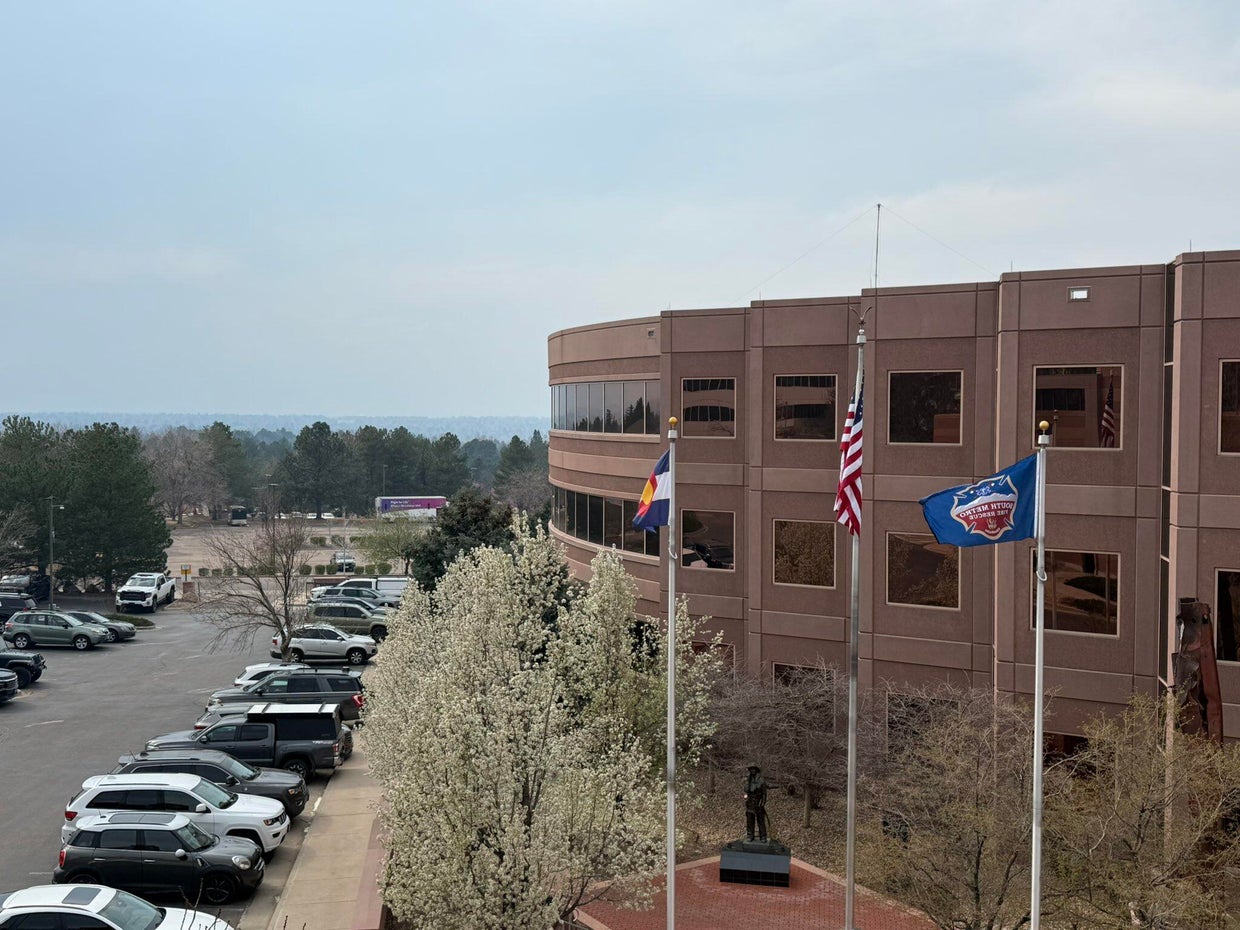
South Metro Fire Rescue said in their post that the smoke is from Colorado’s neighbor to the east. They called it a “significant haze” in the air.
Earlier this month, the Morrill Fire and the Cottonwood Fire burned a significant amount of Nebraska grassland and ranchland. They have mostly been contained by firefighters. Nebraska Gov. Jim Pillen said those two fires combined with several others have burned approximately 800,000 acres of land. On Thursday, Pillen announced that he is signing several executive actions intended to ease the burden caused by the fires.
There were no wildfires burning in the Denver metro area on Thursday afternoon.

ARAPAHOE COUNTY, Colo. (KKTV) – A homicide suspect based out of Colorado, wanted in a fentanyl-related death, is back in the state after being captured in Colombia.
The Arapahoe County Sheriff’s Office (ACSO) said 33-year-old Max Arsenault had been on the run since January 17.
Deputies said this stemmed from an incident in May 2023, where deputies responded to a call for a man named Nicholas Dorotik, who was found unresponsive.
ACSO said the cause of death was a mixed drug overdose involving meth and fentanyl, having about three times the lethal amount of fentanyl in his system.
One year later, Arsenault was arrested. He was scheduled for trial in January 2026 when deputies said he fled the country while on bond three days before the trial was set to start.
He was caught in Medellin, Colombia, on March 4, following a two-month international investigation. He has since been extradited back to Denver, where he is facing charges and awaiting trial.
Copyright 2026 KKTV. All rights reserved.


Oklahoma City Comets preliminary 2026 roster

Merkley Announces Additional Oregon Town Halls April 2-4

Pennsylvania-born indie rockers Tigers Jaw return with new album release

A new safety role at Rhode Island College comes into sharper focus after Brown shooting – The Boston Globe

NFL Draft Injury Analysis: Jalon Kilgore, S – South Carolina

Florida High School Football Rankings: Top 25 teams – Oct. 21

How old is Bo Nix? What to know about Oregon quarterback ahead of 2024 NFL Draft

Cleary's 21 help Le Moyne down Central Connecticut State 69-64 in OT

99th annual Pony Swim held in Virginia

Indiana Members Credit Union announced as new anchor tenant at Bottleworks District

Video: Will ICE Change Under Its New Leader?

DHS shutdown breakthrough comes at cost for Republicans as funding fights nears end

Rubio joins crucial G7 talks as Iran war set to dominate second day

A surprise resignation could open the door for an independent to win a Montana Senate seat

Video: Savannah Guthrie Says She Believes Her Mother Was Taken for Ransom
-

 Detroit, MI1 week ago
Drummer Brian Pastoria, longtime Detroit music advocate, dies at 68
-

 Science1 week ago
How a Melting Glacier in Antarctica Could Affect Tens of Millions Around the Globe
-

 Movie Reviews1 week ago
‘Youth’ Twitter review: Ken Karunaas impresses audiences; Suraj Venjaramoodu adds charm; music wins praise | – The Times of India
-
 Science1 week ago
I had to man up and get a mammogram
-

 Sports6 days ago
IOC addresses execution of 19-year-old Iranian wrestler Saleh Mohammadi
-

 New Mexico5 days ago
Clovis shooting leaves one dead, four injured
-
 Business1 week ago
Disney’s new CEO says his focus is on storytelling and creativity
-

 Texas1 week ago
How to buy Houston vs. Texas A&M 2026 March Madness tickets