West
Candy tours of America: 5 delectable destinations for sweet family memories

The Candy Man, in an earlier era in American pop culture, was portrayed as a kindly magician who charmed children with the secret ingredient to turn sunshine into dreamy sweet confections.
“He mixes it with love / And makes the world taste good,” late multimedia performer Sammy Davis Jr. sang in his signature tune.
Candy as a symbol of love is more than just a bubble-gum pop music lyric, according to renowned candy scholar and historian Susan Benjamin of West Virginia.
BANANA-FOCUSED FOOD TRUCK IN NEW JERSEY SERVES UP FRUITY, FROZEN TREATS” ‘CLEAN AND REFRESHING’
“People love candy because it’s food people eat when they’re having fun and going to parties or going to movies, and those kinds of things,” she told Fox News Digital.
Benjamin is the author of 10 books, including “Sweet as Sin: The Unwrapped Story of How Candy Became America’s Favorite Pleasure.”
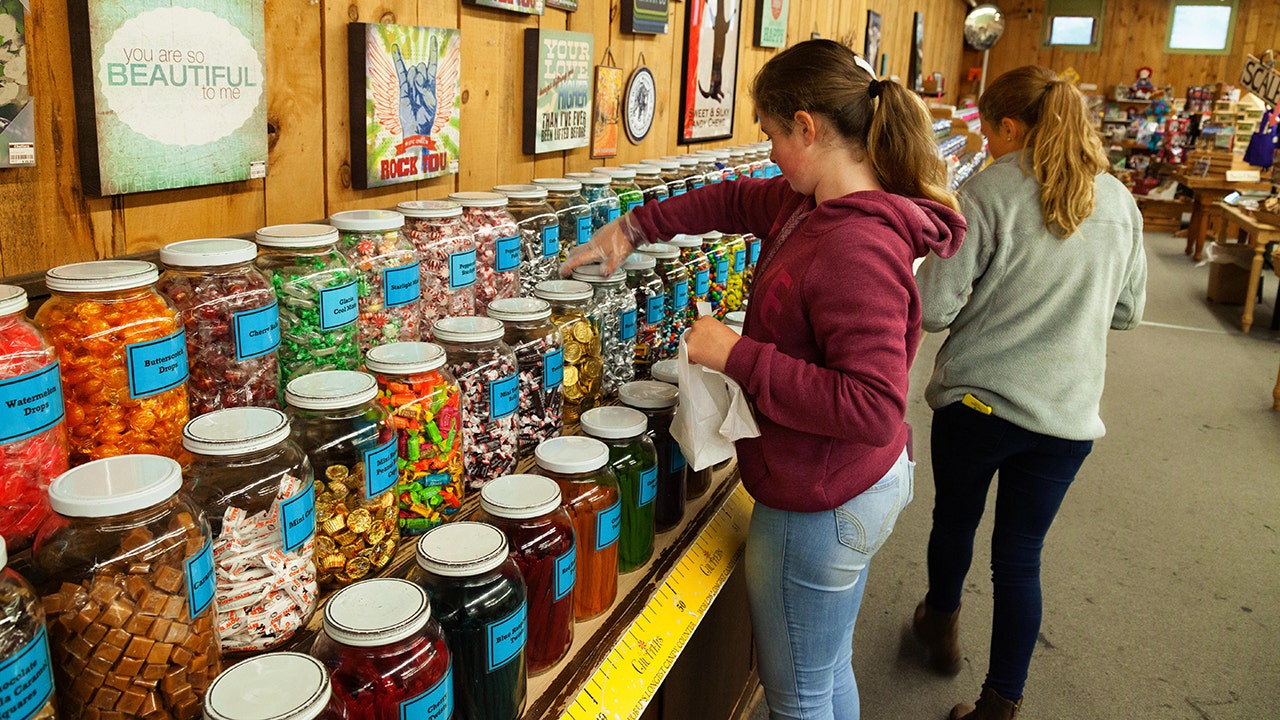
Teenagers are shown shopping for sweets at Chutters candy store, Littleton, New Hampshire. (Imagedoc/Alamy Stock Photo)
She added, “Mostly people love candy because the people we love gave it to us when we were children. We continue as we get older to give or receive candy as a sign of love.”
The American candy industry gives parents and children plenty of chances to make sweet memories by enjoying the nation’s best candy stores, tours and museums.
Here are five.
B.A. Sweetie Candy Co. of Cleveland, Ohio
Acclaimed as “the world’s largest candy store,” this Cleveland colossus of confections is a 74-year-old local institution.
It proudly proclaims that it can satisfy the sweetest teeth at the biggest candy klatch.
B.A. Sweetie of Cleveland, Ohio claims it has more than 1,000 pounds of Tootsie Rolls available to sell at any time. (imac/Alamy Stock Photo)
“Whether you need 1,000 pounds of Tootsie Rolls for a parade, or a half of a pound for your belly, we have it and we have it now,” B.A. Sweetie Candy Co. says on its website.
It also touts its status as one of Cleveland’s most popular tourist attractions.
Chutters of Littleton, New Hampshire
Wedged into the White Mountains of New Hampshire is this idyllic New England Main Street general store that features the world’s longest candy counter.
CRACKER JACK, IMMORTALIZED IN BASEBALL ANTHEM, IS A GRAND-SLAM RECIPE AT HOME, TOO
The claim is confirmed by Guinness World Records.
It measures Chutters’ single continuous tabletop of sweetness at 111 feet, 11 inches long.
On its website, Chutters says it offers “yesterday’s favorites and hard-to-find-flavors, to the best of today’s most sought-after treats.”
Chutters candy store of Littleton, New Hampshire, has the world’s longest candy counter, according to Guinness World Records. (Kumar Sriskandan/Alamy Stock Photo)
It also offers a “vast array of sours and Gummies, gourmet and traditional jellybeans, chocolates, licorice, caramels, and nostalgic pieces.”
Jelly Belly Candy Co. of Fairfield, California
The famous jelly-bean maker offers both self-guided and guided tours of its California confections factory seven days a week.
SHOOFLY PIE WAS BORN IN THE USA: ENTHUSIASTS BAKE PI DAY CLAIM OF ‘MORE AMERICAN’ THAN APPLE PRODUCTS
Self-guided tours can be done on a walk-in basis.
Guided tours require a reservation.
Close-up shot of an assortment of multi-colored Jelly Belly jelly beans in California, April 18, 2021. (Smith Collection/Gado/Getty Images)
Tours follow a quarter-mile route above the factory, looking down on where love and sugar are whipped into jellybeans.
There’s a Jelly Belly Jelly Bean art gallery and — for mom, dad and other grownups — chocolate tastings paired with local wines.
Pez Visitor Center of Orange, Connecticut
Pez candies, those crunchy blocks of sugar, are recognized globally for their plastic toy dispensers topped by a myriad of human, animal or other forms.
Originating in Austria in the 1920s, Pez has been made in Connecticut since 1973.
The company opened its visitor center in 2011.
The Pez Visitors Center opened in Orange, Connecticut in 2011. (Alamy)
Here’s a little-known Pez dispenser of knowledge: The name is an abbreviation of “Pfefferminz,” the German word for peppermint.
True Treats of Harper’s Ferry, West Virginia
Calling itself “the nation’s only research-based candy store,” True Treats was founded by author and candy historian Susan Benjamin.
An interior shot of the IT’SUGAR store on Broadway in Greenwich Village. A display of Mary Janes candy is shown for sale by the ounce. (Ira Berger/Alamy Stock Photo)
It’s located in historic Harper’s Ferry, little more than an hour’s drive northwest of Washington, D.C., and has been lauded nationally.
“This isn’t so much a candy store as it is a museum that sells its Confectionery displays.”
“This isn’t so much a candy store as it is a museum that sells its Confectionery displays,” Washington Magazine wrote in an homage to the candy collection.
“True Treats traces the history of old-school sweets — and we mean old, old school, like hickory bark, enjoyed by the Iroquois — to 19th-century Buttermints and retro faves such as Goo Goo Clusters, Mary Janes, and Squirrel Nut Zippers.”
For more Lifestyle articles, visit www.foxnews.com/lifestyle.
Read the full article from Here

San Francisco, CA
Celebrated San Francisco historic landmark, the Huntington Hotel officially reopens

SAN FRANCISCO (KGO) — First opened as apartments in 1922 and converted into a hotel two years later, the Huntington was once a playground for socialites and Hollywood stars.
It shut its doors in 2020 due to the COVID-19 pandemic and remained shuttered until this week, following new owners and a million-dollar, top-to-bottom renovation.
A ribbon-cutting ceremony was held for The Huntington Hotel in San Francisco’s Nob Hill neighborhood Monday.
The hotel officially reopened on Sunday.
Mayor Daniel Lurie attended the celebration for the hotel on California Street.
“This is another sign that San Francisco is on the rise, when you have major institutions and major hotels reopening,” Lurie said. “We’re seeing it in Union Square. We’re seeing it now up here on Nob Hill. This is an exciting moment for San Francisco.”
What doom loop? Downtown San Francisco showing signs of economic rebound, experts say
The hotel, known for its iconic sign, will be restoring the landmark sign to its former glory.
Many say it’s a symbol of what’s going on in San Francisco.
MORE: Nordstrom making return to San Francisco with new concept, mixed reactions
“It came to symbolize San Francisco’s decline during COVID when it shut and it now, I think, symbolizes San Francisco’s rebirth,” said Greg Flynn, Flynn Group Founder, Chairman, and CEO. “It’s sort of the perfect symbol of it because it’s coming back better than it ever was.”
Alex Bastian, President and CEO of the Hotel Council of San Francisco, said hotel occupancy rates are up in 2024.
“Our data team crunched the numbers, and the four-week rolling hotel occupancy rate for San Francisco Bay Area hotels is 55.1 percent as of January 17 of this year. Compare that to January 17 of 2021, during the pandemi,c when it was 13.1 percent.”
Of course, the Super Bowl helped.
Here’s what Super Bowl LX visitors are saying about San Francisco
“There’s no marketing campaign better than what we achieved as San Franciscans,” Bastian said. “The mayor and his team really elevated the game. They did an incredible job. We are so fortunate, as a city, because so many came here and they left their hearts here in San Francisco.”
Eyewitness News wasn’t allowed to gather video of the hotel’s features, but the hotel provided renderings of a sample room.
Matthew de Quillien, The Huntington Hotel General Manager, said the hotel has 143 rooms, many of them suites. Also, the Nob Hill Spa, Arabella’s Cocktail Salo,n and a reopening of The Big Four Restaurant, featuring its famous chicken pot pie.
“Our owner was able to find the original recipe from the 70’s and we remastered it and we’re … serving it to our guests,” de Quillien said.
He said rates range from $600 a night to $7,000 a night for its Presidential suite.
The restaurant opens to the public on March 17.
If you’re on the ABC7 News app, click here to watch live
Copyright © 2026 KGO-TV. All Rights Reserved.

While most people know beers as “cold ones,” Tyson Barrie opts for a different name.
“We’ve always just called beers chilly ones,” the former Colorado Avalanche defenseman said.
Now, Barrie hopes his moniker goes mainstream with his beer brand Chilly Ones, which made its U.S. debut weeks ago in Colorado. He plans to move to the Centennial State from his home country of Canada come fall to build it out.
So far, the beer is in about 200 businesses across the state, mostly liquor stores like Bonnie Brae and Argonaut, but also eateries such as Oskar Blues.
The light lager is available in cans at 3% alcohol by volume. The less-than-light ABV is popular in Australia and some parts of Europe, he said, but nothing serves that segment in the U.S.
Barrie also said the brand has a nonalcoholic version “in the tanks and ready to go” at Sleeping Giant Brewing Co., the Denver facility where Chilly Ones is made. He said it’s one of the only booze-free options that could “trick” him, and he expects the version to be available by April.
“If you look at all the data that we’re seeing, these two categories – the nonalc and the low – seem to be two of the only ones in the alcohol space that are growing,” Barrie said.
Chilly Ones has been available in Canada since late 2025, and he said a 4.5% to 5% edition is also in the works, though that one won’t hit the shelves for months.
“From what we can see in Canada, people question the 3%. They say it’s not enough,” he said through a grin. “Then in the U.S., people aren’t questioning it at all. They really liked a little bit less and the moderation factor to it.”
That’s why he thinks the low-carb, zero sugar, under 100 calorie drink is a perfect fit for Denver. With the city’s storied history in craft beer combined with a more conscious, active lifestyle, it’s the perfect stateside launching point for his brand, Barrie believes.
Drafted by the Avs and playing in the city from 2011 through 2019, his preexisting connections also were a selling point.
“Every occasion is a little bit different, whether you’re parenting or you’re at a concert or you’ve got to get up early or you’re having two after work and you want to drive,” he said, explaining why there will be multiple versions of the drink available.
“It’s pick your own adventure. We’re not going to judge you,” he continued. “If you want to celebrate and get absolutely hammered, we’ll give you that option too. It’s just you can do it a little bit healthier.”
The idea came to Barrie when he had “a dozen” or so chilly ones during a night with friends years ago. In his phone’s notes app, he wrote that he would one day start a beverage brand with his NHL buddies and call it his colloquial name for beer.
He was still playing in the league at the point, but in 2024, two years after, somebody from the beverage world “very serendipitously” reached out to see if Barrie would be interested in starting a wine or whiskey company.
“And I was like, ‘Yeah, I’d do a beer,’” he recalled.
He was still in the NHL playing with the Nashville Predators but nearing the end of his career. The now-34-year-old gathered several of his fellow skaters, including Avs star Nathan MacKinnon, and other career connections like Lumineers frontman Wesley Schultz, and Chilly Ones was born.
Having that post-playing career journey already laid out has been challenging but worth it, he said.
“I have a lot of friends who have retired, and you struggle with a bit of purpose and you wake up and you’re just kind of looking around, not sure what to do with yourself,” he said. “So I feel grateful. I didn’t even have any time to reset. I was just kind of thrown in the fire.”
Barrie and Chilly Ones raised an undisclosed amount from friends and family to start the brand and are in the midst of a more institutional round.
He and Chilly Ones have no plans to venture outside the state in the short-term. He said he, Chief Operating Officer Kimberley Kainth and CEO Matthew Clayton want to test the market for all three options and get feedback before expanding elsewhere.
Longmont-based Oskar Blues founder Dale Katechis is an adviser, along with White Claw and Mike’s Hard Lemonade alum Todd Anderson.
“We have a team that we really, really trust who has scaled and built products in Colorado and moved out,” Barrie said. “We want to get our feet under us in Colorado and then we’ll start to really look at who’s next.”
Read more from our partner, BusinessDen.
Get more business news by signing up for our Economy Now newsletter.

SEATTLE — A 36-year-old man was arrested after Seattle police say he threw rocks at passing cars in South Seattle early Tuesday, shattering a truck window and injuring a couple in their 50s.
Patrol officers responded at 12 a.m. to reports of a man hurling rocks near Rainier Avenue South and South Henderson Street.
SEE ALSO | 3 hurt after late-night crash sends car into north Seattle auto parts store
Police said they found the couple with facial injuries after their truck window shattered. Firefighters treated both victims at the scene, and the couple then drove to a nearby hospital for further treatment.
Officers found the suspect nearby and arrested him. According to the police report, the man made “multiple threats to shoot officers in the head and kick and punch officers before and after being placed into custody.”
Police also spoke with a King County Metro transit supervisor who reported that two Metro coaches had damage to their windshields and route destination signs after being struck by rocks. Police said no drivers or passengers were hurt.
More witnesses also told police they saw the suspect throwing rocks at moving vehicles.
Police said the suspect is a convicted felon and was booked into the King County Jail for investigation of assault, malicious mischief, and property destruction. Detectives in the General Investigations Unit are assigned to the case.
Nancy Guthrie neighbors’ Ring camera captures vehicles on possible route from crime scene

Family member of American killed by Cuban forces in boat shootout says he was on ‘diabolical’ mission

Police search for suspect, accomplice after teen injured in shooting outside Detroit school gym

Celebrated San Francisco historic landmark, the Huntington Hotel officially reopens

GOP candidates for Texas House face off in Collin County, Park Cities, North Dallas

Florida High School Football Rankings: Top 25 teams – Oct. 21

Cleary's 21 help Le Moyne down Central Connecticut State 69-64 in OT

How old is Bo Nix? What to know about Oregon quarterback ahead of 2024 NFL Draft

99th annual Pony Swim held in Virginia

Indiana Members Credit Union announced as new anchor tenant at Bottleworks District

Fraud-plagued Minnesota sues Trump admin for withholding $243M in Medicaid payments

Is Iran expanding attacks to target energy and civilian sites in the Gulf?

Trump claims US stockpiles mean wars can be fought ‘forever’; Kristi Noem testifies before Congress – US politics live

War in the Middle East: Iran’s broad retaliation in the Gulf • FRANCE 24 English

Melania Trump presides at UN Security Council meeting • FRANCE 24 English
-

 World6 days ago
Exclusive: DeepSeek withholds latest AI model from US chipmakers including Nvidia, sources say
-

 Massachusetts6 days ago
Mother and daughter injured in Taunton house explosion
-

 Denver, CO6 days ago
10 acres charred, 5 injured in Thornton grass fire, evacuation orders lifted
-

 Louisiana1 week ago
Wildfire near Gum Swamp Road in Livingston Parish now under control; more than 200 acres burned
-

 Oregon4 days ago
2026 OSAA Oregon Wrestling State Championship Results And Brackets – FloWrestling
-

 Florida3 days ago
Florida man rescued after being stuck in shoulder-deep mud for days
-

 Technology1 week ago
Arturia’s FX Collection 6 adds two new effects and a $99 intro version
-

 News1 week ago
Video: How Lunar New Year Traditions Take Root Across America