Louisiana
Louisiana marshes bury carbon in the muck. Could they help fight climate change?


Gathered on a strip of salt marsh bordering the Gulf of Mexico, Tim Carruthers and his team of scientists huddle around a patch of soil marked by protruding PVC pipes.
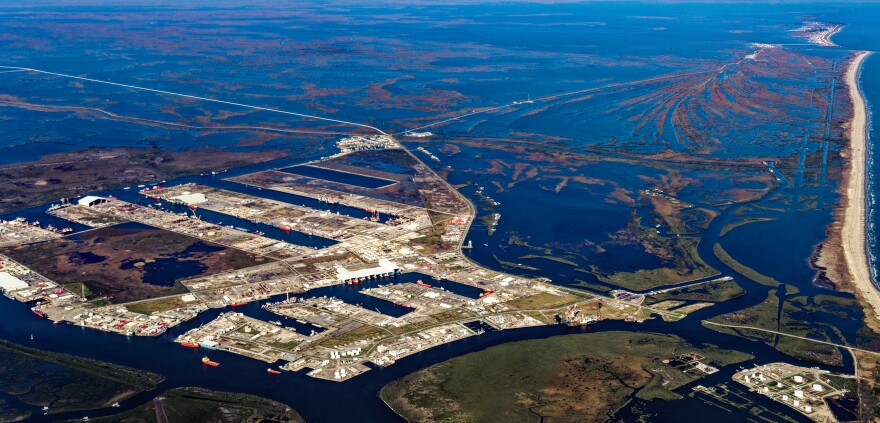
Pelicans soar overhead and massive ocean-going ships cruise by, heading toward the neighboring oil and gas seaport of Port Fourchon. But Carruthers’ team has their eyes fixed on the ground.
The group works a thick pipe into the soft dirt and releases liquid nitrogen, letting it flow into the ground with a loud hiss. The process results in a long tube of frozen mud — a sample they can take back to the lab.
“What we like to call a sediment popsicle,” said Carruthers, director of coastal ecology at the Water Institute of the Gulf.
The sediment popsicle is at the center of his research into something hard to see — carbon dioxide.
Water Institute of the Gulf
Carruthers’ research is part of an effort to understand how big a role Louisiana marshes can play in the fight against climate change. The larger the role, the more money they could be worth.
Marshes can act as“carbon sinks,” or natural spaces that absorb and store more carbon than they release. In fact, coastal wetlands are among the best habitats on Earth at sequestering carbon. Louisiana is rich in them.
The state holds almost two-thirds of all the carbon stored in coastal marshes along the Gulf Coast. The reason is twofold: Louisiana has far more wetlands than its Gulf neighbors and its soil accumulates carbon at a faster rate.
Louisiana marshes’ knack for capturing carbon could allow the state to eventually create a new market for carbon credits, where companies invest in the restoration of coastal ecosystems as a way to offset their greenhouse gas emissions.
Carruthers said the arrangement presents the chance for a “triple win:” reducing planet-warming emissions, enhancing knowledge of marshes and creating a new way to fund coastal restoration.
“All of these efforts are trying to see if we can get to a point that it’s financially viable,” he said.

But the carbon equation for this dynamic habitat is complicated.
Depending on how salty the marsh is, methane-burping bacteria in the soil can thrive, negating some of the carbon stored by marsh grasses and mangroves. The bacteria is less tolerant to salty water, but Carruthers said the salinity of Louisiana marshes can vary widely.
“There are just some uncertainties,” he said. “So we have to make very conservative assumptions.”
The constant flux makes it hard to estimate a marsh’s capacity to store carbon. So far, Carruthers said that’s made selling carbon credits for marshes financially inviable.
Based on current models, Carruthers said a marsh-building project covering almost 3,500 acres would only offer up to $1 million in return over 30 years. To put that into perspective, the state’s largest marsh restoration project — the Upper Barataria Marsh Creation project — was a third of that size and cost $181 million to build.
Even still, the state and companies continue to be enthusiastic about the market’s potential.
Carruthers’ research is in partnership with Chevron, which owns the strip of land outside of Port Fourchon that hosts his study site.
Chevron environmental geoscientist Cas Bridge said the research presents an exciting opportunity to look into nature-based climate solutions.
“I think there’s this acknowledgment that there’s going to be this sort of an amount of emissions that are hard or impossible to abate, and so that’s where offsets come in,” she said.
PETER_D_JANSEN
/
Greater Lafourche Port Commission
Even if carbon credits aren’t in the cards, Bridges said the study is also a way to look at the potential for habitat restoration to increase Port Fourchon’s resiliency against rising sea levels and storms that have grown stronger due to climate change. In a way, a carbon market would be a bonus.
“There is an element of playing the long game,” she said. “And nothing in the research so far indicates that we should stop.”
Isabel Englehart, a policy advisor for the Governor’s Office of Coastal Activities, said there has always been uncertainty around how large of a role marshes can play.
She said Carruthers’ research sheds light on one of the state’s most valuable resources. But the extent to which marshes may play a role in the state’s plan to reach carbon neutrality by 2050 is still a question mark.
“Natural sequestration is not going to be the silver bullet for reducing our statewide emissions,” Englehart said. “But it could be a big part of it.”



![~!@[WATCHLIVE!TV]>> NOW New Mexico United vs Colorado Springs Switchbacks FC Match 𝐋𝐈𝐕𝐄 Free Streams ON Tv Channel](https://i2.wp.com/unicornriot.ninja/wp-content/uploads/2018/09/LiveChannel334x212v2.png?w=400&resize=400,240&ssl=1 "~!@[WATCHLIVE!TV]>> NOW New Mexico United vs Colorado Springs Switchbacks FC Match 𝐋𝐈𝐕𝐄 Free Streams ON Tv Channel")


NEW ORLEANS (WGNO) — For the fifth consecutive year, the Louisiana Children’s Museum hosted its annual environmental festival, Mud Fest, on Saturday, March 28.
From 10 a.m.-4 p.m., parents and their little ones had the opportunity to have fun in the sun and enjoy the “highlight” of the museum’s spring season.
This event was inspired by the iconic New Orleans festival culture which includes good food, live music and a nice, high-energy atmosphere. Mud Fest is tailored for the “youngest environmental stewards” to have fun and make all the mess they want with mud.
Due to the Crescent City being surrounded by wetland habitats, we interact with water daily in both our rural and urban communities.
The festival generates positive associations with our region and also builds critical thinking skills for future educators, engineers, fishermen and farmers. According to LCM, engaging with nature, water and plants “builds a child’s confidence and fosters a lifelong connection to the Earth.”
“As the Louisiana Children’s Museum celebrates its 40th anniversary, events like Mud Fest reflect our long-standing commitment to hands-on learning that sparks curiosity and connects children to the world around them,” LCM CEO Tifferney White said.
This year, Mud Fest had performances from young musicians of the School of Rock, the Louisiana Sunspots and more. There were also a storytelling stage and various family-friendly activities for visitors to engage in.
Mud Fest partnered with Pontchartrain Conservancy, STEM NOL, Whimscapes and Sugar Roots to put on the event.
Stay up to date with the latest news, weather and sports by downloading the WGNO app on the Apple or Google Play stores and by subscribing to the WGNO newsletter.
Latest Posts

Lana Del Rey has enjoyed a low-key life with her gator tour guide husband Jeremy Dufrene in Louisiana and the talented singer recently gave an intimate peek into their relationship.
The 40-year-old Young And Beautiful hitmaker (born Elizabeth Grant) took to her Instagram to post a gallery celebrating the swamp guide’s 51st birthday.
The couple looked just as in love as ever following their wedding in September 2024.
Del Rey shared several recent videos from their modest life together including a cute selfie of the couple by the ocean while she let her natural beauty show by going make-up free.
She also posted a cute video of Dufrene loading up the truck with plants they had just purchased from Home Depot and when he realizes he is being filmed, the Louisiana native flashed a big smile and proudly posed with a Jack-o’-lantern pot.
Del Rey also shared a snap of her hand gripping his wrist as her massive engagement ring could be seen in full view.
Lana Del Rey has enjoyed a low-key life with her gator tour guide husband Jeremy Dufrene in Louisiana and the talented singer recently gave an intimate peek into their relationship as she shared a tribute to him on his 51st birthday
Another snap showed Del Rey wearing one of Dufrene’s tour guide shirts featuring his name embroidered above the pocket.
Weeks ago the musical artist gave what appeared to be a glimpse into her married life in her new video.
Del Rey’s Insta Stories video opened with footage from the 1933 Betty Boop cartoon Snow-White, though it focused on a section starring the character Koko the Clown as he’s turned into a ghost.
Then the video abruptly cut to shaky handheld footage of Del Rey dancing with an ecstatic smile plastered on her face.
The two have kept a relatively low profile since their wedding day but did make a notable appearance last month at the pre-New York Fashion Week Ralph Lauren show on February 10.
The happy couple even stopped for a romantic kiss as they walked the red carpet for the iconic designer.
The couple first met in 2019 during one of Dufrene’s swamp excursions and reconnected years later, before tying the knot in September 2024.
In August, Del Rey revealed how she fell for her husband, a Louisiana bayou tour guide who spends his days surrounded by alligators.
Join the debate
What do you think Lana Del Rey’s choice to marry a swamp guide says about fame and real love?

She posted a cute video of Dufrene loading up the truck with plants they had just purchased from Home Depot and when he realizes he is being filmed, the Louisiana native flashed a big smile and proudly posed with a Jack-o’-lantern pot
Del Rey also shared a snap of her hand gripping his wrist as her massive engagement ring could be seen in full view
Another snap showed Del Rey wearing one of Dufrene’s tour guide shirts featuring his name embroidered above the pocket
Del Rey also posted a video of the cover of their wedding album
‘Like many people who work with large, dangerous beasts, Jeremy has a calm, strong presence,’ Del Rey told W magazine.
‘When we met, I realized pretty immediately that I loved him, but that it might get difficult because of what I was bringing to the table,’ she continued.
Del Rey added that Dufrene reassured her from the start: ‘I work with alligators — I have tough skin.’
And true to his word, he listened through all the drama: ‘All the things that made me upset — and there were so many! — he would just listen and say, “You be you — and I’ll just love you more.”’
Weeks ago the musical artist gave what appeared to be a glimpse into her married life and her new video
The two have kept a relatively low profile since their wedding day but did make a notable appearance last month at the pre-New York Fashion Week Ralph Lauren show on February 10
The happy couple stopped for a romantic kiss as they walked the red carpet for the iconic designer
The couple first met in 2019 during one of Dufrene’s swamp excursions and reconnected years later, before tying the knot in September 2024
Tying the knot in 2024 didn’t make the spotlight any gentler.
Del Rey recalled the intense scrutiny they faced, with drones reportedly hovering over their home to snap photos of their wedding and early days as newlyweds.
‘If I was him, I would have been nervous — my emotions were more overwhelming than usual, and my usual emotions can be quite overwhelming!’ she said with a laugh. ‘But Jeremy was fine. He told me, “Don’t worry about me.”’
And when it comes to music inspired by love, fans have already heard a peek. ‘Stars Fell on Alabama. I open my show with that song — that’s it, so far,’ she revealed.
‘Jeremy is the most impactful person in my life. He’s quiet in public, but around me he talks all the time.’
Louisiana
Meta orders 10 gas-fired power plants for its Hyperion AI campus in rural Louisiana—more than triple the initial plans | Fortune

Meta will pay for a total of 10 gas-fired power plants—enough to power more than 5 million homes—to electrify its rapidly expanding plans for its massive AI data center complex in northeastern Louisiana, dubbed Hyperion.
Meta’s agreement with New Orleans–based Entergy, announced March 27, is to build and finance seven new power plants in Louisiana. That comes on top of plans approved last year to build three gas power plants for the sprawling AI hub. The 10 power plants with 7.5 gigawatts of capacity would represent a more than 30% increase to Louisiana’s entire grid capacity, not even counting up to 2.5 gigawatts of renewable energy capacity, including battery storage, that Meta also agreed to help fund.
Meta initially announced plans for a $10 billion investment in December 2024 for a 2,250-acre data center campus in northeastern Louisiana in rural Richland Parish. But Meta recently, and quietly, acquired an additional 1,400 acres, as Fortune reported in February. In October 2025, Meta entered a joint venture with funds managed by Blue Owl Capital to finance, build, and operate the Hyperion campus with up to $27 billion in total development costs, seemingly ensuring the mega-campus will serve as a long-term, multiphase AI hub.
Meta CEO Mark Zuckerberg has said Hyperion would cover a “significant part of the footprint of Manhattan.”
“Our Richland Parish data center serves as a symbol of the ambition and scale of next-generation AI infrastructure,” said Rachel Peterson, Meta vice president for data centers, in a statement. “We are building foundations for the future of AI innovation right here in the United States. We’ve been working closely with Entergy since early on-site planning to ensure our power needs are met and, importantly, so that Entergy’s other consumers aren’t paying our costs.”
The Louisiana Public Service Commission will still need to approve the projects. The previous three power plants received regulatory authorization last year.
Entergy’s stock jumped 7% on March 27, lifting its market cap to a new record high of about $50 billion. The stock has risen almost 125% in two years.
Entergy is emphasizing that Meta is paying for the projects, rather than shifting the costs to other ratepayers. Entergy argues that the deals will save Louisiana taxpayers billions of dollars over several years.
The 10 power plants are estimated to cost nearly $11 billion. Critics contend ratepayers could be stuck with the bill after 15 years, which is the length of the contractual terms, if Meta no longer requires so much power after that span.
“This agreement reflects what’s possible when strong partners align around long-term growth and value,” said Phillip May, president and CEO of Entergy Louisiana, in a statement. “Working with our customers, regulators, and state leaders, we are making targeted investments that strengthen reliability, support economic development, and deliver meaningful benefits to customers—all while keeping energy rates affordable.”

Thousands without power in Henderson neighborhood after mylar balloon causes outage

Pakistan hosts diplomatic discussions on ending war

Who is running for U.S. House, Senate in New Jersey? Here’s the list
![~!@[WATCHLIVE!TV]>> NOW New Mexico United vs Colorado Springs Switchbacks FC Match 𝐋𝐈𝐕𝐄 Free Streams ON Tv Channel](https://i2.wp.com/unicornriot.ninja/wp-content/uploads/2018/09/LiveChannel334x212v2.png?w=80&resize=80,80&ssl=1 "~!@[WATCHLIVE!TV]>> NOW New Mexico United vs Colorado Springs Switchbacks FC Match 𝐋𝐈𝐕𝐄 Free Streams ON Tv Channel")
~!@[WATCHLIVE!TV]>> NOW New Mexico United vs Colorado Springs Switchbacks FC Match 𝐋𝐈𝐕𝐄 Free Streams ON Tv Channel

Disputes grow between NC Bar, legislative committee tasked with reforming it

Florida High School Football Rankings: Top 25 teams – Oct. 21

How old is Bo Nix? What to know about Oregon quarterback ahead of 2024 NFL Draft

Cleary's 21 help Le Moyne down Central Connecticut State 69-64 in OT

99th annual Pony Swim held in Virginia

Indiana Members Credit Union announced as new anchor tenant at Bottleworks District

JD Vance says he was ‘obsessed’ with UFOs, believes aliens are actually ‘demons’
The EU's recipe for trade deals : easy on beef, tough on wine

Photos: ‘No Kings’ protests across the country

Jeffries declines to break with indicted Democrat after ethics panel’s guilty verdict

Hundreds of thousands march through London in stand against the far right
-

 Sports1 week ago
IOC addresses execution of 19-year-old Iranian wrestler Saleh Mohammadi
-

 New Mexico7 days ago
Clovis shooting leaves one dead, four injured
-

 Tennessee6 days ago
Tennessee Police Investigating Alleged Assault Involving ‘Reacher’ Star Alan Ritchson
-

 Technology7 days ago
YouTube job scam text: How to spot it fast
-

 Minneapolis, MN3 days ago
Boy who shielded classmate during school shooting receives Medal of Honor
-

 Science1 week ago
Record Heat Meets a Major Snow Drought Across the West
-

 Politics1 week ago
Schumer gambit fails as DHS shutdown hits 36 days and airport lines grow
-

 Texas1 week ago
How to buy Houston vs. Texas A&M 2026 March Madness tickets