Science
Trump's first term brought world-changing vaccine. His second could bring retreat


President Trump once celebrated the COVID-19 vaccines released at the end of his first term as “one of the greatest achievements of mankind,” echoing the sentiments of mainstream medical officials who praised their rapid development as pivotal in combating the then-raging pandemic.
But as his second administration takes shape, some are sounding the alarm regarding Trump’s picks to lead major public health agencies, concerned that the nominees’ skepticism, if not hostility, toward vaccines could jeopardize the nation’s ability to respond to new or resurgent infectious threats.
There’s Robert F. Kennedy Jr., Trump’s pick to lead the U.S. Department of Health and Human Services, who has called the COVID-19 vaccine the “deadliest vaccine ever made” and said that “there’s no vaccine that is, you know, safe and effective.”
Robert F. Kennedy Jr. has contended that he’s not against vaccines, but has spread the myth that they commonly injure children and can cause autism.
(Morry Gash / Associated Press)
Nominated to lead the U.S. Centers for Disease Control and Prevention is Dr. Dave Weldon, a former congressman from Florida who has expressed skepticism of the safety of vaccines and promoted the discredited idea that a preservative, thimerosal, that has been used in some vaccines, or the measles, mumps and rubella vaccine — which has never used thimerosal — may be linked to autism.
Skepticism and outright conspiracy theories about vaccines are nothing new, and health officials have long warned about the potential pitfalls of such misinformation.
But now, some top doubters could be in the position to shape federal health policy.
While COVID is no longer the grave public health threat it once was, the disease spikes periodically — as it did this summer — and has continued to be responsible for the most hospitalizations and deaths of any respiratory disease nationally, with nearly 60,000 fatalities for the yearlong period that ended Sept. 30. And other infectious threats, be they whooping cough, measles or the latest strain of bird flu, continue to loom.
“We really don’t want to return to the era where these vaccine-preventable diseases were frequent, and children were getting sick or hospitalized or even dying,” said Dr. Anne Schuchat, a former deputy director at the CDC, who served at the agency for more than three decades, starting in the Reagan administration. “We’ve been fortunate in the past couple decades to have high levels of vaccination and low levels of most of the diseases.”
Neither the Trump transition team, a spokesperson for Kennedy, nor Weldon answered requests for comment for this story.
Trump, who had his own brush with the coronavirus near the end of his first term, hailed the rapid development of the COVID vaccines as a “monumental national achievement” and celebrated the production of “a verifiably safe and effective vaccine.”
He continued in 2021 to promote COVID vaccines in interviews and at rallies, though he also said he didn’t support making the shots mandatory. That year alone, the World Health Organization estimates, the vaccines likely saved at least 14.4 million lives worldwide.
But even then, skepticism surrounding the shots was starting to take root — including among Trump’s supporters. A KFF survey found that 60% of Republicans who support his “Make America Great Again” agenda got at least one dose of a COVID-19 vaccine at some point. But by late 2023, another KFF survey found that 70% of self-identified MAGA Republicans were either not too confident or not at all confident in the safety of the COVID-19 vaccine.
That same survey found that only 36% of Republicans were very or somewhat confident the COVID-19 vaccines are safe, compared with 54% of independents and 84% of Democrats.
Kennedy has contended he is not “anti-vaccine,” but his organization, the Children’s Health Defense, has questioned their safety. Kennedy himself has criticized what he sees as deficits in the science on vaccine safety and spread the myth that vaccines commonly injure children.
When asked by a documentary maker whether there were any vaccines in history that were a benefit to mankind, Kennedy replied: “I don’t know the answer to that.”
More recently, he has said he would not “take away anybody’s vaccines.”
But even if a vaccine isn’t taken away entirely, “you can just make it much harder for people to get,” said Dr. Ashish Jha, dean of the Brown University School of Public Health and a former White House COVID-19 Response coordinator under President Biden.

Dr. Ashish Jha, dean of the Brown University School of Public Health, said Robert F. Kennedy Jr. “consistently shows that he doesn’t believe in modern medicine, doesn’t believe in the scientific process that has led to these huge gains that we’ve had” in public health.
(Susan Walsh / Associated Press)
For instance, Jha said, newly appointed officials could demand randomized clinical trials for every annual update to the COVID vaccine — “even though we don’t do that for the flu vaccines.”
“If that is a new standard that they create, it probably will make it impossible for [updated] COVID vaccines to be available in time for the holiday season,” Jha said. “If they follow through on their own previous critiques, they may box themselves in and make it very, very hard for Americans to even get COVID vaccines.”
Kennedy has also advanced the baseless claim that thimerosal in vaccines can cause autism, which has been thoroughly discredited by scientists. Thimerosal has been removed from childhood vaccines since 2001, according to the CDC, and “research does not show any link between thimerosal and autism.” While it is still used in some flu vaccines, parents can request a formulation without the preservative for their children.
Organizations like the American Academy of Pediatrics also say the MMR vaccine — which protects against measles, mumps and rubella and is a major target of the anti-vax movement — is safe.
Critics have also accused Kennedy of spreading misinformation regarding the safety of the measles vaccine in Samoa. The Associated Press reported that Kennedy traveled to the island nation in June 2019 and met with anti-vaccine activists before a severe outbreak that killed 83, mostly infants and children.
At the time, public health officials said anti-vaccine misinformation had made the nation vulnerable. Kennedy has denied playing a role in the outbreak, which he has characterized as “mild.” “I had nothing to do with people not vaccinating in Samoa. I never told anybody not to vaccinate,” Kennedy told an interviewer in the 2023 documentary “Shot in the Arm.”
In a video published by the New York Post in 2023, Kennedy floated the conspiracy theory that COVID-19 may have been engineered to avoid harming Jews and Chinese people. Critics called his comments antisemitic and anti-Asian.
In a social media post, Kennedy said “the insinuation” that “I am somehow antisemitic, is a disgusting fabrication.” In another post, Kennedy said he has “never, ever suggested that the COVID-19 virus was targeted to spare Jews” and asserted “that the U.S. and other governments are developing ethnically targeted bioweapons and that a 2021 study of the COVID-19 virus shows that COVID-19 appears to disproportionately affect certain races.”
Some scientists have dismissed some of Kennedy’s assertions as absurd and not based in science.
“One of my biggest concerns about about him is the misinformation that he spreads around vaccination,” said Dr. Richard Besser, who served as acting CDC director during the initial response to the 2009 H1N1 “swine flu” pandemic and is now president and chief executive of the Robert Wood Johnson Foundation.
The Health and Human Services secretary plays a major role in setting health priorities for the nation — suggesting how much money various agencies should get, helping determine what is covered for people on Medicare or Medicaid, and having a say in what kind of public recommendations the agency issues, Besser said.
Kennedy “consistently shows that he doesn’t believe in modern medicine, doesn’t believe in the scientific process that has led to these huge gains that we’ve had” in public health, Jha said.
Dr. Scott Gottlieb, whom Trump appointed as commissioner of the U.S. Food and Drug Administration during his first term, said on CNBC that if Kennedy follows through on his rhetoric, “You’re going to see measles, mumps and rubella vaccination rates go down,” which he expects would result in large outbreaks. “For every 1,000 cases of measles that occur in children, there will be one death,” he added.
Trump’s apparent skepticism toward some vaccine requirements — during the campaign he pledged to “not give one penny to any school that has a vaccine mandate” — is also raising alarm bells in some corners.
Making moves that would erode the share of schoolchildren receiving vaccines they have been getting for generations would “create health risks” for the community at large, said Dr. Mark Ghaly, former secretary of California’s Health and Human Services Agency.

“I can imagine that some states may be pushed into a corner” if federal funding for public health work is reduced, said Dr. Mark Ghaly, former secretary of California’s Health and Human Services Agency.
(Rich Pedroncelli / Associated Press)
If a policy scrapping federal funding at schools that enforce vaccination requirements for schoolchildren were enacted, some districts or states may have to make tough decisions. While most public schools largely rely on state and local funding, federal dollars flow to support certain programs, such as school lunches.
California is a little less reliant on federal funding for public health work, but “I can imagine that some states may be pushed into a corner,” Ghaly said.
State and local health officials should also speak up if they see messaging from the federal government that amounts to misinformation, Jha said. “It is, I think, really critical for state and local public health officials to speak up and not cede the floor to federal officials, especially if those federal officials are not sort of sticking to where the scientific evidence is,” Jha said.
Different leadership at national health agencies could also affect the availability or cost of vaccines.
“Could they become harder to get? Could it become more expensive to get in some places? Maybe not in the first year or two, but down the road, absolutely,” Ghaly said.
The federal government’s childhood vaccination program, run out of the CDC with oversight from Health and Human Services, plays a major role in getting half the kids in America their childhood vaccines essentially for free, Jha said. If federal officials decide to gut the program, “a lot of poor kids are not going to have easy access to vaccines, which, of course, would be tragic and would put everybody at risk.”
Other questions include whether future federal health officials would seek next fall to water down the CDC’s current recommendation that everyone age 6 months and up get vaccinated against COVID — and whether that would affect whether insurers cover the costs of vaccines.
One glimpse into a sharply different way of managing COVID vaccination recommendations is in Florida.
In a move at direct odds with the CDC and the Food and Drug Administration, Florida’s surgeon general, Dr. Joseph Ladapo, advised against getting mRNA COVID vaccinations this fall and suggested that healthcare providers look into a non-mRNA shot for the elderly and immunocompromised. The Pfizer and Moderna vaccines both use mRNA technology, while a different vaccine from Novavax does not.
Ladapo, a former professor at UCLA, is viewed favorably by some highly ranked Republicans, including Ron DeSantis, the Florida governor who appointed him. Just after the election, DeSantis urged Trump to appoint Ladapo as the next secretary of Health and Human Services.
The CDC and FDA have rebuked earlier claims by Ladapo, saying his suggestion that there was an increased risk of harmful, life-threatening side effects caused by the COVID-19 vaccines was “incorrect, misleading and could be harmful to the American public.” The letter said the FDA-approved COVID vaccines have met rigorous standards for safety and effectiveness.
Jha said he thought some of Trump’s other administration picks were reasonable, including the nomination of Dr. Marty Makary, a surgical oncologist at Johns Hopkins University, to run the FDA.
Makary drew attention for a February 2021 op-ed in which he wrote he expected COVID-19 to be “mostly gone” by that April, a prediction that failed to materialize. Later that year, he criticized federal recommendations to have 16- and 17-year-olds receive a COVID-19 vaccine booster, citing a lack of supporting clinical data. In early 2022, he criticized experts who he said discounted infection-derived immunity to COVID.
Jha said he disagrees with Makary on a number of topics — such as, in his view, discounting the value of COVID vaccinations in kids. The difference between Kennedy and Makary, Jha said, is that Makary’s views “are within the range of medical professionals who believe in modern medicine, who can disagree honestly.”
Among Trump’s other picks Jha said he considered reasonable was Dr. Jay Bhattacharya, a Stanford University health policy professor and economist who was critical of pandemic lockdowns, and offered pandemic policy advice to Florida. Nominated to run the National Institutes of Health, Bhattacharya supported a pandemic response called “focused protection” — protecting those at highest risk of death while allowing others to “live their lives normally to build up immunity to the virus through natural infection.”
“I think some of his ideas and recommendations during the pandemic were really problematic and caused a lot of suffering,” Jha said of Bhattacharya, adding that no state was able to implement “focused protection” and that “lots of Floridians died.”
But, Jha added, “If the question is — is he qualified? This is a guy who has an MD, PhD at Stanford … he’s got a very broad body of work, mostly in health economics … He’s very smart, very experienced.”



For decades, the American Academy of Pediatrics and the U.S. Centers for Disease Control and Prevention spoke with a single voice when advising the nation’s families on when to vaccinate their children.
Since 1995, the two organizations worked together to publish a single vaccine schedule for parents and healthcare providers that clearly laid out which vaccines children should get and exactly when they should get them.
Today, that united front has fractured. This month, the Department of Health and Human Services announced drastic changes to the CDC’s vaccine schedule, slashing the number of diseases that it recommends U.S. children be routinely vaccinated against to 11 from 17. That follows the CDC’s decision last year to reverse its recommendation that all kids get the COVID-19 vaccine.
On Monday, the AAP released its own immunization guidelines, which now look very different from the federal government’s. The organization, which represents most of the nation’s primary care and specialty doctors for children, recommends that children continue to be routinely vaccinated against 18 diseases, just as the CDC did before Robert F. Kennedy Jr. took over the nation’s health agencies.
Endorsed by a dozen medical groups, the AAP schedule is far and away the preferred version for most healthcare practitioners. California’s public health department recommends that families and physicians follow the AAP schedule.
“As there is a lot of confusion going on with the constant new recommendations coming out of the federal government, it is important that we have a stable, trusted, evidence-based immunization schedule to follow and that’s the AAP schedule,” said Dr. Pia Pannaraj, a member of AAP’s infectious disease committee and professor of pediatrics at UC San Diego.
Both schedules recommend that all children be vaccinated against measles, mumps, rubella, polio, pertussis, tetanus, diphtheria, Haemophilus influenzae type B (Hib), pneumococcal disease, human papillomavirus (HPV) and varicella (better known as chickenpox).
AAP urges families to also routinely vaccinate their kids against hepatitis A and B, COVID-19, rotavirus, flu, meningococcal disease and respiratory syncytial virus (RSV).
The CDC, on the other hand, now says these shots are optional for most kids, though it still recommends them for those in certain high-risk groups.
The schedules also vary in the recommended timing of certain shots. AAP advises that children get two doses of HPV vaccine starting at ages 9 to12, while the CDC recommends one dose at age 11 or 12. The AAP advocates starting the vaccine sooner, as younger immune systems produce more antibodies. While several recent studies found that a single dose of the vaccine confers as much protection as two, there is no single-dose HPV vaccine licensed in the U.S. yet.
The pediatricians’ group also continues to recommend the long-standing practice of a single shot combining the measles, mumps and rubella (MMR) and varicella vaccines in order to limit the number of jabs children get. In September, a key CDC advisory panel stocked with hand-picked Kennedy appointees recommended that the MMR and varicella vaccines be given as separate shots, a move that confounded public health experts for its seeming lack of scientific basis.
The AAP is one of several medical groups suing HHS. The AAP’s suit describes as “arbitrary and capricious” Kennedy’s alterations to the nation’s vaccine policy, most of which have been made without the thorough scientific review that previously preceded changes.
Days before AAP released its new guidelines, it was hit with a lawsuit from Children’s Health Defense, the anti-vaccine group Kennedy founded and previously led, alleging that its vaccine guidance over the years amounted to a form of racketeering.
The CDC’s efforts to collect the data that typically inform public health policy have noticeably slowed under Kennedy’s leadership at HHS. A review published Monday found that of 82 CDC databases previously updated at least once a month, 38 had unexplained interruptions, with most of those pauses lasting six months or longer. Nearly 90% of the paused databases included vaccination information.
“The evidence is damning: The administration’s anti-vaccine stance has interrupted the reliable flow of the data we need to keep Americans safe from preventable infections,” Dr. Jeanne Marrazzo wrote in an editorial for Annals of Internal Medicine, a scientific journal. Marrazzo, an infectious disease specialist, was fired last year as head of the National Institute of Allergy and Infectious Diseases after speaking out against the administration’s public health policies.
Science
‘We’re not going away’: Rob Caughlan, fierce defender of the coastline and Surfrider leader, dies at the age of 82
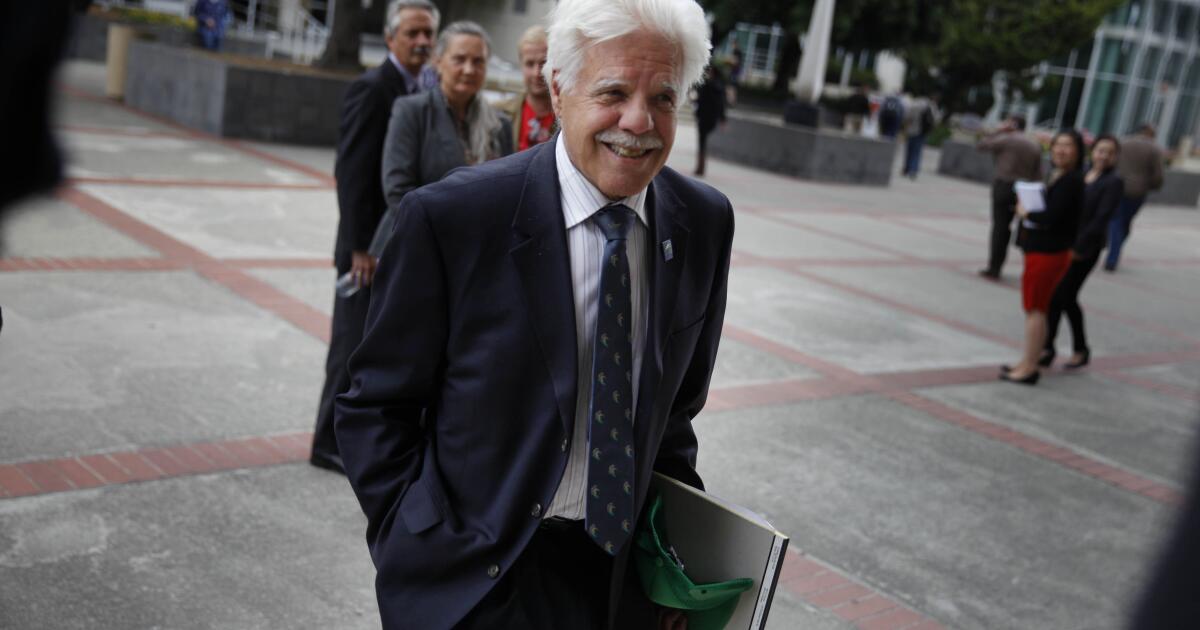
Known by friends and colleagues as a “planetary patriot,” a “happy warrior” and the “Golden State Eco-Warrior,” Rob Caughlan, a political operative, savvy public relations specialist and one of the early leaders of the Surfrider Foundation, died at his home in San Mateo, on Jan. 17. He was 82.
His wife of nearly 62 years, Diana, died four days earlier, from lung cancer.
Environmentalists, political operatives and friends responded to his death with grief but also joy as they recalled his passion, talent and sense of humor — and his drive not only to make the world a better place, but to have fun doing it.
“He’d always say that the real winner in a surfing contest was the guy who had the most fun,” said Lennie Roberts, a conservationist in San Mateo County and longtime friend of Caughlan’s. “He was true to that. It’s the way he lived.”
“When he walked into a room, he’d have a big smile on his face. He was a great — a gifted — people person,” said Dan Young, one of the original five founders of the Surfrider Foundation. The organization was cobbled together in the early 1980s by a group of Southern California surfers who felt called to protect the coastline — and their waves.
They also wanted to dispel the stereotype that surfers are lackadaisical stoners — and show the world that surfers could get organized and fight for just causes, said Roberts, citing Caughlan’s 2020 memoir, “The Surfer in the White House and Other Salty Yarns.”
Before joining Surfrider in 1986, Caughlan was a political operative who worked as an environmental adviser in the Carter administration. According to Warner Chabot, an old friend and recently retired executive director of the an Francisco Estuary Institute, Caughlan got his start during the early 1970s when he and his friend, David Oke, formed the Sam Ervin Fan Club, which supported the Southern senator’s efforts to lead the Watergate investigation of President Nixon.
According to Chabot, Caughlan organized the printing of T-shirts with Ervin’s face on them, underneath the text “I Trust Uncle Sam.”
“He was an early social influencer — par extraordinaire,” he said.
Glenn Hening, a surfer, former Jet Propulsion Laboratory space software engineer and another original founder of the Surfrider Foundation, said one of the group’s initial fights was against the city of Malibu, which in the early 1980s was periodically digging up sand in the lagoon right offshore and destroying the waves at one of their favorite surf spots.
According to Hening, it was Caughlin’s unique ability to persuade and charm politicians and donors that put Surfrider’s efforts on the map.
Caughlan served as the foundation’s president from 1986 to 1992.
The foundation grabbed the national spotlight in 1989 when it went after two large paper mills in Humboldt Bay that were discharging toxic wastewater into an excellent surfspot in Northern California. The foundation took aim and in 1991 filed suit alongside the U.S. Environmental Protection Agency; the paper mills settled for $5.8 million.
Hening said the victory would never have happened without Caughlan.
The mills had tried to brush off the suit by offering a donation to the foundation, Hening said. But Caughlan and Mark Massara — an environmental lawyer with the organization — rebuffed the gesture.
“The paper mill guys said, ‘Well, what can we do here? How can we make this go away?’” said Hening, recalling the conversation. “And Rob said, ‘It’s not going to go away. We’re not going away. We’re surfers.”
Roberts said Caughlan’s legacy can be felt by anyone who has ever spent time on the San Mateo County coastline. In the 1980s, the two spearheaded a successful ballot measure still protects the coast from non-agricultural development and ensured access to the beaches and bluffs. It also prohibits onshore oil facilities for off-shore facilities.
The two also worked on a county measure that led to the development of the Devil’s Slide tunnels on Highway 1 between Pacifica and Montara, designed to make that formerly treacherous path safer for travelers.
The state had wanted to build a six-lane highway over the steep hills in the area. “It would have been dangerous because of the steep slopes, and it would be going up into the fog bank and then back down out of the fog. So it was inherently dangerous,” Roberts said.
Chad Nelsen, the current president of the Surfrider Foundation, said he was first drawn into Caughlan’s orbit in 2010 when Surfrider got involved with a lawsuit pertaining to a beach in San Mateo County. Silicon Valley venture capitalist Vinod Khosla purchased 53 acres of Northern California coastline for $32.5 million and closed off access to the public — including a popular stretch known as Martin’s Beach — so Surfrider sued.
Nelsen said that although Caughlan had left the organization about 20 years before, he reappeared with a “sort of unbridled enthusiasm and commitment to the cause,” and the organization ultimately prevailed — the public can once again access the beach “thanks to ‘Birdlegs.’”
Birdlegs was Caughlan’s nickname, and according to Nelsen, it was probably coined in the 1970s by his fellow surfers.
“He had notoriously spindly legs, I guess,” Nelsen said.
Robert Willis Caughlan was born in Alliance, Ohio, on Feb. 27, 1943. His father, who was a parachute instructor with the U.S. Army, died when Caughlan was 4. In 1950, Caughlan moved with his mother and younger brother to San Mateo, where he saw the ocean for the first time.
He rode his his first wave in 1959, at the age of 16, from the breakwater at Half Moon Bay.
Science
LAUSD says Pali High is safe for students to return to after fire. Some parents and experts have concerns

The Los Angeles Unified School District released a litany of test results for the fire-damaged Palisades Charter High School ahead of the planned return of students next week, showing the district’s remediation efforts have removed much of the post-fire contamination.
However, some parents remain concerned with a perceived rush to repopulate the campus. And while experts commended the efforts as one of the most comprehensive post-fire school remediations in modern history, they warned the district failed to test for a key family of air contaminants that can increase cancer risk and cause illness.
“I think they jumped the gun,” said a parent of one Pali High sophomore, who asked not to be named because she feared backlash for her child. “I’m quite angry, and I’m very scared. My kid wants to go back. … I don’t want to give him too much information because he has a lot of anxiety around all of these changes.”
Nevertheless, she still plans to send her child back to school on Tuesday, because she doesn’t want to create yet another disruption to the student’s life. “These are kids that also lived through COVID,” she said.
The 2025 Palisades fire destroyed multiple buildings on Pali High’s campus and deposited soot and ash in others. Following the fire, the school operated virtually for several months and, in mid-April of 2025, moved into a former Sears department store in Santa Monica.
Meanwhile, on campus, the U.S. Environmental Protection Agency and the U.S. Army Corps of Engineers cleared debris from the destroyed structures, and LAUSD hired certified environmental remediation and testing companies to restore the still-standing buildings to a safe condition.
LAUSD serves as the charter school’s landlord and took on post-fire remediation and testing for the school. The decision to move back to the campus was ultimately up to the charter school’s independent leadership.
The Los Angeles Department of Water and Power tested the drinking water for a slew of contaminants, and environmental consultants tested the soil, HVAC systems, indoor air and surfaces including floors, desks and lockers.
They tested for asbestos, toxic metals such as lead and potentially hazardous organic compounds often unleashed through combustion, called volatile organic compounds, or VOCs.
“The school is ready to occupy,” said Carlos Torres, director of LAUSD’s office of environmental health and safety. “This is really the most thorough testing that’s ever been done that I can recall — definitely after a fire.”
Construction workers rebuild the Palisades Charter High School swimming pool.
(Allen J. Schaben / Los Angeles Times)
A handful of soil samples had metal concentrations slightly above typical post-fire cleanup standards, which are designed to protect at-risk individuals over many years of direct exposure to the soil — such as through yard work or playing sports. An analysis by the environmental consultants found the metals did not pose a health risk to students or staff.
On indoor surfaces, the consultants found two areas with lead and one with arsenic, spaces they recleaned and retested to make sure those metals were no longer present.
The testing for contamination in the air, however, has become a matter of debate.
Some experts cautioned that LAUSD’s consultants tested the air for only a handful of mostly non-hazardous VOCs that are typically used to detect smoke from a wildfire that primarily burned plants. While those tests found no contamination, the consultants did not test for a more comprehensive panel of VOCs, including many hazardous contaminants commonly found in the smoke of urban fires that consume homes, cars, paints, detergents and plastics.
The most notorious of the group is benzene, a known carcinogen.
At a Wednesday webinar for parents and students, LAUSD’s consultants defended the decision, arguing their goal was only to determine whether smoke lingered in the air after remediation, not to complete more open-ended testing of hazardous chemicals that may or may not have come from the fire.
Andrew Whelton, a Purdue University professor who researches environmental disasters, didn’t find the explanation sufficient.
“Benzene is known to be released from fire. It is known to be present in air. It is known to be released from ceilings and furniture and other things over time, after the fire is out,” Whelton said. “So, I do not understand why testing for benzene and some of the other fire-related chemicals was not done.”
For Whelton, it’s representative of a larger problem in the burn areas: With no decisive guidance on how to remediate indoor spaces after wildland-urban fires, different consultants are making significantly different decisions about what to test for.
LAUSD released the testing results and remediation reports in lengthy PDFs less than two weeks before students plan to return to campus, while the charter school’s leadership decided on a Jan. 27 return date before testing was completed.
At the webinar, school officials said two buildings near the outdoor pool have not yet been cleared through environmental testing and will remain closed. Four water fixtures are also awaiting final clearance from the Los Angeles Department of Water and Power, and the school’s food services are still awaiting certification from the L.A. County Department of Public Health.
For some parents — even those who are eager to ditch the department store campus — it amounts to a flurried rush to repopulate Pali High’s campus that is straining their decisions about how to keep their kids safe.
Torres stressed that his team acted cautiously in the decision to authorize the school for occupancy, and that promising preliminary testing helped school administrators plan ahead. He also noted that the slow, cautious approach was a point of contention for other parents who hoped their students could return to the campus as quickly as possible.
Experts largely praised LAUSD’s efforts as thorough and comprehensive — with the exception of the VOC air testing.
Remediation personnel power washed the exterior of buildings, wiped down all surfaces and completed thorough vacuuming with filters to remove dangerous substances. Any soft objects such as carpet or clothing that could absorb and hold onto contamination were discarded. The school’s labyrinth of ducts and pipes making up the HVAC system was also thoroughly cleaned.
Crews tested throughout the process to confirm their remediation work was successful and isolated sections of buildings once the work was complete. They then completed another full round of testing to ensure isolated areas were not recontaminated by other work.
Environmental consultants even determined a few smaller buildings could not be effectively decontaminated and consequently had them demolished.
Torres said LAUSD plans to conduct periodic testing to monitor air in the school, and that the district is open to parents’ suggestions.
For Whelton, the good news is that the school could easily complete comprehensive VOC testing within a week, if it wanted to.
“They are very close at giving the school a clean bill of health,” he said. “Going back and conducting this thorough VOC testing … would be the last action that they would need to take to determine whether or not health risks remain for the students, faculty and visitors.”

Chicago Mayor Brandon Johnson heads to D.C., set to talk about responding to immigration raids

Anti-ICE demonstrators gather downtown during snow squall

Texas Republicans are using anti-Muslim rhetoric in their campaigns

Who starts at Alabama, Tennessee? Monitoring the most notable post-portal QB battles

‘Extremely dangerous’ conditions on Glenn Highway due to snowfall, APD says

Florida High School Football Rankings: Top 25 teams – Oct. 21

Cleary's 21 help Le Moyne down Central Connecticut State 69-64 in OT

How old is Bo Nix? What to know about Oregon quarterback ahead of 2024 NFL Draft

99th annual Pony Swim held in Virginia

Indiana Members Credit Union announced as new anchor tenant at Bottleworks District

Graham pushes back on Tillis’ criticism of Noem, Miller for labeling man killed by Border Patrol a ‘terrorist’

North Korea’s Kim to outline plans to boost nuclear arsenal

Rep. Ilhan Omar rushed by man on stage and sprayed with liquid at town hall event

Video: F.A.A. Ignored Safety Concerns Prior to Collision Over Potomac, N.T.S.B. Says

Democrats demand Kristi Noem be fired or warn impeachment will follow
-

 Illinois6 days ago
Illinois school closings tomorrow: How to check if your school is closed due to extreme cold
-

 Sports1 week ago
Miami’s Carson Beck turns heads with stunning admission about attending classes as college athlete
-

 Pittsburg, PA1 week ago
Sean McDermott Should Be Steelers Next Head Coach
-

 Lifestyle1 week ago
Nick Fuentes & Andrew Tate Party to Kanye’s Banned ‘Heil Hitler’
-

 Pennsylvania2 days ago
Rare ‘avalanche’ blocks Pennsylvania road during major snowstorm
-

 Sports1 week ago
Miami star throws punch at Indiana player after national championship loss
-

 Cleveland, OH1 week ago
Northeast Ohio cities dealing with rock salt shortage during peak of winter season
-

 Technology6 days ago
Ring claims it’s not giving ICE access to its cameras