Science
Incurable silicosis cost a countertop cutter his lungs. Are these companies at fault?


From morning to evening, six days a week, Gustavo Reyes Gonzalez spent his days cutting engineered stone, a man-made product that has become a popular choice for kitchen and bathroom countertops.
The glossy slabs resist stains, are highly durable and come in many colors. They are also rife with crystalline silica: tiny particles that can irreparably scar the lungs when inhaled.
By the time Reyes Gonzalez had reached his 33rd birthday, his lungs had been ravaged by silicosis, an incurable disease. He was forced to rely on an oxygen tank and grew thin and weak. At one point, he said, he asked God to take his life so that his suffering would end.
His doctor says the 34-year-old is only alive today because both his lungs were replaced in a transplant — and that painstaking surgery may only buy him another six years.
“We don’t know how long he has with that lung,” his wife Wendy Torres Hernandez said in a Los Angeles courtroom. In the wake of his transplant, he must take a barrage of medications, restrict his diet and keep a close eye on his blood pressure and sugar levels.
All of those measures, she said, are “going to continue until he passes away.”
In Los Angeles County, a jury will weigh a question that could reverberate through the stone industry: Are corporations that manufacture or distribute engineered stone at fault?
Health researchers have tied the surge in silicosis cases among countertop cutters to the booming popularity of engineered or artificial stone, which is typically much higher in silica than natural marble or granite. In California, dozens of workers with silicosis have lodged lawsuits against companies like Cambria and Caesarstone.
Reyes Gonzalez is the first of them to go to trial, according to his attorneys. The L.A. County civil case poses a test of whether companies that make engineered stone could be held responsible amid the devastating eruption of silicosis, which has killed more than a dozen countertop cutters across California in recent years.
Dr. Robert Harrison, a professor of occupational medicine at UC San Francisco who has done research on silicosis among countertop cutters, said a decision for the plaintiff would “send a message to manufacturers that they are accountable for producing a toxic product like engineered stone.”
Regardless of the outcome, Harrison said the court case “shines a spotlight on the workers behind the products that we buy.” That could bolster public awareness that “there are workers who make our products who get sick and die,” he said — and hopefully inspire new efforts to stop it.
Marissa Bankert, executive director of the International Surface Fabricators Assn., which represents businesses that cut slabs, said that “irrespective of the outcome of this case, it is essential that all companies engaged in surface fabrication and their employees are educated on, and adhere to, safety practices.”
In a trial that has stretched for weeks, lawyers for Reyes Gonzalez have argued that engineered stone manufacturers failed to give proper warnings about the dangers of their product. Attorney Gilbert Purcell called it “terribly toxic and dangerous” and “defective in design,” arguing that its risks far outweigh its benefits.
The question is, “why not eliminate this product altogether? Society doesn’t need this product,” Purcell told jurors. “It certainly doesn’t need the carnage it causes.”
Attorneys for engineered stone manufacturers countered that the blame lay with the operators of the Orange County workshops where Reyes Gonzalez worked. Such “fabrication shops” cut the slabs made by manufacturers.
“We know that this product is safe,” Cambria‘s attorney, Lindsay Weiss, said, “when handled safely.”
Reyes Gonzalez testified that he worked in a string of Orange County shops cutting slabs of engineered stone. At times, he said, the air was so dusty that it looked like fog. His mask grew “very filthy,” he testified. Even when he used water while cutting, Reyes Gonzalez said that after it dried, “a lot of dust would come off.”
Caesarstone argued in court that the company had given the shops all the information they needed to protect workers, including guidance on ventilation and wet cutting to tamp down dust. Its attorney, Peter Strotz, said what happened to the worker was a tragedy, but a preventable one.
It could have been prevented if those “who owned and operated the fabrication shop where he worked had done what Caesarstone asked them to do,” Strotz argued.
He and other attorneys representing engineered stone manufacturers sought to turn the focus to members of the Silverio family, who had paid Reyes Gonzalez for his work at the Orange County shops.
Lawyers for the worker argued the Silverios were not his employers and that Reyes Gonzalez was an independent contractor. Fernando Silverio Soto, who set up Silverio Stone Works, testified that all he knew about the dangers was what he was told: To minimize risk by wearing masks and using water while cutting.
Strotz showed the courtroom a Caesarstone form that Silverio had signed, which stated he had received safety information and an instructional movie. In court, Silverio denied having seen such materials.
Jon Grzeskowiak, Cambria’s executive vice president of research and development and process operations, said the company offers free training to stonecutters and that safety information for its products was available on its website. Fernando Silverio Soto said during his testimony that he hadn’t seen that website, nor had he gone to the Caesarstone website for such information.
“I was never told that I needed to do that,” he said of the Caesarstone website.
Defense attorneys also brought forward expert witnesses who testified that engineered stone could be cut and polished safely with the effective use of workplace safeguards. Attorneys for Reyes Gonzalez, in turn, turned to experts who disputed that measures such as masks or using water while cutting were adequate.
Among them was industrial hygienist Stephen Petty, who testified that an N95 mask was insufficient to protect a worker from the dust generated by grinding artificial stone.
Petty said even the best kind of respirator available, which supplies a worker with clean air from a tank, would not work well in the long term because it is so uncomfortable that workers tend to adjust it, breaking the seal.
Harrison of UCSF, who did not testify in the case, said it is very difficult to protect workers cutting engineered stone. “It takes a lot of money and a pretty sophisticated, knowledgeable employer with a lot of expensive machines and ventilation systems to protect workers from exposure to artificial stone dust.”
Safety regulators across the globe have grappled with the risks of engineered stone as its popularity has soared. In Australia, the government ultimately banned the artificial slabs amid a public uproar over stonecutters falling ill and dying. Workplace safety regulators there called it “the only way to ensure that another generation of Australian workers do not contract silicosis from such work.”
In California, government regulators have stopped short of a ban, instead enacting tighter rules on silica exposure in the workplace. Another proposal that would have clamped down on which businesses could perform stonecutting was held this summer by its author, Assemblymember Luz Rivas (D-North Hollywood), who said state regulators were “not receptive” to creating a tracking system for licensed shops.
Cal/OSHA officials have warned in the past that if tightening the rules does not show results, they could press forward with a ban on engineered stone. In a recent report, however, the agency said it had so far rejected the idea because a ban could fuel “the creation of illegal fabrication shops that are hidden from regulators.”



Sharon Horton stepped through the door of a sky-blue mobile clinic and onto a Skid Row sidewalk. She wore a yellow knit beanie, gold hoop earrings and the relieved grin of a woman who has finally checked a mammogram off her to-do list.
It had been years since her last breast cancer screening procedure. This one, which took place in City of Hope’s Cancer Prevention and Screening mobile clinic, was faster and easier. The staff was kind. The machine that X-rayed her breast was more comfortable than the cold hard contraption she remembered.
Relatively speaking, of course — it was still a mammogram.
“It’s like, OK, let me go already!” Horton, 68, said with a laugh.
The clinic was parked on South San Pedro Street in front of Union Rescue Mission, the nonprofit shelter where Horton resides. Within a week, City of Hope, a cancer research hospital, would share the results with Horton and Dr. Mary Marfisee, the mission’s family medical services director. If the mammogram detected anything of concern, they’d map out a treatment plan from there.
Naureen Sayani, 47, a resident of Union Rescue Mission, left, discusses her medical history with Adriana Galindo, a medical assistant, before getting a mammogram on last week.
(Kayla Bartkowski / Los Angeles Times)
“It’s very important to take care of your health, and you need to get involved in everything that you can to make your life a better life,” said Horton, who is looking forward to a forthcoming move into Section 8 housing.
Horton was one of the first patients of a new women’s health initiative from UCLA’s Homeless Healthcare Collaborative at Union Rescue Mission. Staffed by third-year UCLA Medical School students and led by Marfisee, a UCLA assistant clinical professor of family medicine, the clinic treats mission residents as well as unhoused people living in the surrounding neighborhood.
The new cancer screening project arrives at a time of dire financial pressures on county public health services.
Citing rising costs and a $50-million reduction in federal, state and local grant and contract income, the Los Angeles County Department of Public Health on Feb. 27 ended services at seven of 13 public clinics that provide vaccines, tests and treatment for sexually transmitted diseases and other services to housed and unhoused county residents.
Although Union Rescue Mission’s own funding comes mainly from private sources and is less imperiled by public cuts, the 135-year-old shelter expects the need for its services to rise, Chief Executive Mark Hood said.
Even as unsheltered homelessness declined for the last two years across Los Angeles County, the unsheltered population on Skid Row — long seen as the epicenter of the region’s homelessness crisis — grew 9% in 2024, the most recent year for which census data are available.
For many local women navigating daily concerns over housing, food and personal safety, “their own health is not a priority,” Marfisee said.
Those whose problems have become too serious to ignore face daunting obstacles to care. Marfisee recalled one patient who came to her with a lump in her breast and no identification.
In order to get a mammogram, Marfisee explained, the woman first needed to obtain a birth certificate, and then a state-issued identification card. Then she needed to enroll in Medi-Cal. After that, clinic staff helped her find a primary care physician who could order the imaging test.
Given the barriers to preventative care, homeless women die from breast cancer at nearly twice the rate of securely housed women, a 2019 study found. Marfisee’s own survey of the mission’s female residents found that nearly 90% were not up to date on recommended cancer screenings like mammograms and pap smears, which detect early cervical cancer.
To address this gap, Marfisee — a dogged patient advocate — reached out to City of Hope. The Duarte-based research and treatment center unveiled in March 2024 its first mobile cancer screening clinic, a moving van-sized clinic on wheels that it deploys to food banks and health centers, as well as to companies offering free mammograms as an employee benefit.
“In true Dr. Mary fashion, she saw the vision,” said Jessica Thies, the mobile screening program’s regional nursing director. After working through some logistical hurdles, the mission and City of Hope secured a date for the van’s first visit.
The next challenge was getting the word out to patients. Marfisee and her students walked through the surrounding neighborhood, went cot to cot in the women’s dorm and held two informational sessions in December and January to answer patients’ questions.
At the sessions, the team walked through the basics of who should get a mammogram (women age 40 or older, those with a family history of breast cancer) and the procedure itself. (“Like a tortilla maker?” one woman asked skeptically after hearing a description of the mammography unit.)
The medical students were able to dispel rumors some women had heard: The test doesn’t damage breast tissue, nor do the X-rays increase cancer risk. Others questioned a mammogram’s value: What good was it knowing they had cancer if they couldn’t get follow-up care?
On this latter point, Marfisee is determined not to let patients fall through the cracks.
Thirteen patients received mammograms at the van’s first visit on Wednesday. Within a week, City of Hope will contact patients with their results and send them to Marfisee and her team. She is already mentally mapping the next steps should any patient have a situation that requires a biopsy or further imaging: working with their case manager at the mission, calling in favors, wrangling with any insurance the patient might have.
“It’ll be a good fight,” Marfisee said, as residents in the adjacent cafeteria carried trays of sloppy joes and burgers to their lunch tables. “But we’ll just keep asking for help and get it done.”

At first glance, it looks like nothing more than a charming Spanish-revival, quintessentially Californian home — but this Pacific Palisades rebuild is constructed like a tank.
Every exterior wall of the steel-framed home is a foot-thick, fire-resistant barricade. The home is connected to a satellite fire monitoring service. Should a fire start in town, sturdy metal shutters descend to cover every window. An exterior sprinkler system can pump 40,000 gallons of water from giant tanks hidden behind the shrubs in the property’s yard. If the cameras and heat sensors around the house detect danger, the system can envelop the home in over 1,000 gallons of fire retardant and hundreds of gallons of fire-suppressing foam.
Palisades resident and architect Ardie Tavangarian is so confident in his design that he even asked the fire department if they could start a controlled fire on the property to test it all out. (They said no.)
Tavangarian built a career designing multimillion-dollar luxury homes in Los Angeles, but after the Palisades fire destroyed 13 of his works — including his family’s home — he found another calling: how to design a house that can handle what the Santa Monica Mountains throw at it. And how to do it quickly and affordably.
Water tanks form part of a backup water supply in a newly built fire-resistant home in Pacific Palisades.
“Nature is so powerful,” he said, sitting on a couch in the new house, which he built for his adult twin daughters. “We are guests living in that environment and expecting, ‘Oh, nature is going to be really kind to me.’ No, it’s not. It does what it’s supposed to do.”
Tavangarian watched the Jan. 1 Lachman fire from his property not far from here; a week later that fire rekindled, grew into the Palisades fire, and burned through his house. But the painful details of the fire — the missteps of the fire department, the empty reservoir — didn’t matter when it came to deciding how to rebuild, he said. The reality is, many fires have burned in these mountains. Many more will.

A sprinkler on the roof is part of a house-wide sprinkler system.
For the architect, who has spent much of his 45-year career designing for luxury, hardening a home against wildfire has brought a new kind of luxury to his homes: peace of mind.
It’s a sentiment that resonates with fire survivors: Tavangarian says he’s received considerable interest from other property owners in the Palisades looking to rebuild their houses.
The metal shutters and advanced outdoor sprinkler system are the flashiest parts of Tavangarian’s home hardening project, and the efficacy of these adaptations is still up for debate. Because the measures have not yet been widely adopted, there are few studies exploring how much or little they protect homes in real-world fires.

Architect Ardie Tavangarian inside the house he designed.
Anecdotal evidence has indicated the effectiveness of sprinklers can vary significantly based on the setup and the conditions during the fire. Extreme wind, for example, can make them less effective. Lab studies have generally found shutters can reduce the risk of windows shattering.
These measures aren’t cheap, either. Sprinkler systems can cost north of $100,000, for example. However, Tavangarian said when all was said and done, the home he built for his daughters cost around $700 per square foot — less than what Palisades residents said they expected to pay, but more than what Altadena residents expected for their rebuilds.
Tavangarian also hopes to see insurers increasingly consider the home-hardening measures property owners take when writing policies, which he said could potentially offset the extra cost in a decade or less. As he explored getting insurance for the new home, one insurer quoted him $80,000 a year. After he convinced the company to visit the property, it lowered the quote to just $13,000, he said.

The house includes metal heat shields that can drop down if a fire approaches.
The home also has essentially all of the other less flashy — but much cheaper and well-proven — home hardening measures recommended by fire professionals: The underside of the roof’s overhang is closed off — a common place embers enter a home. The roof, where burning embers can accumulate, is made of fire-resistant material. The windows, vulnerable to shattering in extreme heat, are made of a toughened glass. There is virtually no vegetation within the first five feet of the home.
When asked if he felt he had compromised on design, comfort or aesthetics for the extra protection — one of the many concerns Californians have with the state’s draft “Zone Zero” requirements that may significantly limit vegetation within five feet of a home — Tavangarian simply said, “You be the judge.”
Science
Commentary: My toothache led to a painful discovery: The dental care system is full of cavities as you age
I had a nagging toothache recently, and it led to an even more painful revelation.
If you X-rayed the state of oral health care in the United States, particularly for people 65 and older, the picture would be full of cavities.
“It’s probably worse than you can even imagine,” said Elizabeth Mertz, a UC San Francisco professor and Healthforce Center researcher who studies barriers to dental care for seniors.
Mertz once referred to the snaggletoothed, gap-filled oral health care system — which isn’t really a system at all — as “a mess.”
But let me get back to my toothache, while I reach for some painkiller. It had been bothering me for a couple of weeks, so I went to see my dentist, hoping for the best and preparing for the worst, having had two extractions in less than two years.
Let’s make it a trifecta.
My dentist said a molar needed to be yanked because of a cellular breakdown called resorption, and a periodontist in his office recommended a bone graft and probably an implant. The whole process would take several months and cost roughly the price of a swell vacation.
I’m lucky to have a great dentist and dental coverage through my employer, but as anyone with a private plan knows, dental insurance can barely be called insurance. It’s fine for cleanings and basic preventive routines. But for more complicated and expensive procedures — which multiply as you age — you can be on the hook for half the cost, if you’re covered at all, with annual payout caps in the $1,500 range.
“The No. 1 reason for delayed dental care,” said Mertz, “is out-of-pocket costs.”
So I wondered if cost-wise, it would be better to dump my medical and dental coverage and switch to a Medicare plan that costs extra — Medicare Advantage — but includes dental care options. Almost in unison, my two dentists advised against that because Medicare supplemental plans can be so limited.
Sorting it all out can be confusing and time-consuming, and nobody warns you in advance that aging itself is a job, the benefits are lousy, and the specialty care you’ll need most — dental, vision, hearing and long-term care — are not covered in the basic package. It’s as if Medicare was designed by pranksters, and we’re paying the price now as the percentage of the 65-and-up population explodes.
So what are people supposed to do as they get older and their teeth get looser?
A retired friend told me that she and her husband don’t have dental insurance because it costs too much and covers too little, and it turns out they’re not alone. By some estimates, half of U.S. residents 65 and older have no dental insurance.
That’s actually not a bad option, said Mertz, given the cost of insurance premiums and co-pays, along with the caps. And even if you’ve got insurance, a lot of dentists don’t accept it because the reimbursements have stagnated as their costs have spiked.
But without insurance, a lot of people simply don’t go to the dentist until they have to, and that can be dangerous.
“Dental problems are very clearly associated with diabetes,” as well as heart problems and other health issues, said Paul Glassman, associate dean of the California Northstate University dentistry school.
There is one other option, and Mertz referred to it as dental tourism, saying that Mexico and Costa Rica are popular destinations for U.S. residents.
“You can get a week’s vacation and dental work and still come out ahead of what you’d be paying in the U.S.,” she said.
Tijuana dentist Dr. Oscar Ceballos told me that roughly 80% of his patients are from north of the border, and come from as far away as Florida, Wisconsin and Alaska. He has patients in their 80s and 90s who have been returning for years because in the U.S. their insurance was expensive, the coverage was limited and out-of-pocket expenses were unaffordable.
“For example, a dental implant in California is around $3,000-$5,000,” Ceballos said. At his office, depending on the specifics, the same service “is like $1,500 to $2,500.” The cost is lower because personnel, office rent and other overhead costs are cheaper than in the U.S., Ceballos said.
As we spoke by phone, Ceballos peeked into his waiting room and said three patients were from the U.S. He handed his cellphone to one of them, San Diegan John Lane, who said he’s been going south of the border for nine years.
“The primary reason is the quality of the care,” said Lane, who told me he refers to himself as 39, “with almost 40 years of additional” time on the clock.
Ceballos is “conscientious and he has facilities that are as clean and sterile and as medically up to date as anything you’d find in the U.S.,” said Lane, who had driven his wife down from San Diego for a new crown.
“The cost is 50% less than what it would be in the U.S.,” said Lane, and sometimes the savings is even greater than that.
Come this summer, Lane may be seeing even more Californians in Ceballos’ waiting room.
“Proposed funding cuts to the Medi-Cal Dental program would have devastating impacts on our state’s most vulnerable residents,” said dentist Robert Hanlon, president of the California Dental Assn.
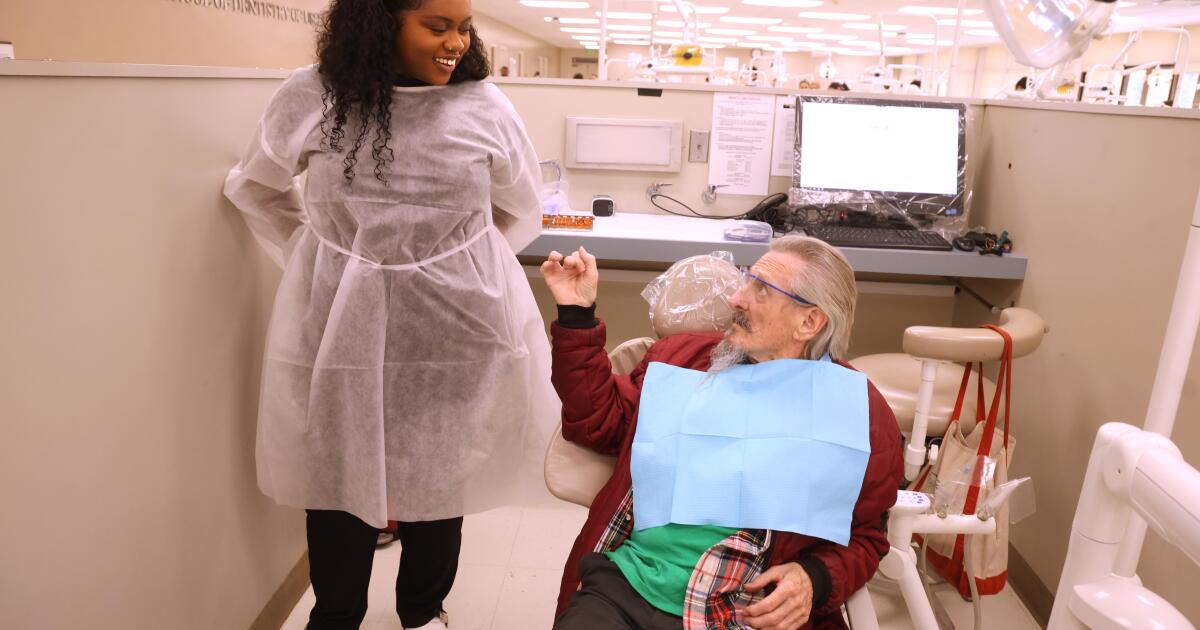
Dental student Somkene Okwuego smiles after completing her work on patient Jimmy Stewart, 83, who receives affordable dental work at the Ostrow School of Dentistry of USC on the USC campus in Los Angeles on February 26, 2026.
(Genaro Molina / Los Angeles Times)
Under Proposition 56’s tobacco tax in 2016, supplemental reimbursements to dentists have been in place, but those increases could be wiped out under a budget-cutting proposal. Only about 40% of the state’s dentists accept Medi-Cal payments as it is, and Hanlon told me a CDA survey indicates that half would stop accepting Medi-Cal patients and many others will accept fewer patients.
“It’s appalling that when the cost of providing healthcare is at an all-time high, the state is considering cutting program funding back to 1990s levels,” Hanlon said. “These cuts … will force patients to forgo or delay basic dental care, driving completely preventable emergencies into already overcrowded emergency departments.”
Somkene Okwuego, who as a child in South L.A. was occasionally a patient at USC’s Herman Ostrow School of Dentistry clinic, will graduate from the school in just a few months.
I first wrote about Okwuego three years ago, after she got an undergrad degree in gerontology, and she told me a few days ago that many of her dental patients are elderly and have Medi-Cal or no insurance at all. She has also worked at a Skid Row dental clinic, and plans after graduation to work at a clinic where dental care is free or discounted.
Okwuego said “fixing the smiles” of her patients is a privilege and boosts their self-image, which can help “when they’re trying to get jobs.” When I dropped by to see her Thursday, she was with 83-year-old patient Jimmy Stewart.
Stewart, an Army veteran, told me he had trouble getting dental care at the VA and had gone years without seeing a dentist before a friend recommended the Ostrow clinic. He said he’s had extractions and top-quality restorative care at USC, with the work covered by his Medi-Cal insurance.
I told Stewart there could be some Medi-Cal cuts in the works this summer.
“I’d be screwed,” he said.
Him and a lot of other people.
steve.lopez@latimes.com

For filmmaker Chloé Zhao, creative life was never linear

Apple’s website leaks MacBook ‘Neo,’ which could be its new cheaper laptop

Ambassador Huckabee describes ‘best option’ for Americans looking to flee Israel

Fraud-plagued Minnesota sues Trump admin for withholding $243M in Medicaid payments

Seniors over 80 who eat specific diet may be less likely to reach 100 years old

Florida High School Football Rankings: Top 25 teams – Oct. 21

Cleary's 21 help Le Moyne down Central Connecticut State 69-64 in OT

How old is Bo Nix? What to know about Oregon quarterback ahead of 2024 NFL Draft

99th annual Pony Swim held in Virginia

Indiana Members Credit Union announced as new anchor tenant at Bottleworks District
Fraud-plagued Minnesota sues Trump admin for withholding $243M in Medicaid payments

Is Iran expanding attacks to target energy and civilian sites in the Gulf?

Trump claims US stockpiles mean wars can be fought ‘forever’; Kristi Noem testifies before Congress – US politics live

War in the Middle East: Iran’s broad retaliation in the Gulf • FRANCE 24 English

Trump sends official notification to Congress on strikes against Iran
-

 World6 days ago
Exclusive: DeepSeek withholds latest AI model from US chipmakers including Nvidia, sources say
-

 Massachusetts6 days ago
Mother and daughter injured in Taunton house explosion
-

 Denver, CO6 days ago
10 acres charred, 5 injured in Thornton grass fire, evacuation orders lifted
-

 Louisiana1 week ago
Wildfire near Gum Swamp Road in Livingston Parish now under control; more than 200 acres burned
-

 Oregon4 days ago
2026 OSAA Oregon Wrestling State Championship Results And Brackets – FloWrestling
-

 Florida2 days ago
Florida man rescued after being stuck in shoulder-deep mud for days
-

 Technology1 week ago
Arturia’s FX Collection 6 adds two new effects and a $99 intro version
-

 News1 week ago
Video: How Lunar New Year Traditions Take Root Across America