Connect with us

News

Microsoft and Alphabet enjoy AI-powered gains from cloud divisions

Published

on

Microsoft and Alphabet enjoy AI-powered gains from cloud divisions

Microsoft and Google’s owner Alphabet have quashed investor scepticism around the vast sums spent on developing artificial intelligence, after being boosted by rampant corporate demand for their cloud computing services.

The combined market value of the two US tech giants rose by more than $250bn on Friday, a day after each reported double-digit revenue growth in their first-quarter results to comfortably beat analysts’ expectations. Shares in Amazon and Nvidia, two other beneficiaries of AI spending, also rose by around 3 and 6 per cent respectively.

This week’s earnings reports from Microsoft and Alphabet have soothed market anxiety about the huge jumps in spending on the infrastructure needed to power AI chatbots such as OpenAI’s ChatGPT and Google’s Gemini, as well as several other companies experimenting new AI models.

Meanwhile, advertising revenue at Google also rose, suggesting that AI-powered chatbots are yet to hit usage of the world’s dominant search engine. Jim Tierney, head of US growth at AllianceBernstein, said that Alphabet’s first-quarter results reported on Thursday “didn’t lay the questions [about AI] to rest. But there was so much good stuff elsewhere, it buys them more time”.

Analysts at Baird estimate that capital expenditures by Alphabet, Amazon, Microsoft and Meta this year will total about $188bn, almost 40 per cent more than in 2023. Electric-car maker Tesla said it had invested $1bn in AI in the first quarter and would accelerate spending on chips and automated driving.

Advertisement

The bullish outlook from members of the “Magnificent Seven” US tech bellwethers could reignite the AI-fuelled rally that accounted for most of the gains on US stock markets in 2023. This had faltered at the start of the year as pessimism spread about runaway tech spending and broader concerns about interest rates and conflict in the Middle East.

Alphabet shares jumped 10 per cent on Friday, a rise helped by the company paying the first dividend in its history and boosting its market capitalisation past the $2tn threshold. Microsoft, the world’s most valuable company and OpenAI’s biggest backer, rose almost 2 per cent to climb back above $3tn.

Those gains stand in contrast to Meta’s 11 per cent drop on Thursday after the Facebook parent said it would “invest aggressively” in new AI products such as chatbots, despite generating only limited returns from them so far. Meta’s finance chief Susan Li said capital expenditure would rise to $40bn this year and go even further in 2025, projections that overshadowed a 91 per cent increase in first-quarter net income.

But for those building cloud infrastructure, investors took even bolder AI spending plans in their stride. Google chief financial officer Ruth Porat said capital expenditure would jump 50 per cent or more to at least $48bn this year.

“After what seemed like a year-plus of coming from behind [on AI], we believe Google is beginning to go on the offensive,” said analysts at JPMorgan. 

Advertisement

Microsoft finance chief Amy Hood unveiled a 79 per cent year-on-year leap in quarterly capital expenditure to $14bn, before adding that even more funding for data centres was required because “AI demand is a bit higher than our available capacity”.

The OpenAI website ChatGPT about page
Demand has soared for AI services such as ChatGPT, a chatbot developed by OpenAI © Bloomberg

Such is the rapid growth in demand for AI services from start-ups such as OpenAI and Anthropic, as well as from large corporate customers, that many necessary components including chips and power supplies have become scarce.

“If you’re not engaging AI actively and aggressively you’re doing it wrong,” Nvidia chief Jensen Huang said at an event organised by payments company Stripe on Wednesday.

“Your company is not going to go out of business because of AI,” he said. “It’s going to go out of business because another company used AI. There’s no question about that.”

The first-quarter performance eases pressure on Alphabet chief Sundar Pichai, who has faced criticism for letting Google lose the initiative to Microsoft in consumer and enterprise AI products after the latter’s $13bn partnership with OpenAI.

Google had to pull image generation in its own flagship AI system, Gemini, following a furore over its inaccurate historical depiction of different ethnicities and genders.

Advertisement

“Google has faced near-constant critique around the inevitable AI-led disruption to search, a string of PR mis-steps that questioned whether Google was too far behind in AI or too ‘woke’ to make it,” said Bernstein analyst Mark Shmulik. “Google needed to be perfect, or face a repeat of being penalised for micro-misses.”

Revenue at Google’s core search-linked advertising business also rose 13 per cent. But longer-term, Pichai still faces questions on whether chatbots that provide instant answers will start to eat away at usage of its ubiquitous search engine.

He told analysts that early experiments of using generative AI to give more comprehensive answers to search queries “improves user satisfaction”. He added: “I’m comfortable and confident that we’ll be able to manage the monetisation transition here well.”

Other companies are joining the spending spree on AI. Both Apple and Amazon, which report first-quarter earnings next week, have said they will also invest heavily in computing power and staff to improve their products.

However, Microsoft’s Azure offering “is the only software business that is benefiting from AI at this point in the cycle”, said Brad Sills, research analyst at Bank of America. “Microsoft remains ahead of the curve in this massive new cycle.”

Advertisement

Additional reporting by George Steer in New York, George Hammond in San Francisco and Philip Stafford in London


News

Video: First Batch of Epstein Files Provides Few Revelations

Published

on

Video: First Batch of Epstein Files Provides Few Revelations

new video loaded: First Batch of Epstein Files Provides Few Revelations

transcript

transcript

First Batch of Epstein Files Provides Few Revelations

The Justice Department, under pressure from Congress to comply with a law signed by President Trump, released more than 13,000 files on Friday arising from investigations into Jeffrey Epstein.

Put out the files and stop redacting names that don’t need to be redacted. It’s just — who are we trying to protect? Are we protecting the survivors? Or are we protecting these elite men that need to be put out there?

Advertisement
The Justice Department, under pressure from Congress to comply with a law signed by President Trump, released more than 13,000 files on Friday arising from investigations into Jeffrey Epstein.

By McKinnon de Kuyper

December 20, 2025

Continue Reading

News

Apple, Google tell workers on visas to avoid leaving the U.S. amid Trump immigration crackdown

Published

on

Apple, Google tell workers on visas to avoid leaving the U.S. amid Trump immigration crackdown

With reported months-long consulate and embassy delays, Google and Apple say employees on H-1B visas should stay put in the U.S. right now to avoid the risk of getting stranded abroad. The latter tech company’s headquarters campus is seen in Mountain View, Calif.

Justin Sullivan/Getty Images


hide caption

toggle caption

Advertisement

Justin Sullivan/Getty Images

Apple and Google are warning some U.S-based employees on visas against traveling outside of the country to avoid the risk of getting stuck coming back, as the Trump administration toughens vetting of visa applicants, according to recent internal memos from the tech companies that were reviewed by NPR.

U.S. consulates and embassies have been reporting lengthy, sometimes months-long delays, for visa appointments following new rules from the Department of Homeland Security requiring travelers to undergo a screening of up to five years’ of their social media history — a move criticized by free speech advocates as a privacy invasion.

For Apple and Google, which together employ more than 300,000 employees and rely heavily on highly-skilled foreign workers, the increased vetting and reports of extended delays were enough for the companies to tell some of their staff to stay in the U.S. if they are able to avoid foreign travel.

Advertisement

“We recommend avoiding international travel at this time as you risk an extended stay outside of the U.S.,” Berry Appleman & Leiden, a law firm that works with Google, wrote to employees.

The law firm Fragomen, which works with Apple, wrote a similar message: “Given the recent updates and the possibility of unpredictable, extended delays when returning to the U.S., we strongly recommend that employees without a valid H-1B visa stamp avoid international travel for now,” the memo read. “If travel cannot be postponed, employees should connect with Apple Immigration and Fragomen in advance to discuss the risks.”

Apple and Google declined to comment on the advisories, which were first reported by Business Insider.

It’s the latest sign of how the Trump administration’s aggressive immigration policies are affecting the foreign-born workforce in the U.S.

Earlier this year, the White House announced that companies will be subjected to a $100,000 fee for all new H-1B visas, a type of visa popular among tech companies eager to hire highly skilled workers from abroad.

Advertisement

H-1Bs typically last three years, and applicants have to return to an embassy or consulate in their home country for a renewal, but reports suggest such a routine trip could lead to people being stranded for months as a result of the Trump administration’s new policies.

On Friday, The Washington Post reported that hundreds of visa holders who traveled to India to renew their H-1Bs had their appointments postponed with the State Department explaining that officials needed more time to ensure that no applicants “pose a threat to U.S. national security or public safety.”

At Google, the Alphabet Workers’ Union has been campaigning for additional protections for workers on H-1B visas. Those workers would be particularly vulnerable in the event Google carried out layoffs, since losing employer sponsorship could jeopardize their legal status, said Google software engineer Parul Koul, who leads the union.

The need to support H-1B holders at Google, she said, has “only become more urgent with all the scrutiny and heightened vetting by the Trump administration around the H1B program, and how the administration is coming for all other types of immigrant workers.”

Advertisement
Continue Reading

News

U.S. launches strikes in Syria targeting Islamic State fighters after American deaths

Published

on

U.S. launches strikes in Syria targeting Islamic State fighters after American deaths

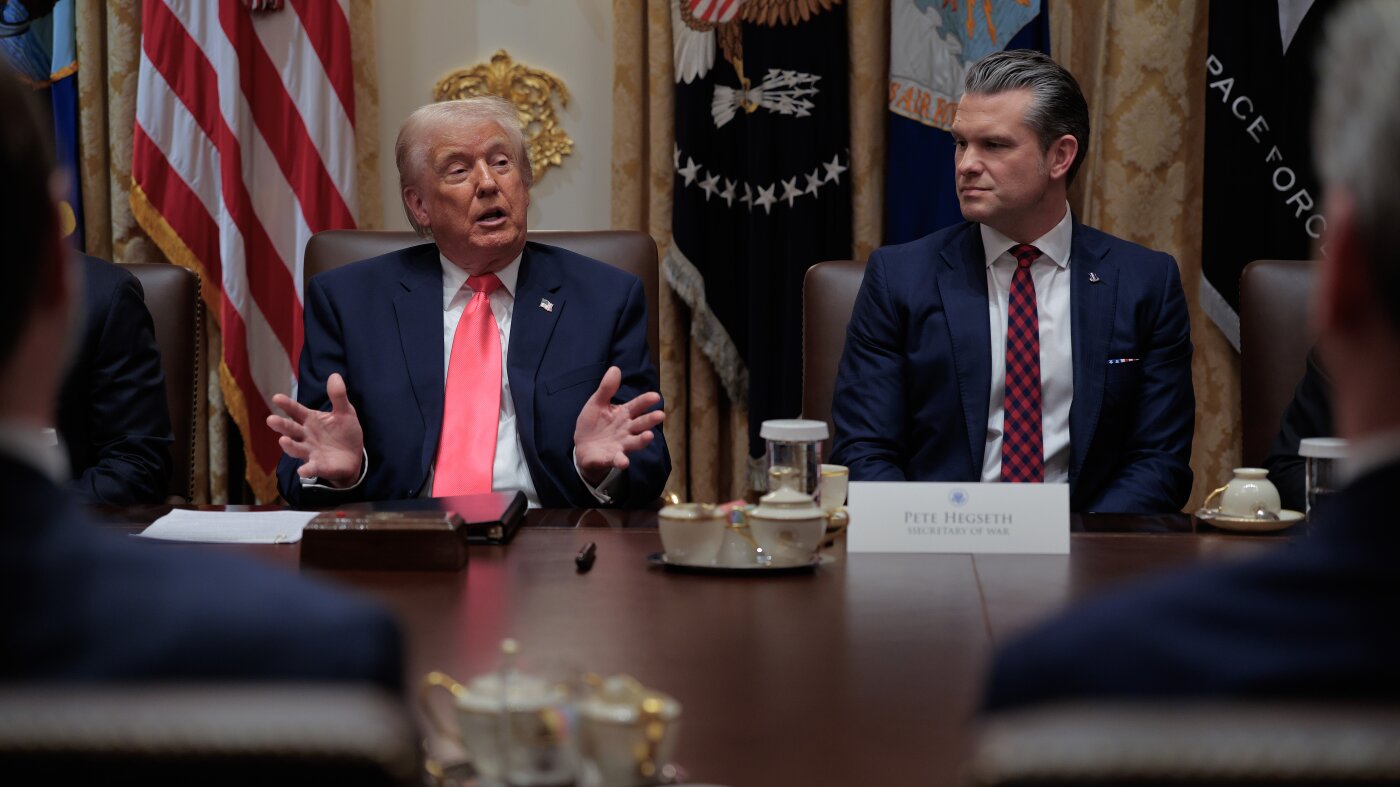
President Donald Trump and Defense Secretary Pete Hegseth salute as carry teams move the transfer cases with the remains of Iowa National Guard soldiers Sgt. William Nathaniel Howard, 29, of Marshalltown, Iowa, and Sgt. Edgar Brian Torres-Tovar, 25, of Des Moines, Iowa, and civilian interpreter Ayad Mansoor Sakat, who were killed in an attack in Syria, during a casualty return, Wednesday, Dec. 17, 2025 at Dover Air Force Base, Del.

Julia Demaree Nikhinson/AP


hide caption

toggle caption

Advertisement

Julia Demaree Nikhinson/AP

WASHINGTON — The Trump administration launched military strikes Friday in Syria to “eliminate” Islamic State group fighters and weapons sites in retaliation for an ambush attack that killed two U.S. troops and an American civilian interpreter almost a week ago.

A U.S. official described it as “a large-scale” strike that hit 70 targets in areas across central Syria that had IS infrastructure and weapons. Another U.S. official, who also spoke on condition of anonymity to discuss sensitive operations, said more strikes should be expected.

“This is not the beginning of a war — it is a declaration of vengeance. The United States of America, under President Trump’s leadership, will never hesitate and never relent to defend our people,” Defense Secretary Pete Hegseth said on social media.

Advertisement

The new military operation in Syria comes even as the Trump administration has said it’s looking to focus closer to home in the Western Hemisphere, building up an armada in the Caribbean Sea as it targets alleged drug-smuggling boats and vowing to keep seizing sanctioned oil tankers as part of a pressure campaign on Venezuela’s leader. The U.S. has shifted significant resources away from the Middle East to further those goals: Its most advanced aircraft carrier arrived in South American waters last month from the Mediterranean Sea.

Trump vowed retaliation

President Donald Trump pledged “very serious retaliation” after the shooting in the Syrian desert, for which he blamed IS. Those killed were among hundreds of U.S. troops deployed in eastern Syria as part of a coalition fighting the militant group.

During a speech in North Carolina on Friday evening, the president hailed the operation as a “massive strike” that took out the “ISIS thugs in Syria who were trying to regroup.”

Earlier, in his social media post, he reiterated his backing for Syrian President Ahmad al-Sharaa, who Trump said was “fully in support” of the U.S. effort.

Trump also offered an all-caps threat, warning IS against attacking American personnel again.

Advertisement

“All terrorists who are evil enough to attack Americans are hereby warned — YOU WILL BE HIT HARDER THAN YOU HAVE EVER BEEN HIT BEFORE IF YOU, IN ANY WAY, ATTACK OR THREATEN THE U.S.A.,” the president added.

The attack was conducted using F-15 Eagle jets, A-10 Thunderbolt ground attack aircraft and AH-64 Apache helicopters, the U.S. officials said. F-16 fighter jets from Jordan and HIMARS rocket artillery also were used, one official added.

U.S. Central Command, which oversees the region, said in a social media post that American jets, helicopters and artillery employed more than 100 precision munitions on Syrian targets.

How Syria has responded

The attack was a major test for the warming ties between the United States and Syria since the ouster of autocratic leader Bashar Assad a year ago. Trump has stressed that Syria was fighting alongside U.S. troops and said al-Sharaa was “extremely angry and disturbed by this attack,” which came as the U.S. military is expanding its cooperation with Syrian security forces.

Syria’s foreign ministry in a statement on X following the launch of U.S. strikes said that last week’s attack “underscores the urgent necessity of strengthening international cooperation to combat terrorism in all its forms” and that Syria is committed “to fighting ISIS and ensuring that it has no safe havens on Syrian territory and will continue to intensify military operations against it wherever it poses a threat.”

Advertisement

Syrian state television reported that the U.S. strikes hit targets in rural areas of Deir ez-Zor and Raqqa provinces and in the Jabal al-Amour area near the historic city of Palmyra. It said they targeted “weapons storage sites and headquarters used by ISIS as launching points for its operations in the region.”

IS has not said it carried out the attack on the U.S. service members, but the group has claimed responsibility for two attacks on Syrian security forces since, one of which killed four Syrian soldiers in Idlib province. The group in its statements described al-Sharaa’s government and army as “apostates.” While al-Sharaa once led a group affiliated with al-Qaida, he has had a long-running enmity with IS.

The Americans who were killed

Trump this week met privately with the families of the slain Americans at Dover Air Force Base in Delaware before he joined top military officials and other dignitaries on the tarmac for the dignified transfer, a solemn and largely silent ritual honoring U.S. service members killed in action.

The guardsmen killed in Syria last Saturday were Sgt. Edgar Brian Torres-Tovar, 25, of Des Moines, and Sgt. William Nathaniel Howard, 29, of Marshalltown. Ayad Mansoor Sakat, of Macomb, Michigan, a U.S. civilian working as an interpreter, also was killed.

The shooting near Palmyra also wounded three other U.S. troops as well as members of Syria’s security forces, and the gunman was killed. The assailant had joined Syria’s internal security forces as a base security guard two months ago and recently was reassigned because of suspicions that he might be affiliated with IS, Interior Ministry spokesperson Nour al-Din al-Baba has said.

Advertisement

The man stormed a meeting between U.S. and Syrian security officials who were having lunch together and opened fire after clashing with Syrian guards.

Continue Reading
Advertisement

Trending