Lifestyle
How to have the best Sunday in L.A., according to Amanda Gorman


Growing up in Westchester, Amanda Gorman’s Sundays were dedicated to one thing: church.
“I went to a historically Black church and I feel like it’s always an occasion to go to church as an African American,” says 27-year-old Gorman, who became the youngest inaugural poet in U.S. history in 2021. “You’re dressing up in your Sunday best and you’re going to be there for several hours.”

In Sunday Funday, L.A. people give us a play-by-play of their ideal Sunday around town. Find ideas and inspiration on where to go, what to eat and how to enjoy life on the weekends.
These days, her Sundays are not entirely devoted to church, but the poet, activist and author says that those early years taught her the importance of intentionally carving out time to spend with loved ones and be in community.
“It can be getting together with some gal pals that you haven’t convened with in a while,” says Gorman, who became the youth poet laureate of Los Angeles at age 16 in 2014 and the first national youth poet laureate three years later. “It can be spending time with your pets. It can be going to the book club that you love, but finding something where you can ground yourself in what it is to be a human being. I think I still try to translate that into my Sundays.”
Gorman is set to make her second appearance at the Los Angeles Times Book Festival on April 26, where she’ll be talking about her third book, “Girls on the Rise,” released this year. The Harvard graduate began writing the children’s book in 2018 after she watched Christine Blasey Ford — who accused Justice Brett M. Kavanaugh of sexually assaulting her when they were teenagers — testify to the Senate Judiciary Committee.
“I just remember being so struck by her courage, bravery and truth,” says Gorman. “It made me think about the next generation of young women, girls and nonbinary children, who also would be speaking their truth in a patriarchal society. So I wanted to write a book that created a safe space for young girls and their allies to feel a sense of kinship.”
On her ideal Sunday in L.A., Gorman would hang out with her dog, Kenny (named after Kendrick Lamar), visit her favorite bookstores, enjoy afternoon tea like a “Bridgerton” character and hit up a rooftop.
This interview has been lightly edited and condensed for length and clarity.

10 a.m.: Embrace brunch vibes at home
If I can sleep in until 10 a.m., that’s like a miracle, magical day for me. I love just taking the extra time on a Sunday. Breakfast is my favorite and maybe my main meal of the day if I’m being honest. So I will carve out Sunday as my day to really splurge on my breakfast. I’ll maybe make some french toast. I have been dallying and making a gluten-free french toast with some nice seeds, vanilla, cinnamon and berries. Then I’ll make some veggie patties and have some other fruit. I’ll also make some hot chocolate and then I’ll put on “The Great British Bake Off” show while I’m cooking, so I can really luxuriate in the Sunday chill vibes. I pretty much start the day with as much brunch energy as I can.
12:30 p.m.: Get some sunshine
I’d love to get some sunshine, so I’d go to the beach. I love taking a stroll with my friends along the Santa Monica Pier, kind of on the northern side because it’s a bit less crowded.

3 p.m.: Live out my ‘Bridgerton’ fantasy
By this time, I’d be hungry and ready for lunch. If I was down by the beach, there’s a restaurant I like called Ivy at the Shore, kind of close to the Third Street Promenade. You can eat and watch the sunset. They have a good salad. I’ve also gotten really good enchiladas there, and fish and chips.
Or I’d go to the Peninsula. For my birthday, I just did an afternoon high tea at the Peninsula. It was so nice and so worth it. I feel like if someone wants to splurge on a Sunday, go. They have a harpist, tea, sandwiches and scones, so I’d probably spend the rest of my afternoon there on my dream, ideal day. You can sit in their parlor lounge, which has these nice, colorful couch sofas or these elegant corner chairs. They have music playing and very snazzily dressed butlers. One of my friends wore a fascinator. I wore lace gloves. I said, “Come in your ‘Bridgerton’ aura.” It really feels like “Bridgerton” because on the show, they have the instrumentalists playing modern songs and they were playing like “Diamonds” by Rihanna on the harp, so I love that mix of the contemporary with the classic and bougie.
5:30 p.m.: Get lost in a bookstore
Next, I’d go to the Last Bookstore in DTLA or Chevalier’s Books in Larchmont. The Last Bookstore has an enthralling, picturesque maze of used and new books, and Chevalier’s is a cozy, intimate bookshop with stores and cafes nearby.

7 p.m.: Catch a second wind at a rooftop restaurant
I’d probably go home, but if I got a second wind of energy, there are some really nice restaurants that I like in West Hollywood. There’s Catch L.A. and Perch. Both are really cute, glitzy rooftop places to go after the sun has set. Catch L.A. has a “Hit Me” chocolate cake, where they pour melted chocolate over it and crack it open in front of you, so that’s really nice. Tons of people love to take videos of that and post it because it’s a real moment.

10 p.m.: ‘Great British Bake Off’ and tea
I’m probably home, watching some more “British Bake Off,” “The Office” or something cozy, making myself some chamomile tea and reading. That’s also the thing I love to do on Sundays because I feel like it’s so hard to find time nowadays, in the modern age, to step away from the screen and engage stories and text. I was reading this book that’s really funny to me called “How to Kill Your Family.” [Laughs] I was like, I feel like my family is going to see me reading this at like Thanksgiving and think I’ve gone unhinged, but it’s this dark thriller comedy that was published in the U.K. I just finished it and I thought it was hilarious. It’s not a step-by-step guide, by the way. It’s more a narrative of a character’s journey [laughs].

11 p.m.: Wind down
I discourage the elaborate nighttime routines because I think they’re hard to maintain and sustain. I try to make it as straightforward as possible, which gives a good routine for me as well as my dog. So my nighttime routine would be giving my dog a walk and making sure he has time to pee and do all the nature stuff. Reading, having chamomile tea and maybe doing some slow restorative yoga for 10 minutes or a meditation. I get the humidifier all set with essential oils, turn the lights down and try to have the last hour with no blue light, sugar, food, and keep it really quiet and soft. I also like to listen to lullaby music, which makes me sound like a fetus, but it helps me get over my insomniac tendencies. I like this artist, Priscilla Ahn, who has really soothing albums that are good for all ages. Then honestly, I’ll listen to the Disney princess playlists with songs like “So This is Love” [by Ilene Woods and Mike Douglas], all that soft, cozy stuff. I try to be in bed by 11:30 p.m.



Sen. Tillis To Kristi Noem
ICE Killings Are Like Dog You Killed
Published
Fireworks on Capitol Hill … Sen. Thom Tillis ripped into DHS Secretary Kristi Noem during a congressional hearing … comparing American citizens killed by immigration agents to a dog she killed.
Check out the video … the Republican Senator from North Carolina says Noem has shown terrible leadership and decision-making as Trump‘s DHS Secretary.
AP

Tillis says the killings of Renee Good and Alex Pretti in Minneapolis by ICE and Border Patrol remind him of a passage from Noem’s book … where she recalls killing a dog she brought on a hunting trip.
Noem said the 14-month-old dog, Cricket, was misbehaving … so she led the dog to a gravel pit and shot her.
X/@DHSgov
Sen. Tillis told her straight up … “Those are bad decisions made in the heat of the moment. Not unlike what happened up in Minneapolis. We’re an exceptional nation, and one of the reasons we’re exceptional is we expect exceptional leadership. And you’ve demonstrated anything but that.”

In 2021, Zhao made history as the first woman of color to win the best director Oscar for her film Nomadland. Her Oscar-nominated drama Hamnet has made $70 million worldwide.
Bethany Mollenkof for NPR
hide caption
toggle caption
Bethany Mollenkof for NPR
It took a very special kind of spirit to make Hamnet, which is nominated for best picture at this year’s Academy Awards. Chloé Zhao brought her uniquely sensitive, mind-body approach to directing the fictionalized story about how William Shakespeare was inspired to write his masterpiece Hamlet.
Zhao adapted the screenplay from a novel by Maggie O’Farrell, and for directing the film, she’s now nominated for an Oscar. She could make history by becoming the first woman to win the best director award more than once.
Zhao says she believes in ceremonies and rituals, in setting an intention, a mood, a vibration for any event. Before Hamnet premiered at the Toronto International Film Festival last year, she led the audience in a guided meditation and a breathing exercise.

Zhao also likes to loosen up, like she did at a screening of Hamnet in Los Angeles last month, when she got the audience to get up and dance with her to a Rihanna song.
She, her cast and crew had regular dance parties during the production of Hamnet. So for our NPR photo shoot and interview at a Beverly Hills hotel, I invited her to share some music from her playlist. She chose a track she described as “drones and tones.”
Our photographer captured her in her filmy white gown, peeking contemplatively from behind the filmy white curtains of a balcony at the Waldorf Astoria.
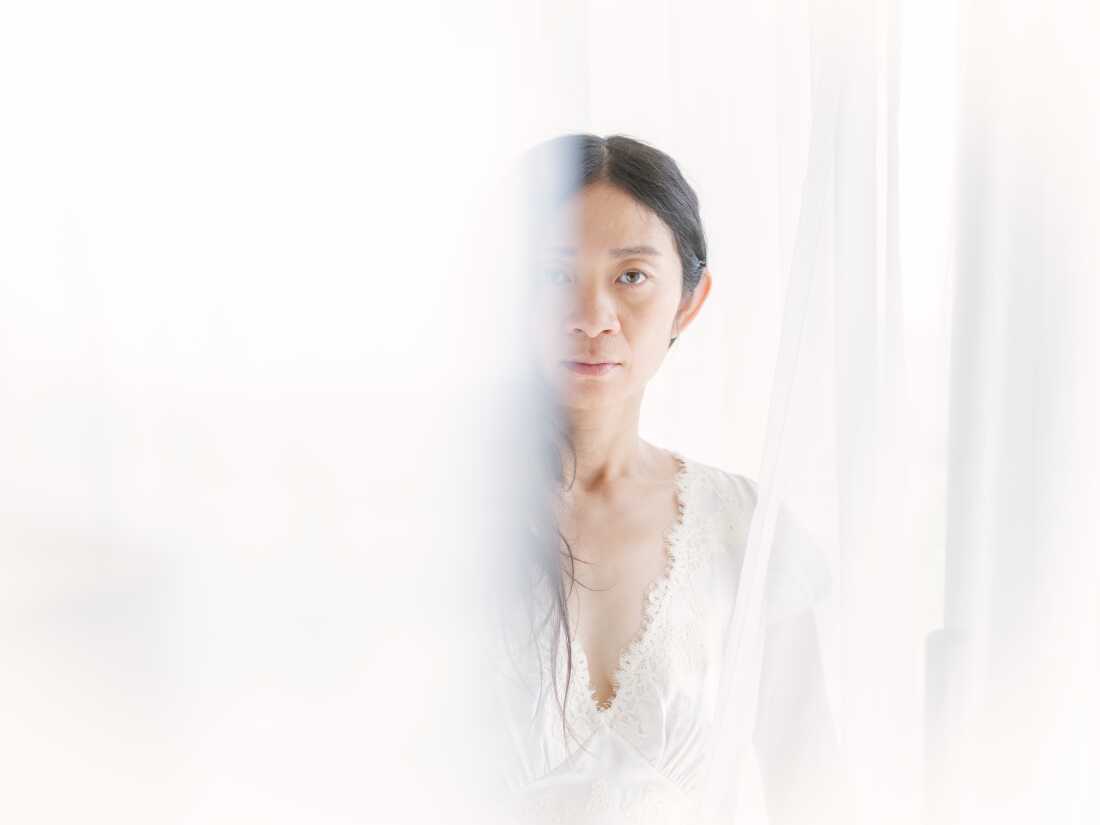
Zhao says she believes in ceremonies and rituals, and makes them a part of her filmmaking process.
Bethany Mollenkof for NPR
hide caption
toggle caption
Bethany Mollenkof for NPR
Then Zhao and I sat down to talk.
“I had a dream that we were doing this interview,” I told her. “And it started with a photo shoot, and there was a glass globe –”
“No way!” she gasped.
It so happens that on the desk next to us, was a small glass globe — perhaps a paperweight.
I told her that in my dream, she was looking through the globe at some projected images. “We were having fun and it was like we didn’t want it to stop,” I said.
“Oh, well, me and the globe and the lights on the wall: they’re all part of you,” Zhao said. “They’re your inner crystal ball, your inner Chloé.”
“Inner Chloé?” I asked. “What is the inner Chloé like?”
“I don’t know, you tell me,” she said. “Humbly, from my lineage and what I studied is that everything in a dream is a part of our own psyche.”
Dreams and symbols are very much a part of Zhao’s approach to filmmaking, which she describes as a magical and communal experience. She said it’s all part of her directing style.
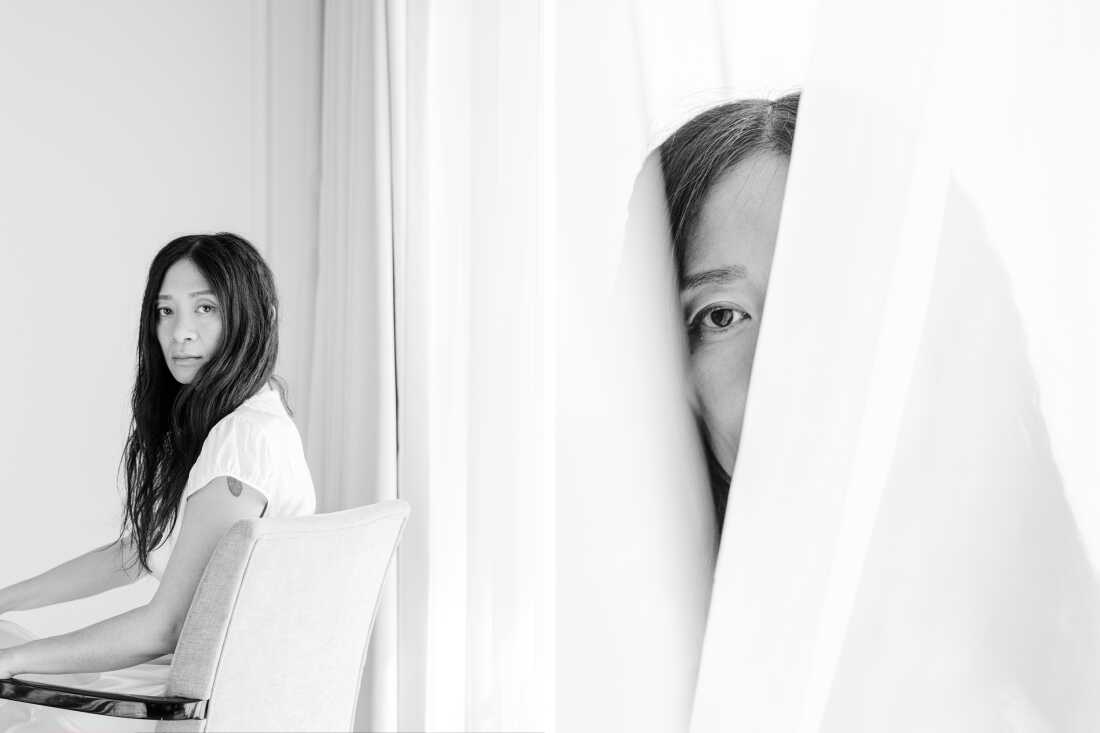
Chloé Zhao used painting and dance to connect with actors on the set of her latest film Hamnet.
Bethany Mollenkof for NPR
hide caption
toggle caption
Bethany Mollenkof for NPR
“If you’re captain of any ship, you are not just giving instructions; people are also looking to you energetically as well,” she explained. “Whether it’s calmness, it’s groundedness, it’s feeling safe: then everyone else is going to tune to you.” Zhao says it has taken many years to get to this awareness. Her own journey began 43 years ago in Beijing, where she was born. She moved to the U.S. as a teen, and studied film at New York University where Spike Lee was one of her teachers. She continued honing her craft at the Sundance Institute labs — along with her friend Ryan Coogler and other indie filmmakers.
Over the years, Zhao’s film catalogue has been eclectic — from her indie debut Songs My Brothers Taught Me, set on a Lakota Sioux reservation, to the big-budget Marvel superhero movie Eternals. She got her first best director Oscar in 2021 for the best picture winner Nomadland. Next up is a reboot of Buffy the Vampire Slayer.
“A creative life,” she notes, “is not a linear experience for me.”
Zhao still lingers over the making of Hamnet, a very emotional story about the death of a child. During the production, Zhao says she used somatic and tantric exercises and rituals to open and close shooting days.
She also invited her lead actors Paul Mescal and Jessie Buckley to help her set the mood on set. They danced, they painted, they meditated together.
“She created an atmosphere where everybody who chose to step in to tell this story was there for a reason that was deeply within them,” actress Jessie Buckley told me.

Buckley is a leading contender for this year’s best actress Oscar. She said that to prepare for her very intense role as William Shakespeare’s wife, Zhao asked her to write down her dreams “as a kind of access point, to gently stir the waters of where I was feeling.”
Buckley sent Zhao her writings, and also music she felt was “a tone and texture of that essence.”
That kind of became the ritual of how they worked together, Buckley said. “And not just the cast were moving together, but the crew were and the camera was really creating dynamics and a collective unconscious.”
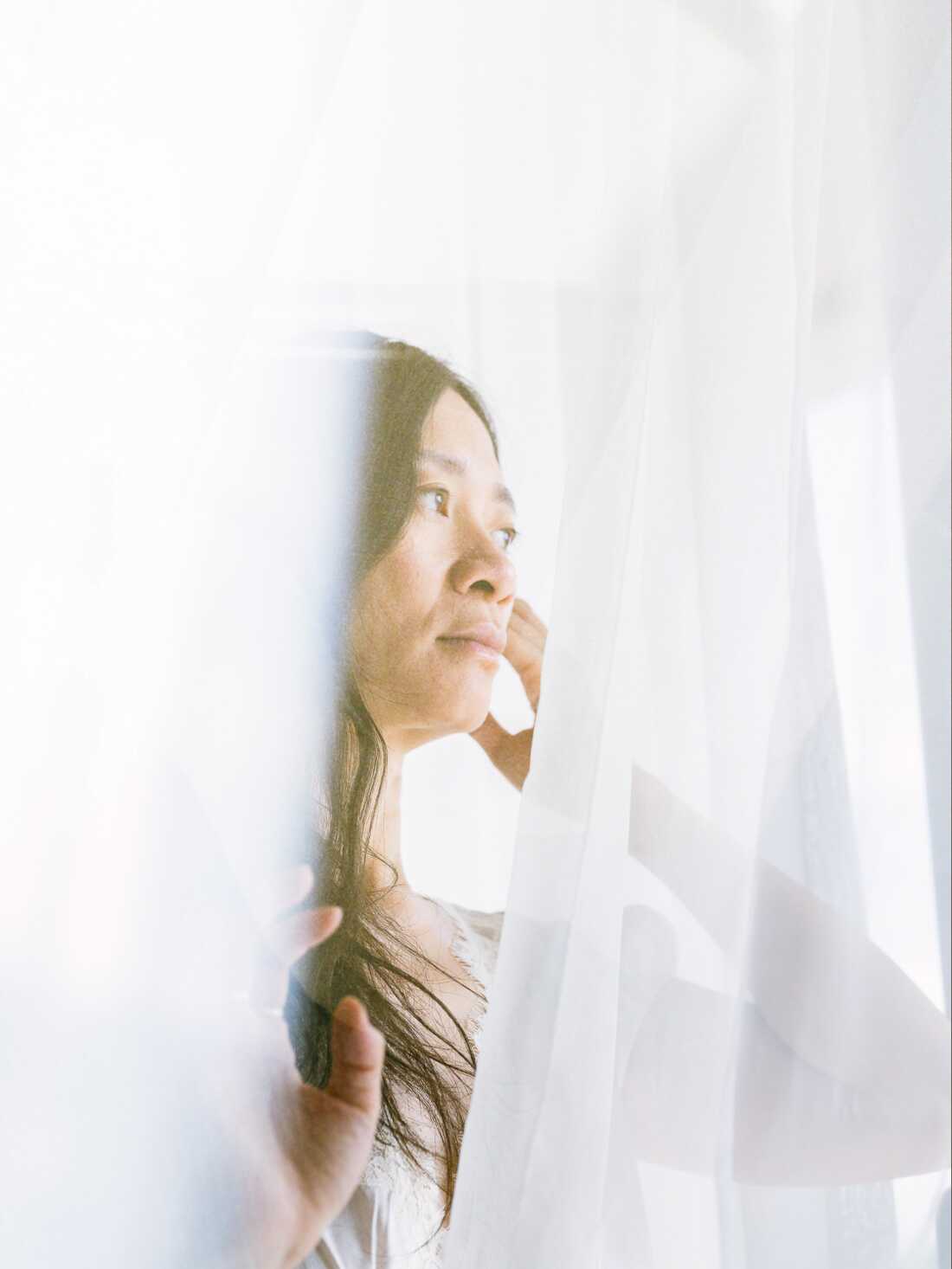
Filmmaker and Hamnet producer Steven Spielberg calls Zhao’s empathy her superpower.
Bethany Mollenkof for NPR
hide caption
toggle caption
Bethany Mollenkof for NPR
That was incredibly useful for creating Hamnet — a story about communal grief. Steven Spielberg, who co-produced the film, called Zhao’s empathy her superpower.
“In every glance, in every pause and every touch, in every tear, in every single moment of this film, every choice that Chloé made is evidence of her fearlessness,” Spielberg said when awarding Zhao a Directors Guild of America award. “In Hamnet, Chloé also shows us that there can be life after grief.”
Zhao says it took five years and a midlife crisis for her to develop the emotional tools she used to make Hamnet.
“I hope it could give people a two-hour little ceremony,” she told me. “And in the end, I hope that a point of contact can be made. That means that there’s a heart opening. But it will be painful, right? Because when your heart opens, you feel all the things you usually don’t feel. And then a catharsis can emerge.”
As our interview time came to a close, I told Zhao I have my own little ritual at the end of every interview; I record a few minutes of room tone, the ambient sound of the space we’re in. It’s for production purposes, to smooth out the audio.
Zhao knew just what I meant. She told me a story about her late friend Michael “Wolf” Snyder who was her sound recordist for Nomadland. “He said to me, ‘I don’t always need it, but just so you know, I am going to watch you. And when I tell that you are a little frazzled, I’m going to ask for a room tone … just to give you space.’” she recalled. “‘And if you feel like you need the silence space, you just look at me, nod. I’ll come ask for a room tone.’”
I closed our interview ceremony with that moment of silence, a moment of peace, for director Chloé Zhao.
Lifestyle
This spring, have a tea ceremony inside of an art installation and shop the latest Givenchy

Givenchy by Sarah Burton introduces the Snatch
Givenchy’s “The Snatch” handbag.
(Marc Piasecki / Getty Images)
Echoing the designer’s ready-to-wear sculptural designs, the Snatch from Givenchy by Sarah Burton is sensually shaped by the contours of the person who carries it. Its supple leather, fluid silhouette and three sizes allow it to slip effortlessly and intimately into the hand, over the shoulder or across the body. Now available. givenchy.com
Guess Jeans opens new L.A. store

Guess Jeans store interior.
(Josh Cho)
In a move familiar to many millennials these days, Guess Jeans has returned home in its 45th year. The new flagship store in West Hollywood is both a return to its California roots and an envisioning of its future still ahead. While the brand may be an established icon, the store boldly reimagines the retail space as a living laboratory for design, craftsmanship and collaboration, with dedicated workshop and customization spaces. 8700 Melrose Ave., Los Angeles. guess.com
Louis Vuitton’s new Color Blossom collection


Louis Vuitton’s new Color Blossom collection highlights sodalite.
(Louis Vuitton)
Taylor Swift’s sky may be opalite, but the starry blue hues in the new jewels of Louis Vuitton’s Color Blossom collection belong to sodalite. Rarely used in jewelry, the dark navy of sodalite adds an unexpected layer of depth to Color Blossom’s existing luminous gemstone lineup. Sun and star motifs rendered in gold enhance the gem’s night sky coloring, while the classic flower designs celebrate the 130th anniversary of the Louis Vuitton Monogram. Sodalite pieces available March 6, entire collection available April 4. louisvuitton.com
Loro Piana debuts Library of Knits


Loro Piana’s Library of Knits comes in over 20 shades.
(Lora Piana)
L.A.’s (many) winter showers bring spring wildflowers, and a bouquet of Loro Piana’s new Library of Knits fits right into the vibrant spectacle. The exquisitely soft cashmere pieces in classic styles now come in over 20 shades inspired by Sergio Loro Piana’s personal wardrobe. With a spectrum ranging from blues and greens to corals and creams, it’s hard to choose just one for a frolic in the fields. Now available. loropiana.com
Margesherwood X Peanuts

The Margesherwood X Peanuts collaboration features instantly recognizable motifs.
(Marge Sherwood)
Love is famously in the air this time of year, apparently even for cartoon characters. This enduring love is illustrated (literally) in the Margesherwood X Peanuts collaboration. Inspired by the heart-fluttering love letters Sally writes to Linus, the designs feature instantly recognizable motifs that marry the Peanuts’ charm with Margesherwood’s refined silhouettes. The zig-zag of that famous yellow shirt winkingly graces a crescent baguette, while the black stripes of Linus’s red red shirt wrap around a slouchy shoulder bag. For the true heads and lovers, there’s even a petite hobo emblazoned with Sally’s pet name for Linus: “FOR MY SWEET BABBOO.” Now available. margesherwood.com
Ryan Preciado at Hollyhock House

Ryan Preciado’s site-responsive “Diary of a Fly” at Hollyhock House features Oaxacan-woven textiles.
(Roman Koval)
Ryan Preciado’s new site-responsive installation at Hollyhock House, “Diary of a Fly,” is titled after a late-1930s musical composition by Béla Bartók that imitates the frenzied pace of a fly — a fitting name since his show reconceptualizes the experience of the springtime pest flitting around a house. Instead of hovering around overripe fruit or stalking a trash can long neglected, however, viewers are invited to take in Preciado’s Oaxacan-woven textiles and brightly colored sculptures situated throughout the city’s only UNESCO World Heritage Site. Open through April 25. 4800 Hollywood Blvd., Los Angeles. hollyhockhouse.org
Veronica Fernandez at Anat Ebgi

Veronica Fernanadez’s “Prey” filters childhood memories through experience and emotion.
(Veronica Fernandez)
In the figurative paintings of Veronica Fernandez’s first solo exhibition, “Prey,” the artist’s childhood is recalled through dreamlike and fantastical scenes, with memories filtered through experience and emotion. Many of her works place a child at the center of the scene among family, friends and caretakers, who usually appear shadow-like at the edges of the paintings. As a kid, Fernandez endured periods of homelessness. But rather than depict a childhood of adversity, her paintings empower the kids within them to claim their own space, imbuing her memories with strength and light. Open through April 4. 6150 Wilshire Blvd., Los Angeles. anatebgi.com
Dior launches J’Adore Intense

Dior’s J’Adore Intense captures the scent of solar flowers with Rihanna as its muse.
(J’Adore)
Florals for spring can be groundbreaking, especially when they’re created with none other than Rihanna as their muse. Dior’s J’Adore Intense captures the scent of solar flowers — jasmine, ylang-ylang, rose, violet — right before they burst into fruit. The result is a warm, bold, addictive fragrance that drips with sensuality and femininity, down to the curves of its signature gold and glass figure-eight amphora. In other words, it’s Rihanna in a bottle. Available now. dior.com
Rocky’s Matcha X Oscar Tuazon at Morán Morán


Rocky’s Matcha hosts Japanese tea ceremonies in an ensō-inspired tea house from Oscar Tuazon at Morán Morán.
(Stade New York)
The single, uninhibited brushstroke of the ensō, the circular form in Zen art, serves as a record of a moment. Commissioned by Rocky’s Matcha, Oscar Tuazon’s “Circle House” at Morán Morán shares both the ensō’s form and its call to mindfulness. In the artist’s tea house, constructed from cardboard, wood and tatami mats, architecture is inseparable from ritual: visitors will soon be able to partake in a Japanese tea ceremony inside the installation, thereby participating in a choreography of attention not unlike the act of gliding an ink brush across a sheet of washi. Open through December 31. 641 N. Western Ave. Los Angeles. Subscribe to rocky’s newsletter for tea ceremony information. rockysmatcha.com and moranmorangallery.com
Celebrate Mr. Wash’s new book, “Artists in Space”

Celebrate the launch of Mr. Wash’s new book of studio visits and interviews with other L.A. artists.
(Mr Wash)
Make your first BBQ of the season a meaningful one at the Art By Wash Studio & Community Center, where Compton artist and criminal justice advocate, Mr. Wash, will celebrate the release of his book “Artists in Space.” Proceeds from the book, which features interviews and studio visits with 20 Angeleno residents, go toward establishing the new community center where individuals returning home from incarceration will have access to art classes, creative residencies and housing. Mr. Wash will be in conversation with Patrisse Culllors and Evan Pricco (co-publisher and founder of the Unibrow) as well as displaying new works. The event is on March 7 from 2-6 p.m. 15 W. Rosecrans Ave., Compton. artbywash.com

Todd Meadows, ‘Deadliest Catch’ deckhand, dies at 25

Sen. Thom Tillis Rips Kristi Noem, Compares ICE Killings To Dog She Killed

Israel believes Iran war could last months, testing U.S. resolve
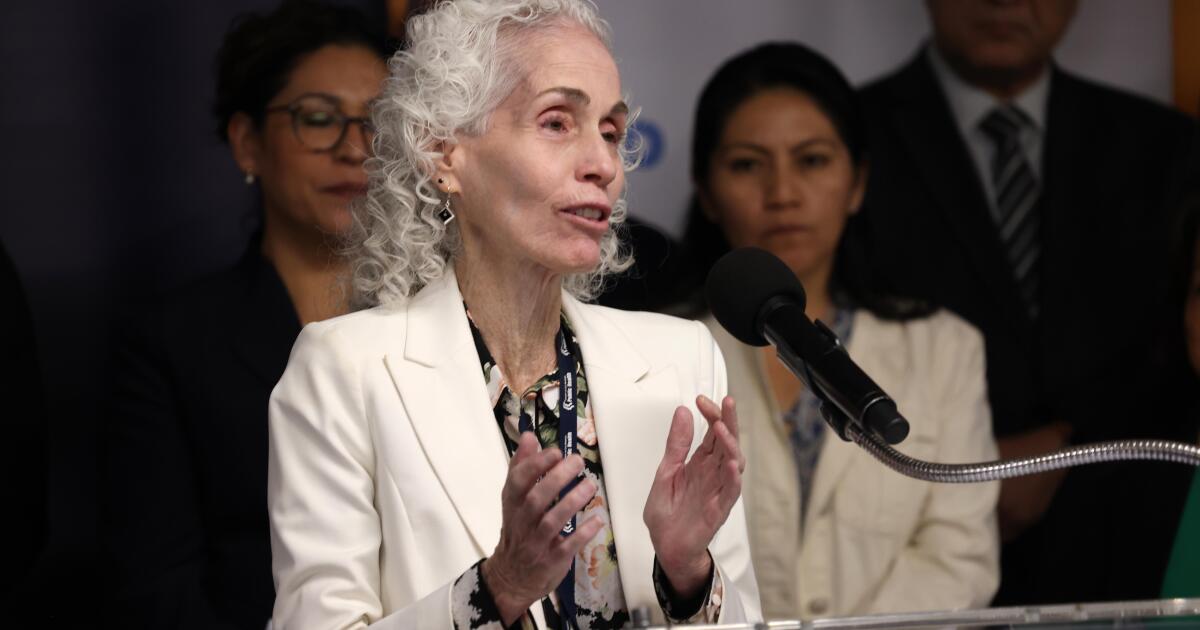
There were 13 full-service public health clinics in L.A. County. Now there are 6

Arnold, Jamie Lee Curtis, Janet Evans, Carl Lewis new members of California’s Hall of Fame

Florida High School Football Rankings: Top 25 teams – Oct. 21

Cleary's 21 help Le Moyne down Central Connecticut State 69-64 in OT

How old is Bo Nix? What to know about Oregon quarterback ahead of 2024 NFL Draft

99th annual Pony Swim held in Virginia

Indiana Members Credit Union announced as new anchor tenant at Bottleworks District

Hungarian veto proves EU needs less unanimity, says new Dutch PM

Pregnant migrant girls are being sent to a Texas shelter flagged as medically risky

Fraud-plagued Minnesota sues Trump admin for withholding $243M in Medicaid payments

Is Iran expanding attacks to target energy and civilian sites in the Gulf?

Trump claims US stockpiles mean wars can be fought ‘forever’; Kristi Noem testifies before Congress – US politics live
-

 World6 days ago
Exclusive: DeepSeek withholds latest AI model from US chipmakers including Nvidia, sources say
-

 Massachusetts6 days ago
Mother and daughter injured in Taunton house explosion
-

 Denver, CO6 days ago
10 acres charred, 5 injured in Thornton grass fire, evacuation orders lifted
-

 Louisiana1 week ago
Wildfire near Gum Swamp Road in Livingston Parish now under control; more than 200 acres burned
-

 Oregon4 days ago
2026 OSAA Oregon Wrestling State Championship Results And Brackets – FloWrestling
-

 Florida3 days ago
Florida man rescued after being stuck in shoulder-deep mud for days
-

 Maryland3 days ago
AM showers Sunday in Maryland
-

 Culture1 week ago
Try This Quiz on Thrilling Books That Became Popular Movies