Entertainment
Finn Bennett tells how Peter Prior's shocking scene unfolded in 'True Detective: Night Country'


This article contains spoilers for Episode 5 of HBO’s “True Detective: Night Country.”
Episode 5 of “True Detective: Night Country” ended not with a whimper, but with a bang.
After Ennis, Alaska, Police Chief Liz Danvers discovers that Hank Prior, one of her fellow officers, is interfering with her investigation into the deaths of the scientists from Tsalal Research Station, the duo clash over a potential witness. Hank kills the witness in Danvers’ house before his son, Peter Prior, rushes in. In the closing minutes, following a tense standoff, Peter shoots and kills his father to protect Danvers.
It’s a shocking scene that Finn Bennett, who plays Peter, knew was coming from the very beginning, although he wasn’t sure how exactly it would unfold until the cast was actually on set.
“All the scripts went through many different iterations,” Bennett says. “But that one in particular, that moment, was changing all the time. The beats were there, what was going to happen was always there, but how it happened and the lines that played out and [Peter] being pulled in two different directions — that was all changing.”
Police Chief Liz Danvers (Jodie Foster), left, calls on Peter Prior (Finn Bennett) often to help with the case at the center of “True Detective: Night Country.”
(Michele K. Short/HBO)
The scene is pivotal for Peter, who has spent the season kowtowing to Danvers (Jodie Foster) as she investigates a gruesome murder. He’s been pulled between his devotion to work, his wife, Kayla (Anna Lambe), and their young child, Darwin, and Hank (John Hawkes). As Danvers and Hank face off over the investigation, Peter is forced to make a choice that Bennett says represents what the character stands for.
“The big conversation was how Danvers appeals to Prior’s rationality and how Hank, his father, appeals to something more sentimental and emotional,” Bennett says. “I think what it comes down to in the end is: Is Prior sentimental and emotional? Is the relationship with his father enough? Or is he moral and rational? I don’t think there will ever be a time in his life thereafter where he doesn’t second guess that decision.”
During production, which took place in Iceland, creator and showrunner Issa López held rehearsals with the cast each weekend. To nail down this particular moment, she gathered Bennett, Foster, Hawkes and Kali Reis, who plays Evangeline Navarro, the state trooper who is working with Danvers on the case, in her apartment (even though Reis isn’t in the scene).
Bennett recalls that even though “it was a brilliant scene,” the lines weren’t working. “I workshopped it with Jodie and John, who are complete masters of their craft,” he says. “I was like a kid in a sweet shop watching the two of them going back and forth.”
Being from England, which has some of the strictest firearm laws in the world, Bennett didn’t have much experience with guns. The cast underwent training before production and practiced target shooting, but the actor wasn’t completely comfortable with the firearms. The gunshot onscreen is a combination of practical and visual effects.
“We did a couple of takes where I did a very dramatic blast,” he says. “And they were like, ‘Um, chill out.’ But there is a slight kickback.”
Because of the challenges of shooting in Iceland in winter, including extreme weather conditions, it wasn’t possible to film “True Detective: Night Country” sequentially. But López purposefully scheduled Prior’s big scene toward the end of production. Bennett says he “needed that run-up” to get in the right head space and to feel comfortable in the room with Foster and Hawkes.
John Hawkes plays Hank Prior, Peter’s father with whom he has a strained relationship.
(Michele K. Short/HBO)
“I don’t think there’s any situation where you’re going to go into a room with those titans of the craft and be comfortable per se,” he says. “But it certainly helped that we’d been working for five months before that. … I think it’s more than being a dramatic and thrilling scene. It’s a deeply sad and moving scene. It’s sad killing your father.”
He adds, “It was an intense day. But it was also one of the best days because I was learning so much and I was so involved.”
Bennett was cast as Peter in the summer of 2022. López had seen his audition tape for a series she directed in the U.K. and she was also a fan of his work in Channel 4’s limited series “Kiri.” Although Bennett didn’t end up in López’s previous show, the pair kept in touch.
“She called me and she was like, ‘I’m writing something, and I think you would be great in it,’” Bennett says. “And I was like, ‘Fantastic. Is it shooting in the U.K.?’ And she told me it was HBO’s ‘True Detective.’ I never thought I would actually get it. But to have her in my corner fighting for me has been a real honor.”
The cast worked with a police officer, who Bennett says “had really seen some stuff,” to better understand what it’s like to investigate criminal cases. López also connected the actor with a pastor named Peej Jones, whom she’d met in Alaska during a research trip. Like Peter, Jones is a white man married to an Indigenous woman and he lives in a remote community. Over weekly hour-long phone conversations with Jones, Bennett says he became essential to understanding Peter’s complicated life.
“My questions started off quite profound, like, how does it feel to be from outside that community and then move into that community?” Bennett says. “I wanted to know what life is like for him there because it’s such a world away from where I live. I’ve never had to hunt for my dinner.”
Bennett spent six months in Iceland. Many of the days he was there had only an hour or two of sunlight, and because much of the story takes place during the polar night he would regularly get to set at 6 p.m. To convey the stark Arctic life, “True Detective: Night Country” also largely used practical exteriors rather than soundstages.
“You’re in the cold and you’re in the dark and your nose runs and your eyes water and you’re shivering,” Bennett says. “That kind of stuff makes it believable. And all you really want from something is to make it believable.”
Finn Bennett describes his character as a “people pleaser to a fault.”
(Lilja Jons/HBO)
Because the production on the series was so intense and lengthy, Bennett spent a lot of time thinking about Peter and what motivates him. He sees the character as a “people pleaser to a fault,” which explains the lengths he goes to for Danvers. But Bennett also points out that a small community in Alaska, like the one depicted in the show, would rarely see a case as horrific and complex as this one.
“You would be driven as a young cop looking to prove yourself and having a purpose in life other than cleaning caribou off the road,” he says. “I think that’s why he’s prepared to go the extra mile for Danvers. But it’s a really good question why he doesn’t go the extra mile for his wife or his father.”
Bennett is aware of the scrutiny “True Detective: Night Country” has received (more recently, López has responded to remarks made by series creator Nic Pizzollato about this season). But as a long-time fan of the series, he’s just grateful to be part of its legacy. Because the first season was such a success, he says, people hold any subsequent seasons to the same level.
“And for my money, I’d say we’ve achieved that standard,” he says. “I’m so proud of the work we did, not because I was involved and I know the people involved, but because I think it’s really f— good. But it’s fair to say going into it there was a high expectation.”
While he can’t say anything about the finale, Bennett teases that the conclusion is “a very cooperative ending to a show.” “I think you get to decide how you want it to end,” he says, adding that his own reaction to watching the sixth episode was awe.
“Unbelievable,” he says. “I burst into tears because I was so proud.”



Entertainment
How a mural of Altadena became a symbol of resilience for one small store, through fire and flood

Every time Adriana Molina drives up Lake Avenue to her retro-style women’s clothing shop Sidecca in Altadena, she sees the new outdoor mural she commissioned for the store by muralist and illustrator Annie Bolding. It gives her hope.
“I’m here to stay, and this mural solidified my decision to reopen my business,” said Molina on a recent winter day, sitting next to Bolding inside the boutique. “I grew up in Altadena. The community has motivated me this whole time, and I want them to drive by this mural and smile.”
“ALTADENA.” The word — in big white letters, set against layers of blue — appears toward the top of the mural, on the store’s brick wall facing Lake. Above are the San Gabriel Mountains, painted a deep brown, California poppies and Mariposa Street and Lake Avenue street signs. Below are green grass, a monarch butterfly and Altadena’s Christmas Tree Lane. A bright blue house is on a multicolored striped path in the middle of the mural. Next to it, on a hiking trail, a sign says, “Welcome Home Altadena… With Love, Sidecca.”
For Molina and Bolding, the mural is a personal ode to the Eaton fire-ravaged community — art as a message of optimism and healing.
A car passes by the new Altadena mural on the side of Sidecca apparel shop, which commissioned the piece after fire and floods devastated the community.
(Genaro Molina / Los Angeles Times)
When the fire tore through Altadena in January 2025, Sidecca and a few other stores on the north side of Mariposa Street’s bustling Mariposa Junction survived, while the other half-block of businesses burned to the ground. The fire leveled Bolding’s parents’ house off Lake and the home of one of Molina’s close relatives.
Molina staged pop-ups and sold merchandise online during months of remediation, and officially reopened Sidecca’s doors in November as part of Mariposa Junction’s larger comeback. Then the store suffered another blow: flooding and damage during rainstorms in late December. While Molina prepped to temporarily close her store yet again for renovations, Bolding began work on the mural. She started painting on the one-year anniversary of the fire and finished eight days later.
“On the day I started it, it was so cold and windy, and I was scared being up on the ladder,” said Bolding. “But getting to talk to community members while I was painting was very special. People were excited and honking as they drove by. That night, I drove up to the lot where my parents’ place was, and I stood there and all the feelings flooded back.”
The mural’s origin story is that of two creative women bound by strength and a desire to give back.
Molina, who has worked in the fashion industry for more than 30 years, opened Sidecca’s Altadena spot in 2023, after closing its longtime Pasadena location. Voted Pasadena’s best women’s clothing store five times by Pasadena Weekly, Sidecca sells fun vintage-inspired merchandise and clothes, from ‘50s style dresses to snazzy magnets, tote bags and sunglasses. A big rainbow zips across the top of one of the store’s walls.

A display in Sidecca in 2023, two years before the Eaton fire devastated Altadena.
(Alejandro R. Jimenez)
“A few months after Sidecca opened in Altadena, my mom walked in and saw how colorful it was, and said, ‘This reminds me of my daughter,’ ” Bolding said. “With zero hesitation, my mom said to Adriana, ‘Here’s her Instagram. This is my daughter’s stuff.’ ”
Bolding, who goes by Disco Day Designs, calls herself “a joyful creator who loves to intentionally transform spaces.” Known for the bright murals she creates for brands and shops, Bolding gained attention on social media for a trash bin she painted with palm trees and stripes. She brought it to the 2024 Coachella Valley Music and Arts Festival as part of a contest organized by the festival’s sustainability partner, Global Inheritance.
“I fixated on the trash can,” said Molina. “I looked at Annie’s murals and was like, ‘Oh, she has to do something in here for us.’ ”
“Game recognizes game,” added Bolding, smiling.
Molina wanted to rebrand Sidecca with a new logo, bags and art, and connected with Bolding about that and a possible mural inside the store. “I wanted ‘Sidecca’ painted across a wall as an acronym that stands for style, individuality, diversity, expression, community, culture and art,” she said. “That’s who we are.”
Then came Jan. 7, 2025.
The store was closed all day for a holiday lunch. Then the winds picked up and the flames roared. Molina, who lives with her husband and two children on the Altadena-Pasadena, evacuated with her family to Long Beach and came back days later. She knew the store was OK because she’d seen it — intact — on the news.
“As soon as we could come up to the shop, we went,” Molina said. “There were ashes all over.”
Bolding and her husband were in Palm Springs fixing up an AirBnb they cohost when Bolding got a call from her mom about the fire in Altadena. She urged her mom, dad and younger brother to evacuate. After they did, their home burned down. Her parents now live in a Pasadena apartment.
When Molina started selling Altadena-themed merch on Sidecca’s website, Bolding donated three designs, including one with lively retro daisies. In July, she wrote an email to Molina reviving the idea of a mural, but outside versus inside, as an ode to Altadena.
“It felt like anything I could do to bring joy, let’s go,” said Molina. “And I really wanted a little house in there, and for it to say, ‘Welcome home.’ ”
The mural would be Bolding’s first public piece of art on a main street.
“Lake always felt like the road going home,” she said. “That rainbow road in the mural, leading to the mountains, is so symbolic. Very ‘Wizard of Oz.’ The mountains, their silhouette, have always felt majestic, safe, and why it was so heartbreaking anytime to see them burn. To me, they feel like mother.”

Muralist Annie Bolding stands in front of her new Altadena mural on the side of the Sidecca apparel shop. The work is Bolding’s first piece of public art on a main street.
(Genaro Molina / Los Angeles Times)
Bolding’s joyful daisies decorated the Sidecca tote bag given to customers at November’s reopening, just before December’s intense rainstorms. Water gushed through Sidecca’s ceiling. Molina and her employee Manisa Ianakiev were overwhelmed.
“We were like, ‘Is this really happening?’ ” said Molina. “Then people started bringing tools and towels. It was an example of community.”
Bolding planned to start painting the mural Jan. 4, during the Altadena Forever Run, but rain swept through. After Molina’s landlord installed a plywood base, Bolding started on the mural several days later.
Since then, the shop’s ceiling has been replaced, and Molina is working on trying to replace the floor — while continuing to stage pop-ups and sell merchandise online — before fully reopening the bricks-and-mortar boutique this spring.
“People say, ‘Every time I go into your store, I just get happy. I’m in a better mood,’ ” said Molina. “I get that all the time. And what Annie has done, this mural, is beautiful. It makes me happy.”

Just when you think Pixar’s petting-zoo cute new movie “Hoppers” is flagrantly ripping off James Cameron, the characters come clean.
movie review
HOPPERS
Running time: 105 minutes. Rated PG (action/peril, some scary images and mild language). In theaters March 6.
“You guys, this is like ‘Avatar’!,” squeals 19-year-old Mabel (Piper Curda), the studio’s rare college-age heroine.
Shoots back her nutty professor, Dr. Fairfax (Kathy Kajimy): “This is nothing like ‘Avatar!’”
Sorry, Doc, it definitely is. And that’s fine. Placing the smart sci-fi story atop an animated family film feels right for Pixar, which has long fused the technological, the fantastical and the natural into a warm signature blend. Also, come on, “Avatar” is “Dances With Wolves” via “E.T.”
What separates “Hoppers” from the pack of recent Pix flix, which have been wholesome as a church bake sale, is its comic irreverence.
Director Daniel Chong’s original movie is terribly funny, and often in an unfamiliar, warped way for the cerebral and mushy studio. For example, I’ve never witnessed so many speaking characters be killed off in a Pixar movie — and laughed heartily at their offings to boot.
What’s the parallel to Pandora? Mabel, a budding environmental activist, has stumbled on a secret laboratory where her kooky teachers can beam their minds into realistic robot animals in order to study them. They call the devices “hoppers.”
Bold and fiery Mabel — PETA, but palatable — sees an opportunity.
The mayor of Beaverton, Jerry (Jon Hamm), plans to destroy her beloved local pond that’s teeming with wildlife to build an expressway. And the only thing stopping the egomaniacal pol — a more upbeat version of President Business from “The Lego Movie” — is the water’s critters, who have all mysteriously disappeared.
So, Mabel avatars into beaver-bot, and sets off in search of the lost creatures to discover why they’ve left.
From there, the movie written by Jesse Andrews (“Luca”) toys with “Toy Story.” Here’s what mischief fuzzy mammals, birds, reptiles and insects get up to when humans aren’t snooping around. Dance aerobics, it turns out.
Per the usual, “Hoppers” goes deep inside their intricate society. The beasts have a formal political system of antagonistic “Game of Thrones”-like royal houses. The most menacing are the Insect Queen (Meryl Streep — I’d call her a chameleon, but she’s playing a bug), a staunch monarch butterfly and her conniving caterpillar kid (Dave Franco). They’re scheming for power.
Perfectly content with his station is Mabel’s new best furry friend King George (Bobby Moynihan), a gullible beaver who ascended to the throne unexpectedly. He happily enforces “pond rules,” such as, “When you gotta eat, eat.”
That means predators have free rein to nosh on prey, and everybody’s cool with it. Because of bone-dry deliveries, like exhausted office drones, the four-legged cast members are hilarious as they go about their Animal Planet activities.
No surprise — talking lizards, sharks, bears, geese and frogs are the real stars here. They far outshine Mabel, even when she dons beaver attire. Much like a 19-year-old in a job interview, she doesn’t leave much of an impression.
Yes, the teen has a heartfelt motivation: The embattled pond was her late grandma’s favorite place. Mabel promised her that she’d protect it.
But in personality she doesn’t rank as one of Pixar’s most engaging leads, perhaps because she’s past voting age. Mabel is nestled in a nebulous phase between teenage rebellion and adulthood that’s pretty blasé, even if a touch of tension comes from her hiding her Homo sapien identity from her new diminutive pals. When animated, kids make better adventurers, plain and simple.
“Hoppers” continues Pixar’s run of humble, charming originals (“Luca,” “Elio”) in between billion-dollar-grossing, idea-starved sequels (“Inside Out 2,” probably “Toy Story 5”). The Disney-owned studio’s days of irrepressible innovation and unmatched imagination are well behind it. No one’s awed by anything anymore. “Coco,” almost 10 years ago, was their last new property to wow on the scale of peak Pixar.
Look, the new movie is likable and has a brain, heart and ample laughs. That’s more than I can say for most family fare. “A Minecraft Movie” made me wanna hop right out of the theater.
Entertainment
Ulysses Jenkins, Los Angeles artist and pioneer of Black experimental video, dies at 79
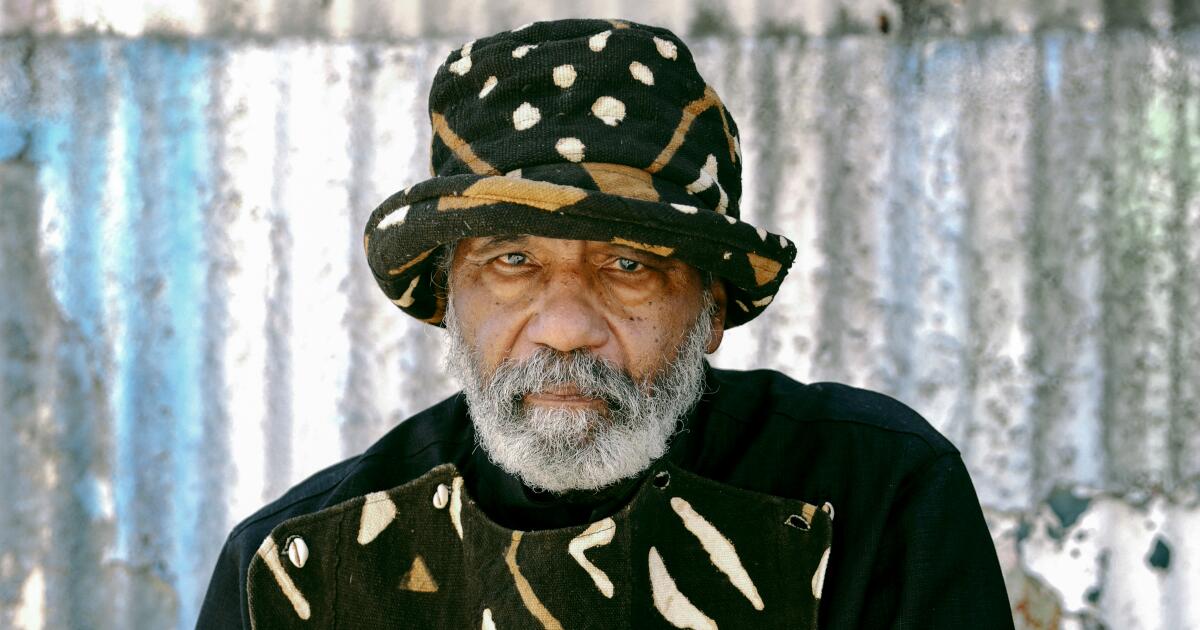
Ulysses Jenkins, the pioneering Los Angeles-born video artist whose avant-garde compositions embodied Black experimentalism, has died. He was 79.
Jenkins’ death was confirmed by his alma mater Otis College, where he studied under renowned painter and printmaker Charles White in the late 1970s and returned as an instructor years later. The Los Angeles art and design school shared a statement from the Charles White Archive, which said, “Jenkins had a profound impact on contemporary art and media practices.”
“A trailblazing figure in Black experimental video, he was widely recognized for works that used image, sound, and cultural iconography to examine representation, race, gender, ritual, history, and power,” the statement said.
A self-proclaimed “griot,” Jenkins throughout his decades-spanning career maintained an art practice grounded in the tradition of those West African oral historians who came before him. Through archival documentaries like “The Nomadics” and surrealist murals like “1848: Bandaide,” he leveraged alternative media to challenge Eurocentric representations of Black Americans in popular culture.
He was both an artist and a storyteller who sought to “reassert the history and the culture,” he told The Times in 2022. That year, the Hammer Museum presented Jenkins’ first major retrospective, “Ulysses Jenkins: Without Your Interpretation.”
“Early video art was about the problems with the media that we are still having today: the notions of truth,” Jenkins said. “To that extent, early video art was a construct that was anti-media … a critical analysis of the media that we were viewing every night.”
Born in 1946 to Los Angeles transplants from the South, Jenkins was ambivalent about the city, which offered his parents some refuge from the blatant systemic racism they encountered in their hometowns, but housed an entertainment industry that had long perpetuated anti-Black sentiment.
“What Hollywood represents, especially in my work, is the classic plantation mentality,” Jenkins told The Times in 1986. “Although people aren’t necessarily enslaved by it, people enslave themselves to it because they’re told how fantastic it is to help manifest these illusions for a corporate sponsor.”
Jenkins, who participated in a group of artists committed to spontaneous action called Studio Z, was naturally drawn to video art over Hollywood filmmaking. “I can address any issue and I don’t have to wait for [the studios’] big OK. I thought this was a land of freedom, and video allows me that freedom and opportunity that I can create for myself and at least feel that part of being an American,” he said.
Jenkins went on to deconstruct Hollywood’s vision of the Black diaspora in experimental video compositions including “Mass of Images,” which incorporates clips from D.W. Griffith’s notoriously racist “The Birth of a Nation,” and “Two-Tone Transfer,” which depicts, in Jenkins’ words, a “dreamscape in which the dreamer awakens to a visitation of three minstrels who tell the story of the development of African American stereotypes in the American entertainment industry.”
Jenkins’ legacy is not only artistic but institutional, with the luminary having held teaching appointments at UCSD and UCI, where he co-founded the digital filmmaking minor with fellow Southern California-based artists Bruce Yonemoto and Bryan Jackson.
As artist and educator Suzanne Lacy penned in her social media tribute to Jenkins, which showed him speaking to students at REDCAT in L.A., “he has been an important part of our histories here in Southern California as video and performance artists evolved their practices.”

For filmmaker Chloé Zhao, creative life was never linear

Apple’s website leaks MacBook ‘Neo,’ which could be its new cheaper laptop

Ambassador Huckabee describes ‘best option’ for Americans looking to flee Israel

Fraud-plagued Minnesota sues Trump admin for withholding $243M in Medicaid payments

Seniors over 80 who eat specific diet may be less likely to reach 100 years old

Florida High School Football Rankings: Top 25 teams – Oct. 21

Cleary's 21 help Le Moyne down Central Connecticut State 69-64 in OT

How old is Bo Nix? What to know about Oregon quarterback ahead of 2024 NFL Draft

99th annual Pony Swim held in Virginia

Indiana Members Credit Union announced as new anchor tenant at Bottleworks District
Fraud-plagued Minnesota sues Trump admin for withholding $243M in Medicaid payments

Is Iran expanding attacks to target energy and civilian sites in the Gulf?

Trump claims US stockpiles mean wars can be fought ‘forever’; Kristi Noem testifies before Congress – US politics live

War in the Middle East: Iran’s broad retaliation in the Gulf • FRANCE 24 English

Trump sends official notification to Congress on strikes against Iran
-

 World6 days ago
Exclusive: DeepSeek withholds latest AI model from US chipmakers including Nvidia, sources say
-

 Massachusetts6 days ago
Mother and daughter injured in Taunton house explosion
-

 Denver, CO6 days ago
10 acres charred, 5 injured in Thornton grass fire, evacuation orders lifted
-

 Louisiana1 week ago
Wildfire near Gum Swamp Road in Livingston Parish now under control; more than 200 acres burned
-

 Oregon4 days ago
2026 OSAA Oregon Wrestling State Championship Results And Brackets – FloWrestling
-

 Technology1 week ago
Arturia’s FX Collection 6 adds two new effects and a $99 intro version
-

 Florida2 days ago
Florida man rescued after being stuck in shoulder-deep mud for days
-

 News1 week ago
Video: How Lunar New Year Traditions Take Root Across America