Business
‘Our stomping ground’: Demolition of historic Valley Plaza mall begins


David Udoff fondly remembers how his mother would drive him and his brother to Valley Plaza in her avocado Dodge Dart.
The family would shop at the once-vibrant and bustling selection of retail businesses. They would visit the Sears, a bakery and the animatronic fortune-telling machine in front of the drugstore. Then they would lunch on Salisbury steak and Jell-O platters at Schaber’s Cafeteria.
“The good old Valley days,” the 67-year-old former North Hollywood and Toluca Lake resident said of his family outings in the 1960s.
Now, swaths of the historic San Fernando Valley mall are being demolished after years of complaints from neighbors that the collection of vacant buildings and parking lots had fallen into disrepair.
The Valley Plaza, which opened in 1951, was among the first and largest open-air shopping malls on the West Coast and a major center of commerce.
In its heyday, the sprawling complex of suburban buildings and modernist high-rises drew crowds and even a visit from John F. Kennedy during his 1960 presidential campaign.
The demolition, which began this week, came after a panel of Los Angeles city commissioners appointed by Mayor Karen Bass voted in August to declare much of the site a public nuisance.
The vote greenlighted the destruction of six buildings in the plaza. Some structures deemed historic, including the iconic 12-story, 165-foot-tall tower — among the first skyscrapers built in L.A. — will be spared.
“It’s crazy that it’s happening. It has been an eyesore in the Valley for so long,” said Stuart Waldman, president of the Valley Industry and Commerce Assn. “We’re excited we are going to have something built there that will be usable.”
The site had drawn squatters, and nearby homeowners voiced concerns about crime and potential fires.
Waldman, who lives nearby, said watching the mall’s deterioration “has been sad.”
He said he expects the property will be turned into a mixed-use commercial and residential space, as was done in the development of NoHo West, which repurposed the site of the former Laurel Plaza mall and a Macy’s department store.
But Waldman warned it could be an uphill battle.
“It’s hard to build in L.A. It is expensive, and the city makes it difficult,” Waldman said. “I hope someone’s going to take a chance. It’s an opportunity to help the community while also making a profit.”
The influential regional shopping center was an early example of how building entrances were reoriented to face large rear parking lots instead of streets and sidewalks, emphasizing vehicle access from newly built freeways, according to the Los Angeles Conservancy.
“This was our stomping ground,” Jack McGrath, a former president of the Studio City Chamber of Commerce, said in a video series on Valley Plaza published by the news outlet Patch in 2013.
McGrath, in the video, described how thousands of people crowded into the mall’s sprawling parking lot to see Kennedy speak.
“This man was absolutely handsome, and more importantly, he had the best-looking tan I’ve ever seen on a man or a politician,” McGrath said. “The women were goofy, looking at this fellow.”
The shopping center’s decline began with the rise of big-box retail, as well as competition from other newer malls in Burbank and Sherman Oaks. Economic strife in the 1990s and damage from the 1994 Northridge earthquake also dealt blows, pushing some businesses to permanently close.
In 2000, about 30% of the mall’s storefronts were vacant, and in recent years film and television producers have used the site as a grimy, boarded-up backdrop — rather than an iconic institution once showcased in the music video for Randy Newman’s 1983 anthem, “I Love L.A.”
On Thursday, piles of dirt, concrete shards and other debris surrounded the property, with a bulldozer watching over.
Fred Gaines, an attorney for Charles Co., the real estate and development firm that owns the property, and which engaged the demolition contractor, said there was not yet a specific redevelopment plan for the site. He said future development would depend on how the city handles homelessness encampments in the area.
“We certainly will look to the city to fix this problem in the neighborhood and allow this to be a viable development site,” Gaines said.
Charles Co. has had its own problems in recent years, as one of the firm’s owners became embroiled in a major L.A. corruption case. Co-owner Arman Gabaee was sentenced in 2022 to four years in federal prison after making payments to a county official in return for leases and nonpublic information.
Udoff, the former Valley resident who currently lives in South Florida, said he tried to move back to L.A. a few years ago, but housing was too expensive. As prices rise in the Miami-area suburb where he lives, he is looking to resettle in a more affordable area in California or Oregon.
In August, he wrote a letter to Bass’ office urging the city to help steer development of the property into a cultural center or subsidized affordable housing.
“How things change,” Udoff said. “They should make it into something really nice.”
Times staff photographer Eric Thayer contributed to this report.



SACRAMENTO — Julianna Arnold wasn’t alarmed when her teen daughter first joined Instagram.
Many people her age were using it. And her daughter Coco had a social life and other hobbies, like track and gymnastics, to balance out her time online.
“It was music and dancing videos and it seemed innocent,” said Arnold, who resides in Los Angeles, explaining that she would look over the content Coco watched.
But Arnold said a man used Instagram to target her daughter while they were living in New York in 2022, sending private messages and acting like a “big brother” to earn her trust. Two weeks after her 17th birthday, Coco met him near her home — and died after taking a fentanyl-laced fake Percocet that he provided.
Similar stories are playing out nationwide as parents grapple with how to protect their children from a myriad of threats online.
As the state is home to many tech giants, Gov. Gavin Newsom has said California is paving the way for legislative restrictions on social media and artificial intelligence. But while child safety advocates agree progress was made at the state capital this year, they argue there’s still a long way to go and plan to fight for more protections when legislators reconvene in January.
“I would say California is definitely leading on this,” said Jai Jaisimha, co-founder of the Transparency Coalition, a nonprofit researching the risks and opportunities associated with AI. “[But] I would love to see a willingness to be a bit stronger in terms of understanding the impacts and taking action faster. We can’t afford to wait three or four years — harm is happening now.”
A survey last year from the Pew Research Center found nearly half of U.S. teens ages 13 to 17 say they’re online “almost constantly.” Nine in 10 teens said they use YouTube, and roughly 6 in 10 said they use TikTok and Instagram. Fifty-five percent reported using Snapchat.
During the recent legislative session, Newsom signed a slate of legislation intended to make the internet safer, particularly for minors.
One new law requires operating system providers to ask account holders for the user’s age when setting up equipment such as laptops or smartphones. The system providers then send a signal to apps about the user’s age range so content can be adjusted for age-appropriateness. Another measure requires certain platforms to display warning labels about the adverse mental health effects social media can have on children.
A third new law requires companion chatbots to periodically remind users they are not interacting with a human and to put suicide prevention processes in place to help those who show signs of distress. A companion chatbot is a computer program that simulates humanlike conversations to provide users with entertainment or emotional support.
Newsom, however, vetoed what was arguably the most aggressive bill, saying it was too broad and could prevent children from accessing AI altogether.
Assembly Bill 1064 would have prohibited making companion chatbots available to minors if the chatbots were “foreseeably” capable of promoting certain behaviors, like self-harm, disordered eating or violent acts. It would also have required independent safety audits on AI programs for children.
“That is one piece that we are going to revisit next year,” said Sacha Haworth, executive director of the Tech Oversight Project. “We are in conversations with members’ offices and the governor’s office about getting that legislation to a place where he can sign it.”
Another organization is taking a different approach.
Common Sense Media Chief Executive Jim Steyer has launched a campaign for a state ballot initiative, dubbed the California Kids AI Safety Act, to take the issue directly to voters. Among other provisions, it would strictly limit youth access to companion chatbots and require safety audits for any Al product aimed at children or teens. It would also ban companies from selling the personal data of users under 18 without consent.
Steyer added that AB 1064 had widespread support and likely would have been signed were it not for the tech industry’s aggressive lobbying and threats to leave the state.
“In the world of politics, sometimes you have to try and try again,” Steyer said. “[But] we have the momentum, we have the facts, we have the public and, most of all, we have the moral high ground, so we are going to win.”
Ed Howard, senior counsel and policy advocate for the Children’s Advocacy Institute at the University of San Diego, said one of its goals for next year is to give more teeth to two current laws.
The first requires social media platforms to provide a mechanism for minors to report and remove images of themselves being sexually abused. The second requires platforms to create a similar reporting mechanism for victims of cyberbullying.
Howard said the major platforms, like TikTok, Facebook and Instagram, have either not complied or made the reporting process “incredibly difficult.”
“The existence of such imagery haunts the survivors of these crimes,” he said. “There will be a bill this year to clean up the language in [those laws] to make sure they can’t get away with it.”
Howard believes legislators from both sides of the aisle are committed to finding solutions.
“I’ve never before seen the kind of bipartisan fury that I have seen directed at these [tech] companies,” he said.
Lishaun Francis, senior director of behavioral health for Children Now, said the organization is still exploring potential legislative priorities for 2026.
She explained they often take a measured approach because stronger legislation tends to get tied up in lawsuits from the tech industry. Meta, Google and TikTok, for example, are challenging a California law enacted last year that restricts kids’ access to personalized social media feeds.
“We are still trying to do a little bit more research with our young people about how they want to interact with AI and what they think this should look like,” Francis said. “We think that is an important missing piece of the conversation; you’ve just got a bunch of 40-and-up adults in the room talking about technology and completely ignoring how young people want to use it.”
David Evan Harris, senior policy advisor for the California Initiative for Technology and Democracy, said he’s keeping an eye on Washington as he prepares for the state session.
“There are people in Congress and in the White House who are trying to make it impossible for states” to regulate AI, he said. “They want to take away that power from the states and not replace it with any type of federal regulation, but replace it with nothing.”
The White House has a draft executive order on hold that would preempt state laws on artificial intelligence through lawsuits and by withholding federal funds, Reuters reported Saturday.
When advocates speak out at the statehouse next year, Arnold will be among them. Since her daughter died three years ago, she has co-founded Parents Rise — a grassroots advocacy group — and works to raise awareness about the risks youth face online.
Even before Coco was targeted by a predator, Arnold said technology had already taken a toll on their lives. Her once-lively daughter became addicted to social media, withdrawing from activities she used to love. Arnold took Coco to therapy and restricted her time online, but it resulted in endless fights and created a rift between them.
“You think your kid is safe in their bedroom, but these platforms provide a portal into your home for predators and harmful content,” Arnold said. “It’s like they’re just walking through the front door.”

Oracle founder Larry Ellison was on the cusp of conquering Hollywood.
Just four months earlier, he had bankrolled his son David’s $8-billion acquisition of the storied Paramount Pictures.
Now the Ellison family had designs on scooping up Warner Bros. Discovery, too, offering to buy the entire company for at least $60 billion. The bold play had suddenly thrust this Silicon Valley titan and his son, David — chief executive of the newly-merged Paramount Skydance — into one of the most powerful positions in the film and TV industry.
By most outward appearances, Warner Bros. Discovery was theirs for the taking. Wall Street analysts, Hollywood insiders and even some of the other bidders expected Paramount to prevail. After all, it was backed by one of the world’s richest men. And it even had the blessing of President Trump, who openly expressed his preference for the Paramount bid.
But Ellison’s crowning moment was ruined when Netflix swooped in Friday announcing its own blockbuster deal.
The streamer snapped up Warner Bros. in a $82.7-billion deal for the Burbank-based film and television studios, HBO Max and HBO, delivering a massive blow to Ellison and his son, David.
In the Paramount bid, Larry Ellison was once again the primary backer. But the Warner Bros. Discovery board believed the Netflix offer of $27.75 a share, which did not include CNN or other basic cable channels, was a better deal for shareholders.
The announcement stunned many who had predicted that Paramount would prevail in the contentious auction. It also marked a rare defeat for Ellison, who was outmaneuvered by none other than Netflix’s co-Chief Executive Ted Sarandos and his team.
Analysts and multiple auction insiders told The Times several factors complicated the process, including Paramount’s low-ball offers and hubris.
“This is a bad day for for Paramount and for the Ellisons,” said Lloyd Greif, president and chief executive of Greif & Co., a Los Angeles-based investment bank. “They were overconfident because they underestimated the competition.”
Representatives of Paramount and Warner declined to comment. A representative for Ellison at Oracle did not respond to requests for comment.
Characteristically, Ellison is not backing down, say sources close to the tech mogul who were not authorized to comment. Paramount — whose chief legal counsel is the former head of the U.S. Justice Department’s antitrust division during the first Trump term — is preparing for a legal battle with Warner Bros. over the handling of the auction. They are expected to urge the Securities & Exchange Commission and the Department of Justice to investigate claims that the Netflix deal would be anticompetitive and harmful to consumers and theater owners.
Paramount’s lawyers sent Warner Bros. Discovery Chief Executive David Zaslav a blistering letter Wednesday, accusing the studio of rigging the process in favor of a “single bidder” and “abdicating its duties to stockholders.”
What went wrong
Several sources said Paramount’s first mistake was making low-ball offers.
Paramount submitted three unsolicited bids by mid-October, the first for $19 a share. Warner’s board of directors unanimously rejected all of the bids as too low.
Top Warner Bros. executives were incensed, feeling that the Ellisons had just shown up in Hollywood and now were throwing their weight around to take advantage of Warner Bros.’ struggles.
Paramount had Larry Ellison guaranteeing its Warner bid with $30 billion of his Oracle stock, according to one knowledgeable person who was not authorized to comment.
But as the price of Warner went higher, Paramount needed considerably more money. It turned to private equity firm Apollo Global Management.
In late October, Warner opened the bidding to other suitors. Netflix and Comcast jumped in. Paramount’s leaders seemed to underestimate Netflix, according to several people close to the auction. A senior Netflix executive had publicly downplayed its interest.
“Maybe Netflix was playing possum,” said Paul Hardart, a professor at New York University’s Stern School of Business.
Paramount “thought they were the only game in town,” said a person close to the auction who was not authorized to comment.
At one point, Paramount’s team seemed more concerned about the movements of Comcast Chairman Brian Roberts, who had visited Saudi Arabia, reportedly on theme park business.
David Ellison and RedBird’s Gerry Cardinale were scrambling to line up Middle Eastern sovereign wealth funds to provide more financing for their offer.
“They were going around trying to get money from elsewhere and that probably sowed some doubts among the board at Warner Bros. Discovery,” Hardart said.
Paramount’s negotiations with wealth funds for Saudi Arabia, Qatar and the United Arab Emirates were widely noted, people close to the auction said.
“It invited skepticism of the strength of the Paramount commitment,” said C. Kerry Fields, a business law professor at the USC Marshall School of Business.
When Oracle stock started dropping amid concerns of an AI bubble, it left Paramount‘s bid in a more precarious position.
Worries over Trump ties
In Hollywood, Larry Ellison’s close ties to Trump dampened enthusiasm for Paramount’s bid.
Oracle is among a group of U.S. investors expected to hold a majority stake in the U.S. business of TikTok, after the hugely popular video sharing app is spun out from Chinese parent company ByteDance — in no small part due to the influence and support from Trump.
This summer, Paramount agreed to pay $16 million to settle Trump’s lawsuit against CBS for its edits of a “60 Minutes” interview with Kamala Harris, as it was seeking to gain regulatory approval for the Ellison Skydance takeover. Days later, Paramount’s CBS announced that it was ending Stephen Colbert’s late-night talk show, citing its financial losses.
David Ellison in October made a controversial hire of the Free Press founder Bari Weiss to run CBS News — which delighted the president.
“Larry Ellison is great, and his son, David, is great,” Trump told reporters in mid-October. “They’re big supporters of mine.”
After Trump’s reported intervention, Paramount agreed in late November to distribute Brett Ratner’s “Rush Hour 4,” a project that had been shelved amid sexual assault allegations against the director highlighted in a Los Angeles Times report. Ratner has disputed all the allegations against him.
“They were in the pole position with the Trump administration, but then that [position] started to be not as appealing to people,” Hardart said.
Last month, there was a meeting at the White House to discuss Paramount’s bid and the threat of Netflix, sources said. That same week, David Ellison was among the guests at a White House dinner hosted by Trump for Mohammed bin Salman, the crown prince of Saudi Arabia.
A report in the Guardian also raised alarm bells among some foreign regulators, one knowledgeable person said. The newspaper reported, citing anonymous sources, that White House officials had informally discussed with Larry Ellison several female CNN anchors whom Trump disliked and wanted fired should Paramount succeed in buying Warner.
People close to Paramount contend that Zaslav and his mentor, John Malone, who serves as a Warner board member emeritus, were biased against Paramount and that Zaslav is angling to retain his mogul status.
Paramount ultimately submitted six offers to Warner, including a final $30 a share offer, but none were as strong as Netflix’s proposal, said two people involved with the auction.
Paramount executives knew last Monday that they had been bested, according to people close to the company. Two days later, they lobbed a missive at Warner: “WBD appears to have abandoned the semblance and reality of a fair transaction process,” Paramount’s lawyers wrote.
Netflix said Friday its deal won’t close for a year to 18 months, the anticipated time it will take to win regulatory approval. That’s far from guaranteed, however, given possible antitrust concerns over Netflix’s market dominance.
Now they’re girding for fight with Warner Bros. Discovery over its handling of the auction.
Until recently, Larry Ellison was perhaps best known in Hollywood circles for playing himself in an “Iron Man 2” cameo during which Tony Stark refers to him as the “Oracle of Oracle” — and as the father who quietly bankrolled the film business careers of his children, David and Megan.
Those who know Larry Ellison say he should not be counted out.
At 81, a determined and resolute Ellison has shown no signs of slowing down. Although he stepped down as Oracle’s CEO in 2014, he remains its executive chairman and chief technology officer — and continues to be deeply involved in the company and its growing tentacles.
Larry Ellison, third from right at the White House with President Donald Trump, SoftBank CEO Masayoshi Son and OpenAI CEO Sam Altman, appears to announce Stargate, a new AI infrastructure investment.
(Andrew Harnik / Getty Images)
“He keeps reinventing the company. Right when you think that they can’t figure it out, they figure it out and they’re pretty resilient,” said Brent Thill, a tech analyst at Jefferies.
The son of a 19-year-old unwed mother, Ellison grew up in a modest walk-up apartment on Chicago’s South Side, where he was raised by her aunt and uncle.
As he told Fox Business, “I had all the disadvantages necessary for success.”

Larry Ellison at the Oracle OpenWorld 2018 conference in San Francisco.
(Bloomberg via Getty Images)
Smart and headstrong, Ellison attended the University of Chicago, but dropped out and drove to California in a used Thunderbird. He got a job as a bank computer programmer, the first of several computer jobs at various companies.
In the early 1970s, Ellison began working on early databases for a company called Ampex. As the story goes, it became the precursor to Oracle’s systems.
By 1977, Ellison co-founded Oracle with $1,200 and ideas deeply inspired by an IBM research paper. The start-up transformed how companies and organizations stored, managed and retrieved huge volumes of data. The software company quickly became an influential tech giant. Oracle’s first contract was with the CIA.
In 1986, Oracle went public and seven years later Ellison landed for the first time on Forbes billionaire’s list, with a net worth of $1.6 billion.
Even among the ego-driven billionaire eccentrics of Silicon Valley, Ellison stood out. “The Difference Between God and Larry Ellison” is the title of a 1997 biography — one of at least 10 tomes examining the life of Larry.
Unlike many of his tech titan peers, who preferred quiet pursuits and carefully crafted public personas, Ellison reveled in his flamboyant escapades and the attention it attracted.
Ellison has flown fighter jets for fun, won the America’s Cup, twice (in 2010 and 2013), collected super yachts, mansions and samurai swords.
As both Oracle’s and Ellison’s fortunes swelled, he earned a reputation for ruthlessness. For years, his archnemesis was Microsoft founder Bill Gates. During the rival’s antitrust trial in 2000, Ellison not only admitted to hiring private investigators to go through Microsoft’s garbage but he also defended his actions, calling the move his “civic duty.”
Mike Wilson, one of Ellison’s biographers, called him “the Charles Foster Kane of the technological age.”
At Oracle, Ellison pushed to expand into cloud computing, healthcare and, more recently, artificial intelligence, forging close partnerships with AI chipmaking behemoth Nvidia, Meta and xAI.
Hollywood, however, was the domain of Ellison’s children, David and Megan, whom he had with his third wife, Barbara Boothe. They divorced shortly after Megan was born.

Larry Ellison and his children, the producers Megan Ellison and David Ellison.
(Lester Cohen / WireImage)
The Ellison scions grew up with their mother on a horse farm in Woodside, in the San Francisco Bay Area, and spent time with their father during school breaks, sailing around the world on one of his super yachts.
Early on, the tech entrepreneur set up trusts for his children with large tranches of stock in Oracle and later NetSuite, an enterprise software company he helped finance, that went public in 2007. Over time, the trusts, in addition to their independent holdings, have made David and Megan phenomenally wealthy.
With Ellison’s deep pockets, both pursued filmmaking. Megan launched Annapurna, an indie production company behind such acclaimed movies as “Zero Dark Thirty” and “Her.” David, after a brief, unsuccessful stint as an actor and producer of the 2006 flop “Flyboys,” established Skydance Media, bankrolling a slew of massive box office and television hits such as “Top Gun: Maverick,” “Star Trek” and “Grace and Frankie,” later broadening into animation, sports and gaming.
“David made money, his sister made the art,” said Stephen Galloway, dean of Chapman University’s Dodge College of Film and Media Arts.
And Larry Ellison often stepped in.
In 2018, he shepherded a major reorganization of Annapurna after the company stumbled into hundreds of millions in losses amid several box office misfires.
It was Ellison who put up the bulk of his son’s $8-billion bid to buy Paramount, the iconic studio, as well as CBS, MTV and other properties — and he holds nearly 78% of the newly formed company’s stock, making him its largest shareholder.
The Ellison family announced plans to remake the fabled Paramount studio through major investments, leveraging technology and building on popular franchises including “Top Gun,” “Star Trek” and “Yellowstone.”
And they aren’t ready to walk away from Warner Bros.
If history has proven anything, Ellison is always up for a fight.
Times staff writer Queenie Wong contributed to this report.
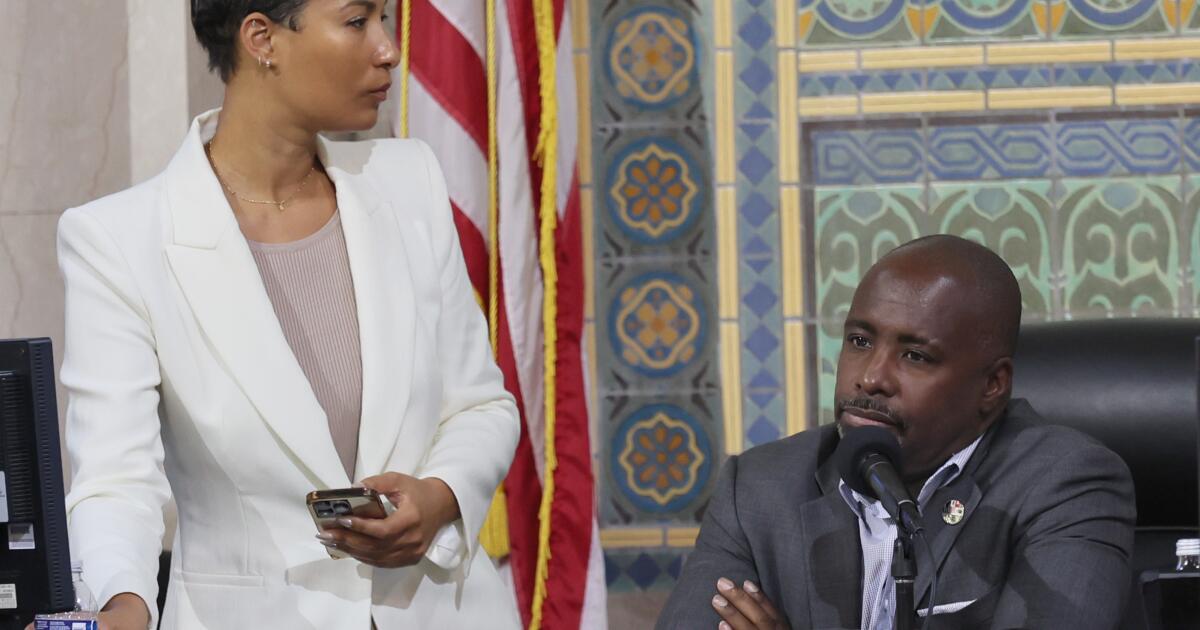
The fight over an effort to boost wages for Los Angeles tourism workers to coincide with the 2028 Olympics has taken a fresh twist, with the City Council president introducing a new motion that critics say would significantly water down the measure.
The issue ostensibly had been put to rest in September, when a business group-backed effort to repeal a $30 per hour minimum wage for Los Angeles hotel and airport workers failed to secure enough signatures to qualify for the ballot.
But now, L.A. City Council President Marqueece Harris-Dawson has introduced a motion that, if approved, would phase the increase in over a longer period of time — delaying the full $30 hourly minimum wage until 2030.
Rhonda Mitchell, a spokesperson for Harris-Dawson, said the council president “continues to work with partners around negotiations,” but did not provide other details when asked for comment by The Times on Friday.
Hospitality and service employee unions sharply criticized the proposal.
“It is a shameful day in Los Angeles when our own elected leaders decide to put forth a motion to strip hard-earned wages from some of the city’s lowest-paid workers,” Yvonne Wheeler, president of the Los Angeles County Federation of Labor, said in a statement Friday. “These workers fought for more than two years to improve their working conditions, only to have the very people who should defend them try to take it all away.”
But Rosanna Maietta — president and chief executive of the American Hotel and Lodging Assn., which had supported repealing the wage increase — said relief from higher labor costs is much-needed in an industry that has struggled to bounce back from pandemic shutdowns. The business group urges the council to “swiftly adopt” the new proposal, she said.
“Hotels are essential to the vitality of Los Angeles, supporting tens of thousands of jobs and generating critical tax revenue that funds essential services like schools, sanitation, and public safety,” Maietta said in a statement Friday. “This motion is a long-overdue step in the right direction and provides hotel owners and operators with short-term relief in the face of decreased travel demand and rising operational costs.”
The City Council originally voted in May to approve a series of yearly wage increases for hotel employees and workers at Los Angeles International Airport, following a two-year campaign by labor organizers.
The law was put on hold during the subsequent opposition ballot campaign, but recently went into effect, with workers seeing the first increments in a series of wage increases designed to boost their minimum pay to $30 per hour by 2028.
The new proposal put forth by Harris-Dawson would instead offer smaller annual wage increases, eventually boosting the workers’ wages to $30 two years later, in 2030.
Harris-Dawson backed the original proposal and helped ease it through a council vote. His spokesperson did not elaborate on why he now supports altering the timeline.
However, the motion comes after a coalition of airline and hotel businesses filed paperwork for a ballot measure to repeal the city’s business tax — a move that would strip about $740 million annually from the city’s general fund, which pays for police officers, firefighters and other services.
The business-backed referendum has been approved to circulate for signatures, and is backed by several airlines as well as the American Hotel and Lodging Assn.
David Huerta, president of SEIU-United Service Workers West, which represents airport workers, said the timing of the motion, in the middle of the holiday season, was “particularly callous.”
“We stand ready to defend the Olympic Wage,” he said in a statement.
The proposal now heads to two committees — one dealing with economic development, the other focused on tourism — for consideration.
Times staff writer David Zahniser contributed to this report.

Red Dead Redemption is so back

Christian pastors, influencers join 1,000-strong Israel mission backing Jewish state, fighting antisemitism

Congress faces holiday crunch as health care fix collides with shrinking calendar

Psychiatrist reveals how simple mindset shifts can significantly reduce chronic pain

Duke upsets Virginia in overtime to claim ACC title, possibly shaking up CFP picture

Florida High School Football Rankings: Top 25 teams – Oct. 21

Cleary's 21 help Le Moyne down Central Connecticut State 69-64 in OT

How old is Bo Nix? What to know about Oregon quarterback ahead of 2024 NFL Draft

99th annual Pony Swim held in Virginia

Video: ‘It Didn’t Have to Happen This Way:’ U.Va. Faculty Call for Review of Police Response to Protests
Congress faces holiday crunch as health care fix collides with shrinking calendar

European Greens declare Usula von der Leyen`’s EPP enemy number one

National parks fee-free calendar drops MLK Day, Juneteenth and adds Trump’s birthday

Map: 7.0-Magnitude Earthquake Shakes Alaska

Hegseth hints major defense spending increase, reveals new details on Trump’s anti-narcoterrorism operations
-

 Politics5 days ago
Trump rips Somali community as federal agents reportedly eye Minnesota enforcement sweep
-

 Ohio3 days ago
Who do the Ohio State Buckeyes hire as the next offensive coordinator?
-

 News5 days ago
Trump threatens strikes on any country he claims makes drugs for US
-

 World5 days ago
Honduras election council member accuses colleague of ‘intimidation’
-

 Texas22 hours ago
Texas Tech football vs BYU live updates, start time, TV channel for Big 12 title
-
 Politics1 week ago
Rep. Swalwell’s suit alleges abuse of power, adds to scrutiny of Trump official’s mortgage probes
-

 Politics5 days ago
Trump highlights comments by ‘Obama sycophant’ Eric Holder, continues pressing Senate GOP to nix filibuster
-

 Politics6 days ago
War Sec Pete Hegseth shares meme of children’s book character firing on narco terrorist drug boat