California
Airman at Vandenberg Space Force Base dies in heavy machinery incident, officials say

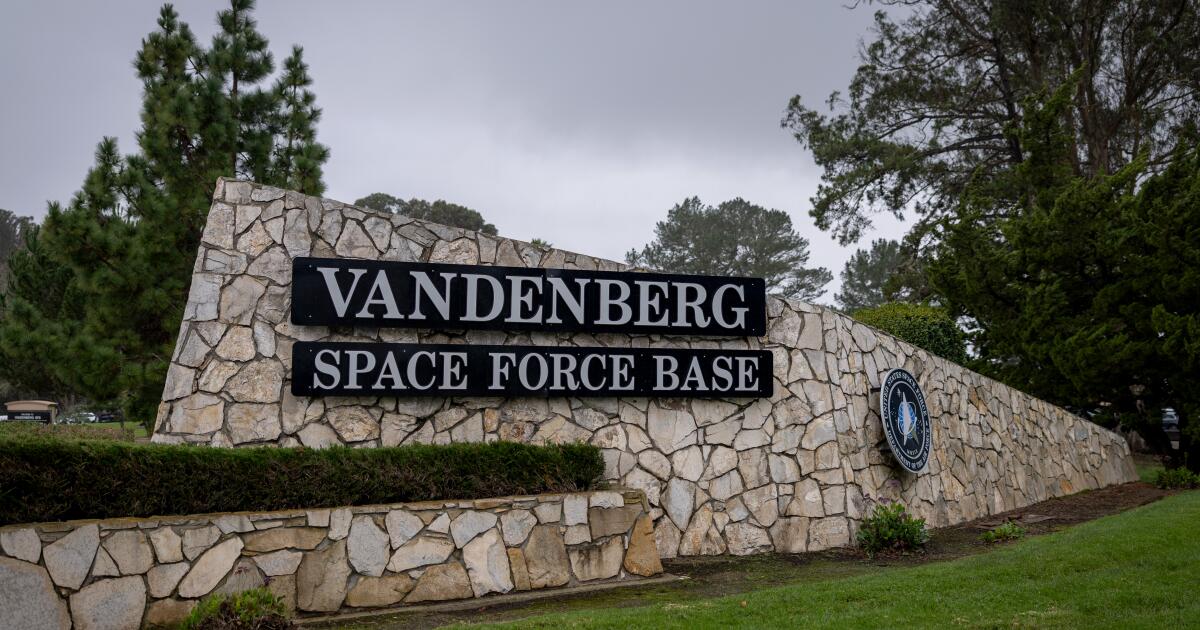
A California airman died Thursday after the heavy machinery he was operating rolled down an embankment at a military base, officials said.
Airman 1st Class Cedric Eneluna was a member of the 30th Civil Engineer Squadron Pavements and Equipment Flight at Vandenberg Space Force Base in Santa Barbara County. He was part of the “Dirt Boyz,” a nickname for heavy construction and civil engineering specialists in the Air Force.
Eneluna, along with other technicians, ensured maintenance and safety of the base’s launch, testing and range operations, according to officials.
He was 23.
Military base officials said an investigation into Eneluna’s death is ongoing. The Santa Barbara coroner’s office has not release an official cause of death, nor did it respond to a request for comment Saturday afternoon.
Eneluna joined the military in March 2024, and was assigned to a post in August of that same year. According to officials, Eneluna “served with professionalism, humility, and an unwavering commitment to his teammates and the mission.”
On Facebook, his mother, Myra Locsin, said Eneluna was excited to continue his military training in Chicago. Locsin shared that four of her son’s brothers in service knocked on her door Thursday night to break the news.
“I thought you were hiding behind them to surprise me but it was the moment that any parent didn’t want to experience,” Locsin wrote in a Facebook post. “I love you son! You had been a very good son. Loving, responsible and smart kid.”
Originally from the Philippines, Eneluna grew up in St. Louis. While in the Philippines, he attended UNO-R Senior High, a private, Catholic university, according to his Facebook page.
“He brought out the best in everyone,” said U.S. Air Force Lt. Col. Seth Poulsen, 30th CES commander. “He was always ready to work, always willing to help, and always had a positive attitude. He truly represented what it means to be an Airman.”


ESSENTIALS
Firm Name: Anacapa Architecture
Principal: Dan Weber
Headquarters: Santa Barbara, California
Accolades: Forbes Architecture’s “America’s Top 200 Residential Architects,” 2025; Forbes Architecture’s “America’s Best-in-State Residential Architects,” 2025
House Name: Off-Grid Guest House
Location: Central California Coast
Area & Layout: 1,800 square feet; 2 BR, 2 BA
Architectural Photographer: Erin Feinblatt (erinfeinblatt.com), Aaron Leitz (aaronleitz.com)
Architects often talk about connecting houses to their settings. But it’s hard to think of an example so seamless as the one Anacapa Architecture devised on a remote stretch of California’s Central Coast. Conceived as a guest house for a nearby residence, the building burrows into the surrounding hillside and is concealed beneath a planted roof, making it barely visible among the emerald bluffs cascading down to the Pacific.
The 1,800-square-foot structure consists of two offset boxes bisected by a staircase that descends from the parking area above. The larger box is wrapped in glass and cantilevered over the hillside, delivering dizzying views from the living, dining, kitchen and bedroom areas within. The smaller volume contains a primary bedroom and bath oriented toward a window wall at one end.
“We worked carefully to position the structure within the natural contours of the property, preserving existing vegetation and reducing the need for significant site disturbance,” says architect Dan Weber, founder and principal of the Santa Barbara–based firm. Since utilities are scarce here, and the primary residence is several hundred yards away, the guest house is powered by a photovoltaic solar array; the surrounding berms help insulate the interior, as does the rooftop garden, which also reduces stormwater runoff. Large overhangs and retractable glass walls keep the interior shaded and breezy.
Inside, the material palette feels as primal as the setting, with exposed steel columns and concrete walls and floors tempered by the warm glow of walnut ceilings and cabinetry. Furnishings are spare, so as not to distract from the view, which can be engulfed in a dense veil of fog one moment, then clear to reveal an undulating carpet of green that stretches to the sea.
Anacapa has several other projects in the works that revolve around sustainability, resiliency and low-impact living. “The Off-Grid Guest House represents a growing interest among our clients in thoughtful, resource-conscious design,” Weber says. “And we expect that conversation to become even more important in the years ahead.”
ABOVE: “An expansive terrace extends toward the canyon beyond,” Weber says, “dissolving the boundary between shelter and the natural environment.” Oversized pavers link the glass-walled living area with the more private bedroom wing, at left.
Erin Feinblatt ABOVE: “The guest house emerges from the hillside, carefully positioned to minimize disturbance while framing expansive views and seasonal coastal fog,” Weber says.
Erin Feinblatt ABOVE: Floor-to-ceiling glazing and generous overhangs create a seamless connection between interior living spaces and the surrounding landscape, which changes with the vicissitudes of the fog.
Erin Feinblatt ABOVE: Living, dining and kitchen areas are confined to a single shared space crowned by a walnut ceiling that extends out over the surrounding terrace. The radiant concrete floors are powered by a photovoltaic solar array, since the guest house is not connected to utilities. Erin Feinblatt ABOVE: Rugged, board-formed concrete walls anchor the house to the hillside, and are left exposed in keeping with the home’s earthy aesthetic, which interior designer Jessica Helgerson underscored with leather furnishings and a live-edge walnut table. “Natural materials and restrained detailing focus attention on the surrounding landscape, making the view the centerpiece of the dining experience,” Weber says.
Erin Feinblatt ABOVE: A doorway to the right of the kitchen conceals a secondary bedroom, tucked at the rear of the guest house’s main wing. “The board-formed concrete, walnut millwork and weathering steel create a tactile palette that reflects the rugged character of the site,” Weber observes.
Erin Feinblatt ABOVE: The driveway deposits visitors at a freestanding garage. From there, they descend down a staircase sandwiched between the planted roofs of the guest house’s two wings, emerging into panoramic ocean views at the bottom.
Erin Feinblatt ABOVE: “Perched along a remote ridgeline overlooking the Pacific, the Off-Grid Guest House glows against the coastal landscape, operating independently from traditional utility infrastructure,” Weber says.
Aaron Leitz
More from America’s Top Architects
California
Forest Service workers held hostage at gunpoint by father, son in CA forest for hours: Authorities

SISKIYOU COUNTY, Calif. — Law enforcement in far Northern California’s Siskiyou County announced the arrests of a father and his adult son in the alleged kidnapping of two U.S. Forest Service workers, who are now safe and free.
The sheriff says they got a call around 10:55 a.m. Thursday from the Forest Service that a man had taken two Forest Service employees hostage in a very remote area.
The 49-year-old suspect had zip-tied the two Forest Service workers, holding them at gunpoint for nearly 15 hours in a trailer near Gumboot Lake in the Shasta-Trinity National Forest, officials said.
The suspect indicated he wanted to speak with the FBI, but it remains unclear why. Officials are still investigating motives for the kidnapping.
A huge contingent of law enforcement moved into the area. The FBI’s Hostage Rescue Team arrived on a Boeing 757 from Quantico as snipers, SWAT teams, bomb units, and drones were deployed.
Dashcam footage shows armed officers in tactical gear hitching a ride from a passing pickup truck.
Eventually, after many hours of negotiating, the two Forest Service workers were released just before 2 a.m. and are now safe at home.
The suspect and his adult son came out and were arrested at around 2:30 a.m.
The father will be charged with kidnapping a federal employee. In the trailer, he had an AR-15, knives, and claimed to have grenades.
It’s unclear if the trailer was his, but it did not belong to the Forest Service.
ABC7 Eyewitness News contributed to this story.
Copyright © 2026 ABC News Internet Ventures.
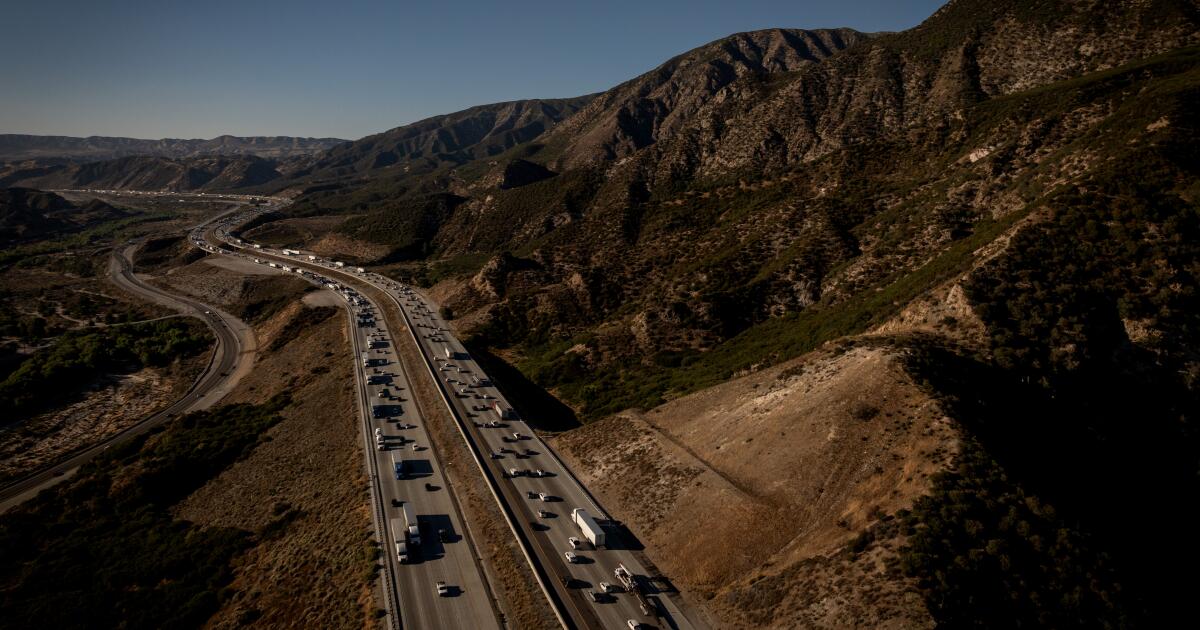
It lurks ominously beneath California’s many natural wonders, a reminder that nothing in this landscape is truly permanent.
It’s been described as “the mother of all earthquake faults,” the source of both our geological birth and, perhaps, our ultimate undoing.
But the most unnerving thing about the San Andreas fault these days may be its silence. It’s a mystery scientists are still trying to unlock.
The San Andreas is central to any discussion of California. It’s the massive 800-mile spine of the state, trundling up the Coachella Valley to the San Gabriel Mountains, and pushing along the edge of Silicon Valley to beyond the Golden Gate.
There is no simple answer for why California’s longest fault, responsible for some of America’s most powerful earthquakes, has produced so few in the last century.
But it is clear that the quiet period is only increasing strain on the San Andreas, as well as on the state’s second-longest fault, the San Jacinto.
A new study underscores the concern. Researchers estimated that key sections of the fault in Southern California are at their highest level of tectonic strain in the last 1,000 years.
The San Andreas, in other words, is locked, loaded and inevitable.
A red-hot San Andreas
Tectonic stress on these sections of the San Andreas and San Jacinto faults is high — shown in red — a product of no significant quakes on them for more than a century. At the Cajon Pass, sections of the faults are at their highest strain in 1,000 years, calculations suggest.
Average tectonic stress, in megapascals

Liliane Burkhard / University of Bern / University of Hawai’i at Manoa; Statewide California Earthquake Center Community Fault Model
Sean Greene LOS ANGELES TIMES
Ticking tectonics
There are generations of Californians who have never experienced the fury of the San Andreas.
The fault was responsible for a megaquake that ripped through the then-sparsely populated state in 1857 — an event that, if repeated today, would reap mass destruction.
In 1906, “a crack in the edge of the world,” as author Simon Winchester described it, flattened San Francisco.
Modern Californians have been forced to make do with Hollywood’s CGI versions of the fault, which cast it as one of our state’s darkest villains.
But sooner or later, scientists say, California’s earthquake faults will rupture in a way not seen in the modern era. While California has seen sizable temblors since the great San Francisco quake of 1906, the state’s faults are capable of producing intense shaking over a much larger area than seen during more modern events such as the Sylmar, Loma Prieta or Northridge quakes.
“We keep accumulating that earthquake energy, and it has to be released. And the only way it gets released is through large earthquakes,” said U.S. Geological Survey geologist Kate Scharer, one of the new study’s co-authors. “The small ones don’t really do it.”

A section of the California Aqueduct crisscrosses the San Andreas fault dozens of times.

-
Share via
The latest study, published last month in the Journal of Geophysical Research: Solid Earth, set out to create a model that calculated the seismic strain on three key segments of the San Andreas and San Jacinto faults where they intersect at the Cajon Pass in San Bernardino County.
The model is based on a number of factors: the estimated timing of earthquakes on the faults over a record of the last 1,000 years; satellite observations of how fast tectonic plates are moving; and estimates of how rigid Earth’s crust is, which determines how much stress can be accommodated and then released, Scharer said.
The computer model “found that tectonic stress has now reached higher levels than at any point in that entire record. From the model, we see that the conditions that historically preceded large joint ruptures crossing both fault systems are now approaching,” said Liliane Burkhard, the lead author of the study and a scientist at the University of Bern in Switzerland and the Hawaii Institute of Geophysics and Planetology at the University of Hawaii.
The last major temblor to strike urban Southern California, the magnitude 6.7 Northridge earthquake of 1994, resulted in severe damage and the deaths of about 60 people. But it was also mostly limited to a relatively small area of Los Angeles County.
By comparison, a hypothetical magnitude 7.8 earthquake on the southern San Andreas would simultaneously bring violent shaking to L.A., Orange, Riverside, San Bernardino, Ventura and Imperial counties and could result in 1,800 deaths, according to a U.S. Geological Survey estimate published in 2008.
The findings of the latest study don’t change the overall expectation of a big earthquake hitting Southern California. But they underscore the persistent risk — as well as the possible scale of the disaster.
There’s a 60% chance of a magnitude 6.7 or greater earthquake striking the Los Angeles region by 2045, according to USGS estimates published in 2015. There’s about a 1 in 5 chance of such a quake striking on the San Andreas fault within L.A. County and the Inland Empire.
Why the drought?
The decades-long relative earthquake drought “is an unusually long interseismic period, and stress has been accumulating continuously throughout,” Burkhard said.
The authors created a 28-second animation, showing how tectonic strain increased along the faults over the last 1,000 years. Big earthquakes then release that strain, before the cycle starts again.

This animation condenses 1,000 years of the Cajon Pass’s earthquake history into 28 seconds. Tectonic stress, shown in shades of orange and red, builds up along three fault segments. Following an earthquake, that stress is released. (Liliane Burkhard / University of Bern / University of Hawai’i at Manoa)
The study calculated that the San Andreas fault just northwest of the Cajon Pass and the San Jacinto fault just southeast of the pass are at their highest tectonic strain since the year 1100.


The pass, located roughly 50 miles northeast of downtown Los Angeles, marks the dividing line between the San Gabriel Mountains to the west and the San Bernardino Mountains to the east.
Specifically, the study’s authors calculated that the current tectonic stress was 2.8 megapascals on the San Andreas northwest of the pass, surpassing the previous highs of 2.7 just before big quakes in 1469 and 1691.
For the San Jacinto, the authors calculated a current seismic stress of 3.6 megapascals, surpassing the previous high of 2.9 before an earthquake in the year 1249.
The study noted that it has been an unusually long time since a megaquakes has hit Southern California. The San Andreas fault northwest of the Cajon Pass usually has big quakes every 100 to 150 years, Scharer said, though intervals of about 200 years are not unheard of.
On the San Andreas southeast of the pass, big quakes usually happen every 200 to 250 years. But the most recent quake on the San Andreas along the Salton Sea, close to the Mexican border, was about 300 years ago.
There are some limitations to the study’s model, scientists acknowledge. For instance, the model presumes that when large earthquakes hit, all the tectonic stress that had been accumulated in the fault gets released, “so you start at a ground state of zero and then you accumulate back up until you have that next big event,” Scharer said.
But whether all that stress actually gets released during a big quake is not definitively known.

The Mormon Rocks in Phelan, Calif.
Tectonic risks
Whenever it strikes, a supersized earthquake on the southern San Andreas would be like no earthquake seen in living memory in California.
The 1857 quake, estimated to be a magnitude 7.9, produced 63 times more shaking energy than the 1994 Northridge earthquake, and across a much larger swath of the state.
In 1994, “violent shaking,” or Level 9 on the Modified Mercalli Intensity Scale, causing great damage in substantial buildings, affected only part of the San Fernando Valley.

But a magnitude 7.8 San Andreas quake hypothesized by the USGS in its 2008 ShakeOut scenario would cause that kind of shaking across Southern California.
In 1994, emergency responders from across Southern California were able to focus the bulk of their efforts on especially hard-hit areas. That wouldn’t be possible in a regionwide disaster.


It might be tempting for Californians to tune out talk of the “Big One” after hearing about it for most of their lives. But generational catastrophes do strike — be they an earthquake in San Francisco in 1906, a hurricane in New Orleans in 2005 or tsunamis in the Indian Ocean in 2004 or Japan in 2011.
Tectonic rewards
Earthquakes are part of the bargain of living in California, a product of the same forces that allow people to ski and surf on the same day. The same tectonics that drive earthquakes act as the state’s landscape artists, said Julian Lozos, associate professor of geological sciences at Cal State Northridge.
“Because we are on the edge of the continent, we’re on a plate boundary, and have been a plate boundary for a couple hundred million years. There’s constantly been stuff crashing into North America, and getting stuck to it, and getting uplifted, and erupted through, and slid around,” Lozos said.
The Sierra Nevada, California’s mightiest mountain range, “are the guts of the volcanoes that used to be there when there was a subduction zone … and then when those volcanoes stopped erupting, the guts of them lifted up through the crust,” Lozos said.

Big Pines Highway rises out of a valley to ride a ridge created by the tectonic forces of the San Andreas fault, two miles southeast of the unincorporated Mojave Desert community of Valyermo, home to about 450 residents.
The same forces that produce earthquakes are also what led gold to form in the Sierra foothills, inciting the state’s famous rush.
Tectonic movement also created today’s Central Valley, a highly productive agricultural area that was once part of the ocean, then an inland sea, and then a freshwater lake, Lozos said.
“Everything about what we see here is stuff that formed because of that plate boundary then, and it’s getting moved around by the plate boundary now,” Lozos said. “And so if we didn’t have anything like that, we would be Nebraska.”
But the risks, like the rewards, are significant. The San Andreas runs right through cities in the Inland Empire. The Los Angeles Basin is also at risk.
If an earthquake on the San Andreas comes from the south and heads north, it would shuttle all that shaking energy “right into downtown,” Lozos said, causing shaking that could last two to three minutes.
“Geologically, L.A. is a bowl of Jell-O. It is a hard rock bowl full of really soft, squishy stuff that shakes very easily,” Lozos said.

It is business as usual at the Wrightwood Inn on a recent Tuesday night. According to a recent study, seismic pressure has been gradually building in the area for more than a century.
It’s not certain why it’s been so quiet between earthquakes, said Scharer. Another study, published in 2023, suggested the lack of sudden, major floodwaters funneling into Lake Cahuilla, the larger historical predecessor to the Salton Sea, may have something to do with it.
Scharer said the study’s results are a good reminder to prepare for the next big earthquake.
To be sure, the computer model’s results are not a prediction, and all models have their limitations and uncertainties. Still, its suggestion that the fault systems are “more loaded than at any point in the 1,000-year record,” Burkhard said, “is a finding worth taking seriously.”
“In the end, the most important message is a simple one: Let’s make sure we are prepared,” she said.
-

 Alaska59 seconds ago
US Marshals arrest Nashville rape suspect in Alaska
-

 Arizona7 minutes ago
How the Diamondbacks answered the inevitable trade-deadline questions
-

 Arkansas13 minutes ago
On the ball | Arkansas Democrat Gazette
-

 California19 minutes ago
America’s Top Architects: An Off-Grid California Retreat By Anacapa Architecture
-

 Colorado25 minutes ago
‘Big Boy’ train returns to Colorado in late July. Where to see it
-
Connecticut31 minutes ago
Where to watch Connecticut Sun vs Phoenix Mercury on July 19: TV channel, start time and streaming
-

 Delaware37 minutes ago
New Castle County sees lower home prices, fewer sales
-
 Florida43 minutes ago
Florida’s jobless rate drops for the first time since 2024

