Michigan
Michigan Supreme Court rules rape admission invalid due to LSD use


A man who took a large quantity of LSD before allegedly sexually assaulting his friend was too dazed to legally confess to the incident when deputies questioned him about it hours later, the Michigan Supreme Court ruled Tuesday.
In a 6-1 decision in which the dissenting justice agreed that the case should be retried, the high court sent the case against Zebadiah J. Soriano, 24, back to the trial.
Soriano’s attorney argued that not only was his client high on the hallucinogenic drug when he admitted to being a rapist after being read his Miranda rights, he also was sleep-deprived, hungry and unfamiliar with law enforcement procedures.
“Voluntary intoxication does not make a Miranda waiver per se invalid,” Justice Kimberly Thomas wrote in the opinion. ” … However, the circumstances here undermined Soriano’s ability to make a knowing and intelligent waiver.”
Defense attorney Ali Nathaniel Wright called the decision “a victory for Michiganders and our right to be protected from self-incrimination.”
“The decision serves as a reminder to our lower courts and law enforcement that confessions elicited from hospitalized teenagers who cannot fully appreciate their rights because they are intoxicated and sleep deprived have no place in a court of law,” Wright said in a statement.
‘I am a rapist’
Soriano was 18 years old on the night of Nov. 20, 2020, when he used LSD with a platonic friend, identified in court documents as “AC,” at her home in Grand Traverse County. Records show that Soriano had made romantic advances toward AC in the past, which she had rebuffed.
AC allegedly took one acid tablet while Soriano has claimed that he took six.
AC later told investigators that, a short time later, Soriano disrobed, forced himself on top of her and groped her, according to court documents. When she got away from him, Soriano allegedly caught her and put his arms around her throat. The alleged victim again was able to escape from Soriano, who eventually fell down a flight of stairs and ran out of the house.
Police were called to the scene and found Soriano around two hours after the alleged assault, in a wooded area about a quarter-mile from AC’s home, court documents show. He was acting strangely and making nonsensical statements, so officers transported him to a hospital, where they read him his Miranda rights before he made the incriminating statement that lies at the heart of the case:
“I am a rapist. I am f***ed,” he allegedly told a Grand Traverse sheriff’s deputy.
Convicted of criminal sexual conduct
Soriano was charged in Grand Traverse Circuit Court with assault with intent to commit criminal sexual conduct involving penetration, as well as assault by strangulation, records show.
Before his trial, Soriano filed a motion seeking to suppress the damning statement he made at the hospital, arguing that because he was high on LSD, he was unable to legally waive his constitutional right to remain silent.
The court denied the motion and, in September 2021, a jury convicted Soriano on the criminal sexual conduct charge while acquitting him of assault by strangulation. He was sentenced to three years of probation, six months in jail and ordered to register as a sex offender for life, according to court records.
The suspect later filed a motion seeking a new trial, arguing that his defense failed to support his motion to suppress with expert testimony, records show.
The trial court denied the motion and, in May 2024, an appeals court affirmed Soriano’s conviction in a 2-1 decision, opining that any alleged errors were harmless and unsupported.
“AC’s testimony, particularly when corroborated by other witness testimony, makes it is clear beyond a reasonable doubt that a rational jury would have found defendant guilty absent any potential error in the admission of his statements made while in the hospital,” the Appeals Court judges wrote.
In September 2025, Soriano appealed the decision to the Michigan Supreme Court. Wright wrote in a brief that two hours after Soriano had been interrogated, a deputy told his parents that he was “too out of it” to speak to them.
“If Zebadiah was not sober enough to hold a basic conversation with his parents two hours after his interrogation, then he was not sober enough to knowingly and intelligently waive his constitutional rights or give a voluntary confession,” Wright wrote. “The State should not be permitted to reap the benefits of (the deputy’s) exploitation of a vulnerable teenager.”
Too high to confess?
In a decision filed Tuesday, the Michigan Supreme sided with the defense.
Thomas, writing for the 6-1 majority in a 24-page opinion, said Soriano did not fully understand the rights he was giving up when he told law enforcement that he was a rapist.
“The short period of time between defendant’s erratic behaviors and being advised of his Miranda rights supports the conclusion that defendant was not able to understand his rights at the time of waiver,” Thomas wrote.
The high court also rejected the Court of Appeals’ conclusion that other evidence made the error harmless, determining that Soriano’s hospital statement was an important part of the prosecution’s effort to prove his intent.
“Given the other evidence concerning defendant’s intent, the average jury would have found the prosecution’s case significantly less persuasive without the erroneously admitted statement,” Thomas wrote.
The dissenting justice, Richard Bernstein, disagreed with his colleagues about the legal reason Soriano’s waiver was invalid, but agreed a new trial was warranted.
The ruling reverses the Appeals Court decision, vacates Soriano’s conviction and sends the case back to the trial court for further proceedings.
mreinhart@detroitnews.com



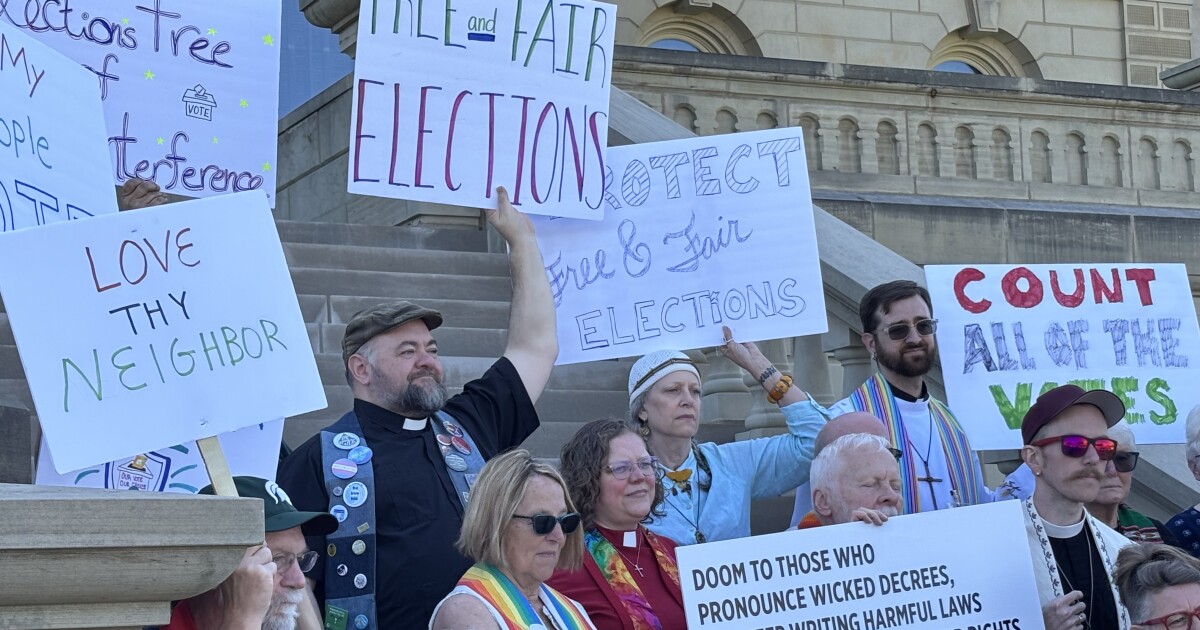
In Detroit, Grand Rapids and Lansing, religious leaders from many faiths gathered Tuesday to speak against what they described as efforts to intimidate and disenfranchise Michigan voters.
Speaking on the steps of the state Capitol building, Rev. Michael Young criticized the Trump administration’s actions leading up to this year’s midterm elections.
“We’re alarmed at the federal government’s attempts to interfere with election administration, efforts that suppress the vote, intimidate voters, limit access to the ballot box and shut eligible voters out of the process,” Young said.
The pastors are especially concerned about the U.S. Justice Department’s plans to send election observers to three Michigan cities to monitor the August primary.
Published reports indicate the monitors would be sent to Detroit, Lansing and East Lansing, communities with traditionally large Democratic voter turnout.
“Sending federal election observers to Michigan; they are not coming to protect the vote,” said Rev. Rudra Dundzila of Brighton. “They are coming to intimidate the voters and disrupt the vote.”
The religious leaders are also concerned about a proposed constitutional amendment that may appear on the November ballot in Michigan. The proposed amendment would require citizenship verification to vote in Michigan elections.

Abdul El-Sayed is leading in the polls ahead of Michigan’s Aug. 4 Senate primary. If he wins the nomination, Democrats will learn fast whether his politics can win a battleground state.

Senate hopeful Haley Stevens booed during Democratic convention
Representative Haley Stevens was met with boos while giving a speech at the Michigan Democratic Endorsement Convention in Detroit on Sunday, April 19.
In 2025, Elissa Slotkin, a Democratic U.S. senator from Michigan, observed the following about her political party: “We’re like a solar system with no sun. We don’t act as a team, and when we don’t work as a team, we turn our guns on each other, and it’s so, so, so, fruitless.”
Fast-forward to now, and the Democratic Party seems to be moving in a distinct direction: far left. Like, socialist left.
From New York to Colorado, newcomer democratic socialists have unseated sitting members of Congress.
But these victories, so far, have come in solidly leftist strongholds. What I’m watching closely is whether a far-left progressive can win in my state of Michigan, a battleground state that helped elect President Donald Trump in both 2016 and 2024.
The Democratic Senate primary here is Aug. 4, and it’s caught the attention of the country because control of the Senate could be decided in the Great Lakes State. Democratic Sen. Gary Peters isn’t running for reelection, giving Republicans a chance to win the seat back.
Democrats must flip four seats to take control of the chamber, and holding Michigan is essential to that math.
To the chagrin of more “moderate” Democrats, candidate Abdul El-Sayed – a former public health official who’s the darling of democratic socialists like Vermont Sen. Bernie Sanders – has done remarkably well in the polls, and he’s maintained a lead over more traditional opponents U.S. Rep. Haley Stevens and state Sen. Mallory McMorrow.
McMorrow suspended her campaign on July 5, first reported by The Detroit News, after weak polling numbers and likely pressure from Democratic Party insiders.
If El-Sayed pulls off a primary win, it could signal which sun the Democratic Party is heading toward.
What works in the primary may not play as well in the general
But El-Sayed may face bigger challenges if he makes it to the November election.
He’ll face off against Republican Mike Rogers, a former congressman who narrowly lost his 2024 Senate bid to Slotkin.
Michigan hasn’t elected a Republican to the Senate in more than 30 years. Yet while Slotkin is a Democrat through and through, she’s adept at appealing to independents and moderates.
That’s not true of El-Sayed, who has palled around with self-identified Marxist streamer Hasan Piker on the campaign trail, in addition to Sanders.
“El-Sayed joins the list of radical leftists running nationally that will also cause consternation amongst mainstream Democrats,” former Michigan Republican Party Chairman Saul Anuzis told me. “Slotkin has already raised the alarm bells and that probably indicates she’s hearing from her constituency, and El-Sayed will need them as well.”
Michigan could determine whether Republicans hold their Senate majority – and it’s the GOP’s best shot at flipping a seat outright.
El-Sayed may be able to rally more radical progressives and the anti-Israel base in the primary, but that message will be a tougher sell to Michigan voters as a whole. As Anuzis put it, El-Sayed’s strength in the primary is his weakness in the general.
“If he wins, then more mainstream Democrats, Reagan/Trump Democrats and culturally conservative, working-class independents will have to make a choice,” he said. “I think that greatly helps Rogers.”
Democratic leadership is shying away from El-Sayed. Will it matter?
Senate Democratic leader Chuck Schumer has openly backed Stevens, the sitting congresswoman, in the race. He and other Democrats clearly think she’s best suited to take on Rogers in November. Along those lines, ahead of McMorrow dropping out of the race, retiring Sen. Peters told associates that Democrats need to back one of the more mainstream candidates to oppose El-Sayed, according to The Wall Street Journal.
Still, El-Sayed has landed a coveted Michigan endorsement: that of the powerful United Auto Workers union, which praised the candidate for pushing forward “a strong working-class agenda with moral clarity.”
And while some believe that McMorrow exiting the race will boost Stevens, that’s far from a certainty. McMorrow notably did not throw her support behind one of the other contenders and her name will remain on the primary ballot.
Following Zohran Mamdani’s successful bid in 2025 for mayor of New York City, U.S. House Minority Leader Hakeem Jeffries said he didn’t think the democratic socialist represented the future of the Democratic Party.
With several more socialists recently winning seats in Congress, that looks a lot less certain.
Whether El-Sayed prevails in the primary, and then wins over Michigan voters in November, will be the biggest test yet of how far left Democrats are willing to go.
Ingrid Jacques is a columnist at USA TODAY. Contact her at ijacques@usatoday.com or on X, formerly Twitter: @Ingrid_Jacques

Detroit Economic Club: Kevin Guskiewicz Ph.D., J. Batt and Matt Elliott
Detroit Economic Club meeting with MSU President Kevin Guskiewicz Ph.D., Athletic Director J. Batt, and moderator Matt Elliott.
Weeks of waiting have paid off for Michigan State, to the tune of $2.5 million.
The reversal of President Kevin Guskiewicz’s decision to leave for Clemson means Kentucky will owe the full $5 million contract buyout for poaching athletic director J Batt last month. A clause in Batt’s contract had cut that buyout in half if Guskiewicz left before him, but Guskiewicz’s decision to stay after all leaves Kentucky with the full buyout.
Guskiewicz, 60, had accepted the presidency of Clemson University in South Carolina after two years on the job at Michigan State. Three weeks later, athletic director J Batt also took a new job at Kentucky, which will pay him nearly $3 million per year on a six-year term sheet signed June 17.
As of Monday, Michigan State’s athletic director position is still occupied by Batt, 44, whose departure date for Kentucky is still to be determined. It is still expected that Batt will depart for Kentucky, and with that Michigan State will still need to hire a new athletic director.
Monday afternoon, Kentucky President Eli Capilouto confirmed Batt will still leave Michigan State for Kentucky, posting a statement on X that, “J Batt and I spoke this afternoon and he has reinforced his commitment to UK and his excitement about joining the Big Blue Nation as soon as possible. We are working quickly to finalize his start date and his family is eager to join our community as well.”
However, Michigan State will embark on its athletic director search with a $5 million sum from Kentucky aiding its search.
Buyout sum opens up Michigan State’s options for AD hire
Michigan State made an aggressive move when it hired J Batt away from Georgia Tech. It signed him to a six-year, $12.6 million contract in June 2025 that ranked Batt in the top 10 nationally in base salary. Michigan State also paid his $2 million buyout at previous school Georgia Tech on top of that contract. Now, a little over a year later, Michigan State must repeat that process all over again.
Contractually, athletic directors are on the hook for liquidated buyouts, assessed as damages for ending a contract early. In practice, however, this is almost exclusively paid for by the hiring institution. Usually buyouts are scaled by contract length, with more expensive sums in the early years of a contract and cheaper costs to depart later on.
A $5 million buyout is on the high end of the spectrum, reflective of Batt’s departure early in the second contract year of his tenure.
If Michigan State wanted to poach Michigan’s Warde Manuel, for example, the cost would be twice his base salary, which amounts to $3.8 million. The latest contract for Western Michigan athletic director Dan Bartholomae lists a liquidated buyout of $5.1 million until 2027.
Gaining $5 million for Batt’s departure gives Michigan State with a strong sum to hire Batt’s replacement. If the school uses the whole sum toward a new candidate, it could have its pick of the litter, so to speak.
It could also choose to bank that money and hire someone outside of another university. It could look internally, particularly at executive deputy athletics director Jon Palumbo, who is the CEO of new fundraising arm Spartan Ventures. Or it could tap someone outside of the NCAA realm, such as former athletic director Mark Hollis, who has thrown his name in the ring. He resigned in 2018 after spending a decade as athletic director.
cearegood@detroitnews.com
@ConnorEaregood
-
Cleveland, OH3 minutes ago
Rachelle M. Hale Obituary Jul 3, 2026 – Slone and Co. Funeral Directors
-

 Austin, TX10 minutes ago
Texas Stock Exchange launches in Dallas, big implications for Austin start-ups
-

 Alabama13 minutes ago
Alabama adds commitment from in-state linebacker to 2028 class
-

 Alaska18 minutes ago
Opinion: Alaska’s whale-strike risk is growing while regulators keep studying the obvious
-

 Arizona25 minutes ago
Arizona Lottery Mega Millions, Pick 3 Evening results for July 7, 2026
-
Arkansas28 minutes ago
Arkansas Lottery Mega Millions, Cash 3 winning numbers for July 7, 2026
-

 California40 minutes ago
California still hasn’t released Newsom’s Baby2Baby diaper contract as lawmakers weigh longer public records delays
-

 Colorado43 minutes ago
Colorado River, public lands reopen as Snyder Fire containment increases


