
Lifestyle
Inside Hearts On Fire’s Plan For a New Era of Diamond Jewellery


Once rivals on the tennis court, Martina Navratilova, left, and Chris Evert have become close friends in retirement. They are pictured above at the French Open in 1986.
Trevor Jones/Getty Images Europe
hide caption
toggle caption
Trevor Jones/Getty Images Europe
Chris Evert and Martina Navratilova were the most successful women’s tennis champions of their generation. Both were 18-time Grand Slam tournament winners — and each other’s greatest rivals.
Evert, a Florida native, became a tennis star in her teens. Navratilova was born in communist Czechoslovakia, and emerged as a player after Evert was established. They first faced off during a match in Akron, Ohio, in 1973, when Evert was 18, and Navratilova was 16. Evert won, but Navratilova left an impression.
“I remember thinking to myself, holy cow, when this young girl gets into better shape, she is going to be a force to be reckoned with,” Evert says. “She had so much talent. Her hands were quick, she had a big first serve, she had a big forehand, and she just was so powerful.”

Two years later, on the day she lost a semifinals match to Evert at the U.S. Open, Navratilova defected to the U.S. In the years that followed, her tennis game improved. Though she and Evert had initially been friendly, the friendship cooled as their rivalry heated up.
“Playing Chris was difficult because how can you not like Chris? What’s not to admire?” Navratilova says. “She was like the epitome of cool.”
The new Netflix documentary Chris & Martina: The Final Set tells the story of how Evert and Navratilova re-established their friendship and how they both faced cancer in retirement. Evert was diagnosed with ovarian cancer in 2021; Navratilova was diagnosed with throat and breast cancer in 2022.
“I can’t get away from her,” Evert jokes. “We had a 15-year career, and then we got cancer at the same time. It really is freaky, but I always say: If I want someone to be in the trenches with me, it’s Martina because she has been so supportive and so understanding.”

Navratilova agrees: “We have such a level of trust that we know whatever we say to each other, it stays there. We give each other the best advice we know how to. And there is no ulterior motive, no playing games.”
At the time that this interview was taped, Evert and Navratilova were both in remission from cancer. But late last week, Evert disclosed she’d recently been diagnosed with a recurrence of ovarian cancer.

“We know whatever we say to each other, it stays there,” Martina Navratilova says of her friendship with Chris Evert.
Netflix
hide caption
toggle caption
Netflix
Interview highlights
On supporting each other through cancer
Evert: There are a lot of phone calls between us. … I don’t cook, but Martina would bake bread for me, and her wife Julia would cook, make some chicken soup. … I got a lot of food from Martina. She got a necklace from me.
Navratilova: I get jewelry from Chris, she gets food from me.
Evert: Martina’s and my relationship — because we’ve had one for 50 years — is not the type where we have to talk to each other every day to maintain the closeness. I always knew she was there. She always knew I was there if we needed to talk, and that was that.
On the weakness they experienced with cancer
Navratilova: Chris’ diagnosis and treatment was much more life-threatening than mine, percentage wise, but my treatment was more difficult physically. … I was in New York for seven weeks and I literally sat on a yoga mat, maybe half an hour of the seven weeks, and did some stretching. I couldn’t even do the down dog pose because I would have fallen down. I had absolutely zero strength left.
Evert: The chemo kicked my butt, let’s put it that way. … It left me very weak, very, very weak. After chemo I would have three or four days of intense nausea and I just would feel tingling in my body and it just wasn’t nice. I didn’t have the energy. To walk six blocks was a big deal for me. And it was foreign. You know, it felt like it wasn’t my body, for sure.
On watching the old footage of their matches together for the documentary
Navratilova: For me, it was fun watching with Chris, because we had different reactions to what happened on the court. But what impressed me is how well we played with those wooden rackets. Because you know what? Those rackets are not easy to play with. But you try to put yourself in there physically, what it was like, mentally, what it is like. And it’s like, “Oh, I should have gone down the line,” or, “I can’t believe I missed that shot.” Or “Chris, you had such a great pass.” It was amazing. So it was impressive. … I wish I could still have that six-pack, but anyhow.

Evert: I remember feeling genuinely happy for her. I remember it was her first Wimbledon. That’s always been her dream since she defected. Her family couldn’t be there to watch her. She was all alone. And I just was happy for it. And I knew that this was gonna be one of many for her to win.
On defecting to the U.S. in 1975 when she was 18 years old
Navratilova: I was thrilled to be in the States. I always loved American cars. And when you ordered a ham sandwich, you got, like, two inches of ham and two slices of bread. Whereas growing up, you had thick bread and one slice of ham. So I thought I was in heaven. And it was $2.30 for that sandwich. I still remember it. I couldn’t believe how much ham I was getting.
Lauren Krenzel and Nico Gonzalez Wisler produced and edited this interview for broadcast. Bridget Bentz, Molly Seavy-Nesper and Beth Novey adapted it for the web.

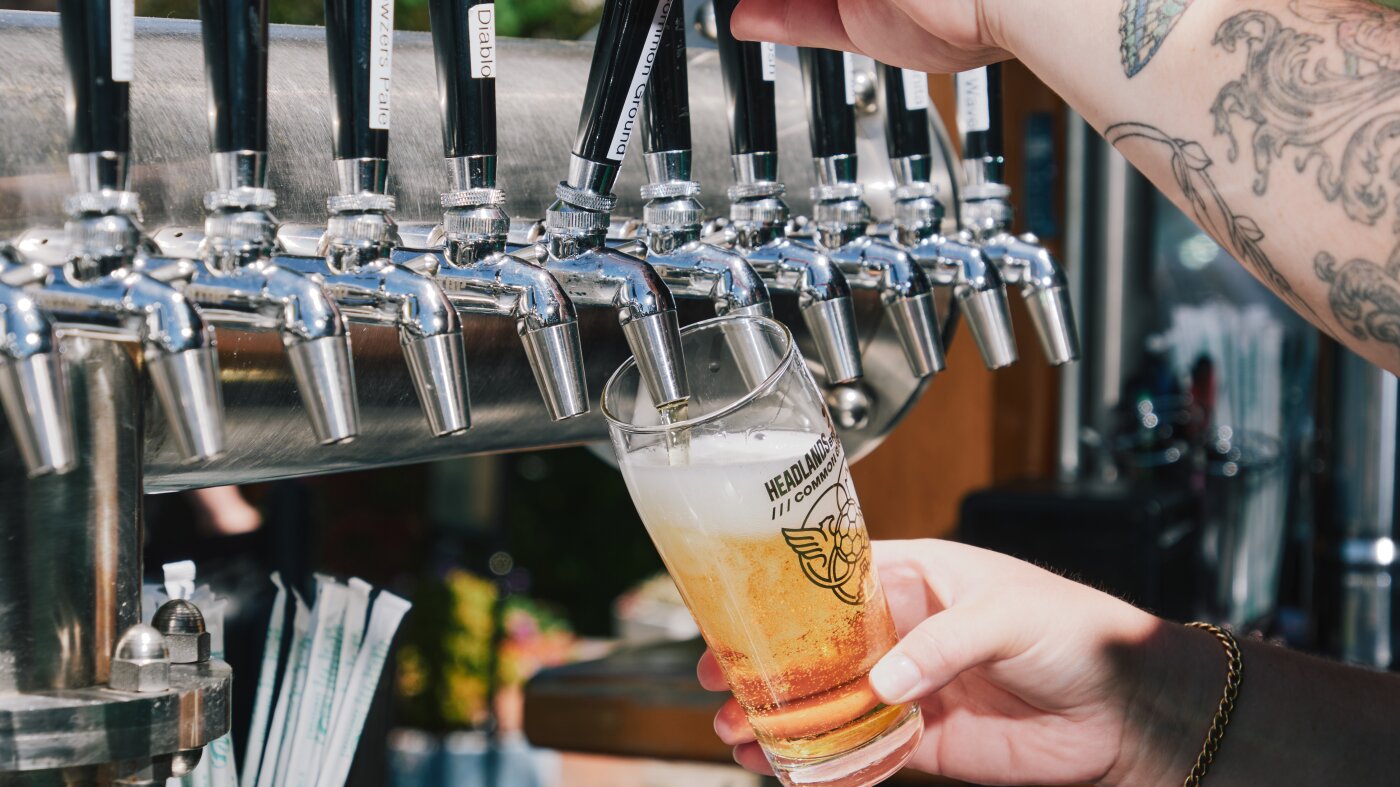
Headlands Brewing launched its World Cup-themed beer Common Ground ahead of the first World Cup game in June.
Justin Gellerson for NPR
hide caption
toggle caption
Justin Gellerson for NPR
The British betting company William Hill predicts that soccer fans will throw back more than 5 million pints of beer in stadiums and fan zones during this year’s World Cup. And that number doesn’t even account for the millions of pints being poured in bars as fans tune in to the global soccer event.
But while international soccer crowds are focusing on goals and penalties, a trio of craft breweries from the tournament’s three host nations are using the tournament to brew something increasingly rare: cross-border solidarity.

A shared recipe with local spin
The collaboration began months ago over a flurry of video chats and emails. The beermakers at Rey Árbol Brewing Co. in Mexico, Headlands Brewing in the United States, and Cabin Brewing Co. in Canada set out to design a single, unified recipe representing the brewing traditions of all three nations.
“It’s a Mexican lager,” said Alejandro Gomez, founder of Rey Árbol.
“That’s like a West Coast IPA,” said Ryan Frank, chief operating officer and brewmaster for Headlands.
“And up in Canada, most of our beers are hop driven,” said Haydon Dewes, co-founder of Cabin. “So we thought, let’s go for a dry-hopped Mexican lager.”
While all three breweries share the exact same recipe, each is giving the final product a distinct local spin, including unique, regionally designed labels. A four-pack of the U.S version costs $15.99. Frank said Headlands has produced about 130 cases of the limited-run brew.
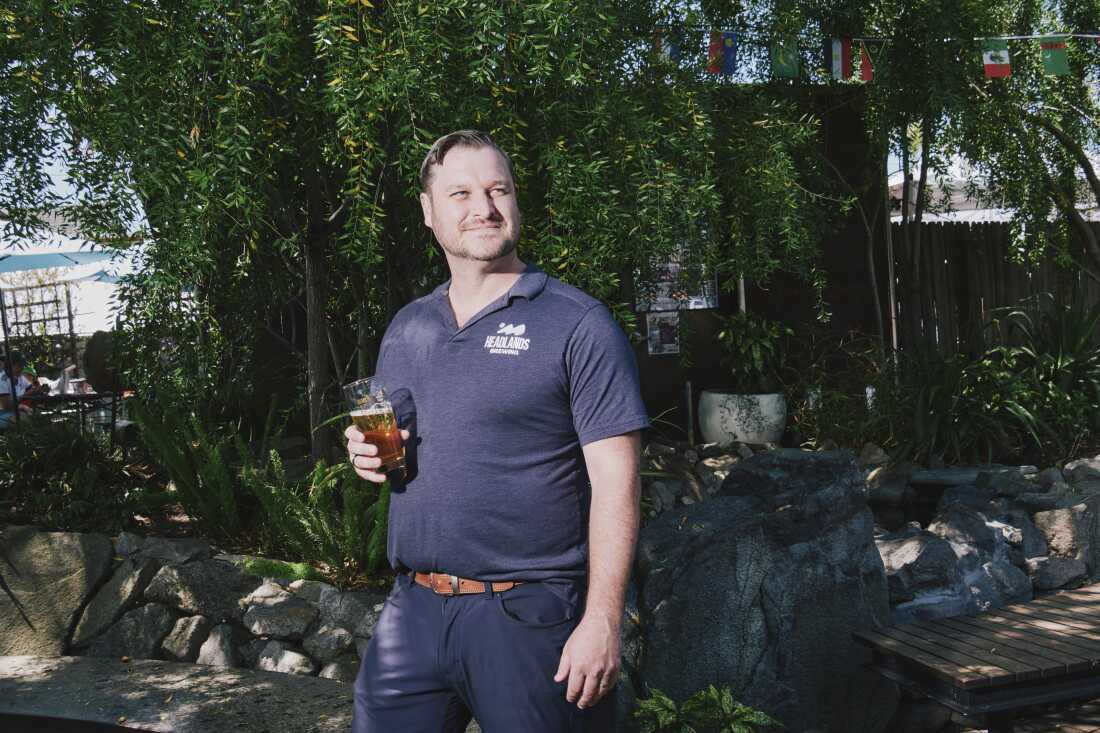
Headlands Brewing COO and brewmaster Ryan Frank drinks a Common Ground beer in Berkeley, Calif., on June 11.
Justin Gellerson for NPR
hide caption
toggle caption
Justin Gellerson for NPR
For the brewers, however, the project is less about marketing and more about connection: They named the multinational beer “Common Ground.”
“When I go to California or Canada, they will treat me like family,” Gomez said.
“It makes the world feel so much smaller,” said Dewes.
“It’s about building bridges and knowing what’s important in life,” said Frank. “And for us, that’s soccer and beer.”
Geopolitical friction in the taproom
The official rhetoric surrounding World Cup 2026 mirrors the brewers’ optimism, with promotional materials promising a tournament where billions are “united as individuals, united as billions.”
Yet this idealistic messaging stands in sharp contrast to a prickly geopolitical reality. Tensions between the U.S., Mexico and Canada have mounted over trade tariffs and auto manufacturing standards as the three nations renegotiate long-standing trade agreements.
The independent brewers behind Common Ground are feeling that friction firsthand through the rising costs of aluminum cans and raw ingredients.
“There are 15% tariffs slapped on any European-grown hops, which are really critical to some of our core brands,” Frank said.

Headlands Brewing brewmaster Ryan Frank and CEO Austin Sharp share a Common Ground beer in Berkeley, Calif., ahead of the first World Cup game on June 11.
Justin Gellerson for NPR
hide caption
toggle caption
Justin Gellerson for NPR
The political discord hasn’t just been confined to trade boards.
When signing an executive order to establish a White House Task Force for the World Cup in March 2025, President Trump suggested that cross-border hostilities might actually benefit the tournament. “Oh, I think it’s gonna make it more exciting,” the president said.
A bittersweet reminder
Tension on the soccer field is one thing; between nations, it’s another.
“It’s true that when it comes to the actual soccer, we’ve developed a very healthy, vibrant rivalry between the three countries,” said Andrés Martinez, the author of The Great Game: A Tale of Two Footballs and America’s Quest to Conquer Global Sport and co-director of Arizona State University’s Great Game Lab, which studies the intersection of sports, media and geopolitics. “But we’re also linked together in this very symbiotic relationship.”
Martinez said that when the U.S., Canada and Mexico initially launched their collaborative bid to host the World Cup back in 2017, the political climate was warmer.
“It was meant to showcase these tight bonds that had developed between the three countries,” Martinez said.

The makers of Common Ground used a shared recipe, but all created their own distinct packaging for the beer: Canada’s Cabin Brewing Co.; Mexico’s Rey Árbol Brewing Co.; the United States’ Headlands Brewing.
Cabin Brewing Company, Rey Árbol Brewing Company, Headlands Brewing
hide caption
toggle caption
Cabin Brewing Company, Rey Árbol Brewing Company, Headlands Brewing
But relations have soured since then, making cross-border business collaborations like Common Ground an anomaly rather than the norm for this tournament.
“To see craft beers across the three countries coming together like this, it’s a bittersweet reminder of what we were hoping to see a lot more of,” Martinez said.
Finding the real common ground
If trade wars and political posturing are looming large in Washington, D.C., Ottawa and Mexico City, they feel a world away at Headlands Brewing’s busy North Berkeley location.
As fans gathered to watch a crucial match between Mexico and South Africa at the start of the tournament, the sunny patio erupted into cheers and shrieks of “Goal!” when Mexico found the back of the net.

Headlands Brewing hosts a screening of the first World Cup game on June 11 in Berkeley, Calif.
Justin Gellerson for NPR
hide caption
toggle caption
Justin Gellerson for NPR
Hovering over a pint of the collaborative brew, soccer fan Roberto Mandujano reflected on the cross-border experiment.
“Three different ways, three different taste buds come together to make something cool,” he said.
When asked about the underlying political tensions between the host nations, Mandujano shrugged off the discord.
“We live in a world where everyone wants to make everything political,” Mandujano said. “But I think we’re all here for soccer. So I guess that’s the common ground.”

Pillarhenge is an eyesore. Since construction at the Eagle Rock site — so nicknamed after a decrepit colonnade — first stalled in 2008, the only thing that accumulated faster than the garbage and graffiti were the epithets from outraged community members.
While many saw blight at the corner of Colorado Boulevard and Holbrook Street, a local artist saw opportunity. One of the site’s 36 pillars — the tallest one in the middle — could be a perch for a big, pink, screeching bird.
“It was a vision, and I just knew we would do it,” says the artist who goes by Flod and is finally ready to share his story. Flod insists on anonymity because, “isn’t it more fun to leave it a mystery?”
Pinky overlooks workers pouring concrete at a construction site known as Pillarhenge because of its colonnade.
Flod scraped together tomato cages, chicken wire, paper, glue and pink house paint. “I’m kinda into recycling, so I didn’t even buy materials for it. It was supposed to just give a laugh, maybe last a day,” he says. That was more than a decade ago.
One day in 2014, Flod’s young adult nephew, adept at climbing, helped him hoist the 4-foot, about 10-pound papier-mache sculpture atop the 70-foot pillar. It fit perfectly. In the years since, the bird, affectionately dubbed Pinky, has inspired a movement. There are custom T-shirts, multifarious fan art, an online forum and a dedicated posse keeping constant watch. Pinky’s fame grew even as the bird bent, molted and faded with each turn of the calendar.

-
Share via
As much as locals loathe Pillarhenge, they idolize Pinky. And now that construction at the site of “The One on Colorado,” a six-level, mixed-use development with 31 units, has restarted, the bird’s future is uncertain.
“There’s a lot of love for this crazy bird,” says Jonathan Ford, who has a direct view of Pillarhenge from his backyard. “It’s iconic.”
While discarded elements are through lines in Flod’s sculptural work, it’s the community impact that separates Pinky from the rest. “I’ve done other things I like a lot, but this one definitely exceeded expectations by many, many times over,” he says.

Flod, the artist behind Pinky, watched in obscurity as the bird’s popularity grew.
A reclusive artist steps forward
Flod never set out to be found. He was happy to relish in Pinky’s celebrity from the shadows. That changed in April 2023 when unknowing construction workers unceremoniously removed a disintegrating Pinky from its eyrie.
General contractor Enrique Valdez of Azteca 111 Builder Inc. was tasked with cutting the ratchet straps securing Pinky, seemingly putting an end to the bird’s reign.

Construction manager Enrique Valdez saved Pinky after concerned locals shouted at him when he removed the molting bird from its perch.
Then something unusual happened as Valdez descended in the boom lift with Pinky’s remains. Valdez recalls, “A few people stopped and yelled, ‘Don’t take Pinky!’” The distressed locals approached Valdez with cellphone videos they’d taken of the act. “They asked if I was going to bring him back and showed me the Facebook page.”
The Facebook page — Goodbye Pillarhenge Park — has been the hub of Pillarhenge lore since 2015. No sooner had clips of Pinky’s removal been posted than comments began streaming in: “Sad day for proud bird,” “End of an era,” “The bird was the best thing about Pillarhenge.”
“I didn’t know Pinky had so many fans!” laughs Valdez while describing the predicament he was in.
The community’s protectiveness saved Pinky from the landfill. Valdez deposited Pinky at a warehouse belonging to the site’s owner, showing him the Facebook posts of Pinky’s removal. The site has changed hands multiple times, with the latest owner being Ara Tchaghlassian, founder of retailer American Tire Depot.
“I told him, ‘It seems we have a legend on our hands,’” explains Valdez.
After stabilizing the hillside, the development team discussed remaking the bird with the help of the original artist. But nobody knew who that was.
“People are just done with decades of this ugliness,” says Annie Choi, owner of Found Coffee across the street from Pillarhenge, about the site. “But it also has this weird claim to fame, you know,” she says, as a regular enters the shop wearing a Pinky T-shirt.

When construction manager Enrique Valdez removed the dilapidated Pinky in 2023, it was placed in a storage unit until Flod the artist could be found.
As a career documentary filmmaker, I’m always on the lookout for quirky Los Angeles stories. I’ve been photographing Pillarhenge for more than eight years, largely on black-and-white film. I met Valdez in May 2023, shortly after construction had restarted. He invited me onto a boom lift to photograph the site from above and inquired if I knew who had made Pinky, which he’d removed just days prior. I offered to do some sleuthing.
While I fruitlessly tapped my L.A. street art connections, Valdez posted in Goodbye Pillarhenge Park: “Looking for the original artist to refurbish the bird.” He included photos of Pinky, headless and forsaken, but safe amid piles of overstuffed filing boxes.
Unbeknownst to its more than 800 members, Flod had been lurking in the public group for years, silently celebrating each new mention of Pinky. Valdez’s post presented a unique moment of decision for the reclusive artist: to reply risked abandoning a mystique he’d long cultivated; but ultimately the lure of a sanctioned Pinky reboot proved too tempting to refuse.
Fortifying Pinky, but for how long?

Beyond site-specific work, Flod also creates masks as part of his art practice.
Tiptoeing into Valdez’s DMs with “I may know the artist,” the two arranged to meet at the warehouse where Flod disclosed his identity, declining compensation and asking only for access to Pillarhenge. Pinky’s carcass then returned home with Flod, who set about removing the rotted skin from the chicken-wire skeleton, which he repurposed for its next version, covering it in paint-dipped cloth, instead of paper and white glue, to better withstand the elements.
Tellingly, the exterior of Flod’s home studio is Pinky’s exact shade of pink. In the yard, multicolored concrete sculptures adorn nearly every nook and cranny. Inside, hand tools, musical instruments and partially completed papier-mache projects are everywhere. “Mind the points,” Flod cautions, as I maneuver around an oversize papier-mache mask covered in protruding footlong spikes. “I can’t fix those if they break.”

Skull masks are a particular theme in Flod’s work.
The back room of Flod’s studio is like a butcher’s walk-in fridge, where dozens more masks hang from the ceiling, each more outlandish than the last. There’s a bug-eyed rabbit, a blue donkey and several variations of what appear to be skulls. “That one’s name is Charles E. Fromage.” I repeat the name and Flod adds, “Get it?”
Pinky is not Flod’s first foray into site-specific social commentary. On a hike in 2005, Flod came across a truck tire lodged between two boulders in Malibu Creek. Returning to the site with a bag of cement, he made a mixture with sand and water from the creekbed. After slathering it over the immovable garbage to make it appear as if it were just one more river rock, he titled the piece “Reinventing the Wheel.” Then there was 2015’s collaborative effort “Stella the Steelhead,” a 35-foot fish skeleton stuffed full of trash taken from the L.A. River, which a group of artists, environmental activists and volunteers towed behind an adult tricycle along the river’s bike path.
Just two months after its rescue, in December 2024, Pinky’s rebirth was heralded in Eastsider LA as “a Christmas miracle.” However, a rainstorm soon damaged Pinky’s reinforced cloth wing and the bird was temporarily removed for repairs. It was around that time that Ford moved near Pillarhenge. One morning he went out back with his coffee and noticed something … pink.
“I texted my neighbor and he responded immediately: ‘Pinky’s back! Oh, thank God, I didn’t know what happened. I love that thing!’ And I just went, So this is normal.”
During Pinky’s broken-wing pit stop, my 10-year-old daughter Margaret Green and friends Ezra Cunningham and Meta Nalepa encountered the bird in a nearby driveway while delivering their neighborhood newspaper. Flod, a subscriber, acknowledged he was Pinky’s creator. Margaret’s article, “Pink Bird: Eagle Rock Artist Found,” includes a rare photo of Pinky away from its pillar-top nest.
In response to being discovered by the grade-school journalists, Flod is effusive: “That was a really cool part of [Pinky’s] story. It definitely means a lot to me. That kind of stuff is the whole thing.”
Now, time is running out on the bird as the rising tide of concrete, scaffolding and rebar obscures Pinky from pedestrian view along the south side of Colorado Boulevard. Another few months and …“Well, you’ll still be able to see Pinky from the freeway,” says Valdez, who expects the construction work to finish in about two years.

Someone made an egg to accompany Pinky atop Pillarhenge. Flod promises it wasn’t him.
In Goodbye Pillarhenge Park, one member’s recent comment betrays what many are perhaps not ready to admit: “I will miss Pillarhenge.”
Recently, a giant egg appeared in a nest atop the pillar beside Pinky’s. “I had nothing to do with that!” insists Flod. Rumors swirl as to what will emerge when the egg hatches: Life-size bronze? Historical landmark plaque? While not quite so grandiose, Valdez says discussions are ongoing regarding the bird’s future.
“If Pillarhenge is completed and Pinky goes into the lobby or something, that’s all right, I guess,” Flod concedes. “We need more housing.” Then the artist’s acquiescence gives way to a defiant smirk: “But I want the bird to win.”
-
Washington2 minutes ago
Port Washington weekly vigils honor community members arrested by ICE
-

 Wisconsin7 minutes ago
3 dead after crash involving UTV, truck in western Wisconsin
-

 West Virginia14 minutes ago
Judge blocks West Virginia SNAP soda ban, restoring benefits for soft drinks
-
 Wyoming17 minutes ago
At 6,000-year-old crossing, Gov. Gordon OKs Wyoming’s first-ever designated pronghorn migration route
-
Crypto22 minutes ago
Consumer alert issued for Bitcoin cryptocurrency ATMs
-

 Finance29 minutes ago
Shanghai needed as finance hub, as Hong Kong ‘not enough’: proposal
-

 Fitness32 minutes ago
This unspectacular full-body exercise could be the secret to long-term fitness
-

 Movie Reviews44 minutes ago
‘The Invite’ Movie Review – Spotlight Report

