Lifestyle
‘The closest thing to church’: How Unusual Tuesday became L.A.’s home for misfit artists


It is not just any Tuesday.
It is 9 p.m. on a dreary night in Shadow Hills, just miles away from the lush foothills of the Verdugo Mountains. The delicate pitter-patter of a drum’s cymbal is the only sound to break through the thick brick wall of the obscure performance venue, Sun Space, and reach the wide, desolate Sunland Boulevard.
There is no sign outside, but follow the noise inside to find the Host arrive on stage from a door hidden behind a hypnotic dayglow projector visual. He’s wearing a gold sequin jacket over a fresh-pressed polka-dot shirt, fuchsia bell-bottoms and yellow trucker hat and he has an Appalachian-style beard.
-
Share via
The Host is just one of a strange cast of characters to escape the loose folds of Noel Rhodes’ mind and make it on-time to the circus. Rhodes, 63, founded Sun Space in 2017 as a performance art venue for wayward artists who don’t properly fit the rigid mold of the Los Angeles club and bar circuit. The space is “not quite open mic,” Rhodes says, but all lovers of experimental ambient music, free-form jazz, observational comedy, paleontology and asteroseismology lectures or just plain old rock ‘n’ roll are welcome on the schedule, nearly every day of the week.
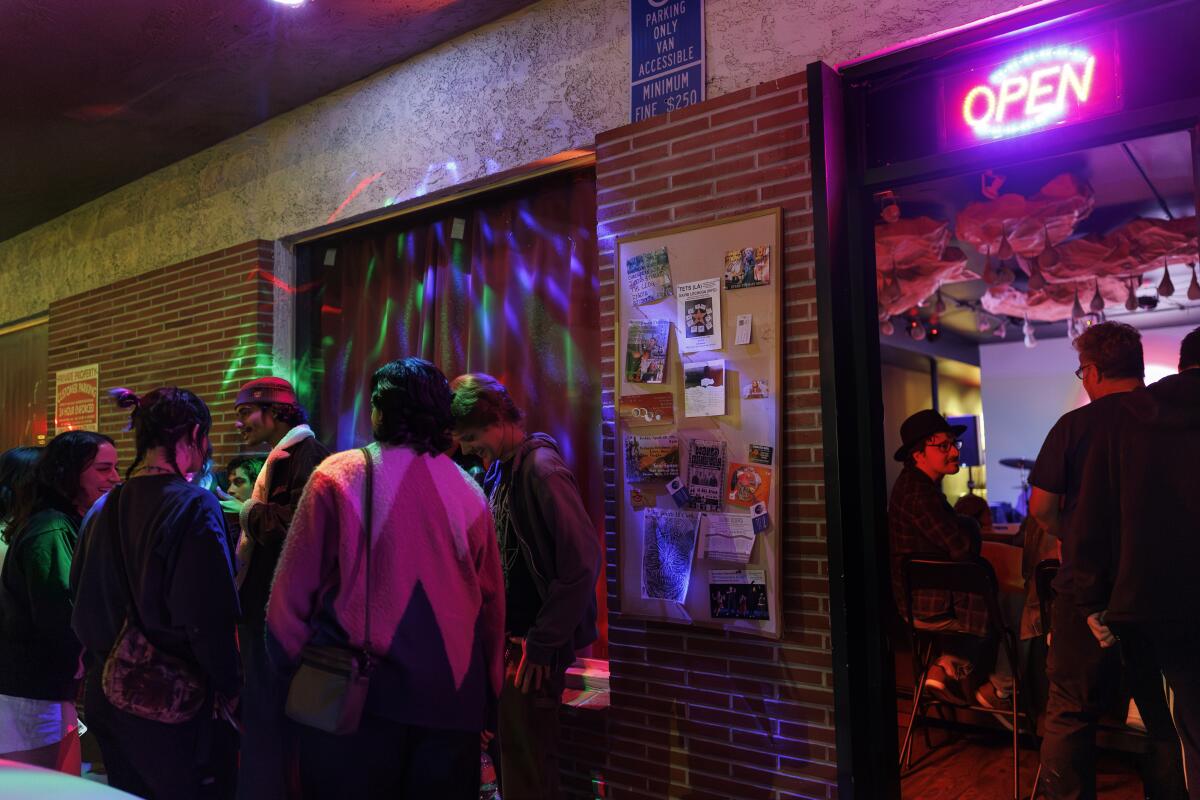
Patrons gather outside Sun Space during a break between performances in the intimate setting for Unusual Tuesday.
(Gina Ferazzi / Los Angeles Times)
Tuesdays, however, are somehow more unusual.
The crowd drowns in the second-long tension as they sit below teardrop-shaped papier-mâché stalactite hanging from handmade alien geodes on the ceiling. A 2-foot-tall, human-goat lovechild mask rests on the stage. Demographics for Unusual Tuesday range from late teens to septuagenarians, mingling and meandering as they await the start of the show.
“Let’s all together, as one great rising cluster, try, together, to accomplish one thing,” says the Host.
“Let’s figure out what this whole thing is!”
The house band drums intensify, a violin cries and guitar chords growl.
“It’s Un-usual Tuesday,” the congregation replies in song. “And all of those other days, like Friday and Saturday and Sunday … are just big wastes of ti-ime!”
Chaos breaks loose. Rhodes’ bones transform into wild, loose cartilage. Tonya Lee Jaynes, the drummer, puts her entire life force into the bass and snare. The crowd sings the chorus in dissonant harmony.
On an entirely normal Wednesday walk through a nature preserve north of Los Angeles, Rhodes says the idea for Sun Space and the hallmark Unusual Tuesday came from small fundraiser shows his father put on for their small Pennsylvanian town when Rhodes was a child. Vague memories of “The Little Rascals” and “Monty Python” influenced the sketch-based, psychedelic feel of Unusual Tuesday, with Sun Space serving as an outlet for other misfit artists looking to perform on the other days of the week.
“My goal was just to cover the rent with volunteers and equipment already bought,” Rhodes says. “I knew it would work if we weren’t having to pay our home rent on it, you know, our medical bills … as long as it stayed afloat.”
Despite its obscure location, stuck between a cafe and vacant building, the weekly show began to attract an eccentric crowd of artists and attendees.
“The whole ethos is creativity, expression and most importantly, freedom,” says Eddie Loyola, who has attended Unusual Tuesday near-weekly since 2017. “It’s really unusual. It helps support the idea of ‘come show us what you got’ rather than something that’s just cliquey, like at other venues.”
For a fledgling artist like Bailey Zabaglio, who most commonly performs electrocrash music at small house shows, Unusual Tuesday can be a time to experiment with other genres outside of their comfort zone. On the last Unusual Tuesday of April, Zabaglio performed soft electric-indie ballads to a roar of applause as the first act of the night.

Musician Bailey Zabaglio performs an original song on an electric guitar during Unusual Tuesday.
(Gina Ferazzi / Los Angeles Times)
“The fact that the demographic is so vast and wide and every person you meet is such a f— character, it’s really cool,” Zabaglio says. “It’s so beautiful that everyone agreed to get off the phone, off their couch on a Tuesday in the middle of the week.”
The social media presence of Sun Space is sparse, so Unusual Tuesday attracts most of its attendees by word of mouth. Zabaglio’s brother, Jamie, visited from Washington and performed a witty free-form comedy act only a few slots after his sibling.
“I used to have a variety show in Washington, and this whole trip has been very healing for me,” Jamie says. “I started my own show and I was just doing whatever I could. … I felt like I would never experience something like that again, but I got it again tonight.”
Booking for this specific show is a strange calculus, says Jamie Inman, who does scheduling, sound engineering and other odd jobs for Sun Space, which he now co-owns with Rhodes. Acts are booked two to three weeks in advance and selected from a pool of artists who expressed interest in performing.
“Every single Tuesday is different. Some weeks are singer-songwriter heavy, some weeks are modular synth heavy, some weeks are everything in between,” Inman says. “Sometimes we have expert lecturers come. … We just mishmash everything together until it makes sense. Or if it doesn’t make sense, that’s fine too.”
The only break in the show’s near decade-long history came during the COVID-19 pandemic, when artists all around the city were holed up in their homes with nowhere to play. Rhodes, Inman and Chris Soohoo, Sun Space’s visuals engineer, threw together a Twitch livestream to continue the chaos.
“[Unusual Tuesday online] was nothing like this, but we all learned some new stuff, like, I got into all the visual stuff,” Soohoo says. “Someone said that their first Unusual Tuesday experience was the stream, and now they get to come here in person. … It’s good to know that we did what we could.”
During the online show, Rhodes’ character Austin Drizzles, who performs the crackpot weekly weather report, would field calls from crazed viewers. Now, back on the regular news cycle, Drizzles accepts photo submissions from viewers before the show with added commentary at the end of Unusual Tuesday.
“This was sent in by Rebecca,” Drizzles says of a photo of a squirrel. “That is a cute little wild dog. … The effervescence there. I hope they eat a banana just like they always do.”
Left Unsaid, a jazz breakbeat fusion duo, performed live for the first time at Unusual Tuesday‘s last April show. Lucian Smith and Sander Bryce, who formed the group this year, say performing in L.A. proper to an attentive audience can be a difficult feat, but Unusual Tuesday provides a full venue for nontraditional acts.

A patron watches the Unusual Tuesday show in very low light at Sun Space.
(Gina Ferazzi / Los Angeles Times)
“There’s so many venues where people are waiting for you to pull them into it,” Smith says. “But here everyone seems like they’re getting something special, and they’re excited to see what they’re gonna find out. … Coming from having no audience, I loved having this.”
For the faithful observers, many of whom attend weekly, Unusual Tuesday is welcomed as a reprieve from the stress, struggle and day-to-day drag of the working week, says August Kamp, an artist and regular attendee of the weekly sermon.
“I think we’re over-saturated with mundane everything,” she says. “The fact that there is a day of the week where I know I’ll feel extra alive and that it’s a day that is otherwise not allocated for that is really valuable.”
Many interviewees likened Unusual Tuesdays to church, a cult or a religious movement. Rhodes, raised Swedenborgian — a Christian denomination that emphasizes “divine love” based on the writings of theologian Emanuel Swedenborg — does not outright reject the comparison.
“Unusual Tuesday is definitely a church service in that we get together and hypnotize the musicians, get into a rhythm and all that stuff,” Rhodes says. “Get people into us — into a vibe.”
Near midnight, following Austin Drizzles’ weekly forecast, the church once again erupts into the Unusual Tuesday gospel. A rapturous feeling takes over the room, as if all of the disparate identities and backgrounds came together in spiritual tune — the cluster having finally risen. Some mouth the words, but others belt away, letting all the emotion built up over the six other days of the week fall onto Rhodes, who’s not Rhodes then, but simply the Host.
He delivers only one promise, which he no doubt will keep: “I will see you in six days, 22 hours, and however many minutes, for Unusual Tuesday!”

Lifestyle
Spain could make World Cup history: The first to win men’s and women’s trophies back-to-back

Pedro Porro #12 of Spain celebrates after the 2-0 victory during the FIFA World Cup 2026 Semi Final match between France and Spain at Dallas Stadium on July 14, 2026 in Arlington, Texas.
Florencia Tan Jun/Getty Images
hide caption
toggle caption
Florencia Tan Jun/Getty Images
If the Spanish Men’s National Team pulls off a World Cup victory on Sunday, the Spanish football federation would make history as the first to bring home successive World Cup championships on the men’s and women’s side in the history of the tournament.
The women’s team won the 2023 World Cup and will enter next year’s tournament in Brazil as defending champions. While the men’s team has been a perennial contender, appearing in 17 out of 23 World Cup tournaments, they last won the Trophy back in 2010.
The FIFA Women’s World Cup has had a much shorter history than its male counterpart; having started in 1991 compared to 1930 for the men. During that time, it has only had five different champions: the United States, Germany, Norway, Japan and Spain.
Only two of those teams, Germany and Spain, have also won the men’s World Cup.
The Spanish System
Spain has a robust men’s soccer league system, led by the Campeonato Nacional de Liga de Primera División, more commonly known as La Liga. Its teams are consistently among the top-ranked in Europe.
Real Madrid, based in the capitol, is one of the world’s most successful soccer clubs. FC Barcelona is the third-most valuable soccer club in the world, and Argentina’s Lionel Messi broke Brazilian legend Pelé’s record for most goals scored for a single club for the Catalonian team. Trips to Barcelona’s stadium, Camp Nou, have reached near-pilgrimage status for diehard soccer fans.

Spain’s players and officials celebrate with the trophy after winning the Australia and New Zealand 2023 Women’s World Cup final football match between Spain and England at Stadium Australia in Sydney on August 20, 2023.
Franck Fife/AFP via Getty Images
hide caption
toggle caption
Franck Fife/AFP via Getty Images
Spanish women’s soccer has lagged far behind, with both a league and a national team system plagued by poor coaching, underinvestment and abuse.
In 2015, the entire Women’s World Cup squad successfully called for the removal of coach Ignacio Quereda, whose leadership of the team since 1988 led many female players to accuse the Royal Spanish Football Federation of indifference to the women’s team. Even before the 2015 tournament, some longtime national team players said they refused to return to international duty as long as Quereda kept coaching.
In a 2021 documentary, “Romper el silencio,” players alleged Quereda sexually harassed and verbally abused them.
In the run-up to Spain’s 2023 Women’s World Cup victory, players again called for improvements to the women’s national team training and resources, with 15 players asking not to receive a national team call-up until the federation made changes.
Then, after Spain won, federation president Luis Rubiales forcibly kissed forward Jenni Hermoso, alongside other alleged indecent behavior. The entire Women’s World Cup squad stood behind Hermoso, calling for the removal of Rubiales and national team coach Jorge Vilda, who supported Rubiales. The players turned the international spotlight and goodwill of their 2023 victory into an international rallying cry that highlighted the poor treatment of female players.
Rubiales was suspended for three years, then tried and found guilty of sexual assault.
Members of the current Spanish men’s World Cup squad supported Hermoso and the other Spanish players in the wake of the Rubiales incident. Borja Iglesias, a striker, refused to play for the Spanish federation after Hermoso’s assault until Rubiales was removed.
In a viral moment on Tuesday, he found Hermoso on the sidelines after Spain defeated France in the World Cup semifinal and they hugged.
Spain will face Argentina at 3pm ET Sunday in New Jersey.

Madeline Fox is News Director at KCUR. For more World Cup coverage from KCUR, check out Soccer City 2026.

Universal Studios Hollywood has long been slated to have the biggest theme park opening of 2026 with its new high-speed coaster, Fast & Furious: Hollywood Drift. But with no officially announced opening date, questions have started to intensify and rumors have begun to swirl as to what may be causing the park to go radio silent on what is expected to be its centerpiece attraction.
According to Universal, there is no need for concern.
Yet speculation has zeroed in on the potential noise of the coaster as being a problem for residents of the nearby of Toluca Lake. Rumors were fueled Friday by Fox 11 Los Angeles reporting, via a since-deleted post on social media network X that Hollywood Drift’s opening had been delayed at least until the end of year due to neighborhood complaints. Videos of audible screams of riders on the coaster have gone viral in recent weeks.
A spokesperson for Universal said reports that the coaster’s opening is postponed until the end of 2026 are “not accurate” and disputed the notion that the coaster has been delayed. Fast & Furious: Hollywood Drift, the spokesperson said, is still on target to open before the end of summer.
“We expect to announce an opening date soon,” read an official statement from the company. “The information online is incorrect.”
The summer season lasts through the end of September. The park begins its popular fall Halloween Horror Nights on Sept. 3. Tickets for the latter are currently on sale, and Universal is promising access to Hollywood Drift for those who purchase its line-skipping express pass, which starts at $259.
Sources familiar with the coaster’s operations have also disputed the notion that noise is a cause for the coaster having not yet opened, instead pointing to more routine mechanical issues that have arisen during its test and adjustment phase. One theme park insider, however, stressed that when Hollywood Drift does open, it will likely be considered a “top-5, or top-10 coaster, in the world.”
The view of Fast & Furious: Hollywood Drift from Universal Studios Hollywood’s Wizarding World of Harry Potter.
(Todd Martens / Los Angeles Times)
Fast & Furious: Hollywood Drift is unique in that it is a 72 mph ride with vehicles created to rotate 360 degrees through multiple inversions. Designed to mimic the feel of stunt cars, its four-seated vehicles will twist and turn through banks in the track in an effort to create a drifting sensation.
Universal’s own website earlier this summer posted June 26 as an opening date, and while that was once the targeted launch, the date was quickly removed from the site. Universal began hosting media for walkthroughs of the coaster in May.
Fast & Furious: Hollywood Drift has been in the works for than a decade. Built essentially on a cliff between the park’s upper and lower lots, the ride’s existence is a feat of engineering, and Universal has described it as among the most intense attractions in its global park portfolio.
Before land was moved, Universal began a series of tests to track how noise would travel through the surrounding neighborhood. Universal placed speakers on the old special effects and stunt buildings to see how ride screams traveled down the hill.
Ultimately, the tracks would be complemented with multiple sound walls and shields, the latter clear structures designed to block coaster rumbles and audience screams. And because the cars can rotate 360 degrees, Universal can in theory direct rider yells away from the studio below and the neighborhood nearby. The actual track has been filled with pea gravel, designed to minimize noise from any reverberations.
“It’s incredibly quiet,” said Jon Corfino, the lead creative at Universal Studios Hollywood. “We were able to do that by putting materials inside portions of the track to deaden the sound. I’m not sure we would have needed it, but it was important to do the right thing. It’s pea gravel and rocks. It’s quieter than I ever thought it was going to be.”
Fast & Furious: Hollywood Drift isn’t the only notable coaster slated to open in Southern California this year. Buena Park’s Knott’s Berry Farm initially intended to launch its reimagined Montezooma’s Revenge, now known as Montezooma: The Forbidden Fortress, on Monday. Late last night, the park indefinitely delayed its public unveiling, with a spokesperson citing additional fine-tuning that surfaced during its final days of testing.
The delay is not expected to be a prolonged one.
“We appreciate everyone’s understanding and look forward to welcoming media and guests in the coming days when we can showcase the attraction exactly as intended,” read a statement from the park. Montezooma: The Forbidden Fortress has been in development for the past four years.
Farrar, Straus and Giroux
English writer Jem Calder’s debut novel, I Want You To Be Happy, reports from the frontlines of modern-day dating. His book is good – but the news is not.
A man in his mid-30s who recently broke off his engagement with his longtime girlfriend meets a young woman at a crowded London bar. He’s a copywriter, she’s a 23-year-old barista. Despite his intention not to talk about his breakup, he finds himself “shouting specific details directly in her ear.” “Pretty intense,” she yells back. He apologizes. “No-no, I like it,” she yells. “It’s like boarding a plane. You go baggage first.”
Neither can think what to say next. After an “interpersonal silence containing all the bar-noise,” they share a few drinks, their first names (Chuck and Joey), some quips about their 12 year age gap and her lack of what he calls “a real job.” They end up at his luxury apartment, which is far nicer than her crowded shared flat.
In other words, Calder’s characters have boarded a plane, baggage first — with no idea where it will land. Will it lead to an actual relationship, nevermind happiness?

Calder made a splash with his first book, Reward System, a collection of six interconnected short stories about young adults linked by social media yet adrift and alienated in today’s fragmented digital world. The title of one story, “Distraction from Sadness is Not the Same Thing as Happiness,” could also work for this closely observed, sad-but-sympathetic novel about the cagey, jittery dance that characterizes the modern-day mating game.
Chuck and Joey are guarded and uncertain. We get to know them better than they get to know each other — their insecurities and disappointments with themselves as well as others. Their fundamental imbalances — age, financial, commitment levels — lead to a wobbly connection. The discovery that they share literary aspirations (poetry for her, prose for him) and write around their day jobs opens up the potential for some sort of bond. Their nascent relationship stirs “a dormant feeling of possibility” in both of them. But a talent gap opens up an abyss. (I won’t say who has more.)
Joey is hopeful, always on stand-by for texts: “A new person finding you interesting makes you feel new,” she ruminates in this tight, third person narrative that alternates between the male and female perspective. Interestingly, although the author is male, the female character comes across as far more sympathetic.
Joey understands that she needs to wait before replying to texts, because responding too quickly betrays “an underlying neediness and desperation.” Chuck is generally avoidant in all aspects of his life — with alcohol as his chosen support system. It’s important to both of them to convey nonchalance. Neither wants to come across as a “tryhard.”
There’s nothing new about this, of course: Self doubts, waiting by the phone, playing hard to get, “acting noncommittal in the hopes of gaming his desire.” It’s a tale as old as time, with updated electronic devices.
Both characters are addicted to instant gratification: brand name status items, cyclist-delivered meals, push notifications, Instagram scrolling, podcasts, alcohol, smoking, vaping, sex, screens. They are constantly plugged in and online, compulsively checking their media feeds. One night, trying to distract herself from “recursive worries” about her finances and future, Joey spends “twenty of her non-refundable life minutes researching the relationship timeline of an actor she liked and a musician she didn’t like as much.”
Calder writes with precision, channeling his generation’s activities with a mix of interiority and verbs fabricated to convey the mechanical rote of their daily activities. These are people who routinely “gaze-unlocked” their phones, “V-60-ed” some coffee, and “escalatored” up to open plan spaces at work, where, lacking assigned cubicles, they “hot-desked” and then “sense-checked the work.” And at the end of the day, they “cheersed” drinks.
I Want You to Be Happy would have packed more punch at novella-length. Yet readers of all generations should be able to relate to these characters’ waves of disconsolate loneliness, if not how they deal with it. Older readers might recall their own anxieties about the future — but mostly feel relief that they’re no longer out there.
-

 Minnesota2 minutes ago
Thousands expected to attend Minnesota Yacht Club festival in St. Paul
-

 Mississippi8 minutes ago
Mississippi Lottery Mississippi Match 5, Cash 3 results for July 17, 2026
-
Missouri14 minutes ago
Missouri Lottery Mega Millions, Pick 3 winning numbers for July 17, 2026
-
Montana20 minutes ago
Montana Lottery Mega Millions, Big Sky Bonus results for July 17, 2026
-

 Nebraska26 minutes ago
Nebraska Siege prepare for regular season home finale
-

 Nevada32 minutes ago
Mountain Ridge Seniors one win closer to Little League World Series after Nevada title
-

 New Hampshire38 minutes ago
NH judge: Concord man violated Civil Rights Act in assault on transgender woman
-

 New Jersey44 minutes ago
9 ways to celebrate National New Jersey Day

