Lifestyle
How Tamara Rojo is remaking ballet


San Francisco Ballet artistic director Tamara Rojo is known for taking risks. She says that, with the exception of Nutcracker, “every time you bring back the same work, less people will come. You are cannibalizing yourself. So that’s not really a long-term strategy that you can rely on.”
Karolina Kuras
hide caption
toggle caption
Karolina Kuras
One of the first things Tamara Rojo did when she became artistic director of the San Francisco Ballet in 2022 was to commission a major new work on a very hot, very San Francisco topic: AI.
“I wanted to be somewhere where the answer is, ‘Let’s try,’ rather than, ‘We’ve never done it this way,’” Rojo told NPR about her decision to move to a city known globally for innovation. Rojo had spent decades working in the United Kingdom, first as a principal dancer with the Royal Ballet and English National Ballet and then as artistic director and lead principal dancer with the English National Ballet.
The ballet she commissioned for San Francisco, Mere Mortals, was boundary-pushing on a number of fronts.
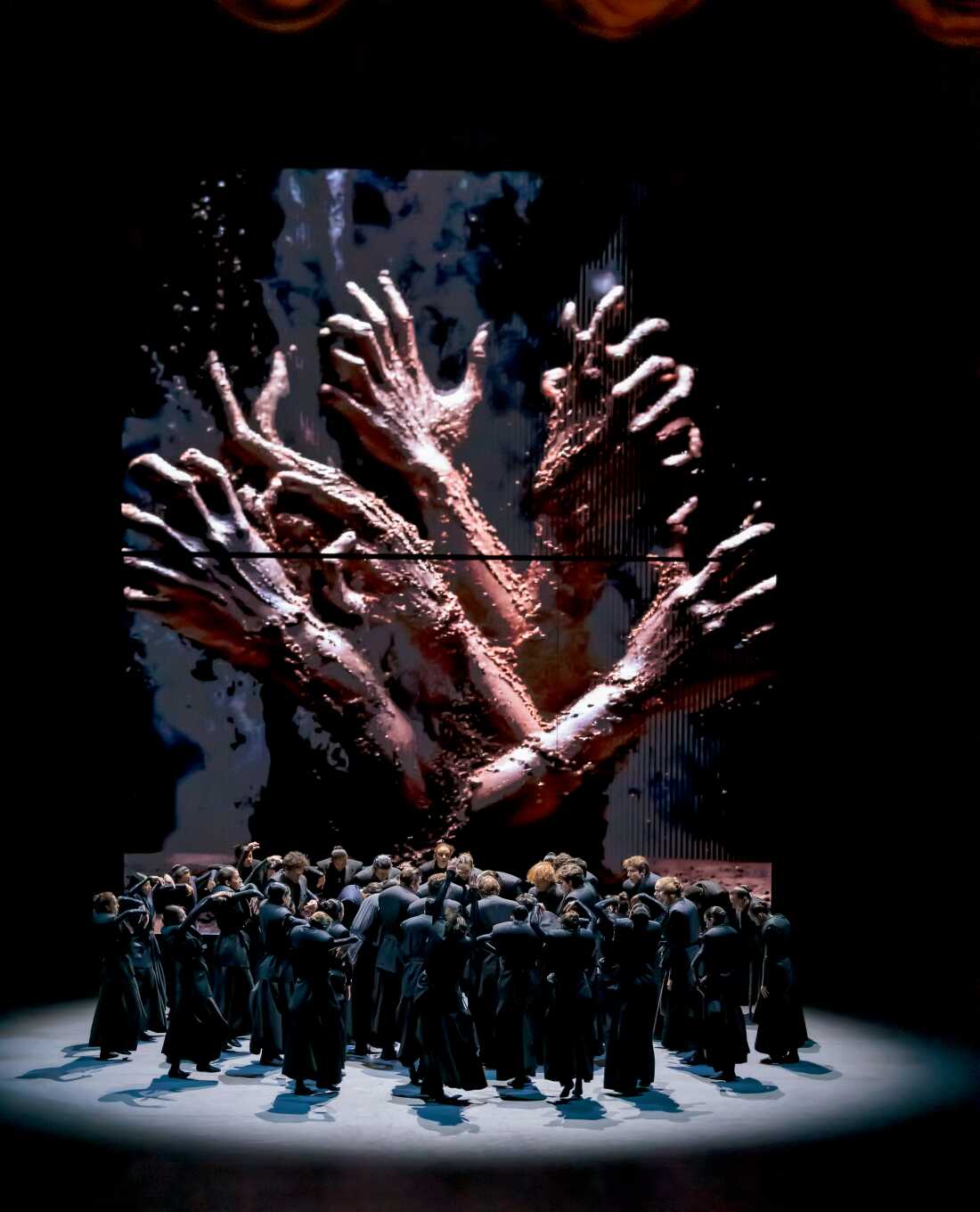
San Francisco Ballet’s new work about AI, Mere Mortals, presents a departure for the nearly 100-year-old dance institution.
Chris Hardy/San Francisco Ballet
hide caption
toggle caption
Chris Hardy/San Francisco Ballet
The jagged, earthbound movement, grainy electronic-driven soundtrack and pulsating AI-generated visuals of the hour-long ballet, presented a departure for the company programmatically. Also, Rojo’s choreographer pick, Aszure Barton, was the first woman ever commissioned to create a full-length work in the San Francisco Ballet’s nearly 100-year history – in an industry where most new dances are still created by men.
“What I love about Tamara is that she is defiant in what she believes in,” Barton said at the San Francisco Ballet’s headquarters during a break from rehearsing Mere Mortals. “This was a huge risk for her. It could have failed.”
Ballet can be a pretty conservative artform, with many companies trundling out Swan Lakes, Nutcrackers, and Cinderellas year after year. Every now and again, though, someone like Rojo comes along and truly shakes things up – even if that has meant ruffling tutus in the process.
Moving beyond limits
Rojo’s desire to move beyond accepted limits is a hallmark of her career. “She has extraordinary ambition,” dance writer Rachel Howard said.
Rojo was only 19 when she volunteered to represent her small, Madrid-based dance school and company at the prestigious Paris International Dance competition in 1994.

During her years as a principal dancer with the Royal Ballet, Tamara Rojo danced many famous roles including Princess Aurora in The Sleeping Beauty. In this 2006 dress rehearsal at The Royal Opera House, the Cuban ballet star Carlos Acosta partnered Rojo as Prince Florimund.
John D. McHugh/AFP/Getty Images
hide caption
toggle caption
John D. McHugh/AFP/Getty Images
“I don’t know what happened, but my hand went up,” Rojo said. “I didn’t think about it. I just went ‘me!’”
She won gold, and soon went on to dance for the Scottish National Ballet, the English National Ballet, and, starting in 2000, the Royal Ballet.
The ballerina became known for her consummate technique as well as her ability to bring emotional depth to roles like Odette/Odile in Swan Lake, Aurora in The Sleeping Beauty, and Giselle.
“Tragically sensual as one could want,” wrote New York Times critic John Rockwell in a review of Rojo’s performance of a duet from Ondine at the Lincoln Center Festival in 2004.
She also somehow found the time to earn a Ph.D. in the psychology of elite dancers from the Universidad Rey Juan Carlos in Madrid.
“She was truly one of the great international ballet stars of the last 40 years, at least,” said Howard.
Daring and success
Rojo has taken that same boundless ambition from the stage to the artistic director’s chair — making moves that match daring with success.
As the English National Ballet’s artistic director and lead principal dancer from 2012 to 2022, she helped transform the company into an international dance powerhouse, in large part through her radical approach to programming. Rojo’s efforts included bringing ballet to the Glastonbury Festival for the first time in the event’s history, and commissioning an Indian Kathak dance-infused reimagining of the beloved classic Giselle from choreographer Akram Kahn.
She also managed to keep the company financially afloat by offering up crowd-pleasing fare like The Nutcracker and a “swashbuckling romp” of a production of Le Corsaire, and oversaw its move from a cramped building in the “old money” South Kensington neighborhood of London to sprawling new studios in hip Canning Town.

Akram Khan and Tamara Rojo, pictured in London in 2013, have become frequent collaborators.
Tim P. Whitby/Getty Images
hide caption
toggle caption
Tim P. Whitby/Getty Images
“Rojo was hugely resourceful and creative about how she revitalized that company,” Howard said.
Sitting in her office at the San Francisco Ballet in dressy white sweatpants and an extravagantly ruffled blue blouse, the Spanish native, who turns 52 on Sunday, said the survival of her artform depends, at least in part, on risk-taking.

“Other than Nutcracker — which is this fabulous thing that keeps us all alive — every time you bring back the same work, less people will come,” Rojo said. “You are cannibalizing yourself. So that’s not really a long-term strategy that you can rely on.”
A risk pays off
The risks Rojo has taken with Mere Mortals seem to be paying off.
The production was recently remounted in San Francisco (it premiered in 2024), and will also be seen by audiences at the Edinburgh International Festival and Sadler’s Wells in London this summer. According to the company, it has brought in millions of dollars in ticket sales and drawn crowds of first-time ticket-buyers to the San Francisco Ballet.

A scene featuring dancer Wei Wang in San Francisco Ballet’s Mere Mortals.
Chris Hardy/San Francisco Ballet
hide caption
toggle caption
Chris Hardy/San Francisco Ballet
Many of them have stuck around for the post-performance DJ parties. These are part of Rojo’s ongoing desire to open things up by turning the company’s lobby into a friendlier space involving collaborations with local cultural groups and artists.
“We have this platform. We don’t have to be a gatekeeper. That’s actually bad for the arts,” Rojo said. “And so who else can we invite to be part of our actions?”
Perhaps most importantly for the company, Mere Mortals inspired a whopping, $60 million gift from an anonymous donor — one of the largest ever given to an American ballet company. This windfall is mainly earmarked to fund new work. Barton, the choreographer, said she remembers when Rojo invited the donor into the rehearsal room.
“She’s very convincing when she believes in something,” Barton said. “If I had the means, I would give it to her too.”
A difference of vision?
But not everyone is on board with the changes she’s made and her leadership style.
In 2018, during her time leading the English National Ballet, the U.K. publication The Times quoted a group of unnamed dancers who it said had accused Rojo of perpetuating a culture of intimidation and downplaying injury. Those dancers also objected to her romantic relationship with one of her company’s lead dancers, Isaac Hernandez, who moved with her to the San Francisco Ballet. They have a son together, but have since separated. NPR has not independently confirmed the allegations.

Tamara Rojo and associate artistic director Antonio Castilla observing rehearsal for the San Francisco Ballet’s recent production of Don Quixote.
Lindsey Rallo/San Francisco Ballet
hide caption
toggle caption
Lindsey Rallo/San Francisco Ballet
In a 2018 statement, English National Ballet said the company had worked with Rojo “from the start to implement improvements across the company,” including better access to medical care, more training for managers and a new building. Arts Council England, which funds and supports the arts across that country, said at the time it was satisfied with the new policies and processes put into place; English National Ballet said it worked with “unions and staff to ensure that feedback was heard and concerns were addressed. Asked about the allegations this week, the ballet told NPR that “No formal grievances were substantiated.”
Looking back, Rojo says that it was challenging to learn how to be a manager while still dancing, and to make changes in an industry where management is so male-dominated. A 2025 report from the Dance Data Project revealed of the 217 artistic directors leading classically based dance companies in the U.S. and internationally, 30% are women, while 70% are men.
“I came in very strong and very fast,” Rojo said. “And that, combined with ‘Women that succeed need to be put in their place,’ was very difficult.”

Tamara Rojo and Isaac Hernandez in London, 2016.
Chris Jackson/Getty Images
hide caption
toggle caption
Chris Jackson/Getty Images
It’s hard to say if similar disagreements over leadership happened when she took over San Francisco Ballet. A handful of high-profile company members have left, including Hernandez. The dancers declined to comment. San Francisco Ballet said the number of roster changes is similar to the number before her tenure.
“Not everybody’s going to agree with my vision,” Rojo said.
Some San Francisco Ballet dancers concur.
“Like any leadership change, sometimes people feel aligned with it and sometimes not,” said principal dancer Sasha De Sola. “The role of an artistic director is to bring their creative vision and continue to build.”
Cultivating dance leaders of the future
Part of Rojo’s creative vision is an unusual, new two-year program aimed at identifying and training the next generation of dance leaders while they continue to perform on stage. De Sola is a participant.
“Many times you’re required to almost wait until the end of your [ballet] career to be able to pursue these things,” De Sola said. “And I feel grateful that I’ve been able to do these in tandem.”
Rojo said she believes ballet dancers are capable of being great leaders if they’re taught how to do it. “You just need to have a vision that is specific and relevant to the institution that you want to direct and that is financially sustainable,” she said. “And you also need to make great art.”
Jennifer Vanasco edited this story for broadcast and web.


Musician Vicki Peterson of The Bangles performs during the 2014 LA Gay Pride Festival on June 8, 2014 in West Hollywood, California. (Photo by Chelsea Guglielmino/Getty Images)
Chelsea Guglielmino/Getty Images
hide caption
toggle caption
Chelsea Guglielmino/Getty Images
This week’s show was recorded in Chicago with guest host Tom Papa, judge and scorekeeper Alzo Slade, Not My Job guest Vicki Peterson and panelists Alonzo Bodden, Helen Hong, and Dulcé Sloan. Click the audio link above to hear the whole show.
Who’s Alzo This Time
Just When You Thought It Was Safe To Go Back To The Salad Bar, A Presidential Spat, and The Next Pumpkin Spice
Panel Questions
Armpit of Despair
Bluff The Listener
Our panelists tell us three stories about something new in funerals, only one of which is true
Not My Job: Vicki Peterson, singer, songwriter, guitarist, and co-founder of The Bangles, answers our questions about mummies
Vicki Peterson co-founded the Bangles with her sister and some friends in high school, and went on to become one of the biggest acts of the 80s. She’s now writing and performing with her husband, John Cowsill. But, can she answer our three questions about mummies?
Panel Questions
Jungle Gym, Haute Happy Meal
Limericks
Alzo Slade reads three news-related limericks: Work Doh, Sweet Workout Bro, and Barnyard Couture
Lightning Fill In The Blank
All the news we couldn’t fit anywhere else
Predictions
Our panelists predict, what’ll be the big surprise at the World Cup final?
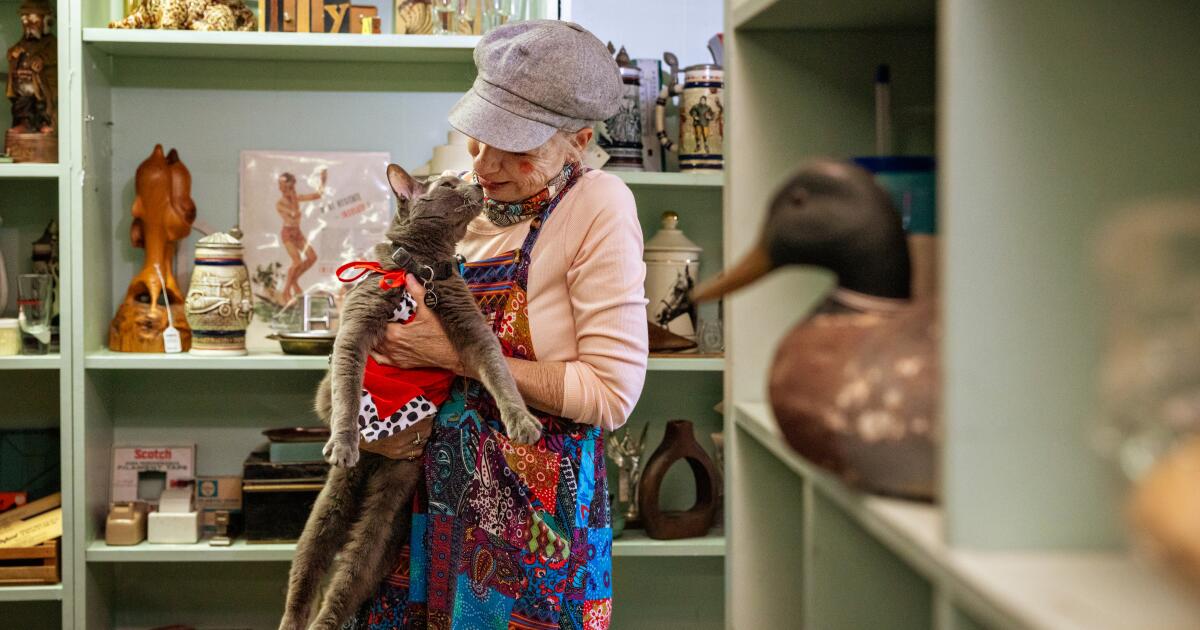
Elizabeth Kobliha knows her one-eyed cat Likho has more friends than she does. So much so that on his 15th birthday last Saturday, the sidewalk outside her downtown Long Beach store where he spends most of his time transformed into a makeshift fair.
There were vendors selling peach cobbler, watches, hot dogs and offering tattoos and face paint. A DJ spun records in celebration.
“He’s a very good businessman. We’ve got stickers, T-shirts, keychains, and buttons [of him], and it all goes under his account, his name,” Kobliha said of the cat.
-
Share via
Before Likho roamed the 7,000-square-foot Long Beach Vintage Etc, there was Apollo. The “big rag doll” came in with health problems but was the perfect shop cat. Apollo, a Maine coon who died at 13 following a seizure a year after his arrival in 2015, had curbed the shop’s mouse problem and brought “so much love and energy.”
Similarly, Likho, a one-eyed Russian Blue, also was ailing when Kobilha took him in at 8 years old, but she wanted him anyhow.
“I always wanted to open my own shop so I can have a shop cat,” Kobliha says, adding she was inspired by bookstores with cats “just chilling.”

Vendors line the sidewalk for Likho’s birthday party. The cat is a local celebrity.
(Jason Armond / Los Angeles Times)
In 2016, Kobliha was swiping through Facebook when a video stopped her scroll. In it, a woman inside of a hoarder’s garage bobbed a feather toy in front of Likho, who jumped up to catch it.
The post was made by Sia Barbi in collaboration with animal rescue group Stray Cat Alliance after the cat had been abandoned at the Hancock Park home. During the early ‘90s, Sia and identical twin sister, Shane, made waves in the fashion and pop culture worlds, often modeling for Chanel, Thierry Mugler and Jean Paul Gaultier. Their rise to fame began after the Los Angeles Times covered a Sunset Boulevard billboard featuring the twins wearing little clothing that had been causing car accidents.
“Guys of a certain generation would get very hot and bothered over them,” Kobliha said of the Barbi twins. As they exited the modeling industry, they pivoted into animal activism and volunteering for rescue groups and trap, neuter and return programs for cats.

Elizabeth Kobliha holds her cat Likho. When she opened her vintage store, she knew she wanted a shop cat just like chill bookstore cats.
(Jason Armond / Los Angeles Times)
Kobliha wanted to adopt Likho, but first he’d need a $3,000 operation to remove an infected eye, paid for by the Stray Cat Alliance.
“They took care of everything, then we had to wait because he had to recuperate,” she recalls. “The whole time I’m thinking, ‘Oh my God, what if it doesn’t work out? What if the cat gets here and is just absolutely bonkers?’”
That fear was for nothing. Likho, who lives at the shop full-time, acclimated within a day. “He has been a beautiful addition ever since then,” Kobliha says.
He’s since become the face of the shop, with a mural dedicated to him outside to welcome customers. That was done by local muralist LaJon Miller, who worked on another on the sidewalk during Likho’s party.
“I got adopted into it,” he says of the Likho fandom. “He’s been my muse on this street for a while. … He just roams around the store, chills, does his little nap thing, and hangs out with everybody, so he’s very social.”
Likho has never harmed the centuries-old objects in her shop, Kobliha says, but he has spooked suspected ghosts.

LaJon Miller, who calls Likho his muse, paints a portrait of the cat on the sidewalk outside of Long Beach Vintage Etc.
(Jason Armond / Los Angeles Times)
Kobliha believes ghosts once connected to shops at the 1922 building — a former patron of a grocery store shamed for his obesity and a former furniture shop owner who died by suicide — still roam her store’s stalls.
“We see shadow figures … there’s a certain area where they pass back and forth. They don’t do anything, but they’re scary as hell,” Kobliha says of unusual sightings. “Likho is very protective, and we do feel really safe when he’s around.”
“It is a little weird, though, when he’s sleeping, and then suddenly he will jump up and look around,” she adds.
Likho’s biggest fan may be a man named Dom Gomez. He lives within walking distance of the shop, and tends to visit after long shifts at a restaurant aboard the Queen Mary. He stopped by the birthday party wearing his work uniform: a white, button-down shirt and black slacks. His hair slicked; his hands behind his back.

Likho’s face graces merchandise at Long Beach Vintage Etc like this fan.
(Jason Armond / Los Angeles Times)
When he speaks of Likho, he speaks with a tender cadence and dignified countenance, as if he were his own.
“Time flies, you know?” he says, smiling, of visiting Likho over the years. “He gets a lot of love from all the ladies that work here and myself … he has a lot of fans. I don’t know who’s more famous, Muhammad Ali or Likho the Cat.”
On a previous birthday, Gomez wanted to get Likho a gift. He settled on a kid’s denim jacket he modified for a cat with a patch for the Cure on the back but, regrettably, it was a “little too big.” Next year, he’ll give it another shot with a sweater.
“That’s my little buddy right there,” he says. “Today is a special day. I didn’t know a cat could live that long, but I think he’s still got a lot of energy to live … maybe another 100 years, I hope.”
Lifestyle
Spain could make World Cup history: The first to win men’s and women’s trophies back-to-back

Pedro Porro #12 of Spain celebrates after the 2-0 victory during the FIFA World Cup 2026 Semi Final match between France and Spain at Dallas Stadium on July 14, 2026 in Arlington, Texas.
Florencia Tan Jun/Getty Images
hide caption
toggle caption
Florencia Tan Jun/Getty Images
If the Spanish Men’s National Team pulls off a World Cup victory on Sunday, the Spanish football federation would make history as the first to bring home successive World Cup championships on the men’s and women’s side in the history of the tournament.
The women’s team won the 2023 World Cup and will enter next year’s tournament in Brazil as defending champions. While the men’s team has been a perennial contender, appearing in 17 out of 23 World Cup tournaments, they last won the Trophy back in 2010.
The FIFA Women’s World Cup has had a much shorter history than its male counterpart; having started in 1991 compared to 1930 for the men. During that time, it has only had five different champions: the United States, Germany, Norway, Japan and Spain.
Only two of those teams, Germany and Spain, have also won the men’s World Cup.
The Spanish System
Spain has a robust men’s soccer league system, led by the Campeonato Nacional de Liga de Primera División, more commonly known as La Liga. Its teams are consistently among the top-ranked in Europe.
Real Madrid, based in the capitol, is one of the world’s most successful soccer clubs. FC Barcelona is the third-most valuable soccer club in the world, and Argentina’s Lionel Messi broke Brazilian legend Pelé’s record for most goals scored for a single club for the Catalonian team. Trips to Barcelona’s stadium, Camp Nou, have reached near-pilgrimage status for diehard soccer fans.

Spain’s players and officials celebrate with the trophy after winning the Australia and New Zealand 2023 Women’s World Cup final football match between Spain and England at Stadium Australia in Sydney on August 20, 2023.
Franck Fife/AFP via Getty Images
hide caption
toggle caption
Franck Fife/AFP via Getty Images
Spanish women’s soccer has lagged far behind, with both a league and a national team system plagued by poor coaching, underinvestment and abuse.
In 2015, the entire Women’s World Cup squad successfully called for the removal of coach Ignacio Quereda, whose leadership of the team since 1988 led many female players to accuse the Royal Spanish Football Federation of indifference to the women’s team. Even before the 2015 tournament, some longtime national team players said they refused to return to international duty as long as Quereda kept coaching.
In a 2021 documentary, “Romper el silencio,” players alleged Quereda sexually harassed and verbally abused them.
In the run-up to Spain’s 2023 Women’s World Cup victory, players again called for improvements to the women’s national team training and resources, with 15 players asking not to receive a national team call-up until the federation made changes.
Then, after Spain won, federation president Luis Rubiales forcibly kissed forward Jenni Hermoso, alongside other alleged indecent behavior. The entire Women’s World Cup squad stood behind Hermoso, calling for the removal of Rubiales and national team coach Jorge Vilda, who supported Rubiales. The players turned the international spotlight and goodwill of their 2023 victory into an international rallying cry that highlighted the poor treatment of female players.
Rubiales was suspended for three years, then tried and found guilty of sexual assault.
Members of the current Spanish men’s World Cup squad supported Hermoso and the other Spanish players in the wake of the Rubiales incident. Borja Iglesias, a striker, refused to play for the Spanish federation after Hermoso’s assault until Rubiales was removed.
In a viral moment on Tuesday, he found Hermoso on the sidelines after Spain defeated France in the World Cup semifinal and they hugged.
Spain will face Argentina at 3pm ET Sunday in New Jersey.

Madeline Fox is News Director at KCUR. For more World Cup coverage from KCUR, check out Soccer City 2026.
-
Lifestyle9 minutes ago
Wait Wait for July 18. 2026: With Not My Job guest Vicki Peterson
-

 Technology21 minutes ago
Google is open-sourcing its 3D emoji
-

 World27 minutes ago
Incoming UK PM Andy Burnham rejects Thatcher-era policies, signals leftward shift
-

 Politics34 minutes ago
Two US service members killed in Iranian strikes on Jordan, CENTCOM says
-

 Health40 minutes ago
Weight-loss drugs may improve job prospects and dating odds for one group
-

 Sports45 minutes ago
Betting preview picks Tampa Bay Rays on the moneyline to end Boston Red Sox 11-game streak
-

 Technology52 minutes ago
HalluSquatting AI attack could hijack your computer
-
 Business57 minutes ago
Amazon delivery companies lay off more than 150 people in the San Francisco Bay Area

