Lifestyle
Jonathan Anderson’s first Dior Cruise show in L.A. was a movie

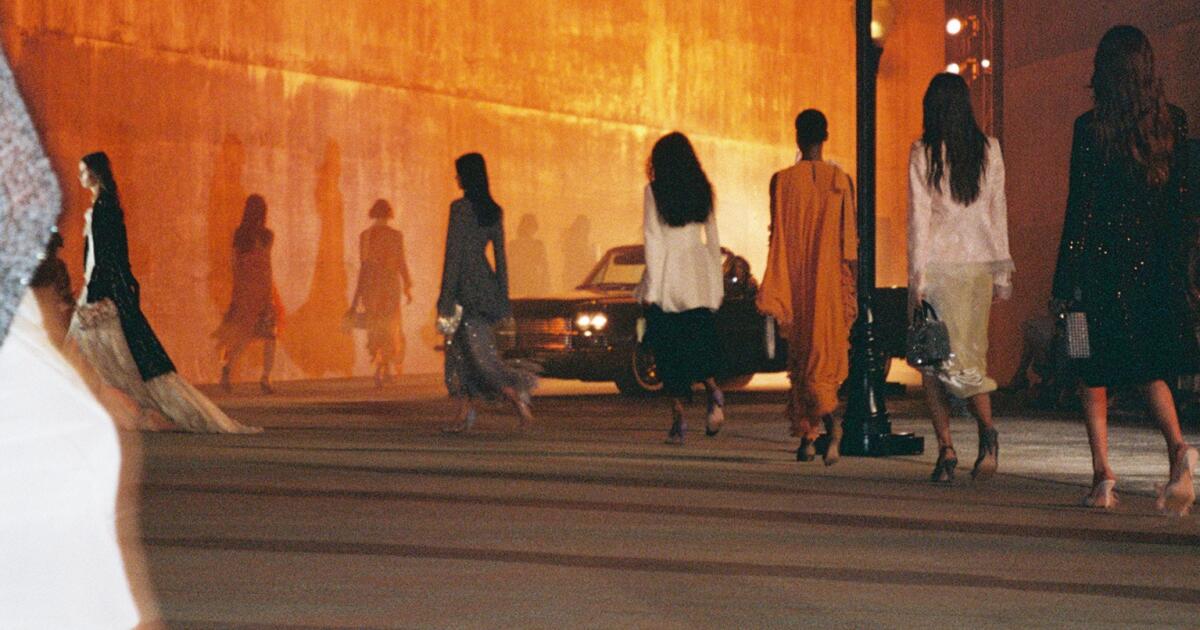

L.A. is proof that sometimes all you need is a car, a streetlamp and that orange light to make something really special happen. Jonathan Anderson presented his first Dior Cruise show in L.A. under the fluttering shadows cast by Peter Zumthor’s new Brutalist building at LACMA, and the whole thing felt like the equivalent of sending a text after hours of getting ready, buzzing with anticipation: “I’m OMW.”
At the base of the David Geffen Galleries, anchored by classic American cars in colors like bubblegum and butter, where models sat inside sucking lollipops and talking close, was “an illusion of L.A., in L.A.,” so say the show notes. The scene mirrored the energy of a film set, all drama and specific lighting and smoke billowing from mysterious corners, honoring the house’s relationship with cinema. The show notes also came in the form of a film script — titled “Wilshire Boulevard” — opening with the “No Dior, No Dietrich!” of it all and followed by Anderson’s thoughts on escapism and dreaming. Today’s Hollywood stars — Taylor Russell, Greta Lee, Anya Taylor-Joy, Alison Oliver, Jisoo, Maude Apatow, Jeff Goldblum, Sabrina Carpenter, to name a few — were in attendance.
The looks that walked down the runway also called upon the dream, soundtracked by a score that included blues icon John Lee Hooker and beloved French band Air. A new iteration of the Dior Saddle bag was car-inspired, sharing DNA with John Galliano’s 2001 Dior Cadillac bags, featuring car paint surfaces and motor key charms. There were the bespoke Philip Treacy hats that revisited a technique the milliner has honed for years, with feathers forming typography in words like “Buzz” and “Flow,” worn with some of the men’s looks. There was Anderson’s take on the bar jacket that Christian Dior made for Marlene Dietrich to wear in Alfred Hitchcock’s “Stage Fright,” white with a geometric black collar. A grey flannel coat was inspired by film noir, featuring a stripe detail that took inspiration from Venetian blinds. A red velvet dress with a rosette was Anderson’s way of playing with Christian Dior’s practice of putting a red dress partway through a show “simply to wake people up.”


As polished-glam and old-Hollywood as the references were, there were moments that also felt sleazy and fun in the way that Hollywood in 2007 did, when getting photographed pouring out of a car on the way into the club was a rite of passage and full of its own twisted promise. Denim was intentionally pilled and embroidered with fine silver chains in the rips, replacing frayed strands of cotton (“the everyday becomes couture,” the show notes say). Leather pants were worn with oversized rhinestone-rimmed sunglasses. A fuzzy coat in almost a wood grain-like pattern was worn slipshod over a shoulder with a black dress. Shirts were made in collaboration with L.A. artist Ed Ruscha, worn by models with messy long hair and hands in their pockets, sporting the kind of attitudinal walk that the skater boy-actor-model working at your local coffee shop has perfected. “When I think of L.A., I think of Ruscha’s work, which has a fascinating sense of the mundane and how it relates to the city’s grandeur,” Anderson wrote in the notes.
A resort collection is all about the destination, and in L.A. a destination can be the most quotidian, normal-ass place. For example, even the rarest piece in your closet is first experienced by your car, or your backyard, or the courtyard of a county museum. L.A. people get that the mundane is the destination because our version of mundane is anything but.


Cut to the afters at the Chateau Marmont. It was a blur of champagne, full sized In-N-Out cheeseburgers, chic ushers wearing Dior uniforms with snug grey sweaters and slacks that pooled perfectly at the leg. Oh, and also, a collective fear that someone would slip and fall into the gleaming turquoise pool (but isn’t that the intrusive thought that hangs over every Chateau party?). Faces like Teyana Taylor, Mikey Madison, Paul W. Downs, Role Model and Dominic Fike, all in Dior, were soaking in the ambiance.
As the night waned and we piled into big black SUVs with an emblematic “CD” on the windows that were there to take us home, one couldn’t help but call to mind a Hollywood trope, where in L.A., the journey was the destination all along.


Dior creative director Jonathan Anderson.

Taylor Russell and Mikey Madison.

Malcolm McRae and Anya Taylor-Joy.


Greta Lee and her parents.


Steven Yeun and Humberto Leon.




The Kennedy Center, the facade of which remains covered with a tarp, is seen in Washington, DC, on June 28, 2026. A US federal judge asked on June 24 for an explanation for why a tarpaulin continues to cover the facade of the Kennedy Center where President Donald Trump’s name was recently removed. District Judge Christopher Cooper gave the board of trustees of the performing arts venue until the end of July to explain “the purpose for and status of the tarp and scaffolding that Defendants have erected on the front portico of the Center.”
ALEX WROBLEWSKI/AFP via Getty Images
hide caption
toggle caption
ALEX WROBLEWSKI/AFP via Getty Images
More than two weeks ago, President Trump’s name was removed from the Kennedy Center facade though it is still covered by a tarp and the legal battle continues.
On Monday, a U.S. Department of Justice filing on behalf of the Kennedy Center included some surprises. The document was submitted in response to issues raised by lawyers for ex-officio board member Rep. Joyce Beatty of Ohio who is suing to remove President Trump’s name from the center and stop its closure for renovations.
Among the revelations, the Kennedy Center admitted that, during a board meeting on December 18, 2025, Beatty had been “muted and prevented from speaking.” It was at that meeting that the board voted to add President Trump’s name to the center. The filing later acknowledges the congresswoman was “prevented from voicing her opposition.”
The John F. Kennedy Center for the Performing Arts is a living memorial to its namesake. The guidelines for how the theatre complex spends federal dollars are very specific. Among other rules, it states that “no additional memorials or plaques shall be designated or installed.” Beatty argues adding Trump’s name runs afoul of those rules and that any change requires approval from Congress.
According to one of Beatty’s filings, “There was no advance notice in the agenda that the Board would be considering a name change,” a statement the Kennedy Center now does not deny. The center admits that, prior to voting, there was “no discussion about potential risks or downsides of the vote to adopt a secondary name for the Center.” Nor was there a board discussion “about any potential conflict of interest that might result from the vote.”
The center’s lawyers previously contended that if Trump’s name were to be removed, it would “lose money from donors who support” him and “impede the Center’s fundraising efforts.”
Closing for renovations
Earlier this year, Trump announced on social media that the Kennedy Center would close for two years for renovations. He wrote that he made the decision after “a one year review” with “Contractors, Musical Experts, Art Institutions, and other Advisors and Consultants.”
But, according to the center’s lawyers, Trump’s announcement “was made without presenting any plans, analyses, timelines, or funding information to his cotrustees and without any Board vote.”
The Kennedy Center has long denied reporting by The Washington Post that ticket sales plummeted after President Trump became the Center’s board chair. In Monday’s legal filing, the Center admits that, by October 2025, “nearly half of the Center’s tickets were going unsold.”


Paul Tremblay has made a career of pushing the horror genre – and the novel format – in strange and exciting new directions.
In his latest, Dead but Dreaming of Electric Sheep, the author offers an amalgamation of genre elements that can be best described as psychological-dystopian-science-fiction horror. It’s a mouthful, but the narrative does all of that and more in a way that defies categorization.
Julia Flang is a former semiprofessional gamer working two mediocre jobs she dislikes and living in a modest ranch house in a San Fernando Valley suburb with her retired uncle, whom she calls Uncle Fun. Julia likes movies and gaming but there’s little else going on in her life, so when her estranged mother, the CFO of a large tech company, contacts her with a possible job offer – a “once-in-a-lifetime thing” that pays handsomely just for doing the interview – she hesitantly agrees.

The job is relatively simple and perfect for someone with gaming skills: using a controller built into a phone to get a man, who is stuck in a vegetative state, from California to the East Coast. It will require her to learn how to control his body – walking, moving, sitting, standing, using his arms – so she can maneuver him out of the facility where he is located and into cars and planes and through crowded airports. A fan of movies, Julia decides to call the man Bernie – after the movie Weekend at Bernie’s. When the ethics of the job start to bother her, Julia realizes it’s too late and she must go through with it. However, she’s soon contacted by people interested in sabotaging the whole thing, people who, like her, don’t align with the shady interests of conglomerates and those set to make “gobs of money” from this new, somewhat inhuman technology.

As with every Tremblay novel, any synopsis barely scratches the surface. The novel’s chapters alternate between Julia and you (yes, you). Julia’s chapters are “normal” in the sense that they obey a chronological order and have action, basic descriptions of movement and places, and dialogue. The chapters in second person are like fever dreams from a shadow world; the desperate experiences of a man trapped inside his own body with no control of it, no clue what’s happening to him, and only a few fragmented memories of his life. Also, Tremblay uses a similarly fragmented style of storytelling (including words and sentences trapped in boxes and/or “moving” on the page) to keep things interesting but also confusing and creepy.
This novel operates on several different levels and – planes of existence? Bernie has a head full of AI that controls his body, but his consciousness is still there and struggling to regain control, struggling to remember things. There are monsters, leeches, mysterious rabbits, and eerie shadows in his world, but the true horror comes from the lack of control, from being moved around against his will and having no clue what comes next. Bernie is the embodiment of losing control to AI, and when taken together with the commentary of creativity and AI and the meta interludes in which the author takes a wrecking ball to the fourth wall and addresses readers, this is the best anti-Generative AI story horror has produced so far.
Despite the horror of it, this is a very funny novel. Julia is sarcastic and struggles to keep her comebacks in line, but the conversations she has and messages she writes are always entertaining. However, the humor is far from the crown jewel here. That title belongs to a plethora of big ideas Tremblay juggles. The nature of life, death, and consciousness, the evils of conglomerates, inhuman practices in the name of capitalism, and AI, and even what it means to be human are all explored here: “Is Bernie alive? Is he feeling pain? Is he experiencing everything as a prisoner looking through the bars of his body? Has his consciousness been winnowed to a metaphysical keyhole? Where does consciousness begin or end?” There are no definite answers here, but the way Tremblay infuses humanity, love, the importance of relationships, and humor throughout the narrative provides the kind of answers that can’t and don’t need to be spelled out.
A genre-bender full of big ideas that constantly switches between a world full of real or uncomfortably plausible nightmares and a bizarre hellscape in which loss of self, memory, and autonomy are only the tip of the proverbial iceberg, Dead but Dreaming of Electric Sheep is a horrific and terrifyingly disorienting novel that invites readers to consider a future that already started. Tremblay has always been an innovator, but this beautifully written collection of real and imagined grotesqueries cements him not only as one of the most original and exciting voices in horror but also as one of the smartest, most engaging authors in contemporary fiction.
Gabino Iglesias is an author, book reviewer and professor living in Austin, Texas. Find him on X, formerly Twitter, at @Gabino_Iglesias.

-

 West Virginia3 minutes ago
Transmission line proposals raise ratepayer cost concerns in West Virginia
-

 Wyoming6 minutes ago
Wyoming Department of Health warns of scam callers using official phone number
-

 Crypto11 minutes ago
Bank of Thailand Backs 1:1 Baht Stablecoin While Tightening Cross-Border Payment Rules
-

 Finance18 minutes ago
Google Cloud Pursues Financial Markets in FactSet Alliance | PYMNTS.com
-

 Fitness21 minutes ago
Boutique Fitness Is Redefining How Americans Work Out. Which Drop-In Classes Are Worth Booking?
-

 Movie Reviews33 minutes ago
‘Supergirl’ Movie Review
-

 World41 minutes ago
Map: 6.0-Magnitude Earthquake Shakes Off Mexico’s Coast
-

 News48 minutes ago
In the United States, Every World Cup Team Is a Home Team

