Lifestyle
11 new books in April offer a chance to step inside someone else’s world


April may well be “the cruelest month,” as T.S. Eliot famously opined — and even a five-minute doomscroll makes it tough to deny that cruelty is riding at anything but record levels lately. But remember you do have an alternative to doomscrolling, one that’s been around much longer: cracking open a book — or doomflipping, I suppose you could call it.
Don’t get me wrong: The books expected this month don’t exactly radiate escapist good vibes, riddled as they are with anxiety, corruption, unfulfilled desire — even the occasional direct challenge to our notions of reality itself. But they do offer the opportunity to step into someone else’s shoes and get to know their own particular view of our shared world — and sometimes that’s consolation enough. Which is nice, because it may have to be this month.
Transcription, by Ben Lerner (4/7)
The jacket copy of Lerner’s novella is basically a journalist’s stress dream: Commissioned to write what may be the final profile of his mentor, an aging literary icon, Lerner’s narrator fries his only recording device just minutes before the interview by dropping his phone in the sink. What follows is a meditation on memory, art and fatherhood, expressed in a handful of conversations that we’ve got plenty of cause to find unreliable, given the circumstances. As in his previous novels, including The Topeka School, Lerner centers some version of himself in this strangely captivating blend of fiction, memoir and critical essay, shot through with humor and anxiety.
American Fantasy, by Emma Straub (4/7)
Speaking of premises that read like one of my nightmares: Straub’s novel portrays the American Fantasy cruise ship and its themed voyage dedicated to an aging boyband and their loyal superfans — at this point, mostly middle-aged women addled with nostalgia and the looming terrors of menopause. The book bounces between the perspectives of a reluctant attendee, a band member and the boat’s hypercompetent event director, who really doesn’t deserve this. It’s infused with a blend of bemused humor and abiding sympathy familiar to readers of Straub’s previous novels, All Adults Here and This Time Tomorrow.
London Falling: A Mysterious Death in a Gilded City and a Family’s Search for Truth, by Patrick Radden Keefe (4/7)
In Keefe’s previous book Say Nothing, the veteran reporter took hold of a single loose thread — a mother’s decades-old disappearance — and pulled with such tenacity that the history of an entire tumultuous era raveled into view. Here, Keefe applies a similar approach — only this time, instead of Northern Ireland’s Troubles, the context of his latest book is modern London’s obliging relationship with the international financial elite. But as before, there’s an intimately human tragedy at the heart of Keefe’s investigation: a young man’s fatal plunge into the Thames and all the uncomfortable questions British authorities appear reluctant to pursue.
The Edge of Space-Time: Particles, Poetry, and the Cosmic Dream Boogie, by Chanda Prescod-Weinstein (4/7)
“You too can have your mind altered — no drugs necessary.” This, from the book’s introduction, offers something of a promise — which Prescod-Weinstein keeps with gusto, in this jaunty affront to just about everything our senses tell us about the world. The Dartmouth physicist’s follow-up to her lauded debut, The Disordered Cosmos, draws from just about every intellectual nook and cranny — from Bantu linguistics and Star Trek, to hip-hop and gender theory — to weave an idiosyncratic illustration of the universe as physicists understand it today. It’s an accessible take on a flabbergasting subject which, to put it mildly, offers a rather different view of reality than the one I remember learning in school.
My Dear You: Stories, by Rachel Khong (4/7)
This is Khong’s third book of fiction and her first short story collection. In it, she shows off the kind of range suggested by her previous novel, the tripartite Real Americans published two years ago. Here, in the new collection, heavy subjects such as race and grief coexist with conjured spirits and a psychic cat, extraterrestrials and a God who has reconsidered the whole “human” thing — and given everyone a deadline by which they’ll need to decide what other species they’d like to be instead. Understandably, given the givens so far.
Go Gentle, by Maria Semple (4/14)
Now this, my friends, is what we call a romp. Semple is best known for funny, deceptively poignant portraits of mothers in midlife crisis — see: Where’d You Go, Bernadette, a smash best-seller with its own Hollywood adaptation. The star of her newest novel is Adora Hazzard, a divorced philosopher with a sullen teenage daughter, a job teaching morals to rich kids and a growing “coven” of friends living nearby. Hold on tight, though — this one’s plot has twists and turns in abundance, as Hazzard certainly earns her last name in a series of, dare I say, shenanigans, animated always by a subtle, irrepressible joie de vivre.
On the Calculation of Volume, Book IV, by Solveig Balle, translated from the Danish by Sophia Hersi Smith and Jennifer Russell (4/14)
Yep, it’s still November 18. This unassuming date has detained Balle’s narrator for three novels already, and is likely to continue doing so for another three after this one. I hesitate to relate any more details about where the plot of the planned septology stands at this point, for fear of spoiling it for folks who still intend to catch up. Suffice to say, change is afoot at this point for our timelocked narrator, who may not be nearly as alone in her plight as she had initially thought.
Last Night in Brooklyn, by Xochitl Gonzalez (4/21)
Gonzalez stays close to home with her third novel. A dyed-in-the-wool Brooklynite, born and bred, the author of Olga Dies Dreaming has already earned a nod as a Pulitzer finalist for her column concerning gentrification in the borough she calls home. So the departure in her latest book is less in space than time, as her latest novel deposits readers in Brooklyn in 2007, on the cusp of global financial freefall, for a story of class, race, dangerous aspirations and the looming death of a heady era, which bears unmistakable echoes of The Great Gatsby.
American Men, by Jordan Ritter Conn (4/21)
The American men referred to in the grandly sweeping title of Conn’s sophomore book of narrative journalism, in fact, number just four. Each of these men bears the mantle of masculinity differently, grappling differently with all the pressures that the label entails, but each one has also bared his experiences and innermost thoughts to Conn with equally thorough candor. From these four interspersed stories Conn does not produce any sociological claims, still less a polemic, so much as a portrait of four lives so disarmingly frank, it can be difficult to look away — and maybe we shouldn’t.
Small Town Girls: A Memoir, by Jayne Anne Phillips (4/21)
Phillips won the 2024 Pulitzer Prize in Fiction for her last book, Night Watch, a wrenching portrayal of trauma and recovery set in a West Virginia mental asylum following the Civil War. Now, Phillips (“one of our greatest living writers,” according to Michael Chabon, one of that year’s Pulitzer jurors) is returning to the Allegheny Mountains of West Virginia, not in historical fiction but in personal retrospect. It’s where Phillips grew up, where she has come to set most of fiction, and her new memoir is not so much about her life alone as it is her lifelong relationship with this place she “can never truly leave.”
The Story of Birds: A New History from Their Dinosaur Origins to Today, by Steve Brusatte (4/28)
Brusatte could not be any clearer about this, folks: Birds. Are. Dinosaurs. The American paleontologist underlines the idea, which is apparently a century and a half old, early and often in The Story of Birds. This expansive history of our fine-feathered neighbors, as scientists understand them today, traces an evolutionary thread that leads directly from landbound behemoths like the triceratops to the airborne raptors that patrol our own skies. As he has done in his previous books — which covered dinosaurs and mammals, respectively — Brusatte offers a lively, loving introduction to his topic that’s as comprehensive as it is accessible.


Once rivals on the tennis court, Martina Navratilova, left, and Chris Evert have become close friends in retirement. They are pictured above at the French Open in 1986.
Trevor Jones/Getty Images Europe
hide caption
toggle caption
Trevor Jones/Getty Images Europe
Chris Evert and Martina Navratilova were the most successful women’s tennis champions of their generation. Both were 18-time Grand Slam tournament winners — and each other’s greatest rivals.
Evert, a Florida native, became a tennis star in her teens. Navratilova was born in communist Czechoslovakia, and emerged as a player after Evert was established. They first faced off during a match in Akron, Ohio, in 1973, when Evert was 18, and Navratilova was 16. Evert won, but Navratilova left an impression.
“I remember thinking to myself, holy cow, when this young girl gets into better shape, she is going to be a force to be reckoned with,” Evert says. “She had so much talent. Her hands were quick, she had a big first serve, she had a big forehand, and she just was so powerful.”

Two years later, on the day she lost a semifinals match to Evert at the U.S. Open, Navratilova defected to the U.S. In the years that followed, her tennis game improved. Though she and Evert had initially been friendly, the friendship cooled as their rivalry heated up.
“Playing Chris was difficult because how can you not like Chris? What’s not to admire?” Navratilova says. “She was like the epitome of cool.”
The new Netflix documentary Chris & Martina: The Final Set tells the story of how Evert and Navratilova re-established their friendship and how they both faced cancer in retirement. Evert was diagnosed with ovarian cancer in 2021; Navratilova was diagnosed with throat and breast cancer in 2022.
“I can’t get away from her,” Evert jokes. “We had a 15-year career, and then we got cancer at the same time. It really is freaky, but I always say: If I want someone to be in the trenches with me, it’s Martina because she has been so supportive and so understanding.”

Navratilova agrees: “We have such a level of trust that we know whatever we say to each other, it stays there. We give each other the best advice we know how to. And there is no ulterior motive, no playing games.”
At the time that this interview was taped, Evert and Navratilova were both in remission from cancer. But late last week, Evert disclosed she’d recently been diagnosed with a recurrence of ovarian cancer.

“We know whatever we say to each other, it stays there,” Martina Navratilova says of her friendship with Chris Evert.
Netflix
hide caption
toggle caption
Netflix
Interview highlights
On supporting each other through cancer
Evert: There are a lot of phone calls between us. … I don’t cook, but Martina would bake bread for me, and her wife Julia would cook, make some chicken soup. … I got a lot of food from Martina. She got a necklace from me.
Navratilova: I get jewelry from Chris, she gets food from me.
Evert: Martina’s and my relationship — because we’ve had one for 50 years — is not the type where we have to talk to each other every day to maintain the closeness. I always knew she was there. She always knew I was there if we needed to talk, and that was that.
On the weakness they experienced with cancer
Navratilova: Chris’ diagnosis and treatment was much more life-threatening than mine, percentage wise, but my treatment was more difficult physically. … I was in New York for seven weeks and I literally sat on a yoga mat, maybe half an hour of the seven weeks, and did some stretching. I couldn’t even do the down dog pose because I would have fallen down. I had absolutely zero strength left.
Evert: The chemo kicked my butt, let’s put it that way. … It left me very weak, very, very weak. After chemo I would have three or four days of intense nausea and I just would feel tingling in my body and it just wasn’t nice. I didn’t have the energy. To walk six blocks was a big deal for me. And it was foreign. You know, it felt like it wasn’t my body, for sure.
On watching the old footage of their matches together for the documentary
Navratilova: For me, it was fun watching with Chris, because we had different reactions to what happened on the court. But what impressed me is how well we played with those wooden rackets. Because you know what? Those rackets are not easy to play with. But you try to put yourself in there physically, what it was like, mentally, what it is like. And it’s like, “Oh, I should have gone down the line,” or, “I can’t believe I missed that shot.” Or “Chris, you had such a great pass.” It was amazing. So it was impressive. … I wish I could still have that six-pack, but anyhow.

Evert: I remember feeling genuinely happy for her. I remember it was her first Wimbledon. That’s always been her dream since she defected. Her family couldn’t be there to watch her. She was all alone. And I just was happy for it. And I knew that this was gonna be one of many for her to win.
On defecting to the U.S. in 1975 when she was 18 years old
Navratilova: I was thrilled to be in the States. I always loved American cars. And when you ordered a ham sandwich, you got, like, two inches of ham and two slices of bread. Whereas growing up, you had thick bread and one slice of ham. So I thought I was in heaven. And it was $2.30 for that sandwich. I still remember it. I couldn’t believe how much ham I was getting.
Lauren Krenzel and Nico Gonzalez Wisler produced and edited this interview for broadcast. Bridget Bentz, Molly Seavy-Nesper and Beth Novey adapted it for the web.


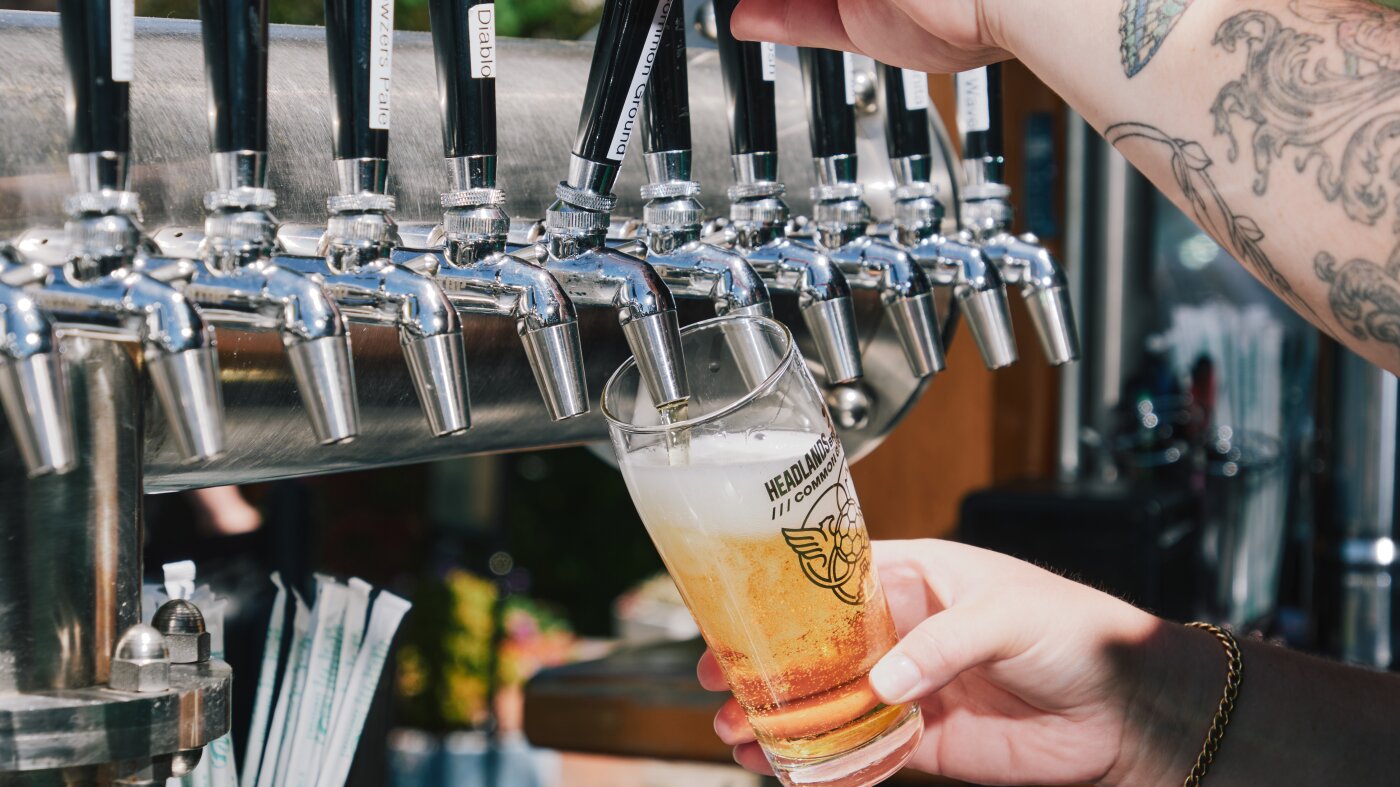
Headlands Brewing launched its World Cup-themed beer Common Ground ahead of the first World Cup game in June.
Justin Gellerson for NPR
hide caption
toggle caption
Justin Gellerson for NPR
The British betting company William Hill predicts that soccer fans will throw back more than 5 million pints of beer in stadiums and fan zones during this year’s World Cup. And that number doesn’t even account for the millions of pints being poured in bars as fans tune in to the global soccer event.
But while international soccer crowds are focusing on goals and penalties, a trio of craft breweries from the tournament’s three host nations are using the tournament to brew something increasingly rare: cross-border solidarity.

A shared recipe with local spin
The collaboration began months ago over a flurry of video chats and emails. The beermakers at Rey Árbol Brewing Co. in Mexico, Headlands Brewing in the United States, and Cabin Brewing Co. in Canada set out to design a single, unified recipe representing the brewing traditions of all three nations.
“It’s a Mexican lager,” said Alejandro Gomez, founder of Rey Árbol.
“That’s like a West Coast IPA,” said Ryan Frank, chief operating officer and brewmaster for Headlands.
“And up in Canada, most of our beers are hop driven,” said Haydon Dewes, co-founder of Cabin. “So we thought, let’s go for a dry-hopped Mexican lager.”
While all three breweries share the exact same recipe, each is giving the final product a distinct local spin, including unique, regionally designed labels. A four-pack of the U.S version costs $15.99. Frank said Headlands has produced about 130 cases of the limited-run brew.

Headlands Brewing COO and brewmaster Ryan Frank drinks a Common Ground beer in Berkeley, Calif., on June 11.
Justin Gellerson for NPR
hide caption
toggle caption
Justin Gellerson for NPR
For the brewers, however, the project is less about marketing and more about connection: They named the multinational beer “Common Ground.”
“When I go to California or Canada, they will treat me like family,” Gomez said.
“It makes the world feel so much smaller,” said Dewes.
“It’s about building bridges and knowing what’s important in life,” said Frank. “And for us, that’s soccer and beer.”
Geopolitical friction in the taproom
The official rhetoric surrounding World Cup 2026 mirrors the brewers’ optimism, with promotional materials promising a tournament where billions are “united as individuals, united as billions.”
Yet this idealistic messaging stands in sharp contrast to a prickly geopolitical reality. Tensions between the U.S., Mexico and Canada have mounted over trade tariffs and auto manufacturing standards as the three nations renegotiate long-standing trade agreements.
The independent brewers behind Common Ground are feeling that friction firsthand through the rising costs of aluminum cans and raw ingredients.
“There are 15% tariffs slapped on any European-grown hops, which are really critical to some of our core brands,” Frank said.

Headlands Brewing brewmaster Ryan Frank and CEO Austin Sharp share a Common Ground beer in Berkeley, Calif., ahead of the first World Cup game on June 11.
Justin Gellerson for NPR
hide caption
toggle caption
Justin Gellerson for NPR
The political discord hasn’t just been confined to trade boards.
When signing an executive order to establish a White House Task Force for the World Cup in March 2025, President Trump suggested that cross-border hostilities might actually benefit the tournament. “Oh, I think it’s gonna make it more exciting,” the president said.
A bittersweet reminder
Tension on the soccer field is one thing; between nations, it’s another.
“It’s true that when it comes to the actual soccer, we’ve developed a very healthy, vibrant rivalry between the three countries,” said Andrés Martinez, the author of The Great Game: A Tale of Two Footballs and America’s Quest to Conquer Global Sport and co-director of Arizona State University’s Great Game Lab, which studies the intersection of sports, media and geopolitics. “But we’re also linked together in this very symbiotic relationship.”
Martinez said that when the U.S., Canada and Mexico initially launched their collaborative bid to host the World Cup back in 2017, the political climate was warmer.
“It was meant to showcase these tight bonds that had developed between the three countries,” Martinez said.

The makers of Common Ground used a shared recipe, but all created their own distinct packaging for the beer: Canada’s Cabin Brewing Co.; Mexico’s Rey Árbol Brewing Co.; the United States’ Headlands Brewing.
Cabin Brewing Company, Rey Árbol Brewing Company, Headlands Brewing
hide caption
toggle caption
Cabin Brewing Company, Rey Árbol Brewing Company, Headlands Brewing
But relations have soured since then, making cross-border business collaborations like Common Ground an anomaly rather than the norm for this tournament.
“To see craft beers across the three countries coming together like this, it’s a bittersweet reminder of what we were hoping to see a lot more of,” Martinez said.
Finding the real common ground
If trade wars and political posturing are looming large in Washington, D.C., Ottawa and Mexico City, they feel a world away at Headlands Brewing’s busy North Berkeley location.
As fans gathered to watch a crucial match between Mexico and South Africa at the start of the tournament, the sunny patio erupted into cheers and shrieks of “Goal!” when Mexico found the back of the net.

Headlands Brewing hosts a screening of the first World Cup game on June 11 in Berkeley, Calif.
Justin Gellerson for NPR
hide caption
toggle caption
Justin Gellerson for NPR
Hovering over a pint of the collaborative brew, soccer fan Roberto Mandujano reflected on the cross-border experiment.
“Three different ways, three different taste buds come together to make something cool,” he said.
When asked about the underlying political tensions between the host nations, Mandujano shrugged off the discord.
“We live in a world where everyone wants to make everything political,” Mandujano said. “But I think we’re all here for soccer. So I guess that’s the common ground.”
-

 Movie Reviews3 minutes ago
‘The Invite’ Movie Review – Spotlight Report
-

 World18 minutes ago
Russia's ruling party runs Ukraine war veteran among lead candidates for September election
-
Politics26 minutes ago
Supreme Court Expands Presidential Powers to Fire Independent Regulators
-

 Culture51 minutes ago
Test Your Knowledge of New York’s Algonquin Round Table
-
Lifestyle56 minutes ago
They were world-class tennis rivals. Now friends, they’ve teamed up against cancer
-

 Technology1 hour ago
T-Mobile is booting customers from its oldest plans
-

 World1 hour ago
Gunman kills 6 at youth welfare facility in suspected child custody dispute: reports
-

 Politics1 hour ago
Emotion and feelings: How Democratic Socialists’ congressional insurgency could come back to bite them

