Florida
Bringing marine life back to South Florida’s ‘forgotten edge’


An experiment in nature-inspired design is underway in a South Florida residential canal. Two mangrove planters are being installed on a new seawall to provide habitat for marine wildlife.
Nathan Rott/NPR
hide caption
toggle caption
Nathan Rott/NPR
POMPANO BEACH, Fla. — At the back edge of a backyard, in a dead-end South Florida canal, Arthur Tiedeman is drilling holes into the face of a seawall his marine construction company recently installed.
The seawall is a newer design of reinforced concrete encased in vinyl. It’s a smooth, hardened ledge at the intersection of land and sea that’s designed to protect property and make the coastline more habitable for people.
The problem, Tiedeman says, is that it makes the coastline not very habitable to anything else. “It’s not a natural shoreline like mangroves and sand,” he says. “It’s just a straight giant wall.”
That’s why he and his crew are on a bobbing barge outfitted with a crane, installing two first-of-their-kind planters that, when hung, will house two living mangrove trees on the otherwise featureless wall.
The planters are pockmarked and rough-cut; etched and grooved to mimic oyster reefs and mangrove roots. They’re a wildlife-focused add-on — one of the latest products in a fast-growing commercial market that’s selling homeowners and municipalities on a more holistic approach to marine infrastructure.

“Even these tiny little pores you get, those are little pockets that tiny organisms will start to take up residence in,” says Keith Van de Riet, the designer of the new planters.
Nathan Rott/NPR
hide caption
toggle caption
Nathan Rott/NPR
“We’re in a time period — a golden era — where humanity has kind of realized what we’ve done here,” Tiedeman says, gesturing up the dredged canal. With the erasure of so much natural habitat, pollution, overfishing and climate change, populations of popular fish like grouper and snapper are declining. Water quality in many canals and bays is worsening.
There’s a growing recognition that municipalities and property owners need to “improve the shoreline and build infrastructure with the environment in mind,” Tiedeman says.

“That’s what makes all these properties worth what they’re worth,” he says, referencing the mansions lining the canal. “The water. And the enjoyment of the water.”
A “forgotten edge”
The new mangrove planters were designed by Keith Van de Riet, a professor at the University of Kansas, who’s helping with their installation.
An architect by training and an avid angler, Van de Riet has long been interested in finding ways to improve the design of coastal infrastructure so that it benefits more than just people. For more than a decade, his primary focus has been on seawalls, what he calls “a forgotten edge.”

“I’ve always wanted to be near water,” says Keith Van de Riet. “And the idea of creating things that are beneficial for people and other species — I find that appealing.”
Nathan Rott/NPR
hide caption
toggle caption
Nathan Rott/NPR
And the reason, he says, is simple: In many places it’s the only shoreline left. “This all would have been meandering mangroves, maybe a mangrove creek here that [people] just blew out,” he says.
By dredging the waterway and barricading its edges, people have taken that soggy horizontal plane — a life-rich intertidal zone that supports oysters, crabs, fish and birds — and collapsed it, he says, “into a vertical wall with a single dimension to it.”
Marine organisms don’t like homogeneity. They like nooks and crannies — places to hide.
“The more texture the better,” Van de Riet says.

For water-filtering oysters, a keystone species in marine habitats, concrete seawalls — the standard in South Florida for more than a century — can provide some of that texture. Van de Riet points to clusters growing on a concrete ledge just below the scumline, just one property down from where his planters are being installed.
It’s a sliver of habitat compared to what they’d have in a natural environment, he says, but a critical one. And it’s now at risk of shrinking further, as many of South Florida’s concrete seawalls, built in the post-World War II boom, are hitting the end of their lifetime — what Tiedeman calls the “seawall pandemic.” Those seawalls, it turns out, are increasingly being replaced with steel or vinyl — smooth, featureless products that offer no welcoming texture for living things.

Arthur Tiedeman measures the distance between scumline and the seawall’s top to determine where to put the planters.
Nathan Rott/NPR
hide caption
toggle caption
Nathan Rott/NPR
“We’re taking that last 1% [of habitat] that they’re clinging to and changing the material,” Van de Riet says, “pulling the rug out from under these oysters.”
His hope is that his mangrove planters will help sustain populations of those oysters through the transition.
Mimicking nature
Globally, there’s a lot of innovation happening and new products like Van de Riet’s becoming available, says Rachel Gittman, a coastal ecologist at East Carolina University.

Property owners can now buy artificial reef balls or request vertical oyster gardens. Miami Beach recently installed its first “living seawall,” a wide mangrove root-etched panel, designed to provide habitat and protect against storm surge. In southwest Florida, a similar-style wall panel, created by Van de Riet, has been in the water since 2016.
“There’s a push towards: Can we mimic nature — and can we reproduce it in a way that’s going to support biodiversity or productive fisheries or erosion protection?” Gittman says.
She’s not convinced all of the new products will work. It’s hard to emulate nature.
“But in places where the habitat has already been lost or someone’s just going to put in a regular seawall, I think it’s a better option,” she says. “Even a small little oyster reef can support a lot of organisms.”
The real challenge will be creating enough of them. A study published in 2021 found that only about 15% of the world’s coastal regions remain ecologically intact. Restoring those coastlines, Gittman says, will require significant policy changes from national and local governments.
She adds that in places like South Florida, where coastal infrastructure is being updated to accommodate rising seas and the vast majority of coastline is privately owned, it will take buy-in from homeowners as well.
“We are in this critical period where we could make huge leaps in terms of how our infrastructure is designed in this country if we make thoughtful investments and we don’t just build exactly what we had 50 years ago,” she says. “I hope that’s not what we do. But we don’t always learn from our mistakes.”
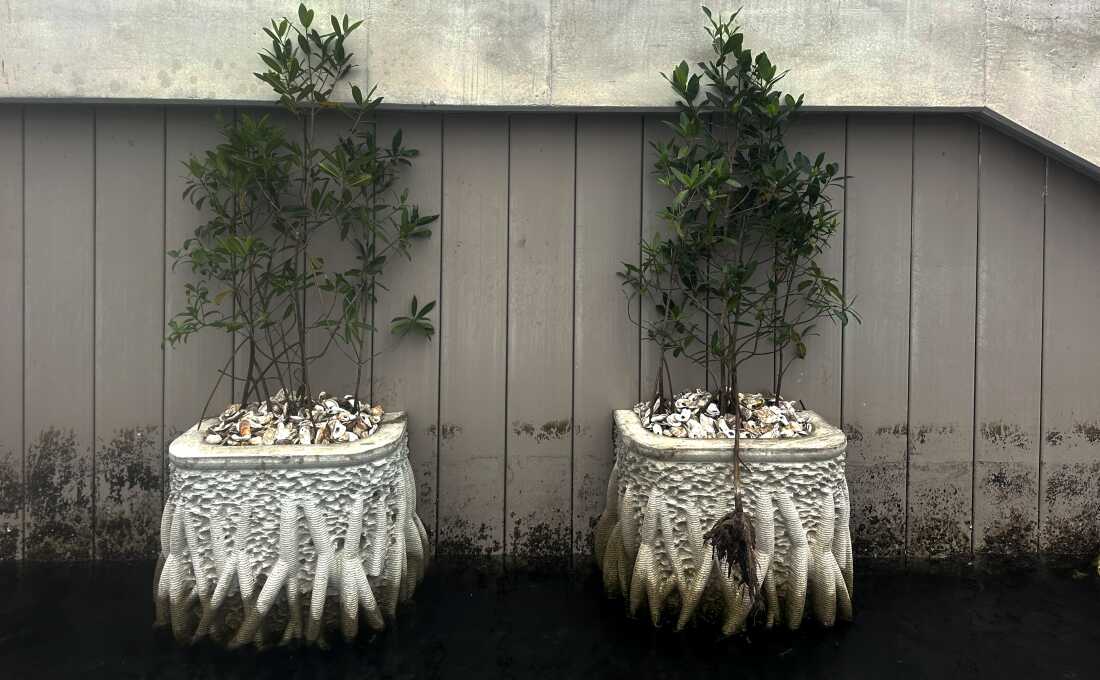
When it comes to improving the built environment, Keith Van de Riet says, “We have to look at these hybrid models.” Incorporating parts of nature — like mangrove trees — into infrastructure.
Arthur Tiedeman/APH Marine Construction
hide caption
toggle caption
Arthur Tiedeman/APH Marine Construction

Florida
Area to watch for tropical development in Gulf to bring downpours to drought-stricken Florida | Latest Weather Clips | FOX Weather

Area to watch for tropical development in Gulf to bring downpours to drought-stricken Florida
While this area to watch for tropical development may not actually become tropical, it will definitely bring rain to Florida, which desperately needs it. The system is likely to bring the most significant rain to the Florida panhandle down south to Tampa, but the entire state can expect some moisture through midweek next week.


Gulf system to bring downpours to Florida
FOX 13 Meteorologist Jim Weber is continuing to watch an area in the Gulf that is expected to bring much-needed rain to Florida this weekend. He said the system will likely drift to the north and northwest and will linger before heading to the northeast. He said to get a tropical depression, or a tropical storm there needs to be winds and a closed low and he is not seeing that in the models yet. Weber is also tracking a system off the coast of Africa that has a 10% chance of developing over the next week. He says it will likely enter a hostile environment and dissipate.
TAMPA, Fla. – Forecasters are tracking a broad disturbance in the Gulf of Mexico off the Florida coast that could bring much-needed rain to parched communities this weekend.
Gulf tropical development potential
What we know:
Models continue to indicate there is a potential for an area of low pressure to form over the northeast Gulf off the west coast of Florida over the weekend.
The National Hurricane Center says an area in the Gulf has a 30% chance of tropical development over the next seven days.
Models a shifting away from the forecast of the system moving over the state and off the coast of the Carolinas. Models are now indicating a more likely scenario that it lingers in the Gulf over the weekend and may drift more to the northwest near the Florida Panhandle or Louisiana coast. Early next week conditions look like they will become less conducive and may prohibit much development. Regardless of whether it organizes, the system will bring tropical downpours and increased moisture across Florida and parts of the Southeast.
FOX 13 Meteorologist Jim Weber states we are close to 7.50″ below average on our rainfall in Tampa for the year. A weak area of low pressure or tropical system can be beneficial in helping to make up for the rainfall deficit we have been experiencing. Drought conditions continue over much of the state of Florida. If this system ends up drifting more westward, it would limit the total amount of rainfall and the highest totals would be along the immediate west coast.
Atlantic tropical development potential
A tropical wave southeast of the Cabo Verde Islands remains disorganized.
It is moving west-northwest and, according to the NHC, there is a chance for slow development over the next day or two. By the weekend it is expected to move into less conducive conditions and Saharan dust will begin to affect this wave, limiting its moisture. The time for this system to develop is very limited and will not develop after the weekend.
The NHC is giving it a 10% chance of developing.
Weather factors and storm names
What we don’t know:
Officials cannot yet confirm if the disturbance will overcome environmental hurdles like land interaction, wind shear and dry air. Computer models remain uncertain on how much this system will develop over the waters of the Gulf. If it stays over the warm waters of the Gulf longer, it may give it additional time to organize. Interactions with land and wind shear will likely pose obstacles in further development.
To become a tropical system, it must develop a defined circulation with organized thunderstorms. If it reaches maximum sustained winds of 39 mph, it will become a tropical storm and be named Bertha.
The Source: The information in this story was gathered by FOX 13Meteorologist Jim Weber, the National Hurricane Center tropical weather outlooks, as well as forecast computer models.

Sign up to get the Florida TODAY statewide newsletter in your inbox weekdays. It’s free.
Here’s a quick glimpse of Florida TODAY, our statewide newsletter:
How long does it take to save for a first home, Florida?
In Jacksonville, the answer could be less than a year.
In Miami, it could be more than 40.
A new report suggests homeownership is slipping further out of reach for many Florida workers — especially those in retail and restaurant jobs.
There’s a lot more going on across the Sunshine State:
License to blush: A South Florida retiree was taken aback by her new license plate. Her family thinks she should keep it. Would you?
Tiny terror: Florida is racing to stop a fuzzy new invasive pest that can wipe out a field in weeks. It has a taste for everything from grass to corn to sugarcane.
Small miracle: Black skimmer chicks are back on the Sanibel Causeway for the first time in 30 years. Photojournalist Andrew West got a close look at the comeback.
That’s not all. Want the full statewide newsletter every weekday? Subscribe to Florida TODAY
NOTE: If you are a digital or print subscriber to a USA TODAY Network-Florida site, follow this link to subscribe via your local site.
-

 Los Angeles, Ca44 minutes ago
Cybertruck driver arrested for DUI after Los Angeles pursuit crash
-

 Detroit, MI1 hour ago
DER Weekends: Pathways for first-gen students at the University of Detroit Mercy – WDET 101.9 FM
-

 San Francisco, CA1 hour ago
“There is no ceiling”: Welcome to Area AI
-

 Dallas, TX1 hour ago
Cowboys news: Dak Prescott embraces high expectations in Dallas
-

 Miami, FL2 hours ago
How to watch France vs. England in the third-place FIFA World Cup match: TV channel, streaming, kickoff time
-

 Boston, MA2 hours ago
Police investigating deadly shooting in Allston – Boston News, Weather, Sports | WHDH 7News
-

 Denver, CO2 hours ago
Former strip club owner selling Castle Pines mansion for $8M
-

 Seattle, WA2 hours ago
‘Imagine you crushed a raccoon like a can’: Curley describes viral deformed ‘mutant’ Jimothy – MyNorthwest.com

