West
49ers stars praise San Francisco as Bay Area hosts Super Bowl: ‘So much to offer’

NEWYou can now listen to Fox News articles!
SAN FRANCISCO – The Super Bowl is returning to the Bay Area for the first time in a decade on Sunday, and San Francisco 49ers stars think it’s a wise choice.
Levi’s Stadium hosted Super Bowl L, Peyton Manning’s final game, while Stanford Stadium was the venue for Super Bowl XIX, when the nearby 49ers defeated the Miami Dolphins, 38-16.
“It’s a historic city with so much character. The food, the hills, the homes, the water, the bridge, the whole thing. It’s just such a great city, too, and it’s really cool to see it come to life even more than it already is,” Christian McCaffrey told Fox News Digital on radio row ahead of the big game.
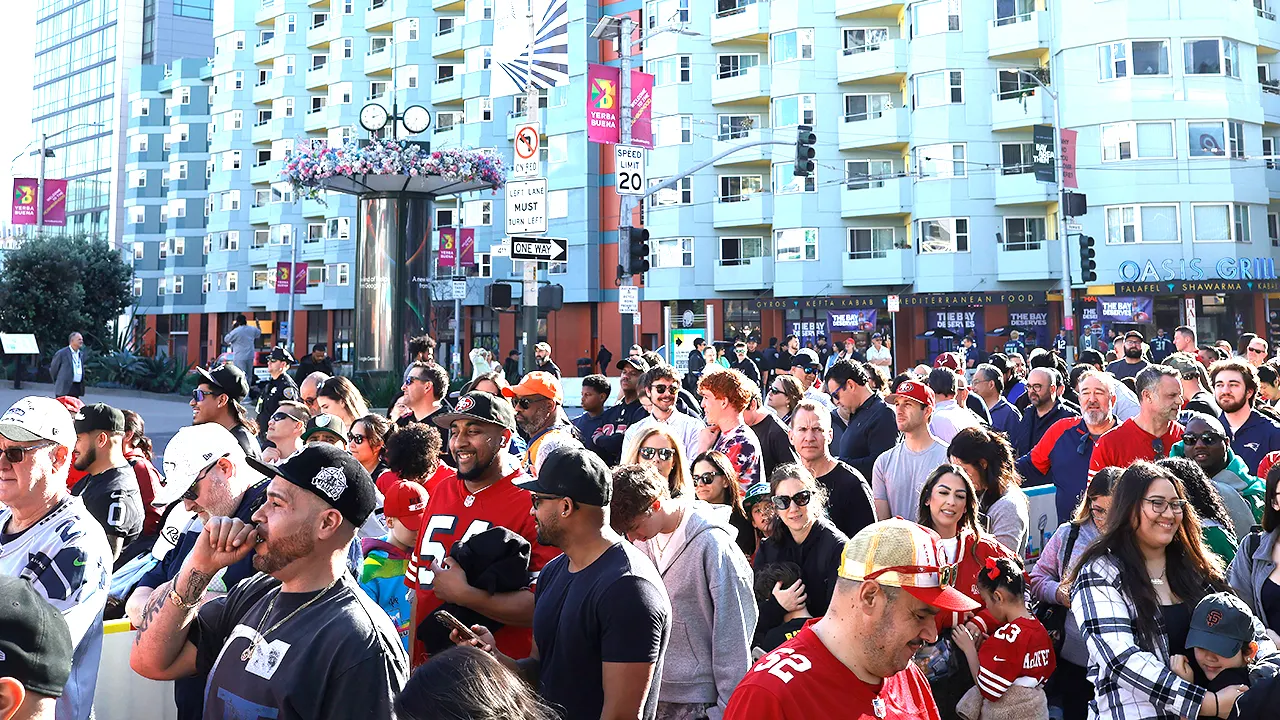
NFL fans walk outside the Super Bowl Experience at Moscone Center on Feb. 6, 2026, in San Francisco. (Ronald Martinez/Getty Images)
“Man, I think San Francisco has so much to offer,” quarterback Brock Purdy added. “Just, obviously, with the restaurants, the experiences, just how pretty it is out here with the Golden Gate Bridge and the ocean. It’s a great city, great people. So to have the Super Bowl out here is really cool.”
Levy Restaurants has also made its way to the Bay Area for the big game. Fred Warner got a chance to sneak a peek at their Super Bowl menu while he was nursing his injury and watching his Niners play from Levi’s Stadium suites.
Helmets of the Seattle Seahawks and New England Patriots displayed outside Levi’s Stadium prior to Super Bowl LX on Feb. 4, 2026, in Santa Clara, California. (Don Juan Moore/Getty Images)
49ERS STAR BROCK PURDY PLAYS LOCAL HERO AT ALL-GIRLS FLAG FOOTBALL GAME IN SAN FRANCISCO
“I had the pleasure of trying out some of their items that they’re gonna have on Super Bowl Sunday up in my suite during this past season. They had the steak frites, which were delicious, man, that’s right up my alley, some delicious steak and french fry combination there. Crab nachos, which were fantastic. Some short ribs, so they got some really good options, man. I think it’s gonna be a hit.”
Warner also echoed his teammates’ sentiments about the California city.
“I think it’s just because it’s a melting pot, man. Just all the different cultures mixing, all the diversity and mixing together,” Warner said. “You can get a little bit of everything that you’re looking for out here, and of course, playing in the greatest stadium in the entire NFL, Levi’s Stadium, you can’t beat it, and so I think it’s gonna be a great Super Bowl Sunday and a great week as well with all the different activities that they got planned for everybody.”
Fans visit Moscone Center for Super Bowl Experience and fun activities in San Francisco on Feb. 3, 2026. (Tayfun Coskun/Anadolu via Getty Images)
The actual game is roughly an hour outside of San Francisco itself, but the Super Bowl experience and Radio Row were all in the heart of the city at the Moscone Center.
Follow Fox News Digital’s sports coverage on X, and subscribe to the Fox News Sports Huddle newsletter.
Read the full article from Here



Colorado
Showers and thunderstorms forecast for Colorado’s high country as wildfires rage across the state

Following several days of hot, dry weather, Colorado’s Western Slope is poised to see a period of rainy skies with possible thunderstorms ahead of what meteorologists expect to be an active monsoon season arriving later this summer.
Beginning Tuesday, a wave of energy is expected to track across the Northern and Central Rockies, leading to a significant uptick in thunderstorm activity statewide, according to a July 6 report from OpenSnow Meteorologist Alan Smith.
The forecast shows a moderate-to-high chance of showers and thunderstorms across the High Country beginning Tuesday afternoon, with patchy smoke lingering from the morning through the early afternoon due to active fires located across Southeast Utah and Southern Colorado.
Wednesday is expected to bring more of the same, with up to a 40% chance of showers and thunderstorms and possible wind gusts up to 25 miles per hour across the northern and central mountains, according to the National Weather Service. Thunderstorms could become more scattered with limited moisture on Thursday, followed by a return to clear skies by Friday.
Temperatures across the northern and central mountains are forecast to sit in the 70s and 80s throughout the week, with some areas, including Glenwood Springs and Steamboat Springs, reaching into the 90s by the weekend as hot and dry conditions once again take hold of the region.
Little-to-no impact on wildfire risk
While stronger storms throughout the week could produce locally heavy rain in some of the mountains, drier air at lower elevations could lead to a “dry thunderstorm” setup when paired with gusty winds and limited rainfall, especially on Thursday, Smith wrote in the report.
The possibility of dry thunderstorms — bringing lightning strikes on dry vegetation with no rain to extinguish the resulting sparks — could heighten wildfire risk in drought-stricken regions of the state.
“There is still some concern about what thunderstorm outflow winds could do to ongoing wildfires if these fires themselves do not receive meaningful rain,” Smith wrote.
Gillian Felton, a Grand Junction meteorologist with the National Weather Service, said it’s hard to say whether the upcoming showers will impact the state’s extreme fire risk. Because the showers and thunderstorms forecast for this week likely won’t be dropping a significant amount of precipitation, it presumably won’t do much to impact existing wildfires across the state.
Much of Colorado’s Western Slope remains in the highest level of drought as of July 2, according to the U.S. Drought Monitor.
“Even though we are getting this push of moisture, it’s really rather weak,” Felton said. “While some localized areas might see more precipitation than others, overall, this moisture moves through quickly and we get right back to very dry, very hot conditions.”
Is monsoon season officially here?
Though this week’s rainy forecast marks a temporary uptick in moisture, Felton said it doesn’t yet signal the start of Colorado’s monsoon season.
“We pretty quickly will return to drier weather,” Felton said. “By Friday, anomalously dry air moves back in, and we’re looking at very hot and very dry conditions this weekend. This little push of moisture we’re getting is nice, but it’s going to be quite short-lived.”
Although hot and dry conditions will take hold across Colorado’s mountains over the weekend, confidence is growing that significant monsoon moisture could surge into the Western U.S. sometime during the week of July 13, though it will likely hit the Northern and Central Rockies before it arrives in Colorado.
“The core of this monsoon moisture surge is coming out of the Gulf of California with strong southerly flow, which may favor Arizona, Utah, Wyoming, Nevada, Eastern Idaho, and the Sierra (Nevada) in California,” Smith wrote in the report. “But this moisture should eventually spread into Western Colorado as well, which is in great need of meaningful rains given the ongoing fire situation.”
Longer-range models are hinting at an overall active monsoon for the second half of July and into August, according to Smith.

HONOLULU (KHON2) — Fried chicken fans have a reason to celebrate today as Popeyes Hawaii marks National Fried Chicken Day with a special one-day-only offer.
On Monday, July 6, participating Popeyes locations across Hawaii are offering five pieces of Signature Chicken for just $5, while supplies last. The deal includes a mix of legs and thighs and is limited to one order per customer and one per vehicle, with no substitutions.
Popeyes says the promotion is a fun way for customers to enjoy its signature crispy, Louisiana-style fried chicken at a value price while celebrating the national food holiday.
The offer is available today only at participating Popeyes Hawaii restaurants including Aiea, Waipahu (Waikele), Kunia, Kapolei, Kailua, Kaneohe, and Pāhoa (Big Island). The offer is limited to one per vehicle in the drive-thru and one order per customer for dine-in, while supplies last.
For more information and participating locations, visit popeyeshawaii.com.
Idaho
An Idaho mother who said her toddler twins died after vaccinations has been charged with murder

An Idaho woman who said her toddler twins died last year after being vaccinated faces murder charges connected to their deaths, authorities said.
A grand jury indicted Andrea Shaw, who is accused of suffocating her 18-month-old twins in May 2025, on two counts of first-degree murder on June 29, according to court records and a news release from the Payette Police Department.
While appearing last year on an internet show produced by Children’s Health Defense — an anti-vaccine group founded by Health and Human Services Secretary Robert F. Kennedy Jr. — Shaw said her twins died after getting vaccinated. Kennedy has not been affiliated with the group since December 2024, when he formally resigned as chairman to join President Donald Trump’s administration.
Shaw, 23, was arrested by Boise police officers Tuesday and arraigned Thursday. She is being held on a $2 million bond and could face life in prison or the death penalty if convicted or if she pleads guilty to first-degree murder. Her next court appearance is July 14.
An attorney representing Shaw did not immediately respond to a request for comment. The Payette Police Department and the Payette County prosecutor declined to comment Monday.
During her May 2025 appearance on the Children’s Health Defense show, Shaw said she found her twins dead in their room days after they got vaccinated for the flu and other diseases.
“They had got their shots at the same time by two nurses at the same time,” Shaw said. “And they got sick.”
Medical experts point out that the childhood vaccines at issue — hepatitis A, influenza and DTaP — are safe and effective for kids and recommended by various medical groups.
Shaw is also a plaintiff in a federal lawsuit brought by Children’s Health Defense and others against the American Academy of Pediatrics. The lawsuit, which was filed in January in federal court in Washington, accuses the American Academy of Pediatrics of racketeering for its “central role in an enterprise that has defrauded American families about the safety of the childhood vaccine schedule for several decades.” In the lawsuit, Shaw is described as a mother “whose children died following routine vaccinations administered according to AAP guidelines.”
The American Academy of Pediatrics has asked the court to dismiss the suit, asserting in an April court filing that it is the “latest missive in a campaign targeting” the academy and its “use of science-backed evidence in vaccine policy.”
In January, pediatricians and other experts became alarmed when U.S. health officials made broad changes to childhood vaccine guidance, dropping several universal recommendations. Kennedy, who helped lead the anti-vaccine movement for years, said the changes better align the U.S. with peer nations “while strengthening transparency and informed consent.”
In March, a federal judge blocked the changes and said Kennedy likely violated federal procedures in revamping a key vaccine advisory committee. But the judge’s order is not the final word; the blocks are temporary, pending either a trial or a decision for summary judgment.
-

 Colorado2 minutes ago
Showers and thunderstorms forecast for Colorado’s high country as wildfires rage across the state
-

 Connecticut5 minutes ago
Eversource crews work to restore power nearly 48 hours after Independence Day storm
-

 Delaware10 minutes ago
Delaware County commissioners criticize Marion County prosecutor
-

 Florida17 minutes ago
Deadly July 4th shooting arrest; South Florida man accused of Miami stabbing attack
-

 Georgia20 minutes ago
Poll shows Georgia Democrats ahead in senate, gubernatorial races
-

 Hawaii25 minutes ago
$5 deal for National Fried Chicken Day
-
Idaho32 minutes ago
An Idaho mother who said her toddler twins died after vaccinations has been charged with murder
-

 Illinois35 minutes ago
Severed arm in Illinois lake: Court records say body parts found in freezer, half-brother claimed self-defense


