Lifestyle
Hyperpop, poetry, BDSM or a Moroccan rave allegory? Choose your own cinematic adventure


Charli xcx in The Moment.
A24
hide caption
toggle caption
A24
Charli xcx’s The Moment expands wide this weekend. Alexander Skarsgård plays a very un-brat director in the faux documentary starring the pop star as a version of herself — and he stars in BDSM rom-com Pillion.
Those and more are in theaters this week.
The Moment
Expanding widely on Friday
This trailer includes instances of vulgar language.
YouTube
Remember brat summer? That was, of course, in 2024, the year when Charli xcx’s Brat album catapulted her into the mainstream. Now she’s turned that moment into the movie The Moment, directed by Aidan Zamiri, who directed the music videos for Charli’s songs “360” and “Guess.” It’s a hyperpop supermeta faux documentary starring Charli as a version of herself in the album’s aftermath. She’s feeling intense pressure to capitalize upon her newfound mainstream success, and reluctantly goes along with her record label’s shrewd business plans. Along for the ride is none other than Alexander Skarsgård, in a great comedic turn as a concert filmmaker named Johannes who’s totally not brat.
The movie’s central question: Can Charli keep the brat momentum going? And, more crucially: Does she even want to? Your mileage may vary, but I’d argue The Moment works on multiple levels: As a self-referential, semiserious commentary on Charli xcx’s fraught (and well-documented) relationship to fame; as a damning critique of the polished artist-approved concert documentary industrial complex; and as a messy, yet interesting observation of the pitfalls of capitalism. — Aisha Harris
Pillion
In limited theaters Friday
YouTube
“What am I going to do with you,” asks Ray (Alexander Skarsgård), a handsome, leather-clad, undeniably dominant biker in Harry Lighton’s debut feature. “Whatever you want,” replies Colin (Harry Melling), the dweeby, shyly submissive parking enforcement officer who can’t believe he’s attracted the attention of this Tom-of-Finland-caliber stud. In his mid-30s, Colin still lives with his gay-affirming parents (Douglas Hodge and Lesley Sharp) in one of London’s outer boroughs. He’s mild in every sense, performs in pubs in a barbershop quartet, and knows absolutely nothing of BDSM. Ray, who needn’t utter a word to get Colin to buy chips for him and his dart-playing buddies at a pub, is about to introduce him to gay biker kink — fetish-wear, a shaved head, dog collars and all — in a dom-com that features a good bit of pretty graphic sex.
But Lighton mixes the raunch with a sweet positivity by focusing on Colin’s growth and Ray’s vulnerability. Skarsgård lets us see Ray as a man who comes to realize he’s painted himself into a corner by closing himself off from emotional connections. Melling is endearing in his snaggle-toothed innocence, and braver than he first seems, both with Ray and with a domineering mom who badgers him in softer, but no less effective ways. (A “pillion,” in case you’re wondering, is the back end of the driver’s seat on a motorbike, where the passenger sits; it can also be used as slang for a submissive partner.) — Bob Mondello
A Poet
In limited theaters Friday
YouTube
Pity the poor artist who knows he’s failing. Simón Mesa Soto’s Colombian dramedy follows Oscar (Ubeimar Rios), a poet who published two books early in an artistic career that’s since gone south. Now in midlife, he’s unemployed, divorced and living with his mother. His daughter is embarrassed when he visits her, his poetry readings tend to start as lectures and devolve into tirades. He drinks too much and is seriously unlucky. His luck seems to change when he gets a gig teaching poetry in a high school and meets Yurlady (Rebeca Andrade), a teenager who seems indifferent to poetry, but writes like a dream.
Oscar becomes her mentee, shepherding her to competitions (she’s interested in prizes if they can help her family out of poverty), and introducing her to a prestigious poetry school that immediately sees publicity and fundraising advantages in adopting this Black child of humble origins as their mascot. Filmmaker Soto casts a skeptical eye on all of this, shooting in grainy 16-millimeter, and using musical scoring to underline the absurdity and pretension. Both Rios and Andrade are non-professionals making their acting debuts. And the film, which is only the sophomore effort of writer and director Sosa, took the Un Certain Regard Jury Prize at Cannes. — Bob Mondello
Sirāt
In limited theaters Friday
YouTube
A wall of speakers is being assembled in the Moroccan desert at the beginning of Óliver Laxe’s nerve-wracking portrait of sensation seekers on what appears to be the brink of World War III. The speakers soon growl, pulse, and thunder as gyrating, sunburned bodies writhe to a techno beat, and with the help of his young son, a father hands out pictures of a daughter he hasn’t heard from for months. Convinced she might be part of this bacchanalian scene, they’re intrigued when Jade (Jade Oukid) says there’s another rave scheduled soon at an unspecified faraway spot. When the military arrive, ordering an immediate evacuation, Jade and four buddies (who, between them, are missing an arm, a leg, and quite a few teeth) strike out across the desert, and the father and son follow them in a minivan that’s not suited to the rough terrain.
Some LSD-inflected comedy ensues, but if you know that the title refers to the vanishingly-slender bridge Muslim faithful must traverse past Hell on the day of judgment if they want to reach Paradise, you’ll sense that trouble lies ahead. With an engaging cast of mostly first-time actors, Laxe takes the story into allegorical — Mad Max meets The Wages of Fear — territory, through a shocking mid-film tragedy, to a downright existential conclusion. — Bob Mondello
Kokuho
In limited theaters Friday
YouTube
The opening moments of Sang-il Lee’s nearly three-hour epic are breathtaking — a yakuza boss’ son, Kikuo (Ryo Yoshizawa), is orphaned in a New Year’s gang massacre that’s choreographed to a fare-thee-well. But the film isn’t a mob saga. Kikuo performs the onnagata (female) role in an amateur kabuki performance at his father’s New Year’s celebration just before the slaughter. A famed Kabuki actor is in attendance, and adopts the boy, raising him alongside his own kabuki-trained son Shunsuke (Ryusei Yokohama). The great man’s wife worries that Kikuo is so adept at the danced, ritualized theatrical form, that he could end up usurping the dynastic succession by which Shunsuke is expected to take over from his father.
That’s the start of a story that rivals, in its melodramatic twists and fable-like symbolism, the arch, stylized form this family practices. The filming is gorgeous, though the story becomes attenuated in its third hour. Still, it’s easy to see how this film, nominated for best makeup and hairstyling at this year’s Oscars, became Japan’s highest-grossing live-action film. — Bob Mondello


Can you say no to a friend’s wedding?
Getty Images/Getty images
hide caption
toggle caption
Getty Images/Getty images
Are we spending too much on other people’s weddings?
Going to a friend’s weddings can be so fun and meaningful… but it can also really hurt your wallet. A survey by LendingTree found that 31% of people who had been to a wedding in the past five years had accrued debt to attend. So what’s driving up the cost of weddings for guests? And what makes it so hard to say no to these expenses?
Brittany breaks it down with Allyson Rees, senior analyst at trend forecasting firm WGSN, and Annie Joy Williams, assistant editor at The Atlantic.
This episode was produced by Liam McBain, with additional support from Corey Antonio Rose. It was edited by Neena Pathak. Our Supervising Producer is Cher Vincent. Our Executive Producer is Barton Girdwood. Our VP of Programming is Yolanda Sangweni.
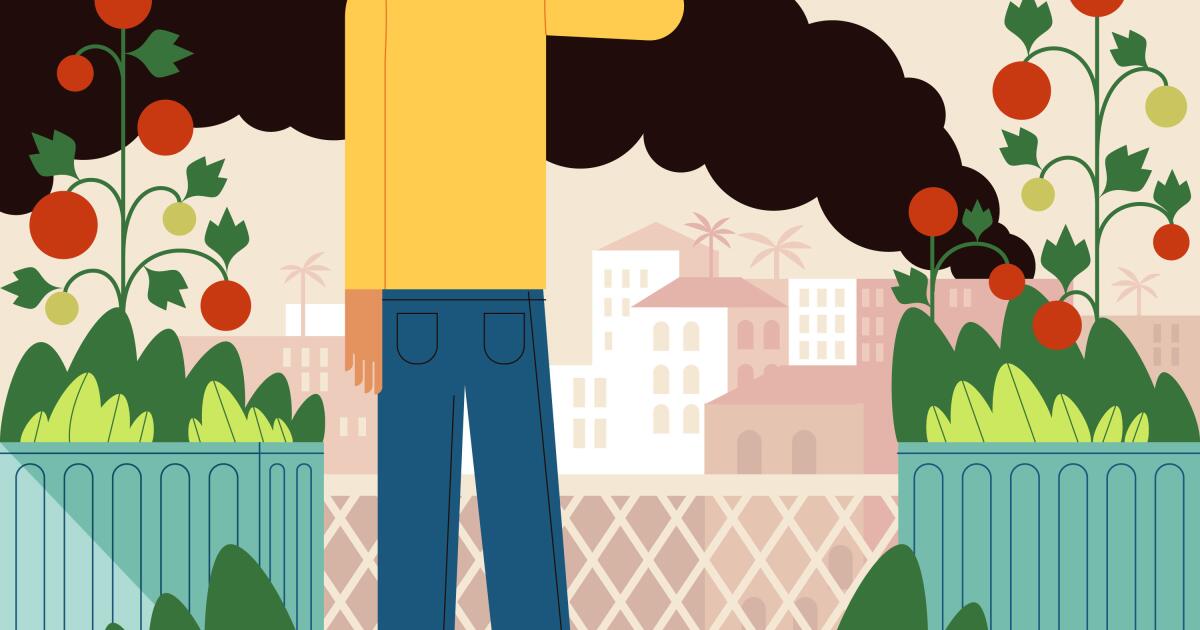
After the eight-day-long fire in a 500,000-square-foot Boyle Heights warehouse, eastern Los Angeles residents are contending with putrid smells, soot and potentially hazardous airborne chemicals after heavy plumes of smoke spread throughout the city. But those who grow food in nearby neighborhoods may also be wondering: How will the fires affect the plants and produce in my garden?
The Boyle Heights warehouse, owned by Lineage — a global temperature-controlled storage facility operator — housed 85 million pounds of frozen food and other products. In the days since the fire, local emergency visits for smoke inhalation and throat pain spiked while agencies still scramble to measure the amount of PM 2.5 — harmful fine particles — and heavy metals, like lead and arsenic, in the air.
According to researchers, any toxic airborne chemicals would likely stem from the charred foam insulation, metal exterior, burned solar panels and any lithium batteries that might have been present inside the warehouse.
After a fire, heavy metal particles can spread through ash and smoke over gardens and inhibit growth, said Olukayode Jegede, an agricultural toxicologist and assistant professor at UC Davis. Since the warehouse fire is so recent and cleanup has just begun, Jegede said the precise impact on gardens can’t be measured until comprehensive soil tests are conducted in the area.
While the L.A. city government hasn’t announced plans for soil testing, the Contaminant Level Evaluation and Analysis for Neighborhoods project at USC is offering free contaminant testing for Boyle Heights and East L.A. residents. Residents can collect soil samples and deliver them to Boyle Heights City Hall and other locations for an evaluation of lead, arsenic, chromium and mercury levels.
The good news is produce, plants and roots can still be preserved. According to Jegede, many of the soil tests conducted last year in the Altadena area after the Eaton fire showed that gardens and poultry were not as contaminated as one might expect.
“Quite a number of the soils we tested [in Altadena] were not really contaminated,” Jegede said. “We weren’t seeing many soils with concerning elevated levels of metal, so gardeners should not be too alarmed when these things happen.”
Nevertheless, there are several measures that gardeners can take to keep themselves, their children, plants and produce safe from potentially harmful contaminants stemming from the fire. Researchers, gardening experts and horticulturists offered some guidance on the handling, recultivation and cleanup that can keep you and your garden in good health.
How do I remove ash and contaminants from my garden?
Altadena horticulturist Leigh Adams said Boyle Heights plants and produce already live in a difficult environment, surrounded by industrial warehouses that spread contaminants daily.
“That area has been used industrially for 100 years, and the soil is impacted by many, many, many things,” Adams said. “Low-income neighborhoods and gardens usually don’t have a lot of resistance against dominant manufacturing.”
This means that the contamination of gardens in eastern L.A. won’t be as catastrophic as compared with those in Altadena, a more suburban environment, Adams said. But fallen ash still poses major health risks if ingested or inhaled.
An advisory from University of California Agricultural and Natural Resources last year recommended suiting up in an N95/KN95 mask, long sleeves, pants, close-toed shoes and gloves before attempting to deal with ash in the garden to limit exposure to potentially toxic contaminants. The advisory added that individuals should make sure all of this gear is cleaned thoroughly before bringing it back inside.
Once in the proper gear, Adams recommends removing the top two inches of topsoil from gardens, where the highest concentration of contaminants will settle after a fire. Using a plastic bag to collect the soil and disposing of it in the garbage — not green yard waste bins — will help to reduce the spread of airborne chemicals.
Gardeners with raised beds are advised to remove approximately six inches of soil, because excess ash can raise the pH level and prevent nutrients from soaking into the soil bed.
After this, watering the garden gently but plentifully will help to promote soil health and get rid of most of the ash present on plant leaves and stems. Adams said replacing the top two inches of soil with store-bought mulch or straw will help to contain any remaining ash and prevent it from spreading any further.
Experts say to avoid using leaf blowers if ash is present in the garden because they can send particles airborne. Doing so will increase the likelihood of heavy metal particles, which can carry lung irritants and carcinogens, being spread and inhaled.
A Boyle Heights resident keep a watchful eye on the fire at the 5,000-square-foot commercial building, which stores 85 million pounds of frozen food.
(Genaro Molina / Los Angeles Times)
Is it safe for me to eat produce from my garden?
Several studies, including one from the UC Cooperative Extension of Sonoma County, have shown that consuming produce in a fire-affected area poses minimal health risks.
Jegede said most root vegetables like potatoes and carrots, along with any fruit that has an outer layer, can be washed to remove potential contaminants, even if they were covered in ash. Peeling the outer layer of your produce can also help to reduce potential risks, he said.
Lettuce and other leafy foods with multiple layers pose a higher risk of contamination, but with a vigorous wash and peeling the outer layers, even the greens can be saved. The County of Los Angeles Department of Public Health recommends soaking leafy produce and fuzzy fruits like peaches in a 10% white vinegar and 90% water mixture.
Jegede said if the leaves or fruit are too delicate to wash or ash is still visible, it would be best to dispose of the produce.
How can I tell if my soil is contaminated?
After ridding your garden of visible ash, you might wonder how to tell if your plants will still thrive in the soil.
At-home soil tests that measure for alkaline, fertility and pH levels are widely available and can be purchased for $15 to $100 (for more detailed results) online. But Jegede said these tests can’t tell the full story of soil health.
Comprehensive soil testing is “something you can’t do properly at home,” Jegede said. “In labs, we are testing for metals like lithium and zinc, stuff that an at-home test will not show … If it comes to the point that you’re worried about your soil, I would just send it out to a lab.”
Wallace Laboratories in El Segundo, Babcock Laboratories in Riverside, Waypoint Analytical in Anaheim and other labs offer more detailed soil tests that measure heavy metal particles in addition to other fertility factors. Prices at Wallace Laboratories can range from $115 to $295 for a complete compost test.
The soil below two inches should be unharmed, Adams said, so long as new compost is set and plants are watered plentifully, which will promote natural biological cycles.
“What you’re doing is capping the soil, so that moisture stays in there, and instead of being dirt, it’s a living system called soil,” Adams said. “The more carbon we can get into our soil, the better.”
What can I do to help my soil recover?
For the last 12 years, Adams has been working with Metabolic Studio, a Los Angeles-based art and research hub focused on environmentalism, on methods for bioremediation, the practice of using additional fungi, plants and compost to decontaminate ash and break down contaminants.
Adams said straw, mushrooms, corn, rye and sunflowers are great bioremediators that can help to repair damage to soils. She said certain samples she’s worked on with Metabolic Studio have gone from testing at high heavy metal levels to nearly contaminant-free.
But for a more immediate fix, wash your produce, water your plants and have a little patience during ash cleanups. Your garden should look better in no time, Adams and Jegede said.

Inde Navarrette and Michael Johnston in Obsession.
Focus Features
hide caption
toggle caption
Focus Features
Two big horror films, Obsession and Backrooms, just smashed all box office expectations. So much of their success has been driven by Gen Z, which is now the biggest moviegoing demographic. But what makes a movie a Gen Z movie? Today we’re bringing you an episode of NPR’s It’s Been a Minute. Host Brittany Luse talks about this trend with Sam Adams and Reanna Cruz.
If you want to hear more about these movies, check out these episodes:
In ‘Obsession,’ love hurts. It really, really, really hurts.
‘Backrooms’ brings YouTube horror to the big screen
Zendaya brings ‘The Drama,’ we bring the spoilers
Connect with Pop Culture Happy Hour:
Letterboxd / Facebook
Our weekly newsletter
Support Pop Culture Happy Hour+
-

 New Jersey54 seconds ago
Police conclude investigation at Walmart in Cherry Hill, officials say
-

 New Mexico6 minutes ago
Monsoon high shifts slightly west but rain is still possible Wednesday in New Mexico
-

 North Carolina13 minutes ago
North Carolina Republican operative shaping the state’s early voting plans is reassigned
-

 North Dakota16 minutes ago
West Fargo Attorney Chosen for North Dakota Ethics Commission Position
-

 Ohio21 minutes ago
Jeff’s Donuts opens first Ohio location, open 24 hours
-

 Oklahoma28 minutes ago
5 Things To Know: Oklahoma County inmate death, deadly OKC hit-and-run
-

 Oregon31 minutes ago
Oregon to ask court to delay Paramount deal for 60 days while it reviews records
-

 Pennsylvania36 minutes ago
Pennsylvania state trooper to be laid to rest after being fatally struck in Schuylkill County

