Washington, D.C
What’s the best meal Keith Duggan can get for €120 in Washington?


Every day this week, our foreign correspondents will accept the challenge of finding the best meal possible in their city for the equivalent of €120. First, Keith Duggan introduces us to dinner in a Washington bookshop.
You won’t live the high life in Washington, DC on a dining budget of €120, but nor will you starve.
The return of Donald Trump in January this year coincided with a prolonged winter blast of snow and the sense of an entirely new era in the city.
Within weeks, Butterworth’s, on Capitol Hill, began appearing in news and magazine articles as a popular meeting spot among the ascendant Maga set – it was the restaurant of choice for Steve Bannon when he participated in the “Lunch with the FT” feature, cheerfully assuring readers that Trump would run for a third term.
Aside from attracting Maga-ites it has drawn rave reviews for an unfussy reimagining of standard bistro favourites and terrific staff. They’ll happily let you in the door in Butterworth’s with your modest budget. But it won’t take them long to serve you.
You could book an evening dinner table, split the crispy cauliflower with miso caramel ($18), have mains of dry-aged duck breast with kale and sauce verjus ($37) or lamb heart Bolognese ($29, and a Maga fave, one imagines), definitely forsake the cocktail menu and have a couple of glasses of Sancerre – and still leave a standard tip of at least 20 per cent.
But a better option, on this budget, would be to take yourself off to one of Washington’s venerable old haunts, Kramers. It’s essentially a wonderful independent bookshop masquerading as both a bar and cafe/restaurant that has been a fixture on Connecticut Avenue, just above the famous green and water fountain on Dupont Circle, since the 1940s.
It was where the concept of the bookshop cafe originated in the United States and for a time, in the boozier decades, it remained open all night.
Now, like much of Washington, the shutters come down early.
Celebrated past visitors include Maya Angelou and Barack Obama, but the place hit national headlines in 1998 when the owner, Bill Kramer, fought a court petition from independent counsel Kenneth Starr to have the bookshop reveal the titles of the books bought by one of its customers, Monica Lewinsky.
[ Patrick Freyne’s quest for the best Christmas sandwich in Dublin: ‘I give it five Santas out of five’Opens in new window ]
It’s a hugely popular weekend brunch location, particularly when it’s still warm enough to sit outside. Unsuspecting first-time visitors often move from the poetry section through a narrow doorway and in to the darkened bar, mirroring the pathway of many an actual poet. The bar is low-lit, even during the day. The restaurant is at the rear.
Decor is minimalist, to put it politely, but the menu is eclectic and everything is good. Steak and eggs ($29) and Kramers Benedict ($22) are brunch staples. For dinner, the cream of crab soup ($14) is served with grilled ciabatta and the crispy Brussels sprouts ($12), with lemon, parmesan and a side of ranch dressing, do much to rehab the reputation of that maligned veg.
Pizzas and those ginormous American sandwiches also feature, but highlights on the mains are blackened salmon ($25) and the shrimp and grits with Andouille sausage in a spicy tomato sauce ($22). It’s the sort of place that invites parking of calorific anxieties at the door.
The Triple Chocolate Devil’s Food Cake ($12) is the best reason to visit Kramers, and possibly Washington itself. It’s an obscenity, in the best sense.
The wine list is short and modestly priced: a bottle of the (only) Sauvignon Blanc is $35. So that’s a three-course meal for two for $120 (if you skip the caffeine) – a bill which would suggest a tip of around $30. And you might even pick up a book. kramers.com



Washington, D.C
DC will pay $50,000 to man detained while protesting guard patrol with ‘Star Wars’ song, record says

WASHINGTON (AP) — The District of Columbia has agreed to pay $50,000 to settle a lawsuit filed by a resident who accused police officers of illegally detaining him for following an Ohio National Guard patrol while playing Darth Vader’s theme song from “Star Wars” on his cellphone, according to a document released Monday.
The plaintiff, Sam O’Hara, sued the district, four Metropolitan Police Department officers and a guard member from Ohio over what he says was his act of protest against President Donald Trump’s federal law enforcement surge in Washington, D.C.
A court filing on Thursday disclosed the settlement but didn’t specify any monetary terms. The amount is included in a copy of the settlement agreement that D.C. Attorney General Brian L. Schwalb’s office provided to The Associated Press.
The $50,000 settlement includes attorney’s fees and costs. O’Hara is represented by the American Civil Liberties Union of the District of Columbia. In an email on Friday, an ACLU spokesperson referred to the settlement’s financial terms as “a significant amount” that O’Hara “is pleased with” but said they weren’t disclosing the dollar figure to protect his privacy.
O’Hara, an artist who works in the hospitality industry, agreed to drop his claims against the district and the MPD officers within three business days of receiving the settlement payment. The settlement isn’t an admission of wrongdoing by the district, the agreement says.
O’Hara’s settlement with the district doesn’t resolve his related claims against an Ohio National Guard member, Sgt. Devon Beck, who has asked a judge to dismiss O’Hara’s claims against him.
O’Hara sued the district in October, claiming police officers violated his First Amendment rights to free speech and his Fourth Amendment rights against unreasonable seizures and excessive force.
O’Hara played “The Imperial March” theme from “Star Wars” on his phone as he followed several National Guard troops down a public street on Sept. 11, 2025. One of the troops summoned police officers, who stopped O’Hara and kept him handcuffed for 15 to 20 minutes before releasing him without charges, according to the lawsuit.
Trump’s ongoing deployment of guard members in Washington began last August after the Republican president issued an executive order declaring a crime emergency in the nation’s capital. The surge inflamed tensions with residents of the heavily Democratic district. Hundreds of guard members remain deployed in the district nearly a year later, with no clear end in sight.

US President Donald Trump escalated his criticism of Democratic mayoral nominee Janeese Lewis George, describing her as a “communist” and warning that her policy agenda could negatively affect Washington, DC, ahead of the city’s November mayoral election. Trump made the remarks on his Truth Social platform, placing crime, immigration and policing at the center of his criticism.Trump attacks Democratic agenda
In his statement, Trump claimed George supports measures including reducing prison populations, expanding sanctuary city policies, opposing Immigration and Customs Enforcement (ICE), restoring cashless bail, cutting police funding and resisting anti-crime initiatives. He argued that such proposals would weaken public safety in the US capital and reverse recent improvements.
George becomes favorite after primary victory
Janeese Lewis George secured the Democratic nomination earlier this month after winning the party’s mayoral primary in Washington, DC. Given the city’s strong Democratic voting base, her victory has positioned her as the leading candidate to succeed outgoing Mayor Muriel Bowser in the November general election.
Trump vows to protect Washington
Trump insisted that his administration would not allow Washington, DC, to be “destroyed,” arguing that the city has become significantly safer through crime reduction efforts and urban renewal projects. He also announced that he intends to meet with George, while describing the US capital as “again a Safe and Prestigious Community.”
Repeating his criticism, Trump said: “Many people, including myself, have worked long and hard to get it there, and we will not let it be destroyed by a Communist adherent who has no intention to, MAKE WASHINGTON GREAT AGAIN!”
Berk Kutay Gokmen
28 June 2026•Update: 28 June 2026
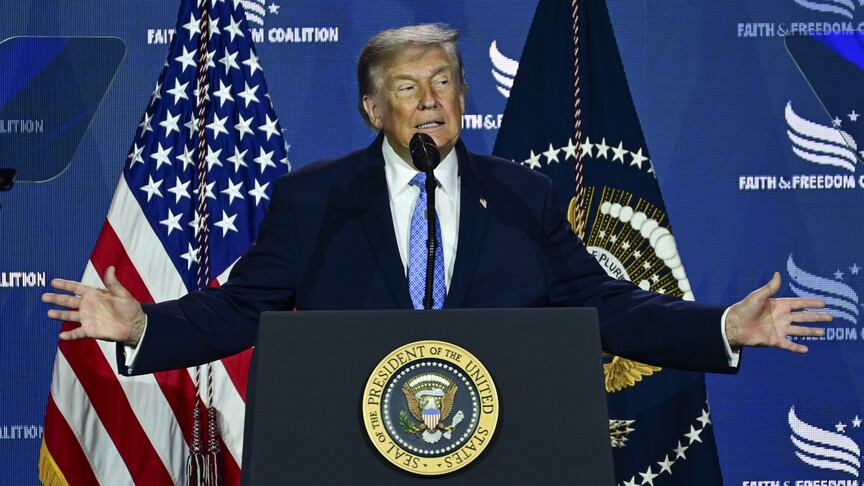
US President Donald Trump on Sunday criticized Democratic mayoral nominee Janeese Lewis George, calling her a “communist” and attacking her policy positions ahead of Washington, DC’s mayoral election.
“Janeese Lewis George, the Communist who is almost certainly going to be elected Mayor of Washington, D.C., has stated that she wants to empty the prisons, make D.C. a Sanctuary City, oppose ICE, welcome Criminal Illegal Aliens back into our beloved Capital, resist Anti-Crime Crackdowns, Defund the Police, continue and expand Cashless Bail, and so many other Capital destroying ‘things’,” Trump wrote on his Truth Social platform.
George won the Democratic primary for mayor of Washington, DC, earlier this month, securing her party’s nomination in the heavily Democratic city and becoming the likely successor to outgoing Mayor Muriel Bowser after the November general election.
Trump said he would not allow Washington, DC, to be “destroyed.”
“In the end, it will never work out, nor will I let it even have a chance because I have worked too hard to make Washington, D.C., the Envy of the World, with almost No Crime, and a Beautification process that has been second to none,” he said.
Trump also said he would “meet with Janeese Lewis George,” adding that Washington, DC, is “again a Safe and Prestigious Community.”
“Many people, including myself, have worked long and hard to get it there, and we will not let it be destroyed by a Communist adherent who has no intention to, MAKE WASHINGTON GREAT AGAIN!” he added.
-

 Idaho2 minutes ago
Distemper found in raccoon population in Pocatello and Chubbuck – East Idaho News
-

 Illinois5 minutes ago
HSHS St. John’s, RMHC open Ronald McDonald House Family Room
-

 Indiana10 minutes ago
Local hardware store sees surge in sales of cooling items amid Indiana heat wave
-

 Iowa17 minutes ago
Iowa City braces for hundreds of thousands of visitors this weekend
-
 Kansas20 minutes ago
New food trucks join Love Lot in Kansas City, benefit from World Cup excitement
-

 Kentucky25 minutes ago
Kentucky Cares, Lexington Humane Society offer free pet food after floods
-

 Louisiana32 minutes ago
Louisiana man sentenced in child sex crimes case involving dolls now banned by state law
-

 Maine35 minutes ago
Maine driver to honor friend Kyle Busch during Celebration of America 300

