Northeast
Judge gives ‘green light’ to controversial New York driver’s license law in blow to Trump admin

NEWYou can now listen to Fox News articles!
A federal judge on Tuesday cleared the way for New York’s so-called Green Light Law, ruling against the Trump administration’s effort to block the state from giving people driver’s licenses without requiring proof that they are in the U.S. legally.
U.S. District Judge Anne M. Nardacci found that the Justice Department — which sued New York Gov. Kathy Hochul and state Attorney General Letitia James in February — had failed to prove its claims that the state law sought to invalidate federal law or that the measure unlawfully regulates or unlawfully discriminates against the federal government.
“As I said from the start, our laws protect the rights of all New Yorkers and keep our communities safe,” James said in a statement. “I will always stand up for New Yorkers and the rule of law.”
U.S. Attorney General Pam Bondi alleged when announcing the lawsuit that Hochul and James were prioritizing “illegal aliens over American citizens,” as the controversial state law blocks federal agents trying to enforce immigration laws from seeing illegal immigrants’ criminal driving records during traffic stops.
SANCTUARY STATE’S ‘GREEN LIGHT’ LAW IS RED FLAG FOR AMERICANS’ SAFETY, NATIONAL SECURITY: EXPERTS
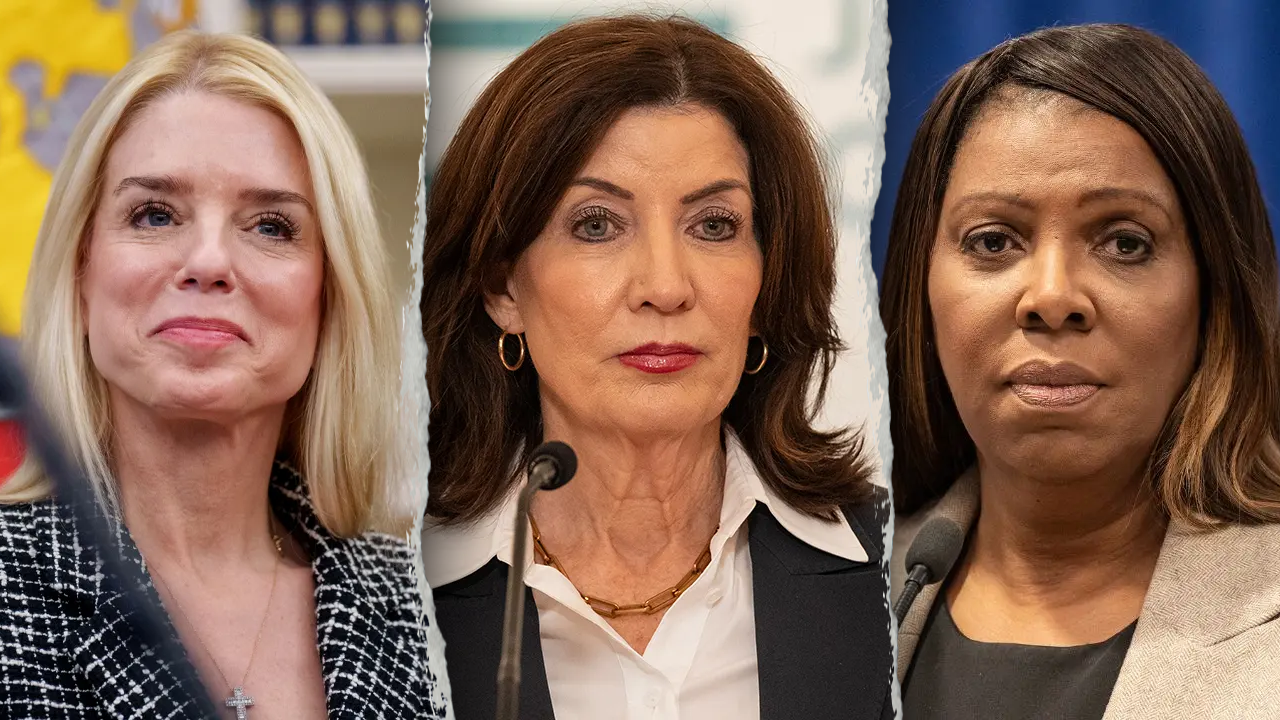
The Justice Department sued New York Gov. Kathy Hochul and state Attorney General Letitia James in February. (Getty Images)
Nardacci wrote in her ruling that her job was not to evaluate the desirability of the law as a policy matter, but to determine whether the Trump administration’s arguments prove its claims that the statute violates the U.S. Constitution’s Supremacy Clause, which establishes that federal laws overrule state laws.
The administration has “failed to state such a claim,” Nardacci wrote.
The Green Light Law, also known as the Driver’s License Access and Privacy Act, was adopted, in part, to improve road safety, as people sometimes drove without a license or without having passed a driving test. Under the measure, it is easier for these license holders to receive auto insurance.
The law states that people who do not have a valid Social Security number can submit alternative forms of ID, including valid passports and driver’s licenses issued in other countries. Applicants must still receive a driver’s permit and pass a road test to qualify for a “standard driver’s license.”
The legislation does not apply to commercial driver’s licenses (CDLs).
BLUE STATE IN THE HOT SEAT AFTER ICE BUSTS ILLEGAL IMMIGRANT WITH ‘NO NAME GIVEN’ ON LICENSE
The DOJ’s lawsuit argued that the law was “a frontal assault on the federal immigration laws, and the federal authorities that administer them,” citing a provision that requires the state’s DMV commissioner to notify people who are in the country illegally when a federal immigration agency has requested their information.
The lawsuit further claimed that it could be easier to enforce the Trump administration’s immigration agenda if federal authorities had unrestricted access to New York’s driver information.
The Green Light Law took effect in 2019, but came under renewed scrutiny following a fatal shootout in Vermont in January that left a U.S. Customs and Border Protection agent dead near the northern border with Canada after a traffic stop involving a German national.
“Any information that can help law enforcement stay safe as they conduct their duties has pretty much been taken away with this Green Light Law,” Hector Garza, vice president of the National Border Patrol Council, told Fox News Digital at the time.
A Department of Homeland Security vehicle sits at the southbound entrance to Interstate 91 in Newport, Vt., where a U.S. Border Patrol agent was shot dead during a traffic stop, Jan. 20, 2025. (David McGlynn for Fox News Digital)
“What [the Green Light Law] does, is that it prevents law enforcement agents from getting any type of information in regards to any registrations that the state has,” Garza added. “For example, before we engage in traffic stops, typically law enforcement will always conduct a vehicle registration check to see if there’s any warrants to see if that person is considered armed and dangerous.”
CLICK HERE TO DOWNLOAD THE FOX NEWS APP
But Nardacci, echoing an appeals court ruling in a county clerk’s earlier challenge to the law, wrote that the information “remains available to federal immigration authorities” through a lawful court order or judicial warrant.
New York is one of a dozen states that allows illegals to drive.
Fox News Digital’s Michael Ruiz and The Associated Press contributed to this report.
Read the full article from Here



Boston, MA
Sonny Gray shines again, and the Red Sox make it two straight wins at the Angels to start grinding road trip – The Boston Globe

In Boston, even after a successful homestand, the Sox are 17-27 — thus the overall 39-48 record record that has them stuck in the bottom third of the league.
What’s up with that?
“That’s a really good question, because it doesn’t feel a whole lot different to me,” Connor Wong said. “I feel like we’re the same group of guys trying to do the same thing.”
Interim manager Chad Tracy said: “I just think we’re playing well on the road. Give us credit, too. We played well at home last, so hopefully it’s just a ‘we’re playing well’ thing. But we have done that the majority of the year.”
This one featured a little of everything: Home runs from Willson Contreras and Romy Gonzalez, a strong start from Sonny Gray, and three double plays turned by the infield.
The Angels (36-54) totaled four hits, and just one after the third inning.
The Red Sox have won seven of their past nine games overall.
“That was a fight,” said Gray, whose 2.61 ERA is second in the American League. “That was just one that you grind through and you try to figure out a way to get better as it goes on. It wasn’t easy, but I’m happy to win.”
That was an unexpected take from Gray, given that he held the Angels to one run and four hits in six innings. The righthander struck out seven and walked two.
Unlike in his previous outing, when he took a no-hit bid into the eighth inning against the Yankees, Gray eliminated the drama early. Josh Lowe homered — an estimated 437 feet to center field — in the second.
Gray’s most significant wobbling came immediately thereafter, when Jo Adell walked and Wade Meckler singled. Following a mound visit from pitching coach Andrew Bailey, Gray recovered by striking out Donovan Walton and Tyler Heineman, both flailing at sweepers well below the strike zone.
Across the rest of his night, Gray faced just one more than the minimum number of batters, using a pair of double-play grounders to help him stay efficient and effective.
“Definitely wasn’t at my best,” he said, referencing that he had trouble recovering “physically, mentally.” “Finally able to settle down there after the second.”
Before the game, Gray found out he was not selected for the All-Star Game, which he admitted was disappointing “for sure.”
“Used a lot of stuff for fuel tonight,” he said without getting specific. “Maybe that was a little part of something. I was a little bummed.”
Tracy pulled Gray after just 70 pitches because of the game situation.
“We had a sizable lead, full bullpen, some guys that haven’t thrown,” Tracy explained. “It felt like we had a pretty good handle on it. And after pushing him hard with the potential no-hitter last time, just felt like it was good to give him a little extra breather.”
The Red Sox struck early against left-handed starter Sam Aldegheri, who walked two of his first three batters — after getting ahead in the count, 1-2, on both. Contreras blasted a no-doubt, three-run home run to left field to boost the Sox to a fast, sizable lead after just one out.
That was the only hit Aldegheri allowed across four innings and 88 pitches, but he had twice as many walks (four) as strikeouts (two) and his ERA jumped to 5.08.
As soon as Aldegheri exited, the Sox blew it open against rookie reliever Samy Natera Jr., who had been quite good across his first month in the majors (0.84 ERA, 15 strikeouts in 10⅔ innings).
Anthony Seigler slapped a double inside the first-base line, and Ceddanne Rafaela drew a walk. Wilyer Abreu smoked a double off the right-field wall, scoring both. Rafaela hesitated coming around third base, but — after the Angels made a delayed throw to try to get Abreu at second — went for it.
With two outs, Gonzalez hammered a slider over the middle of the plate to left field. It eked over the short wall for a two-run homer, his first long ball of the year (in his fifth game).
“We … got three big swings from the big boys,” Tracy said. “Between Willson, Romy, and Abreu — all those are multiple-run extra-base hits, and those are huge. But it starts with the at-bats before and putting people on and taking our base when it’s given to us.”
Tim Healey can be reached at timothy.healey@globe.com. Follow him @timbhealey.

The 24-year-old Skenes joins Rip

-

 Los Angeles, Ca1 minute ago
Firefighters battle Fourth of July blazes around Los Angeles
-

 Detroit, MI21 minutes ago
Storm chances linger into the start of the week across Metro Detroit
-

 San Francisco, CA31 minutes ago
Relay for America runs flag from San Francisco to D.C. in message of unity
-

 Dallas, TX36 minutes ago
Cowboys newcomer already looks like a waste of money in Dallas
-

 Miami, FL43 minutes ago
Police search for suspect after man is shot while on a boat near hotel in Fort Lauderdale on 4th of July
-

 Boston, MA46 minutes ago
Sonny Gray shines again, and the Red Sox make it two straight wins at the Angels to start grinding road trip – The Boston Globe
-

 Denver, CO51 minutes ago
Aldi expanding into Colorado, applies for permits at two Denver locations
-

 Seattle, WA58 minutes ago
Seattle Storm lose 77-72 to Fire behind Carla Leite’s 20 points

