Washington, D.C
Available to download Friday, some Epstein files no longer there Saturday afternoon

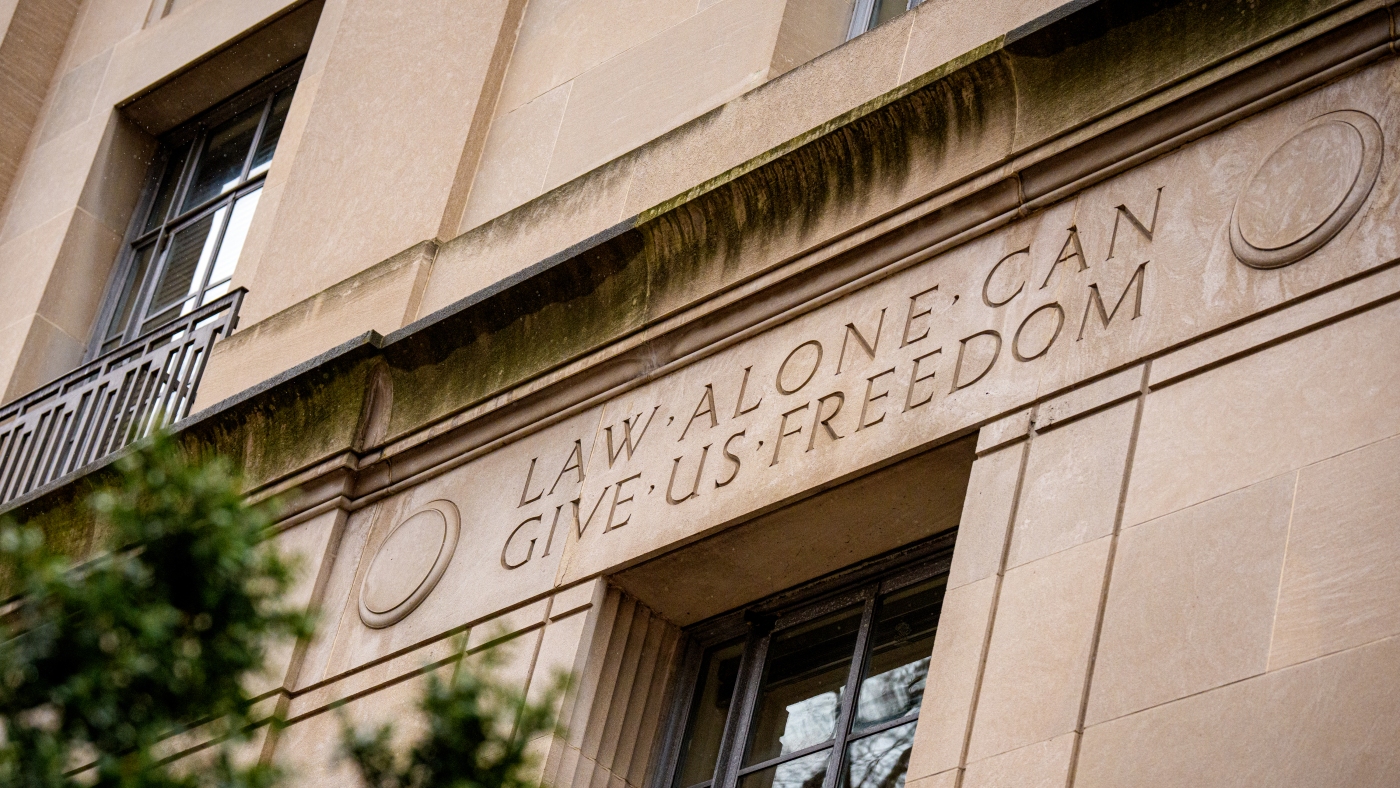
The Robert F. Kennedy Department of Justice Building on Dec. 19, 2025 in Washington, DC.
Andrew Harnik/Getty Images
hide caption
toggle caption
Andrew Harnik/Getty Images
The Department of Justice started releasing files related to the life, death and criminal investigations of convicted sex offender Jeffrey Epstein Friday. Files continued to be posted on its “Epstein Library” website on Saturday.
But NPR identified more than a dozen files released by the DOJ on Friday that are no longer available Saturday afternoon, including one that shows President Trump’s photo on a desk among several other photographs. The removed files also show various works of art, including those containing nudity.
On its website, the Justice Department directs people to report any files that should not have been posted by notifying the agency using a dedicated email address. A statement at the top of each page of the website said: “In view of the Congressional deadline, all reasonable efforts have been made to review and redact personal information pertaining to victims, other private individuals, and protect sensitive materials from disclosure.”
The DOJ acknowledged, though, “because of the volume of information involved, this website may nevertheless contain information that inadvertently includes non-public personally identifiable information or other sensitive content, to include matters of a sexual nature.”
The DOJ did not immediately respond to a request for comment on why the files were no longer available.
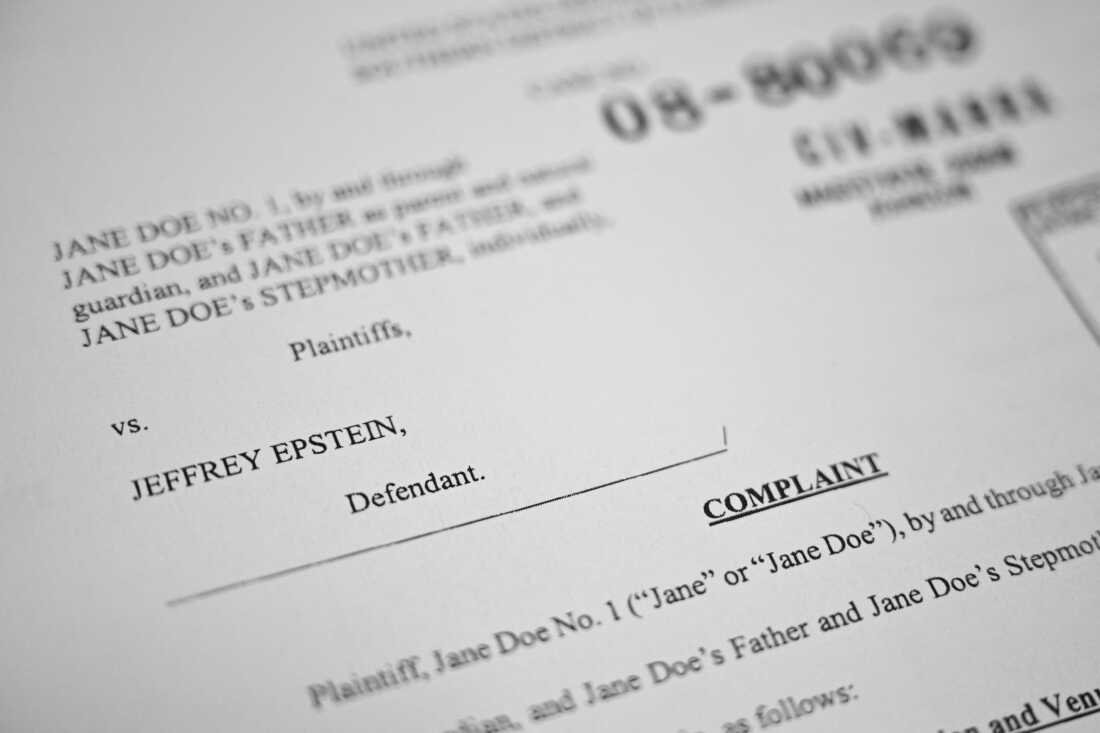
This photo illustration taken in Washington, DC, on Dec. 19, 2025 shows a court document after the Justice Department began releasing the long-awaited records from the investigation into the politically explosive case of convicted sex offender Jeffrey Epstein.
Mandel Ngan/AFP via Getty Images
hide caption
toggle caption
Mandel Ngan/AFP via Getty Images
After the initial release of files, some members of Congress raised concerns about what was missing from the data sets.
“There are powerful men, bankers, politicians who we know from survivors – they’ve told us this — who were at these parties where there were many young women, and a few were under age, and these powerful men knew about it, and they didn’t say anything,” Rep. Ro Khanna, D-Calif., told NPR. They need to be at least publicly held accountable.”
Rep. Thomas Massie, R-Ky., who cosponsored the Epstein Transparency Act in the House along with Khanna, criticized the redactions.
Posting on X, he said the release “grossly fails to comply with both the spirit and the letter of the law.” He also warned “a future DOJ could convict the current [Attorney General] and others” for not properly releasing all files the law mandated be made public.
Apart from the photo that is no longer available to download, Trump’s name and image appears rarely in the new documents available. There are a few pictures of him with women and a framed photo of Epstein and a redacted woman with a $22,500 oversized check signed by Trump.
While Trump wasn’t mentioned much this time around, he was a frequent subject of emails and text messages in another Epstein file tranche released by the House Democratic Oversight Committee — with well over a thousand different mentions — though mainly as the subject of Epstein’s near-obsession with his presidency, as the latter positioned himself as a Trump whisperer of sorts to his powerful associates.
NPR’s Rahul Mukherjee and Stephen Fowler contributed reporting.


This year’s Fourth of July celebrations in Washington, D.C. — marking the nation’s 250th birthday — will include hours of military flyovers and a massive fireworks display that could stretch late into the night, with some of the tightest security in decades, officials said Monday.
This Fourth will include “the largest display of fireworks our city has ever seen,” D.C. Metropolitan Police Department Interim Chief Jeff Carroll said at a news conference. Usually the fireworks begin at around 9 p.m., but this year, they are expected to begin at 11 p.m. and are “going to be longer than in previous years, we are told,” Mayor Muriel Bowser told reporters.
President Trump has said he plans to speak at 9 p.m., ahead of the fireworks. Starting at 1:15 p.m., hundreds of planes will participate in a “Fourth of July Airshow,” the president said. The National Mall also is hosting a daily event called the Great American State Fair that will run until July 10, and some local neighborhoods are hosting parades and other events on the Fourth.
The main festivities have been deemed a National Special Security Event, a designation used for massive events like Super Bowls and presidential inaugurations. Security measures will be more extensive than for any Fourth of July event in D.C. since shortly after the 9/11 attacks, Carroll said, with more blocking vehicles, more fencing, concrete barriers and other security measures that aren’t employed for a typical Fourth of July celebration.
The FBI isn’t tracking any credible threats to the Fourth of July, but “we always remain vigilant,” said Darren Cox, assistant director in charge of the FBI’s Washington field office.
Those planning to view the fireworks show from the Washington Monument grounds should expect “TSA-style” security, with magnetometers screening guests, according to Tara McLeese, special agent in charge of the Secret Service’s Washington field office.
Guests can arrive as early as 1 p.m., and should enter on the east side of the Washington Monument at Constitution Avenue and 14th St. NW, or at Independence Avenue and 14th Street SW, McLeese said.
McLeese said each guest in the restricted area is allowed only one clear bag no larger than a gallon, or a small clutch purse. There will be no storage for prohibited items.
The capacity of the primary viewing area at the Washington Monument is set at about 150,000, according to Secret Service Special Agent in Charge David Yamen, who runs the agency’s dignitary protective division. It is expected to hit capacity.
Attendees of the Great American State Fair at the National Mall are encouraged to remain there to watch the fireworks show, rather than attempting to enter the primary viewing zone on the Washington Monument grounds, said Scott Brecht, chief of the U.S. Park Police. Leaving one zone and moving to another will require additional security screenings, and reentry may not be possible.
To get to the National Mall on the Fourth, public transit use is encouraged. The D.C. Metro will be free after 5 p.m., Washington Metropolitan Area Transit Authority General Manager Randy Clarke said, “to really make sure people can not only enjoy the festivities all over the region as a community, but also make sure from a safety point of view we can get people going through.”
“If you’re going downtown for the fireworks, plan ahead, be ready for an increased security presence, crowds, and road closures,” D.C. Homeland Security and Emergency Management Agency Director Clint Osborn said. “I would say that if you’re going downtown and you’ve done this before, don’t assume you know what it’s going to look like.”
Join CBS for “The Great American Block Party 250,” a primetime special on Saturday, July 4, hosted by CBS Evening News anchor Tony Dokoupil and Entertainment Tonight’s Nischelle Turner, featuring live musical performances, celebrations around the country, and the largest fireworks show in history in the skies over the nation’s capital. Tune in July 4 at 8 p.m. ET on CBS and stream it on Paramount+ and CBS News 24/7.
Washington, D.C
DC will pay $50,000 to man detained while protesting guard patrol with ‘Star Wars’ song, record says

WASHINGTON (AP) — The District of Columbia has agreed to pay $50,000 to settle a lawsuit filed by a resident who accused police officers of illegally detaining him for following an Ohio National Guard patrol while playing Darth Vader’s theme song from “Star Wars” on his cellphone, according to a document released Monday.
The plaintiff, Sam O’Hara, sued the district, four Metropolitan Police Department officers and a guard member from Ohio over what he says was his act of protest against President Donald Trump’s federal law enforcement surge in Washington, D.C.
A court filing on Thursday disclosed the settlement but didn’t specify any monetary terms. The amount is included in a copy of the settlement agreement that D.C. Attorney General Brian L. Schwalb’s office provided to The Associated Press.
The $50,000 settlement includes attorney’s fees and costs. O’Hara is represented by the American Civil Liberties Union of the District of Columbia. In an email on Friday, an ACLU spokesperson referred to the settlement’s financial terms as “a significant amount” that O’Hara “is pleased with” but said they weren’t disclosing the dollar figure to protect his privacy.
O’Hara, an artist who works in the hospitality industry, agreed to drop his claims against the district and the MPD officers within three business days of receiving the settlement payment. The settlement isn’t an admission of wrongdoing by the district, the agreement says.
O’Hara’s settlement with the district doesn’t resolve his related claims against an Ohio National Guard member, Sgt. Devon Beck, who has asked a judge to dismiss O’Hara’s claims against him.
O’Hara sued the district in October, claiming police officers violated his First Amendment rights to free speech and his Fourth Amendment rights against unreasonable seizures and excessive force.
O’Hara played “The Imperial March” theme from “Star Wars” on his phone as he followed several National Guard troops down a public street on Sept. 11, 2025. One of the troops summoned police officers, who stopped O’Hara and kept him handcuffed for 15 to 20 minutes before releasing him without charges, according to the lawsuit.
Trump’s ongoing deployment of guard members in Washington began last August after the Republican president issued an executive order declaring a crime emergency in the nation’s capital. The surge inflamed tensions with residents of the heavily Democratic district. Hundreds of guard members remain deployed in the district nearly a year later, with no clear end in sight.

US President Donald Trump escalated his criticism of Democratic mayoral nominee Janeese Lewis George, describing her as a “communist” and warning that her policy agenda could negatively affect Washington, DC, ahead of the city’s November mayoral election. Trump made the remarks on his Truth Social platform, placing crime, immigration and policing at the center of his criticism.Trump attacks Democratic agenda
In his statement, Trump claimed George supports measures including reducing prison populations, expanding sanctuary city policies, opposing Immigration and Customs Enforcement (ICE), restoring cashless bail, cutting police funding and resisting anti-crime initiatives. He argued that such proposals would weaken public safety in the US capital and reverse recent improvements.
George becomes favorite after primary victory
Janeese Lewis George secured the Democratic nomination earlier this month after winning the party’s mayoral primary in Washington, DC. Given the city’s strong Democratic voting base, her victory has positioned her as the leading candidate to succeed outgoing Mayor Muriel Bowser in the November general election.
Trump vows to protect Washington
Trump insisted that his administration would not allow Washington, DC, to be “destroyed,” arguing that the city has become significantly safer through crime reduction efforts and urban renewal projects. He also announced that he intends to meet with George, while describing the US capital as “again a Safe and Prestigious Community.”
Repeating his criticism, Trump said: “Many people, including myself, have worked long and hard to get it there, and we will not let it be destroyed by a Communist adherent who has no intention to, MAKE WASHINGTON GREAT AGAIN!”
-

 Arizona3 minutes ago
Flags are at half-staff today in Arizona. Here’s who is being honored
-

 Arkansas7 minutes ago
What Is The Arkansas Razorbacks Toughest Stretch of the 2026 Season?
-

 California12 minutes ago
Southern California residents say HOA made them take down American flags
-

 Colorado19 minutes ago
Colorado’s Most Beautiful State Parks, Ranked By A Colorado Local
-

 Connecticut22 minutes ago
CT poised to invest again in childcare, pay down pension debt
-

 Delaware27 minutes ago
Delaware on Main Street Program Grows as 17 Communities Earn National Designations – State of Delaware News
-

 Florida34 minutes ago
Fast-growing South Florida wildfire consumes over 4,000 acres
-

 Georgia37 minutes ago
Aleks Arwood named runner-up at Miss Georgia – Thomasville Times-Enterprise

