Connect with us

Southwest

Quiet GOP ‘Astroturf’ campaign convinced liberal firebrand to run for US Senate, source says

Published

on

Quiet GOP ‘Astroturf’ campaign convinced liberal firebrand to run for US Senate, source says
NEWYou can now listen to Fox News articles!

It appears some behind-the-scenes tinkering by the Senate Republican campaign arm helped spur progressive firebrand Rep. Jasmine Crockett to declare her candidacy this week in Texas’ high-stakes Senate race.

The campaign launch by Crockett, a two-term lawmaker who represents a Dallas-area district and who is known as a vocal critic and foil of President Donald Trump, quickly shifted the political spotlight off of the Republican nomination race, where incumbent GOP Sen. John Cornyn is involved in a divisive primary with Texas Attorney General Ken Paxton and Rep. Wesley Hunt.

The GOP boosting of a preferred primary opponent comes in a race with extremely high stakes, as it’s one of a handful across the country that will likely determine if Republicans hold their Senate majority in next year’s midterm elections.

As the race in Texas was heating up this past summer, Crockett, a rising Democratic Party star who enjoys a large social media footprint, was not among the list of Democrats widely considered as contenders for the party’s nomination.

Advertisement

DEMOCRATS RIFT WIDENS: IS JASMINE CROCKETT TOO FAR LEFT FOR TEXAS VOTERS?

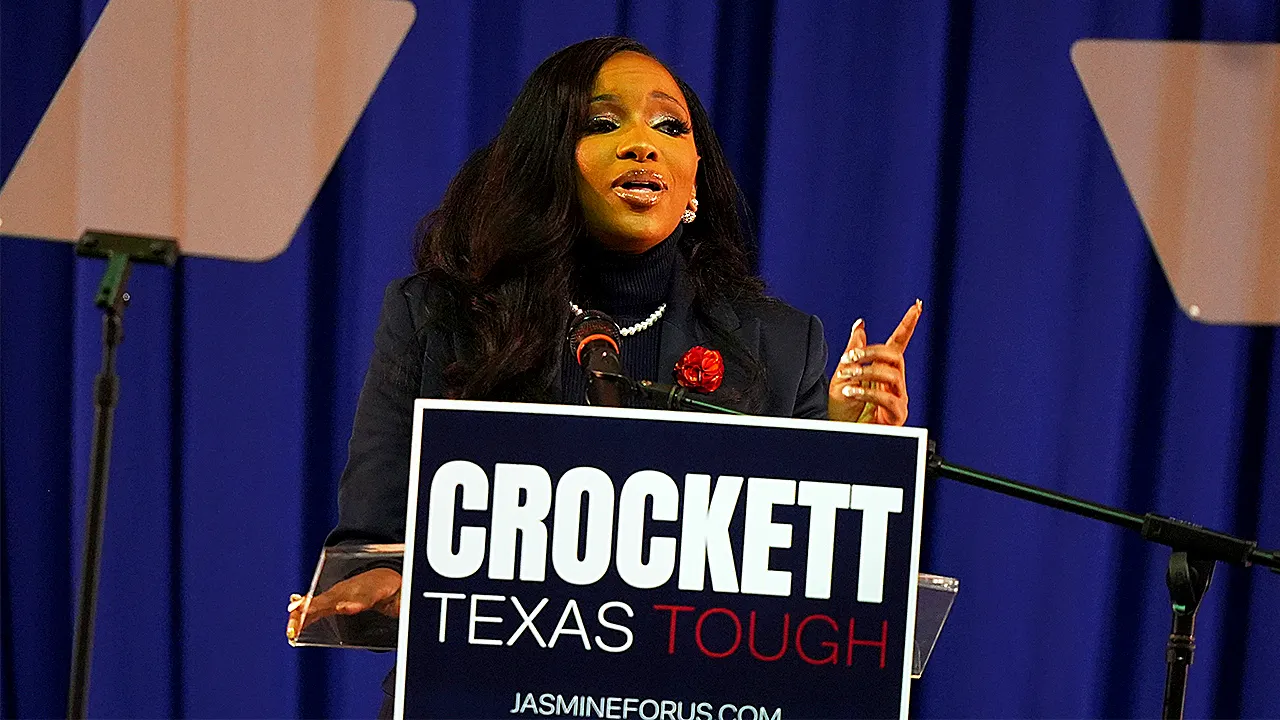
Rep. Jasmine Crockett, D-Texas, speaks after announcing her run in the Democratic primary for U.S. Senate Monday, Dec. 8, 2025, in Dallas.  (LM Otero/AP Photo)

But Republican strategists viewed Crockett as a more beatable opponent in the 2026 general election than either former Rep. Colin Allred, who until Monday was making his second straight Senate bid, state Rep. James Talarico, another rising party star who launched his campaign in September, and former Rep. Beto O’Rourke and Rep. Joaquin Castro, who at the time were mulling bids.

So the National Republican Senatorial Committee (NRSC) released a poll in July that indicated Crockett with a double-digit lead over the rest of the field of actual and potential Democratic Senate contenders.

The poll quickly grabbed plenty of national attention.

Advertisement

A source familiar with the NRSC’s process told Fox News Digital that when they saw the results of the survey, they instantly said, “We’ve got to disseminate this far and wide.”

The survey spurred other polls which also indicated Crockett hypothetically in the lead, and the NRSC helped push those results “to really drive that news cycle and that narrative that Jasmine Crockett was surging in Texas.”

The NRSC then reached out to allies to aggressively push the polls in the progressive digital world in what the source described as an “AstroTurf recruitment process.”

FIERCE TRUMP CRITIC CROCKETT SHAKES UP HIGH STAKES SENATE RACE

The effort also included phone calls and text messages to Texas Democrats calling on voters to urge Crockett to enter the race.

Advertisement

The source called it a “sustained effort that we orchestrated across the ecosystem for several months.”

Crockett, in announcing her candidacy, noted that “I never put myself into any of the polls.”

But she acknowledged that “the more I saw the poll results, I couldn’t ignore the trends, which were clear, both as it relates to the primary as well as the general election.”

Sen. Tim Scott of South Carolina, seen standing for an interview with Fox News Digital, is chair of the National Republican Senatorial Committee. (Paul Steinhauser/Fox News)

NRSC Chair Sen. Tim Scott, speaking exclusively with Fox News Digital on Monday, said that Crockett’s entry into the Senate race is a key sign of the Democrats’ shift to the left.

Advertisement

“I think it says something about who the Democrats are nationally, not just in Texas. What it says is that they’ve been overrun by this radical left agenda that focuses on rhetoric, not reality,” the Republican senator from South Carolina claimed.

SENATE REPUBLICAN CAMPAIGN CHIEF SAYS CROCKETT CANDIDACY EXPOSES HOW ‘RADICAL’ DEMOCRATS ARE

Allred, who was making his second straight bid for the Senate after losing last year to conservative Sen. Ted Cruz by 9 points, abandoned his bid hours before Crockett launched her campaign and announced he would run next year to return to the House.

Former Democratic Rep. Colin Allred of Texas on Monday suspended his 2026 Senate bid and launched a House campaign. (Reuters/Marco Bello)

Crockett will now face off in her party’s primary with Talarico, a former middle school teacher and Presbyterian seminarian who is also seen as a rising Democrat. The two surging contenders with powerful fundraising operations will face off in the March 3 primary.

Advertisement

In the GOP showdown, Cornyn, the longtime incumbent who hails from the party’s establishment wing, has cut into the one-time large lead by Paxton, a MAGA firebrand, with Hunt in third, according to public opinion polling.

The concern among Republicans is that Paxton, who has been battered over the past decade by a slew of scandals and legal problems and who is now dealing with a messy divorce, would put the seat in play if he were to win the GOP nomination.

Republican Sen. John Cornyn of Texas is facing primary challenges from state Attorney General Ken Paxton and Rep. Wesley Hunt as he seeks re-election in 2026. (Kevin Dietsch/Getty)

But Crockett’s Senate candidacy may change the political equation. While her aggressive push-back against Trump and the GOP should play well with the left, it could deflate her chances of winning next November among Texas’ more conservative electorate.

By dropping out of the race, Allred will likely allow Democrats to avoid a costly and messy primary runoff in the spring, giving the party more time to consolidate around their nominee and raise much-needed campaign cash.

Advertisement

Meanwhile, with Cornyn, Paxton, and Hunt all taking aim at each other in a combustible primary, the GOP nomination appears headed towards a runoff, which would be triggered if no candidate tops 50% in the early March primary.

CLICK HERE TO DOWNLOAD THE FOX NEWS APP

Senate Majority Leader John Thune, Scott, and the NRSC are backing Cornyn.

Asked if he’s concerned about the GOP nomination battle extending to a primary runoff, Scott predicted that “Cornyn will win the primary and Cornyn will win the general election.”

Advertisement

Read the full article from Here

Southwest

FAA restricts Texas airspace after Pentagon reportedly strikes down Customs and Border Protection drone

Published

on

FAA restricts Texas airspace after Pentagon reportedly strikes down Customs and Border Protection drone

NEWYou can now listen to Fox News articles!

The Federal Aviation Administration (FAA) restricted flights Thursday near Fort Hancock, Texas, after a U.S. Customs and Border Protection (CBP) drone was reportedly shot down by a laser sytem operated by the Pentagon.

While government agencies have not identified who the drone belonged to, top Democrats on the Transportation and Infrastructure Committee released a joint statement Thursday evening claiming the drone belonged to CBP.

U.S. Reps. Rick Larsen, Bennie Thompson and Andre Carson said their “heads are exploding over the news” that a CBP drone was shot down by the Pentagon with “a high risk counter-unmanned aircraft system.”

The legislators added that this incident is “the result of [the White House’s] incompetence” after a “short-sighted” decision to “sidestep a bipartisan, tri-committee bill to appropriately train C-UAS operators and address the lack of coordination between the Pentagon, DHS and the FAA.”

Advertisement

The FAA expanded a temporary flight restriction near Fort Hancock, Texas, after lawmakers said a Pentagon-operated counter-drone system may have shot down a U.S. government drone. (iStock)

In a joint statement provided to Fox News Digital, the Department of War, CBP and the FAA said the DOW used counter-unmanned aircraft system to respond to a “seemingly threatening unmanned aerial system operating within military airspace.”

The departments said the engagement took place “far away from populated areas and there were no commercial aircraft in the vicinity,” adding they “will continue to work on increased cooperation and communication to prevent such incidents in the future.”

The departments said they are “working together in an unprecedented fashion to mitigate drone threats by Mexican cartels and foreign terrorist organizations at the U.S.-Mexico border.”

“The bottom line is the Trump Administration is doing more to secure the border and crack down on cartels than any administration in history,” the statement added.

Advertisement

FBI RAMPS UP COUNTER-DRONE EFFORTS AS PATEL WARNS OF GROWING THREATS FROM CRIMINALS, TERRORISTS

Congressional aides told Reuters that the Pentagon reportedly used the high-energy laser system to accidentally shoot down the CBP drone near the Mexican border, an area that frequently sees incursions from drones believed to be operated by Mexican drug cartels.

The FAA told Fox News Digital that a temporary flight restriction (TFR) was “already in place” around the Fort Hancock area and that the TFR “has been expanded to include a greater radius to ensure safety.” 

The restriction does not impact commercial flights, the agency said.

The FAA said in a Notice to Air Missions (NOTAM) that airspace around Fort Hancock was temporarily restricted for “special security reasons.”

Advertisement

CLICK HERE TO DOWNLOAD THE FOX NEWS APP

The restriction comes a couple of weeks after the FAA grounded flights to and from El Paso International Airport for 10 days before lifting the order roughly eight hours later.

Drones operated by Mexican drug cartels breached American airspace earlier this month near El Paso International Airport in Texas, leading the FAA to temporarily close the airport. (Kirby Lee/Getty Images)

A Trump administration official previously told Fox News that the initial lockdown came in response to “Mexican cartel drones” that breached U.S. airspace.

A U.S. official later confirmed that the U.S. military had shot down what was later determined to be a party balloon near El Paso.

Advertisement

Fox News Digital reached out to the White House for comment and was directed to the joint statement provided by the Department of War, Customs and Border Patrol and Federal Aviation Administration.

Fox News Digital’s Anders Hagstrom and Reuters contributed to this report.

Related Article

Republicans raise alarm over US vulnerability to mass drone strikes after Israel-Iran conflict

Read the full article from Here

Advertisement
Continue Reading

Southwest

Corporate America is on the move, and these red states are cashing in

Published

on

Corporate America is on the move, and these red states are cashing in

NEWYou can now listen to Fox News articles!

A wave of corporate relocations is reshaping the U.S. economy, and Texas is emerging as the clear winner.

According to a report by CBRE, one of the nation’s largest commercial real estate brokerage firms, 561 companies have relocated their headquarters nationwide since 2018. The research shows many companies are reassessing tax climates, operating costs and growth prospects as they consider a move. 

That’s significant because these moves are often driven by long-term financial and growth strategies, not just geography — giving business-friendly states a competitive edge. 

From Texas to Tennessee, those states are racking up new headquarters, while blue strongholds like California and New York are losing companies at a notable clip.

Advertisement

DALLAS MAYOR PREDICTS ‘AVALANCHE’ OF NYC FINANCIAL FIRMS FLEEING NEW SOCIALIST POLICIES UNDER MAMDANI

Dallas recorded the highest number of corporate headquarters relocations in the country. (Beata Zawrzel/NurPhoto/Getty Images)

The Lone Star State clearly dominates the relocation map. Dallas-Fort Worth captured 100 headquarters moves between 2018 and 2024 — the most of any metro in the country — while Austin secured another 81 and Houston added 31. Combined, those three markets accounted for more relocations than most entire states, cementing Texas’ outsized role in reshaping the corporate landscape.

Meanwhile, California metros saw the steepest net losses, led by the San Francisco Bay Area with a net loss of 156 headquarters over the same period. 

As blue states debate regulation and tax policy, Texas business leaders say the state’s approach is paying off. Megan Mauro, interim president and CEO of the Texas Association of Business, points to the state’s tax structure and lighter regulatory climate as key draws.

Advertisement

“We have a light regulatory touch and no personal or corporate income tax,” Mauro said, citing Texas’ recent $25 billion surplus as evidence of what she calls a competitive tax environment.

Her argument aligns with research from CBRE, which found that companies most often cite lower taxes, reduced operating costs and stronger growth opportunities when relocating their headquarters.

The shift has intensified scrutiny of tax policy in high-cost states. Steve Moore, economist and co-founder of Unleash Prosperity, said those states risk driving away wealth and investment.

“It is common sense for business leaders to pick places for future financial success rather than economic suffocation,” Moore told Fox News Digital.

CALIFORNIA’S LOOMING CAPITAL FLIGHT PROBLEM COULD RESHAPE STATE IN 3 KEY AREAS

Advertisement

California Gov. Gavin Newsom has previously said that he does not support the “billionaire tax” measure. (Sean Rayford/Getty Images)

He argued that proposals such as California’s 2026 Billionaire Tax Act are accelerating the outflow of the state’s ultra-wealthy residents to lower-tax states like Texas and Florida. 

“These business tycoons are running to states like Florida and Texas because of lower taxes, economic freedom and future economic prosperity,” he said, describing it as “voting with their feet.”

That shift is also reflected in population data.

From 2021 to 2024, Texas and Florida posted the largest net population gains, while California and several northeastern states recorded some of the steepest losses, according to IRS and U.S. Census Bureau data.

Advertisement

Moore added that the broader economic implications extend beyond corporate balance sheets.

Growth in states like Texas can expand the tax base and provide additional funding flexibility for infrastructure, education and other priorities — often without raising tax rates.

CLICK HERE TO DOWNLOAD THE FOX NEWS APP

President Donald Trump pointed to job growth and other economic milestones during his State of the Union speech on Feb. 24, 2026. (Win McNamee/Getty Images)

Economic performance frequently shapes midterm messaging, and migration trends like these are poised to feature in debates over tax competitiveness.

Advertisement

Whether those patterns endure remains to be seen. For now, though, population flows are reinforcing a broader argument: tax policy is no longer an abstract debate — it’s shaping where Americans choose to build their futures.

Related Article

This state isn’t just growing — its economy is getting richer per resident

Read the full article from Here

Advertisement
Continue Reading

Southwest

RICK PERRY: Where’s the beef? Trump knows and he’s trying to make it affordable

Published

on

RICK PERRY: Where’s the beef? Trump knows and he’s trying to make it affordable

NEWYou can now listen to Fox News articles!

“America First” has been more than a slogan for President Trump. It has become a governing framework and near-mandate for his administration. America First policy decisions have manifested across immigration strategy, energy regulation, and, perhaps most clearly, trade policy.

The beef market has been in desperate need of an America First recalibration after President Joe Biden’s failed policies. Ground beef prices have become astronomical, reaching an average of $6.69 per pound in December, the highest price since tracking began in the 1980s.

These price increases are outpacing those of other food categories due to structural problems within the domestic beef market. Analysis from the American Farm Bureau Federation shows the domestic herd has fallen to a 75-year low and is continuing to shrink as fewer calves are retained for breeding. As a result, the U.S. cattle herd is unlikely to expand until at least 2028.

From my time as governor of Texas and agriculture commissioner for the nation’s leading cattle-producing state, I understand both the gravity of this situation and the need for a deliberate policy response.

Advertisement

Cattle are shown in pens at the Cattlemen’s Columbus Livestock Auction in Columbus on Wednesday, Oct. 8, 2025. (Melissa Phillip/Houston Chronicle/Getty Images)

In October, President Donald Trump addressed the need for beef affordability measures and signaled plans to increase imports, which he recently finalized through an executive order, opening the U.S. to an additional 80,000 metric tons of lean beef trimmings from Argentina this year.

This step is valuable because the U.S. does not produce enough beef to meet domestic demand, necessitating imports. Argentina is a strategic and well-suited partner to remedy our beef shortage because they specialize in lower-cost, lean beef. These trimmings from Argentina will be blended with fattier domestic beef to produce hamburgers and ground beef products – affordable staples in high demand.

Importing the specific type of affordable beef directly addresses supply and aligns with an America First approach. Expanding lean beef imports will reduce pressures on our beef supply, thus reducing costs for consumers while protecting cattle ranchers’ premium production.

THE SURPRISING REASON WHY AMERICANS COULD FACE HIGH BEEF PRICES FOR YEARS

Advertisement

The impacts of these smart imports are complemented and multiplied by broader efforts to strengthen the cattle sector, including Agriculture Secretary Brooke Rollins’ October plan to fortify the American beef industry and President Trump’s directive for the Department of Justice to crack down on foreign-owned meat packing cartels.

Beyond these efforts, the administration should reassess the existing allocation of tariff-rate quotas (TRQs), which were configured in 1995. Reworking would acknowledge shifts in global production patterns and domestic market needs, putting U.S. ranchers in a better position.

Today, the overwhelming share of tariff-free beef imports are dedicated to Australia and New Zealand. Both countries focus heavily on premium, grass-fed exports – products that compete directly with higher-end U.S. beef in domestic and international markets.

By contrast, lean beef imports from South America primarily serve the lower-cost blended segment. Ranchers and their supporters criticizing the import increase from Argentina, but failing to push back about the near-unlimited market access Australia and New Zealand have are fighting the wrong battles.

The beef market has been in desperate need of an America First recalibration after President Joe Biden’s failed policies. 

Advertisement

Some policymakers have raised concerns that imports would sideline American ranchers and that we should focus on cutting red tape, lowering production costs and supporting cattle herd growth. These priorities are valid – but they’re not mutually exclusive with strategic imports.

RFK JR BACKS BEEF, DECLARING ‘WAR ON PROTEIN IS OVER’ AS HE THANKS AMERICA’S CATTLE RANCHERS

The notion that imports should be avoided is misguided and ignores structural supply realities. Strategic imports like lean trimmings can stabilize prices while allowing U.S. producers to concentrate on premium markets, where profitability is strongest. This is how we pave the path for rancher success.

CLICK HERE FOR MORE FOX NEWS OPINION

If U.S. ranchers are forced to simultaneously try and dominate serving both low-margin ground products and high-margin premium markets with higher-end cuts, they may become overwhelmed. From a long-term market perspective, overextension can discourage heifer retention and delay necessary herd rebuilding.

Advertisement

President Trump and his team are on the right path with the Argentina deal. This expansion should be defended unapologetically, incorporated beyond just 2026, and considered as part of a long-term strategy rather than a temporary measure.

CLICK HERE TO DOWNLOAD THE FOX NEWS APP

Permanently expanding Argentina’s tariff-free access to the U.S. market for lean beef trimmings is how we ensure prices stop rising. The administration should also consider opportunities for expanded imports from other South American nations, such as Paraguay and Uruguay, where production aligns with U.S. market gaps.

Building an American First beef market requires precision and long-term thinking. The current policy shifts are moving in the right direction, which will support ranchers, strengthen our market and deliver affordability for American consumers.

CLICK HERE TO READ MORE FROM RICK PERRY

Advertisement

Related Article

The single crushing problem American cattle ranchers wish Trump would fix instead

Read the full article from Here

Continue Reading

Trending

