Business
Commentary: Is $140,000 really a poverty income? Clearly not, but the viral debate underscores the ‘affordability’ issue


On the Sunday before Thanksgiving, a wealth manager named Michael Green published a Substack post arguing that a $140,000 income is the new poverty level for a family of four in America, where the official poverty line is $32,150.
The post promptly went viral.
One would hope that economic commentators coast-to-coast mentioned Green as their “person I’m most thankful for” at their family gatherings that week, because he gave them something to masticate ever since. On the spectrum from left to right, countless pundits have rerun Green’s numbers to deride or validate his argument.
It is jarring that in one of the richest countries in the world, one-third of the middle class does not make enough to afford basic necessities.
— Stephens and Perry, Brookings
“The whole thing doesn’t pass the smell test,” asserted right-of-center economist Noah Smith in a very lengthy rebuttal. On the other side, Tom Levenson, who teaches science writing at MIT, gave us a Bluesky thread in which he noted that “$140,000 in many urban areas in the US is a family income that is at least precarious, and at worst, one or two missed paychecks from having to make rent-or-food choice.”
Green has asserted that the response to his post has been “massively favorable.” That isn’t my impression, but leave it aside.
Here’s my quick take: Green made a category error (and a rhetorical blunder) by hanging his argument on the concept of “poverty”; that’s the claim that most of his critics focus on. His real argument, however, concerns the concept of affordability. Indeed, in a follow-up post he redefined his argument as applying to “the hidden precarity for many American families.”
We can stipulate that making $140,000 a poverty standard is absurd. Even in a high-cost economy such as California’s, millions of families live comfortable lives on much less. (The median household income in Los Angeles County — meaning half of all households earn less and half earn more — is about $86,500.)
Plenty of working families are raising children and having fruitful social lives on median incomes or even less: Living thriftily is not the same as living penuriously or meanly. Much of what middle-class families give up are things that aren’t necessarily crucial. Green’s image of families stripped to the bones with mid-six-figure or even high five-figure incomes feels like something conjured up by an asset manager with a distinctly affluent clientele, which is what he is.
Yet, what his post alludes to implicitly is that the concept of “middle-class” has evolved over the last few decades, and not in a good direction. That’s why so many Americans, including millions with incomes that used to place them firmly in the middle class, feel strapped as never before, wondering how they can afford things their parents took for granted, such as putting the kids through college and saving for a comfortable retirement.
“The nation’s affordability crisis has not spared middle-class families, one-third of which struggle to afford basic necessities such as food, housing, and child care,” Hannah Stephens and Andre M. Perry of the Brookings Institution observed last week. Their analysis covered 160 U.S. metro areas, and held firm in all of them.
(They defined the middle class as falling into the income range of $30,000 to $153,000.)
Let’s give Green’s argument the once-over.
He started with the origin of the federal poverty calculation, which dates back to 1963, when a Social Security economist named Mollie Orshansky figured that since American households spent an average of one-third of their budget on food, if you estimated the cost of a minimally adequate food basket and multiplied by three, you might have a useful overall standard for poverty. She pegged that at $3,130 for a nonfarm family of four.
“If it is not possible to state unequivocally ‘how much is enough,’” she wrote, “it should be possible to assert with confidence how much, on an average, is too little.” She pegged that at $3,130 for a nonfarm family of four.
Green festooned his post with lots of hand-waving and magic asterisks to accommodate changes in American lifestyles over the ensuing six decades and come up with his $140,000 standard. But if one applies a constant inflation rate to Olshansky’s $3,130 via the consumer price index, you get about $33,440. As it happens, the government’s official poverty level for a family of four today is $32,150. Pretty close.
That’s an important figure, because it defines eligibility for a host of government programs. Eligibility for Medcaid under the Affordable Care Act (in states that accepted the ACA’s Medicaid expansion) runs up to income of 138% of the poverty level; higher than that steers families into ACA health plans. As KFF notes, “in states that have not adopted Medicaid expansion, adults with income as low as 100% FPL can qualify for Marketplace plans.”
Green’s critics generally note that the median household income in the U.S. was $83,730 in 2024, meaning that he’s placed well more than half of America into the poverty zone. That just swears at reality.
It needs to be said that Green’s approach differs from those articles that regularly appear asking us to commiserate with families earning $400,000 or $500,000 because they can’t make ends meet.
As I’ve reported in the past, these articles invariably depend on sleight-of-hand. They offer their own definitions of “rich” and list as necessary or unavoidable expenses many items that ordinary families would consider luxuries — lavish vacations, charitable donations (including to the adults’ alma maters), etc., etc. The strapped family eking out an existence on $500,000 featured in one such piece had fully-funded retirement and college plans, payments on two luxury cars, “date nights” every other week … you get the drift.
Levenson ran the numbers for a hypothetical family in his home town of Brookline, Mass., which is objectively upper-crust, but his approach applies more widely. Let’s run them for a hypothetical household in Los Angeles County. These figures are necessarily conjectural, because your mileage may vary — in fact, everyone’s mileage varies.
The median monthly rent in L.A., according to Zillow, is $2,750, or $33,000 a year. On the other hand, the median home price in the county is close to $1 million. At today’s average mortgage rate of 6.2% and assuming a 20% down payment, the cost of an $800,000 mortgage runs to $4,900 a month, or $58,800 a year. One can find a cheaper home farther from the coast, so for argument’s sake let’s posit a $500,000 home with a $40,000 mortgage: $2,450 a month, or only $29,400. But you’re probably living farther from work, so your transportation costs go up.
The property tax on that $1-million home: $10,000 in year one. (On the $500,000 home, it’s $5,000.)
State and federal taxes on a $140,000 income: about $18,000. Social Security payroll tax: $8,680.
So of our $140,000, housing and taxes leave us with somewhere between $44,500 and $78,920.
Food: The bureau of economic analysis pegs the annual spending of a four-member California family at an average $18,000. That figure is almost certainly on the upswing.
Healthcare? In its annual report on employer-sponsored health coverage, KFF found that the employee share of family covered reached $6,850 this year, with employers shouldering the balance of the average $27,000 total. For families on Affordable Care Act plans, the costs are impossible to calculate just now, because Republicans in Congress can’t get their act together to extend the premium subsidies that make these plans workable.
Then there’s child care. In the old days, when single-earner families were more common than today, that wasn’t as much of an issue than it is today. But if both parents work, children have to be stowed in child care until they’re old enough for kindergarten or first grade — let’s say up to age 5 or 6. In California, according to one survey, that’s about $13,000 per year per child.
A few more things we haven’t counted yet: cellphone account, say $100 a month; home Wi-Fi, another $100; computers, $1,000 or so each; cars, $17,000 to $25,000 used; auto and home insurance, $1,500 each; gasoline; and utilities ($3,300 a year, according to SoFi).
At the low end of housing costs, our California family has remaining monthly discretionary income of a few hundred dollars. At the higher mortgage level they’re underwater. Levenson adds, “our notional couple best not have any student loans.”
It’s also worth noting that our couple has put a dime into retirement or college funding. If they set aside 10% of their income for 401(k) contributions, they’re in trouble.
What we’re actually looking at is the collapse of the American middle class. “It is jarring that in one of the richest countries in the world, one-third of the middle class does not make enough to afford basic necessities,” Stephens and Perry of Brookings write. “The single woman living in Pennsylvania buying her first home, the Latino or Hispanic couple in Indiana running a local business, the Black parents in Texas starting their family — all of these faces of the American middle class are struggling with affordability when they shouldn’t have to.”
Trump could alleviate these pressures, notably by knocking off the tariff stunts. For all that he declares “affordability” to be a Democratic hoax or that his acolytes Treasury Secretary Scott Bessent, Commerce Secretary Howard Lutnick and White House chief economist Kevin Hassett try to smile away the reality, the American public isn’t fooled.
The Conference Board, a business think tank, reported that U.S. consumer confidence fell sharply in November. No surprise. Michel Green put his finger on something, and the likelihood is that things are only getting worse.


Robotaxis could be turning into robocops.
A self-driving Waymo reported two teens to San Mateo, Calif., police on Monday after they were found drinking alcohol and shooting toy guns in the back of the vehicle.
According to a social media post from the San Mateo Police Department, officers detained two 15-year-olds after the Waymo they were riding in contacted the department and stopped in a parking lot until law enforcement arrived.
“Parents do you know where your teens are?” the San Mateo Police Department wrote on Facebook following the incident. “Waymo does!”
Officers removed both teens from the vehicle and determined they were using toy guns to shoot Orbeez out the windows. Orbeez are small, water-absorbing beads sold at toy stores.
“Toy guns, water guns, and BB guns all pose real dangers, especially to an untrained eye,” the Police Department said. “The simple handling of them can cause fear in [passersby].” “
A video posted on Facebook shows at least five officers and a police dog responding to the scene and approaching the Waymo with their weapons raised.
Waymo did not immediately respond to a request for comment.
Waymo vehicles have internal cameras and microphones that may be used in an emergency or to “promote safety and security,” according to Waymo’s online support page.
The cameras are also used to ensure the vehicles are clean and to help find lost items, according to the support page.
The company said it does not use facial recognition or other biometric identification technologies to identify individuals.
“In more urgent circumstances, support may access live video during a trip,” the Waymo page said.
The San Mateo Police Department’s Facebook post has garnered nearly 60 comments, with one user accusing Waymo of “snitching.”
“At least they got a designated driver?!” one user commented.
Business
Commentary: How right-wing anti-transgender attacks led to a Supreme Court ruling upholding sex discrimination
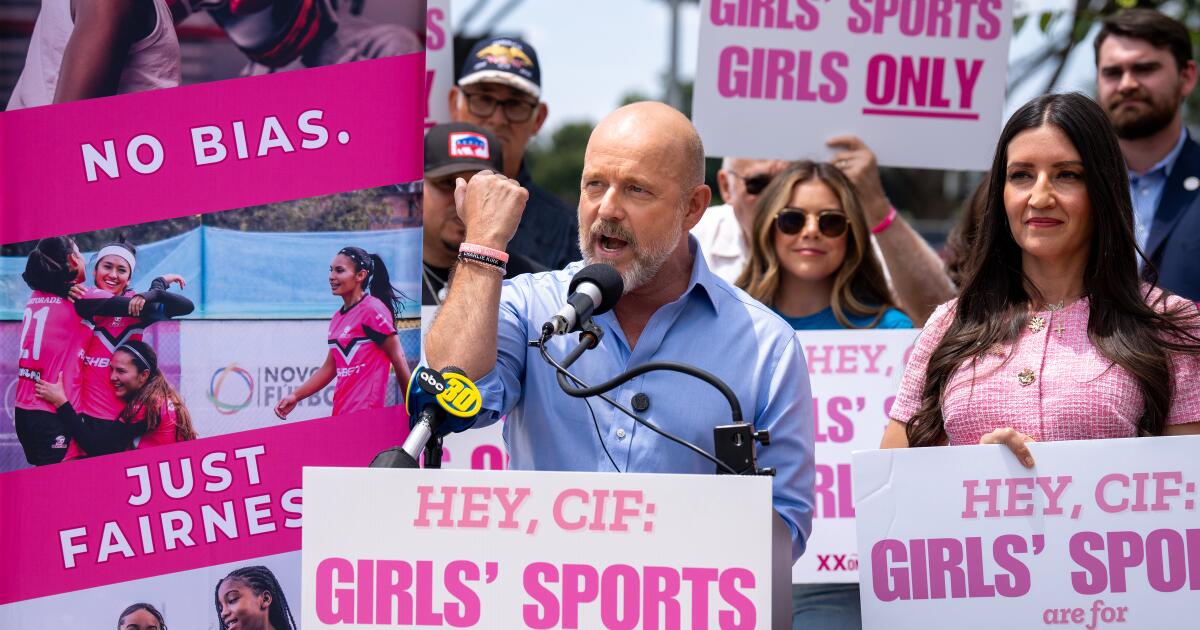
At the Supreme Court, the unfounded fear of boys masquerading as girls in youth sports rolled the clock back on gender equality.
On the surface, the Supreme Court’s June 30 opinion upholding state laws barring transgender girls from women’s and girl’s sports teams looks like a victory for women’s rights.
The 6-3 opinion by Justice Brett M. Kavanaugh certainly presents itself that way. “Females and males have inherent physical differences relevant to athletic performance,” Kavanaugh wrote. “Therefore, in contact sports, forcing female athletes to compete against males can create significant safety risks.” He also asserted that “forcing female athletes to compete against males can undermine competitive fairness.”
The ruling applied to prohibitions enacted in Idaho and West Virginia against “biological” males’ participation on women’s teams in public schools. Federal judges in both states overturned the bans. The Supreme Court majority restored them. The ruling essentially upholds similar bans enacted in 25 other states.
There was no record of any transgender person participating in school sports in the State, let alone any ‘problem’ with transgender students … creating unfair competition or unsafe conditions.
— Justice Sonia Sotomayor, demolishing the Supreme Court’s argument in favor of banning transgender girls from girl’s sports
Kavanaugh, like Donald Trump and others in the anti-transgender camp, maintained that one’s gender is an immutable fact of life, established even before birth.
Anything else, Trump stated in an executive order he issued on inauguration day 2025, could only be the product of “gender ideology extremism.” The U.S., his order stated, recognizes “two sexes, male and female. These sexes are not changeable and are grounded in fundamental and incontrovertible reality.” That’s a “biological truth,” he declared.
In his own version of this overconfident and factually insupportable conclusion, Kavanaugh wrote: “As all agree, females and males have inherent physical differences relevant to athletic performance.”
Science recognizes that some people are “born with sex traits that don’t fit into typical male or female patterns,” to cite a discussion on the Cleveland Clinic web page on the topic “intersex.” The condition “may involve chromosomes, hormones, reproductive organs or genitals.”
From a psychological standpoint, medical science recognizes “gender dysphoria” as a real condition often requiring counseling and medical intervention such as the use of puberty blockers and hormones to stave off the development of secondary sex characteristics until the condition can be resolved.
No one disputes that there are physical differences between the sexes. Few would dispute that on average or even at the median, males may be bigger and more powerful than females, or that in certain contact sports the difference may be telling and on occasion dangerous.
But that’s not the same as asserting that the physical differences between males and females invariably mean that men will invariably prevail over women in all competitions or that their participation will endanger women.
The International Olympic Committee — in a policy statement Kavanaugh cited incompletely — says that in “most running and swimming events,” males have a 10% to 12% advantage over women. That’s a range that would accommodate the full spectrum of outcomes — transgender females win, cisfemales win, they tie. (The “cis” prefix denotes those living consistent with their birth gender.)
West Virginia and Idaho addressed this ambiguity by banning transgender women from all girls’ teams. So under their rules transgender girls can’t play football or soccer with cisgirls. But what’s the argument in favor of banning them from the 100-yard dash, or cross-country track, or diving, or archery?
But something else is going on here. The Supreme Court’s ruling was almost preordained, given the years-long campaign by conservatives to demonize transgender individuals as if they’re members of an alien species.
It will be recalled that during his presidential campaign, Trump spun a despicable fantasy in which children were kidnapped in school and secretly subjected to sex-change operations.
Trump’s executive order wiped out policies aimed at protecting transgender adults from discrimination. He moved to outlaw gender-affirming medical therapies for anyone under 19 by cutting off federal funding for healthcare institutions that provide such care.
He banned transgender individuals from serving in the military and ordered federal prison officials to move transgender inmates into the general populations consistent with their birth genders, which exposes them to physical assault. (Federal Judge Royce Lamberth of Washington, D.C., has blocked the government from transferring three transgender women into the male prison population or terminating their hormone treatments.)
I wrote during Trump’s first term, when his anti-transgender policies were still gestating, that the goal was to show that “one can target any community, as long as it doesn’t have a strong political voice or political power. These are the actions of bullies and cowards, pretending to be strong.”
Last year, the Supreme Court struck its first blow against transgender rights by upholding a Tennessee law banning transgender care, including puberty blockers and hormone therapy, for minors. Similar laws have been enacted in 25 other states. The majority in that ruling by Chief Justice John G. Roberts Jr. was identical to the one in the June 30 ruling — Roberts, Kavanaugh, and Justices Clarence Thomas, Samuel A. Alito Jr., Neil M. Gorsuch and Amy Coney Barrett.
Who are the targets of this ideological campaign? They number only about 1.6 million U.S. adults, or one-half of 1% of the U.S. population. About 300,000 adolescents ages 13 to 17, or 1.4%, identify as transgender, according to a study by UCLA School of Law.
In West Virginia, as Justice Sonia Sotomayor observed in her dissenting opinion, “there was no record of any transgender person participating in school sports in the State, let along any ‘problem’ with transgender students … creating unfair competition or unsafe conditions.”
In endorsing the flat bans directed at transgender women in Idaho and West Virginia, Kavanaugh argued that any attempt to implement case-by-case judgments of students’ requests to join sports teams inconsistent with their biological gender would create “an enormous practical and administrability problem.”
Is that so? That wasn’t the case in Maine, where the annual K-12 population is more than 170,000. There, a committee was charged with determining whether a student’s participation in a sport consistent with their gender identity but inconsistent with their biological sex would “result in an unfair athletic advantage” or present a risk of injury to others. The committee held 56 hearings from 2013 through 2021, or an average of seven per year. During the entire time span, only four involved transgender girls. (The outcome of those hearings couldn’t be learned.)
It was Maine’s policy, one might recall, that provoked a confrontation between Trump and Maine Gov. Janet Mills at the White House last year, when Trump threatened to withhold federal funding from the state unless it barred transgender students from competing on women’s sports teams. “We’ll see you in court,” Mills snapped.
Whether the Idaho and West Virginia laws genuinely protect girls from unfair competition is questionable. (The Idaho law is styled the “Fairness in Women’s Sports Act.”) In practice, the laws may subject women in public schools to “invasive sex verification procedures,” as educational expert George Theoharis of Syracuse University wrote after the court ruling.
They’re also based on a retrograde view of women as fragile creatures needing men’s protection, Theoharis wrote — “the same logic that has historically been used to justify excluding women from making their own healthcare decisions and girls from rigorous math and science; that physically demanding work is simply beyond them.” (There don’t appear to be any state laws barring transgender women from competing in men’s sports.)
Becky Pepper-Jackson, the plaintiff in the West Virginia case, in which she is identified only as B.P.J., is the only transgender girl who sought to join girl’s teams — track and cross-country — in the state. That was in 2021, just after West Virginia passed its law and she was about to enter sixth grade. She didn’t appear to pose any competitive risk to others on the track and cross-country teams she applied to join — her lawyers told the Supreme Court that on those no-cut teams, she “came in near the back.”
Anyway, she had not gone through male puberty, which theoretically might have endowed her with a competitive advantage, because she had been taking puberty blockers and female hormones.
Thanks to the court’s ruling, Sotomayor observed in a dissent joined by Justices Elena Kagan and Ketanji Brown Jackson, West Virginia can deny Becky access to school sports “because it thinks they have an inherent athletic advantage, even if the facts show that they do not.”
B.P.J., Sotomayor wrote, “cannot practice on girls’ teams, even if she would not take anyone’s spot in an eventual competition, even if everyone who tries out for the team makes it, and even if having the chance to participate could aid immensely in treating B. P. J.’s gender dysphoria.”
So whose interest was really protected by the Supreme Court?

An Orange County real estate investor accused of criminally defrauding an Arizona bank of nearly $100 million pleaded not guilty Monday and remains in custody.
Mahender Makhijani, 44, of Corona del Mar — who also was ordered by an arbitrator to pay $1.34 billion in a separate civil fraud case — was arraigned in Santa Ana federal court on two charges.
He is accused of bank fraud and making a false statement to a bank in a June 8 case involving a $100 million real estate loan made by Phoenix-based Western Alliance Bank. He was taken into custody on June 10.
Makhijani is accused of providing bogus collateral for the October 2024 loan now in default. In a civil lawsuit, Western Alliance said the outstanding balance as nearly $99 million.
Prosecutors say he falsified title insurance policies that showed the bank would have a first lien on the underlying collateral if the loan went bad, when in fact it did not.
A trial was set for August 11 before U.S. District Judge David O. Carter in Santa Ana.
Michael Schachter, his criminal defense attorney, did not respond to messages seeking comment.
In the civil case, an arbitrator in May ordered Makhijani to pay Laguna Beach real estate mogul Mohammad Honarkar $1.34 billion after ruling he had fraudulently induced him into a 2021 joint venture — and then wrested control and lost to creditors more than two dozen properties Honarkar had owned.
Makhijani has not been criminally charged in that case, but prosecutors alleged in an affidavit in support of the bank fraud charges that he used “force and threats” in his dealings with Honarkar and others — including taking over the landmark Hotel Laguna in 2023 that Honarkar was renovating.
Prosecutors sought to hold Makhijani without bail after his arrest.
The affidavit noted he is a legal Indian immigrant with a home and bank accounts in that country, has access to private jets and threatened to “run away” if caught in a difficult situation.
The request was denied and he was granted $500,000 bail.
However, Makhijani remains in custody after a hearing sought by prosecutors last month before Magistrate Judge Autumn Spaeth.
The judge declined to accept a $450,000 cashier’s check submitted by a Makhijani associate for the bail, finding insufficient proof the source of the funds was legitimate, according to court records.
Makhijani is not prominent outside Orange County real estate circles, but he established a thriving distressed-assets business over the last decade that attracted prominent Southern California real estate investors.
Prosecutors said it paid for a lifestyle that included two multimillion-dollar homes in Corona del Mar, a luxury apartment in Newport Beach and various luxury vehicles.
As of last month, prosecutors had not fully traced his assets, which they believe are not held in his name and some of which may be in India.
The businessman employed an array of shell companies and strawmen to sign documents on his behalf, and to stand in for him as operators of his companies, according to the affidavit.
Makhijani told an associate he took extra precautions because wanted to insulate himself from litigation and that “they were sharks in the distressed world who took advantage of people,” the affidavit stated.
-

 Hawaii5 minutes ago
Redesigned Hawaii IDs begin rolling out statewide
-
 Idaho8 minutes ago
All lanes blocked on I-84 in Payette County due to multiple brush fires, officials say
-

 Illinois13 minutes ago
Lake Geneva boat accident, 3 kids drowned; Illinois school district responds
-

 Indiana20 minutes ago
Baby abducted in Marshall County found safe in northwest Indiana
-

 Iowa23 minutes ago
Iowa City Man who ran over people in homeless encampment sentenced to nearly two decades in prison
-
Kansas28 minutes ago
Kansas Lottery Mega Millions, Pick 3 winning numbers for July 7, 2026
-

 Kentucky35 minutes ago
US 51 Cairo bridge to remain closed for period of time
-

 Louisiana38 minutes ago
Heart of Louisiana: Lafitte Wetlands

