News
A Supreme Court ruling on voting rights could boost Republicans’ redistricting efforts

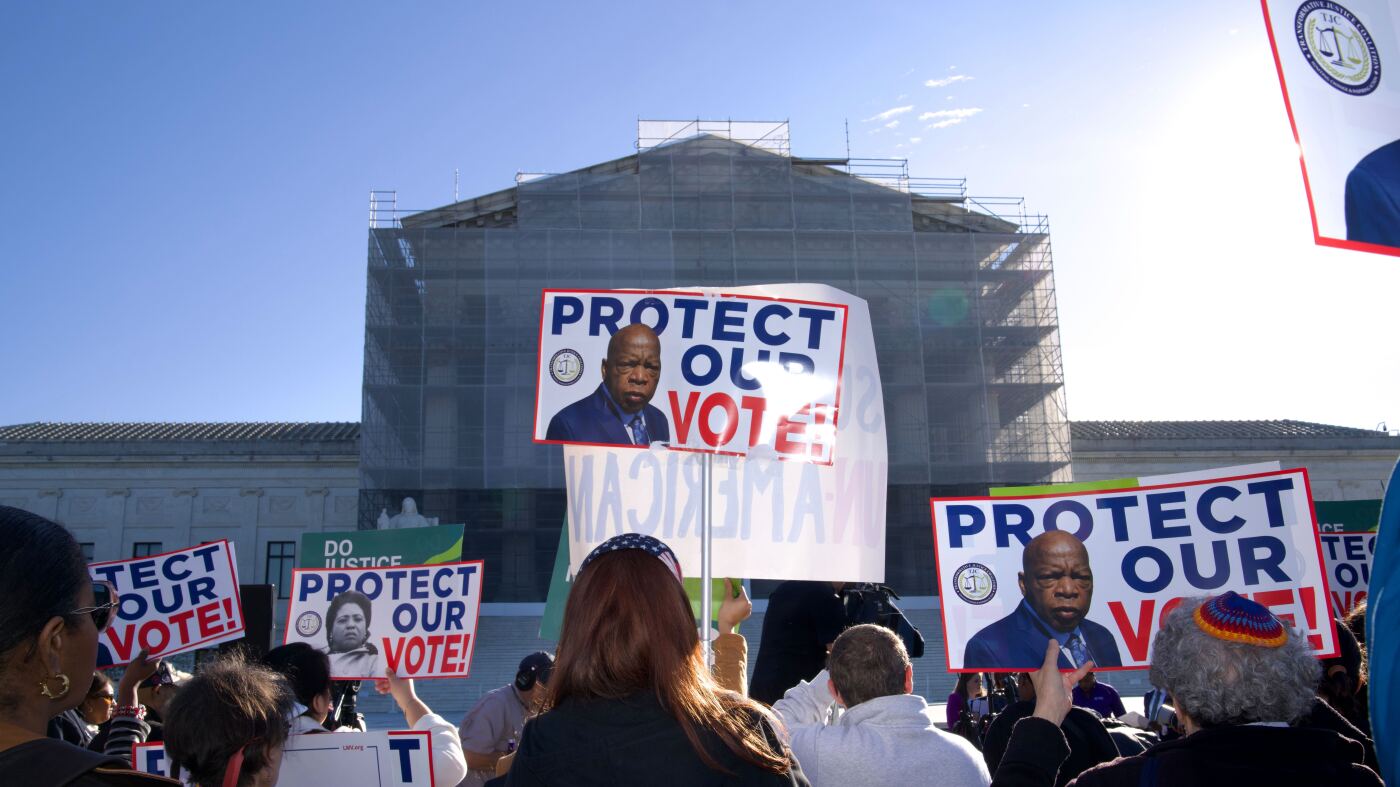
Demonstrators holding signs in support of minority voting rights gather outside the U.S. Supreme Court in Washington, D.C., on Wednesday.
Claire Harbage/NPR
hide caption
toggle caption
Claire Harbage/NPR
A major redistricting case returning to the U.S. Supreme Court on Wednesday could not only determine the fate of the federal Voting Rights Act, but also unlock a path for Republicans to pick up a slew of additional congressional seats.
If the high court overturns the act’s Section 2 — a provision that bans racial discrimination in voting — GOP-controlled states could redraw at least 19 more voting districts for the House of Representatives in favor of Republicans, according to a recent report by the voting rights advocacy groups Black Voters Matter Fund and Fair Fight Action.

And depending on when the court rules in the case, known as Louisiana v. Callais, some number of the seats could be redistricted prior to next year’s midterm election.
The analysis comes as President Trump continues to lead a GOP push for new maps in Texas, Missouri, North Carolina and other states that could help Republicans preserve their slim House majority after the 2026 election.
The GOP effort could be bolstered by a Supreme Court ruling that eliminates longstanding Section 2 protections against the dilution of the collective power of racial minority voters.
Many of the landmark law’s supporters fear such an outcome after the conservative-majority court didn’t rule last term on the Louisiana case, and instead scheduled a rare second round of oral arguments, which is expected to focus on the constitutionality of Section 2’s redistricting requirements.


A ruling gutting Section 2 could have a cascading effect on congressional maps in mostly Southern states where Republicans either control both legislative chambers and the governor’s office or have a veto-proof majority in the legislature — and where voting is racially polarized, with Black voters tending to vote Democratic and white voters tending to vote Republican.
If mapmakers in those states are no longer required under Section 2 to draw districts where racial minority voters have a realistic opportunity of electing their preferred candidate, Louisiana, Florida, Georgia, Missouri, North Carolina and Texas could end up with fewer Democratic representatives in Congress. Alabama, Mississippi, South Carolina and Tennessee could lose all of theirs, the report finds.
As much as 30% of the Congressional Black Caucus and 11% of the Congressional Hispanic Caucus could also be lost.
It all leads to a possibility of Republicans cementing one-party control of the House for at least a generation, says Cliff Albright, co-founder and executive director of Black Voters Matter Fund.

Demonstrators hold signs and wear shirts for Black Voters Matter Fund outside the Supreme Court on Wednesday.
Claire Harbage/NPR
hide caption
toggle caption
Claire Harbage/NPR
“Part of the point that we’re trying to make with this report is that what happens in the South doesn’t just stay in the South,” Albright adds. “This racial gerrymandering has the ability to not just disempower, disenfranchise Black voters and to eliminate Black elected officials and Latino elected officials. What happens in these states impacts the entire country.”
How the Supreme Court overturning Section 2 could lead to a redistricting “free-for-all”
In the Louisiana case, a lower court ordered the state’s Republican-controlled legislature to draw a new congressional map after a group of Black voters sued under Section 2.
Section 2 “ensures all communities of color can still participate equally in the voting process and elect candidates who reflect their interests,” says Alanah Odoms, executive director of the American Civil Liberties Union of Louisiana, whose attorneys are helping to represent those Black voters. “And if communities of color are not able to do that, we stand to lose what I think most of us believe is so fundamental to our democracy, which is equal participation, equal opportunity.”

The court-ordered map, which was in effect for the 2024 election, led to Democrats picking up a second seat in Louisiana.
A group of self-described “non-African American” voters, led by Phillip Callais, has argued, however, that the race-based redistricting the court ordered to get in line with Section 2 is unconstitutional. Just as the Supreme Court ruled against race-based affirmative action at colleges and universities in 2023, they argue, the court should put an end to race-based political mapmaking under Section 2.
In seeking a rehearing in the Louisiana case, the Supreme Court asked all sides in the case to consider whether the state’s “intentional creation of a second majority-minority congressional district violates the Fourteenth or Fifteenth Amendments to the U.S. Constitution.”
In one of their latest briefs to the high court, Republican state officials in Louisiana now argue against using race “in any form” when redistricting.
And in a major shift from past administrations, the Justice Department under Trump agrees that Section 2’s protections against racial discrimination are no longer constitutional.
Two years ago, the Supreme Court rejected a similar argument by Alabama Republicans.
“The court could reaffirm the Voting Rights Act as it did in 2023 in Allen v. Milligan,” says Atiba Ellis, a professor and an associate dean at Case Western Reserve University’s law school. “But many observers — and I am one of them — have been concerned about the court becoming more and more cynical about race-conscious remedies to address longstanding civil rights wrongs. And this decision has the potential to be the tipping point where the court declares unconstitutional or heavily restricts the ability for Congress to create remedies that promote multiracial democracy.”
That kind of decision coming amid the ongoing mid-decade congressional redistricting war between Republicans and Democrats, Ellis adds, could set the stage for a true “free-for-all” — pointing also to the court’s 2019 ruling that partisan gerrymandering is not reviewable by federal courts.

“It is one thing for politicians on both sides of the aisle to use the power that they have to engage in unprecedented power grabs. But the most important check on those grabs has been the prevention of racial discrimination,” Ellis says about Section 2. “Absent the federal law that would prevent that discrimination, I think the consequences could be tremendous and could be felt for decades.”
The window of time to pass new congressional maps before the midterms is closing as state deadlines draw nearer. Louisiana’s top election official, Secretary of State Nancy Landry, has asked the Supreme Court to rule in this case by early January 2026 to avoid disrupting the state’s current schedule.
But the timing remains unclear for the Supreme Court, which usually releases decisions for major cases toward the end of its term in June.
The court has confirmed that it plans to discuss early next month if it will take up a North Dakota case about whether private individuals and groups — whose lawsuits have been the main way of enforcing Section 2 — can continue to sue. Republican state officials in Mississippi have also raised that issue in another redistricting case on direct appeal to the high court.
Edited by Benjamin Swasey


Washington — The House on Wednesday passed a measure that would force President Trump to end the war with Iran without congressional authorization, marking the first time the lower chamber has defied the White House on the conflict.
The House voted 215 to 208 to approve the war powers resolution with the help of four Republicans. Democratic Rep. Jared Golden of Maine, who has voted against the three previous failed attempts, also dropped his opposition and voted for the measure, giving his party unanimity on the issue.
Republican Reps. Thomas Massie of Kentucky, Brian Fitzpatrick of Pennsylvania, Tom Barrett of Michigan and Warren Davidson of Ohio voted with Democrats in favor of the measure.
Democrats in the chamber erupted in applause after passage.
The vote was supposed to take place before lawmakers left for the Memorial Day recess, but House GOP leaders abruptly pulled the vote when it became clear they did not have the numbers to block it. Several Republicans were absent and others were expected to support it.
The Senate advanced a similar measure in May to rein in Mr. Trump on Iran after four Republicans joined all but one Democrat to push it forward. Three Republican absences also helped deliver the breakthrough after seven previous unsuccessful votes.
But the Senate’s procedural vote was just the first step on the way to potential passage, and Republicans will have another opportunity to block it in the coming days.
It’s unclear when they plan to vote on the House version. In a statement, House Democratic leaders called on Senate Republicans “to do the right thing.”
Support for the war from some Republicans waned after the conflict passed a statutory 60-day deadline under the War Powers Resolution of 1973, which says the president must remove armed forces from hostilities if Congress has not authorized the war. The war passed the deadline on May 1, but the administration has argued that a fragile ceasefire stopped the clock in early April, though both sides have carried out attacks since then.
The Trump administration has also argued the War Powers Resolution of 1973 is unconstitutional, though that theory has never been tested in court.
Republicans who have voted in favor of limiting Mr. Trump’s military powers in Iran have been uncomfortable with the lack of congressional authorization on the war and a strategy to end it. Some fear the war’s unpopularity and the economic fallout could harm the GOP’s chances at keeping control of Congress after the midterm elections in November.
GOP Rep. Ashley Hinson of Iowa, who is running for Senate, said in a private exchange at a campaign stop last week that the war could be a “political liability” if it continues beyond “the next couple of weeks,” according to audio obtained by CBS News.
But Mr. Trump said last month he was in “no hurry” to make a deal with Iran ahead of the midterms.
“Everybody’s saying, ‘Oh, the midterms, I’m in a hurry.’ I’m in no hurry,” he said.
The resolution approved Wednesday was introduced in April by Rep. Gregory Meeks of New York, the top Democrat on the House Foreign Affairs Committee. It directs the president “to remove United States Armed Forces from hostilities with Iran,” unless Congress declares war or authorizes the use of military force.
Rep. Brian Mast of Florida, the Republican chairman of the House Foreign Affairs Committee, earlier Wednesday called it a “stupid political vote” that “weakens the president’s hands as he’s negotiating with Iran.”
After the vote, Meeks brushed off the assertion that the war powers votes have undercut the president during negotiations with Iran. When asked whether Democrats would keep forcing votes to end the Iran war, Meeks told reporters, “You can expect us to continue to do our jobs.”
“We’re going to continue to do our constitutional responsibilities,” he said.
Fitzpatrick, who also voted in favor of a war powers resolution in May, said, “The law is the law.”
“We have to follow the law. There’s a law on the books,” Fitzpatrick said. “So you have two choices: You either follow the law or you change the law. You can’t violate the law. That’s not an option.”
During floor debate on the measure on May 20, Democrats questioned why Republicans haven’t held a vote on an authorization for military force to provide Mr. Trump with legal guardrails for attacking Iran.
“If my Republican colleagues believe this is justified, they should bring an AUMF to the floor,” Meeks said.
There’s been little momentum so far behind an AUMF introduced by Barrett earlier in May.
Rep. Kevin Kiley of California, an independent who caucuses with Republicans, argued there are “better tools” for Congress to assert its authority.
“We actually have the ability to provide direction as to how funds should be used,” Kiley said, referring to Congress’ power of the purse. “I understand why people want to use whatever tools are available, but I believe that Congress should use those tools of congressional oversight and the powers we have under Article I that really have teeth here.”

Note: Map shows the area with a shake intensity of 3 or greater, which U.S.G.S. defines as “weak,” though the earthquake may be felt outside the areas shown. The New York Times
A moderately strong, 5.1-magnitude earthquake struck in the North Pacific Ocean on Wednesday, according to the United States Geological Survey.
The temblor happened at 5:45 a.m. Pacific time about 40 miles west of Petrolia, Calif., data from the agency shows.
As seismologists review available data, they may revise the earthquake’s reported magnitude. Additional information collected about the earthquake may also prompt U.S.G.S. scientists to update the shake-severity map.
Subsequent quakes have been reported in the same area. Such temblors are typically aftershocks caused by minor adjustments along the portion of a fault that slipped at the time of the initial earthquake.
Aftershocks detected
Quakes and aftershocks within 100 miles
Aftershocks can occur days, weeks or even years after the first earthquake. These events can be of equal or larger magnitude to the initial earthquake, and they can continue to affect already damaged locations.
The New York Times
When quakes and aftershocks occurred
Sources: United States Geological Survey (epicenter, aftershocks, shake intensity); LandScan via Oak Ridge National Laboratory (population density) | Notes: Shaking categories are based on the Modified Mercalli Intensity scale. When aftershock data is available, the corresponding maps and charts include earthquakes within 100 miles and seven days of the initial quake. All times above are Pacific time. Shake data is as of Wednesday, June 3 at 6:03 a.m. Pacific time. Aftershocks data is as of Wednesday, June 3 at 8:01 a.m. Pacific time.

Xavier Becerra, Democratic gubernatorial candidate for California, and Steve Hilton, Republican gubernatorial candidate for California, shake hands while arriving for a gubernatorial debate at KRON Studios in San Francisco in April.
Jason Henry/Getty Images North America
hide caption
toggle caption
Jason Henry/Getty Images North America
SAN FRANCISCO — The primary election for California governor is too close to call, with vote counting continuing Wednesday. Democrat Xavier Becerra and Republican business executive Steve Hilton lead the field with Democrat Tom Steyer in third place.
In California’s unusual primary system, all candidates, regardless of party, appear on a single ballot open to any registered voter. The top two candidates then move on to the general election, even if they’re from the same party. This year, voters had 60 names for governor to choose from.
The winner will lead the country’s most populous state, where leaders often take on national political prominence. Incumbent Gov. Gavin Newsom is at his two-term limit and could be a Democratic contender for president.
Becerra, former Health and Human Services secretary under President Joe Biden, pitched himself to voters as an experienced political leader who isn’t afraid of President Trump, but his lead caps one of the most surprising and dramatic comebacks in recent state political history. As recently as April, polls were showing Becerra — also a former member of Congress and California attorney general — languishing in single digits in a crowded field.
In his remarks at his watch party in Los Angeles, Becerra noted his underdog status.
“Here in Hollywood’s hometown, we love a good underdog success story,” he said, drawing parallels between his campaign and his immigrant parents’ success story in California. “Guess what? The underdog stayed in the fight. Like my parents, I never gave up. Never stopped putting one foot in front of the other. Never stopped believing in the beacon-like goodness of California. And thankfully, neither did you.”
Hilton is a former Fox News commentator who also served as a political adviser to former British Prime Minister David Cameron. He was endorsed by President Trump in April, helping him to pull ahead of Riverside County Sheriff Chad Bianco, the other major Republican in the race. Hilton has campaigned on the idea that California needs change after 16 years under total Democratic control.
The race is narrowing down after a tumultuous campaign
At his watch party in Huntington Beach, the British-born candidate — who became an American citizen five years ago — said it was the “honor of his lifetime” to receive over 1 million votes so far.
“Change is coming to California and it’s long overdue,” Hilton said. “We’re not there yet, but it’s looking good. It looks very much as if Californians really will have the chance to vote for change in November and take our state in a new direction.”
Democratic billionaire activist Steyer spent more than $213 million of his own money to boost his candidacy and push a progressive, populist message. While he was trailing Becerra and Hilton on Tuesday night, he said at his watch party in San Francisco that he remains confident he can close the gap in the days ahead.
“Together, we’ve scared the hell out of the corporate interests used to getting their way,” Steyer said. “It might take some time to figure out where this is going. We’re going to wait until every ballot is counted. We’re gonna give democracy a time to work. And we know we finished really strong.”
The early results are not certain to hold, in part because of unusual voting patterns in this primary election: Ballot-tracking data heading into Tuesday evening showed that Republicans were more likely to vote early by mail, while Democratic voters in this deep-blue state held onto their mail-in ballots or chose to vote in person. That’s the reverse of recent elections, which saw more Democrats voting by mail and Republicans tending to vote in person on Election Day.
The uncertainty on election night capped a race that remained crowded and unsettled to the end. To some extent, the race was defined by who wasn’t running.
Some of the state’s most high-profile Democrats — former Vice President Kamala Harris, U.S. Sen. Alex Padilla and California Attorney General Rob Bonta — all passed on a potential bid to succeed Newsom.
The race was disrupted in April when then-U.S. Rep. Eric Swalwell’s campaign for governor imploded amid allegations of sexual assault and harassment. Swalwell resigned from Congress shortly after the accusations surfaced and has denied assault allegations.
Swalwell had been gaining in polls and racking up high-profile endorsements, and his exit seemed to primarily benefit Becerra, who had been stuck in single digits in many polls. Ultimately, it quieted fears among Democrats who worried that the messy Democratic field could result in Bianco and Hilton winning the top spots in the June primary.
Marisa Lagos covers California politics at KQED and co-hosts the Political Breakdown show and podcast.
-
 Sports5 minutes ago
‘SNL’ star Marcello Hernández to host 2026 ESPYs as show leaves L.A. for New York
-

 World15 minutes ago
US House passes Iran war powers resolution in rare moment of Trump backlash
-

 News42 minutes ago
House votes to rein in Trump on Iran as war loses GOP support
-

 Los Angeles, Ca2 hours ago
Police investigate deadly stabbing in Tarzana; suspect in custody
-

 Detroit, MI2 hours ago
Detroit Tigers sweep Tampa Bay Rays in win as Dillon Dingler stays hot
-

 San Francisco, CA3 hours ago
Retired San Francisco firefighter dies from lung cancer after Blue Shield denies treatment claims
-

 Dallas, TX3 hours ago
Trackdown: Dallas 7-Eleven robbery suspect wanted
-

 Miami, FL3 hours ago
This new Italian restaurant in Brickell only has 10 items on the menu

