Entertainment
San Cha upends telenovela archetypes in experimental new opera, ‘Inebria me’


For L.A.-based musician, composer and artist San Cha, the Spanish language is a creative gold mine. “One of my favorite Spanish words is ‘embriágame,’ which I think the direct translation is ‘make me drunk’ or ‘intoxicate me,’” she says. “I love that word. I think there’s a song by Thalía that has that word, it’s called ‘Piel Morena,’ and every time she said that, I’m like — ‘That’s it!’”
San Cha is speaking of her latest work, “Inebria me,” ahead of its Los Angeles premiere Thursday at REDCAT, inside the Walt Disney Concert Hall complex. “Inebria me” is a 90-minute experimental opera that expands on her critically acclaimed 2019 ranchera fusion album, “La Luz de la Esperanza.” San Cha stars as Dolores, a humble bride to the much wealthier Salvador, whose jealousy turns deadly; enter Esperanza, a genderless spirit of empowerment, who helps light Dolores’ path to freedom.
Having gone from singing rancheras in the restaurants of Mexico City to experimenting in underground drag scenes in the Bay Area, San Cha has developed a knack for synthesizing disparate influences that result in visually arresting and thought-provoking work. Born Lizette Gutierrez in San Jose to Mexican immigrant parents, San Cha grew up offsetting her intense Bible study by binging on telenovelas after school. It shows in “Inebria me,” where she employs the classic narrative structure of the telenovela, but with a queer twist. “I wanted to hold [onto] the queerness of [the story] and the religious aspects of it,” she says.
The opera is the latest of San Cha’s collaborative efforts. She’s previously linked up with an array of artists — including La Doña, Rafa Esparza, Yesika Salgado and even country singer Kacey Musgraves, who featured San Cha in a pivotal moment from her 2021 visual album, “Star-Crossed.” Darian Donovan Thomas also stars in “Inebria me,” alongside Stefa Marin Alarcon, Lu Coy, Kyle Kidd, Carolina Oliveros and Phong Tran.
In our latest interview, she discusses developing her music for the stage and what it took to build the confidence to advocate for her original vision on her own.
This interview has been edited and condensed for clarity.
San Cha performs with Darian Donovan Thomas on Sept. 5 at the Winningstad Theatre in Portland, Ore.
(Jingzi Zhao)
When did the idea to adapt “La Luz de la Esperanza” come to you?
It actually came to me in 2023 or 2024 when I partnered with the National Performance Network for this grant. I started talking with the Portland Institute for Contemporary Art, which was already on board, and the Performance Space New York. Like, what would I do to adapt this work?
Did you have experience in traditional theater growing up?
No, I didn’t. And I also didn’t watch too many movies. I missed out on a lot of those very American experiences. People would be like, “Do you know this movie?’ And “It’s like a classic,” and it’s like “No.” I was really sheltered, you know, “I’m over here in Bible study” kind of s—.
Has anyone in your family seen this piece? If so, what was their feedback?
My parents saw a trial version of this piece in San Jose, my hometown. They saw the PG-13 version, which is what I’d like to say, and my mom was confused; I don’t even know how my dad felt. My mom’s one comment was, “You didn’t sing rancheras. Everyone wants you to sing rancheras.” And I was like, “Oh, my God.” So they also came to the closing night with a big group, and I sang the rancheras for them at the end.
How would you relate “Inebria me” to what’s considered a “traditional” opera?
I would say it has a very clear narrative … everything is sung, except for the parts [where] the Man [is] talking or speaking.
I sing rancheras [and] that kind of blends into operas. I didn’t grow up being an opera singer, or wanting to be an opera singer, but somehow it developed in that direction. In this, we get to be all the things: a little hardcore, a little pop, a little mix with opera.
Where did the idea to bring in telenovelas come from?
I wanted to make a telenovela set to music. And because I’d never seen a queer telenovela … I just was like, I want to make the telenovela and set it to disco music … something electronic, glamorous. It [speaks to] the illusion of glamour, underneath everything is ugly and twisted.
What was your first memory of watching a telenovela?
There are so many. I’d watch the kid telenovelas. But there’s one in particular … it’s one where Lucero, a big pop star in Mexico, plays three versions of herself, so she’s a triplet. And there’s one [version] that is so evil. I still remember, [the characters] would get very BDSM … like locking people up! As a kid, I was feeling like … “Why am I watching this? I’m a child!”

“I didn’t grow up wanting to be an opera singer, but somehow it developed in that direction,” says San Cha of “Inebria me.”
(Jingzi Zhao)
You’ve talked about how drag queens were instrumental, especially early in your career. Queer and drag culture have come into mainstream pop and youth culture on the one hand, but remain demonized on the other. How do you reconcile those two extremes in your work?
I guess visibility doesn’t always mean safety or acceptance. I remember being in San Francisco and seeing drag that wasn’t as polished and more on the fringe side of it.
I was … kind of hating it when I got to L.A. and how polished everyone was. But when I saw “RuPaul’s Drag Race” reruns on VH1, I was like, “This is literally life-changing.” And how cool that this is becoming mainstream!
In a previous interview, you discussed sin and guilt as the themes of this work. Many artists have explored this theme in various ways across different cultures and times. Why do you think ideas around guilt and sin hold such power over us?
You’re made to do what you don’t want to do by [people] making you feel shame for the ways you act. And in [“Inebria me”], the sisters each have a confession, and I wanted to make that a focal point — with the nun, the religious person.
In telenovelas, there’s always a priest [they] talk to when they have troubles, you know? And I think in the [Catholic practice of] confession, it is important to relieve yourself of the shame and guilt. But it’s almost like you relieve yourself and then you feel shame, you know? And that’s the part that stops growth, evolution and freedom.
For someone whose first impression of “Inebria me” is that it’s not for them, what do you think they would be surprised to discover or an element they would enjoy?
Everyone in this piece is a star, everyone’s a diva. I think they all really shine on their own, and they really bring it with the acting. Their voices are all incredible, and their stage presence. Maybe they could be into the scene design by Anthony Robles — it’s super minimal, but it does so much for the space in creating this oppressive world. I think there is something for everyone. It’s a story that can relate to a lot of people.


The Invite is a remake of the Spanish film The People Upstairs, itself based on a play by the same director Cesc Gay. With all remakes, the question is: What’s this version bringing to the table. In this case, it’s a rock solid cast with great chemistry and some very snappy direction by Olivia Wilde.
Joe (Seth Rogen) and Angela (Olivia Wilde) are a dysfunctional couple with some noisily amorous upstairs neighbours. They invite Hawk (Edward Norton) and Piña (Penélope Cruz) to dinner and hijinks ensue.
There’s a lot to like about The Invite. Each member of the cast is funny in their own way. Rogen plays his usual schlub but his character is more nuanced than usual, with the rapid-fire jokes masking a deep frustration and melancholy. Wilde‘s Angela is a persnickety neurotic, but it’s not hard to see why. Cruz plays a sultry therapist who’s in permanent flirt mode but is also holding something back. Norton steals the show with a quietly hilarious performance as a retired firefighter who is all too eager to share his new age insights. The way each person interacts with the other results in a rollercoaster of cringe comedy, acerbic satire and genuine gut-busters. This is a film that relies entirely on performance and actually succeeds.
The story itself is a little masterpiece. Adapted from Gay’s original by Rashida Jones and Will McCormack, the dialogue is quick, laden with not-very-subtextual motivations and always up to something. It’s very even-handed, and all the characters are sympathetic but flawed in amusing ways. Watching the increasingly desperate Joe and Angela bouncing off the Hawk and Piña is both funny and excruciating. Joe’s attraction to Piña is played fairly straight, but Angela’s attraction to Hawk becomes side-splitting as she pours out her soul to his Zen-calm ears and gets responses that make her even more attracted to him and by the end she’s practically hyperventilating.
The Invite does take something of a turn towards the end, although the film is in a state of continual twist throughout. This final shift throws the couples’ dysfunction into stark terms but doesn’t ruin anything. In the end, it moves from a somewhat misanthropic tone to a sincere and compassionate one. It skillfully makes you complicit in Joe and Angela’s spatting and then forces you to reconsider. The comedy is so intense throughout the film that when this happens it might lose some viewers, but it’s well-earned, true to the characters and it’s a very satisfying payoff.
The Invite is a small film that feels like a return to a better era in cinema. It’s a remake that is worth watching for its performances, and it’s very, very funny. It’s the sort of film that can be watched at home given its confined setting, but it generates enough laughs that seeing with an audience is a real pleasure.
Entertainment
Jesús Ortiz Paz and Jimmy Humilde took their legal dispute to Instagram. Here’s the breakdown
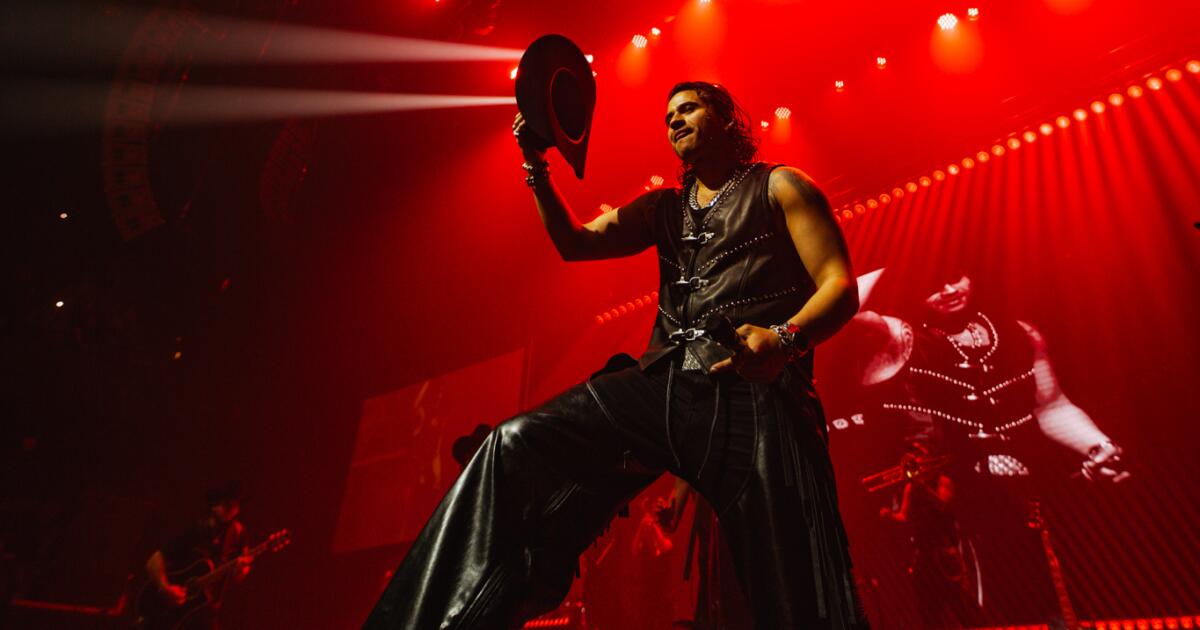
What started off as a trailblazing music partnership between música mexicana band Fuerza Regida and L.A. label Rancho Humilde has now fizzled into a sticky online drama.
On Saturday, Fuerza Regida frontman Jesús Ortiz Paz, better known as JOP, took to his personal Instagram account to post a statement addressing the band’s ongoing legal battle with the independent label led by music mogul Jimmy Humilde, who signed the band in 2018.
“To everyone who supports Fuerza Regida, you deserve to hear our music,” Ortiz Paz wrote in a public statement. “You deserve to see us perform at the World Cup. You deserve to listen to us on the MLB [Major League Baseball] album.”
This statement, which has since disappeared from JOP’s Instagram post, alleged that music created by the música mexicana group “keeps disappearing.”
Among the songs that have been taken down from streaming platforms by Rancho Humilde are “Triston,” “Todos nos Shipean” and “67,” according to the band’s publicist.
In September 2025, Rancho Humilde filed a lawsuit against Fuerza Regida, alleging breaches of contract for unilaterally collaborating with artists outside the label — such as Chino Pacas and Drake — and signing exclusive live performance deals with Apple Music and Live Nation.
Fuerza Regida countersued, alleging that Rancho Humilde withheld millions in royalties and attempted to “sabotage” the band’s success, including by neglecting to submit its music for consideration ahead of the 2024 Latin Grammys.
The case is still making its way through the courts.
“Everyone knows [what’s] going on[.] [You see] it [in the] media, [that’s] why I’m going to let justice do its job, everyone is going to know who you really are,” the post by JOP continued in both English and Spanish. “[He who has nothing to hide has nothing to fear], go let [Jimmy Humilde] & [Rancho Humilde] know how you feel, make your voice heard. Our story isn’t over I promise.”
Humilde responded to the artist in the comment section shortly after the post was made public.
“You asked me for a bigger [deal], I got it done. You asked me for your [masters], I fought to make it happen. You wanted to become one of the biggest artists in the [world], I have everything I had to help build that dream,” wrote Humilde.
“When you needed help, I didn’t just bring business. I brought my lawyers, my doctors, my relationships, my time, and my heart. I stood by you when it mattered the most,” Humilde continued. “You walked away with the biggest check of your [life,] over $50 million. I never complained. I was happy to see you win because your success was our success.”
“What hurts is seeing everything we’ve built together reduced to a public narrative that doesn’t tell the whole story. If you believe people deserve the truth, then honor the agreement we made. Complete the contract the same way I honored every commitment I made to you. I never stopped looking out for you. I only ask that you do the same. [He who has nothing to hide has nothing to fear].”
In a separate comment — which Humilde uploaded to his own Instagram account with Fuerza Regida’s own song “El Dinero Los Cambio” (which describes how money can change someone) — the label head pushed back on allegations of robbery: “I robbed you? Robbed you of what, fool. You didn’t even have a dollar for me to rob.”
The music mogul also accused JOP — who founded his own label Street Mob Records in 2018 — of sabotaging his own bandmates. “Let’s talk about [how] your own band members went from partners to being employees. They didn’t have much of a choice.”
“And let’s not forget I helped you land a $15 million deal for your label. After that, how you choose to take care of your artists is on you. [Let’s] ask Chinito [Pacas], Calle [24] and Armenta!!” added Humilde, including the names of artists signed to Street Mob Records.
JOP of Fuerza Regida performs at South By Southwest on March 13 in Austin, Texas.
(Cat Cardenas / For De Los)
In an email to De Los, Humilde’s lawyer, Mike Trauben, pushed back on claims that Rancho Humilde is trying to stop Fuerza Regida from making music and obtaining other opportunities.
They cite two recent deals that were approved by Rancho Humilde, including Fuerza Regida’s appearance on “Grand Theft Auto” and in the online video game “Fortnite,” which aligns with the contractual framework both parties had negotiated.
With regards to the proposed MLB and FIFA collaborations, Humilde’s council said that Fuerza Regida sought to prevent Rancho Humilde from exercising its claimed contractual rights, which was ultimately denied by a federal court.
The reason certain songs were removed from streaming platforms is because Fuerza Regida chose to release music outside the agreed Rancho/Sony distribution structure and without the approvals required under the parties’ agreements, per Humilde’s lawyers.
“Ultimately, this case is not about stopping an artist from succeeding,” wrote Trauben to The Times. “It is about whether sophisticated parties are required to honor the agreements they voluntarily negotiated after success had already arrived.”
According to Trauben, Rancho Humilde and Fuerza Regida, both parties entered a completely new agreement in 2022 that fundamentally restructured their entire business relationship, fully terminating the initial 2018 contract in place. As a result, Fuerza Regida received a flat million-dollar bonus, Rancho Humilde converted its ownership of existing masters into a 50/50 structure and the two entered into a new agreement, which Humilde’s lawyers claim favors Fuerza Regida.
“This case is not about whether artists should have rights. They absolutely should. Nor is it about preventing Fuerza Regida from making music,” wrote Trauben. “Rather, this case asks a much broader question that affects the entire music industry: Do contracts still matter after artist success arrives?”
The Times reached out to Fuerza Regida’s attorney but did not hear back as of this publication.

NEW YORK (OSV News) – At what is meant to be a poignant moment in the DC Comics adaptation “Supergirl” (Warner Bros.), the title character, played by Milly Alcock, is told by her mother (Emily Beecham) that she doesn’t have to be nice but she must be good. The recipient of this advice takes it to heart in a way that lends the whole film an unpleasant tone.
We’re not talking Deadpool depths of obscene snark here. Yet scrappy Supergirl, aka Kara Zor-El, in contrast to her affable cousin — and fellow Kryptonian — Superman (David Corenswet), does not come across as especially likeable.
Nor is she a figure to be imitated since, before she embarks on the quest to which most of the running time is devoted, early scenes show her waking up with a succession of staggering hangovers. She gets blotto, we later learn, in an effort to blot out her troubled past. The only positive ingredient in her current life is the bond she shares with her beloved dog, Krypto.
So when evil alien Krem of the Yellow Hills (Matthias Schoenaerts) wounds Krypto with a poisoned dart, leaving him with only hours to live, Supergirl is desperate to help the pup survive. Learning that Krem carries the antidote with him wherever he goes, she sets off on an interplanetary hunt for the villain, racing against time.
Supergirl has already crossed paths with another of Krem’s victims, Ruthye (Eve Ridley). Having watched as Krem slaughtered her entire family, Ruthye is out for revenge and wants to join forces with Supergirl.
Since Ruthye, though courageous, is undersized and completely untrained for combat, Supergirl initially tries to ditch her. But Ruthye is not to be so easily rebuffed.
The unlikely duo eventually acquire an informal ally in the person of cigar-chomping, motorcycle-riding freelance warrior Lobo (Jason Momoa). Lobo has reasons of his own for hating the band of brigands Krem leads.
As scripted by Ana Nogueira, director Craig Gillespie’s scifi adventure includes more than one exchange in which Supergirl warns Ruthye about the morally corrupting effects of exacting vengeance. Yet this thoroughly respectable ethical message is completely undermined as the action reaches its climax.
“Supergirl” may not be a dose of Kryptonite. But it’s no energy-infusing sunbath either.
The film contains much harsh but bloodless violence, a scene of urination, a passing reference to nonscriptural religious ideas, a couple of mild oaths, several uses each of crude and crass language and an obscene gesture. The OSV News classification is A-III – adults. The Motion Picture Association rating is PG-13 — parents strongly cautioned. Some material may be inappropriate for children under 13.
Read More Movie & Television Reviews
Copyright © 2026 OSV News
-

 Minnesota56 seconds ago
Driver in fatal crash near Belview, Minnesota, was fleeing law enforcement
-

 Mississippi8 minutes ago
Mississippi gas prices drop ahead of Fourth of July weekend
-

 Missouri11 minutes ago
Gas prices falling in Missouri despite U.S. conflict with Iran
-

 Montana16 minutes ago
June 29 recap: Missoula and Western Montana news you may have missed today
-

 Nebraska23 minutes ago
Nebraska running back arrested in Florida on aggravated battery charge
-

 Nevada26 minutes ago
An ‘orchestrated dance’: Nevada moves bighorn sheep to help restore northern herd
-

 New Hampshire31 minutes ago
Nashua Man Indicted On 8 Child First-Degree Assault Charges: Hillsborough County Superior Court Indictments
-

 New Jersey38 minutes ago
Jersey City, N.J. revises proposed property tax increase to 15%. Here’s why.

