Entertainment
How Kamasi Washington and 100 musicians filled LACMA's empty new building with a sonic work of art


“The general public was admitted to new Los Angeles County Museum of Art for the first time on Friday night — not to look at art but to listen to music,” wrote Times music critic Albert Goldberg in 1965. Exactly 70 years and three months later, history repeated itself.
Thursday night was the first time the public was allowed into LACMA’s David Geffen Galleries. The occasion was a massive sonic event led by jazz saxophonist Kamasi Washington. More than a hundred musicians spread out in nine groups along 900-foot serpentine route of Peter Zumthor’s new building, still empty of art.
The celebration, which drew arts and civic leaders for the first of three preview nights, was far grander than the concert on March 26,1965, that opened LACMA’s Leo S. Bing Theatre the night before the doors opened to the museum’s original galleries. That occasion, a program by the legendary Monday Evening Concerts in which Pierre Boulez conducted the premiere of his “Éclat,” helped symbolize an exuberant L.A. coming of age, with the Music Center having opened three months earlier.
Monday Evening Concerts had been a true L.A. event drawing local musical celebrities including Igor Stravinsky and showing off L.A.’s exceptional musicians. The mandolinist in “Éclat,” for instance, was Sol Babitz, the father of the late, quintessential L.A. writer Eve Babitz. Boulez, an explosive composer, eventually turned the 10-minute “‘Éclat,’ for 15 instruments” into a 25-minute orchestral masterpiece, “Éclat/Multiples,” and left unfinished sketches behind to extend that to a full hour.
Kamasi Washington performing Thursday night.
(Allen J. Schaben / Los Angeles Times)
Washington turned out to be the ideal radical expansionist to follow in Boulez’s footsteps for the new LACMA, with a resplendent enlargement of his 2018 half-hour EP, “Harmony of Difference.” The short tracks — “Desire,” “Knowledge,” “Perspective,” “Humility,” “Integrity” and “Truth” — employ nearly three dozen musicians in bursts of effusive wonder.
For LACMA, Washington tripled the number of musicians and the length. What some critics thought were bursts of bluster, however enthralling, became outright splendor. Introducing the program, LACMA Director Michael Govan called it an event that has never happened before and may never happen again. I got little sense of what this building will be like as a museum with art on the walls, but it’s a great space for thinking big musically and, in the process, for finding hope in an L.A. this year beset by fires and fear-inducing troops on our streets.
Washington is one of our rare musicians who thrives on excess. He has long been encouraged to aim toward concision, especially in his longer numbers, in which his untiring improvisations can become exhausting in their many climaxes. But that misses the point. I’ve never heard him play anything, short or long, that couldn’t have been three times longer. His vision is vast, and he needs space.
In the David Geffen Galleries, he got it. The nine ensembles included a large mixed band that he headed, along with ensembles of strings, brass, woodwinds and choruses. Each played unique arrangements of the songs, not quite synchronized, but if you ambled the long walkways, you heard the material in different contexts as though this were sonic surrealism.
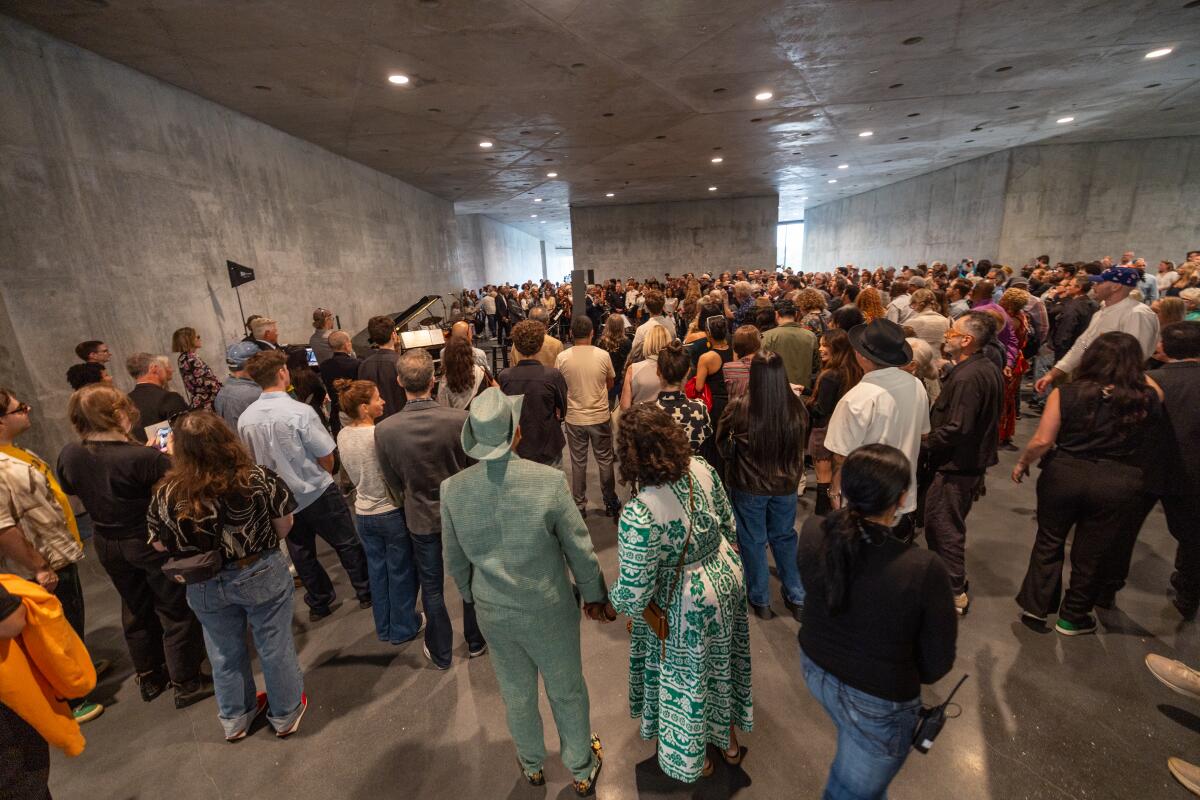
A crowd gathers to watch Washington on Thursday.
(Allen J. Schaben / Los Angeles Times)
Acoustically, the Geffen is a weird combination. The large glass windows and angled concrete walls reflect sound in very different ways. Dozens of spaces vary in shape, size and acoustical properties. During a media tour earlier in the day, I found less echo than might be expected, though each space had its own peculiarities.
Washington’s ensembles were all carefully amplified and sounded surprisingly liquid, which made walking a delight as the sounds of different ensembles came in and out of focus. A chorus’ effusiveness gradually morphed into an ecstatic Washington saxophone solo down the way that then became a woodwind choir that had an organ-like quality. The whole building felt alive.
There was also the visual element. The concert took place at sunset, the light through the large windows ever changing, the “Harmony of Difference” becoming the differences of the bubbling tar pits nearby or the street life on Wilshire or LACMA’s Pavilion for Japanese Art, which looks lovely from the new galleries.
Govan’s vision is of a place where art of all kinds from all over comes together, turning the galleries into a promenade of discovery.

LACMA Director Michael Govan addressing the crowd Thursday night before Kamasi Washington performs.
(Allen J. Schaben / Los Angeles Times)
Musically, this falls more in line with John Cage’s “Musicircus,” in which any number of musical ensembles perform at chance-derived times as a carnival of musical difference — something for which the Geffen Galleries is all but tailor-made. Nevertheless, Washington brilliantly demonstrated the new building’s potential for dance, opera, even theater.
The museum may not have made performance a priority in recent years, but Washington also reminded us that the premiere of Boulez’ “Éclat” put music in LACMA’s DNA. Seven decades on, Zumthor, whether he intended it or not, now challenges LACMA to become LACMAP: Los Angeles County Museum of Art and Performance.


It’s summer blockbuster movie season and there have been a lot of new releases from many of the biggest studios and directors. Some of the biggest titles include “Supergirl”, “Disclosure Day”, and “Toy Story 5.”
GBH’s Morning Edition guest host Tori Bedford spoke with GBH correspondent and film critic Sarah G. Vincent, along with GBH’s Callie Crossley, an avid cinephile and host of Under the Radar with Callie Crossley, for their take on some of the season’s biggest releases. What follows is a lightly edited transcript.
SUPERGIRL
Tori Bedford: So one of the biggest movies to hit theaters lately has been the next installment in James Gunn’s new DC Universe, “Supergirl”, starring Millie Alcock. Sarah, let’s start with you. What did you think?
Sarah G. Vincent: I actually loved it. It’s the first summer movie where I didn’t have any disclaimers of “I liked it but…” I was very invested in the storyline because if someone hurt my fluffy baby, I would run around the universe and try to save him. Also, I like that it was like a superhero movie with a woman where she didn’t become a surrogate mother, where she wasn’t sexualized, where she was dealing with real emotion. The real emotion really hit me. I love the backstory. It was gorgeous. I understand that it’s a lot of jokey jokes.
Bedford: What do you mean jokey jokes?
Vincent: On the present day storyline where she’s helping Ruthye, they do try to keep it light because they’re dealing with a lot of heavy issues, and so there are a lot of like flippant jokes and one-liners and everything. And I didn’t mind that because this is still a blockbuster and I think that a blockbuster does need to have some like mass appeal. I’m not going for a Bergman film, right?
Bedford: Yeah, it’s summer. Like, chill out.
Vincent: Right.
Bedford: What’d you think, Callie?
Callie Crossley: I am the “but” — I liked it except some of the themes were so heavy, even though presented in an entertaining way. So, don’t take me wrong. You should see it. It’s a popcorn movie. But I was like, “OK…”
Bedford: You wanted more jokey jokes.
Crossley: Well, it was just to me, I looked at it and I thought, “Epstein Files” because we have a plot of young girls being trafficked to an island of crazy men. So that’s what came to me. But then I thought, I guess I’m just— I live in news, so this is what I would think of. But I can understand in the moment why it was there, but I’m not sure it resolved itself for me in the best way possible that sort of made it maybe not so uncomfortable about it. Now, she is great, Millie Alcock as Supergirl, and I loved her backstory. I really enjoyed that part. And there are some cameos from Superman. So you really get to see the difference between the two of them and why there is a difference, because now you know the backstory.
Bedford: I love their relationship, where he’s like, “This is why Krypto is not well-behaved” and she’s all disorganized.
DISCLOSURE DAY
Bedford: All right, next up — I can’t wait to talk about this. Steven Spielberg is back with an alien mystery thriller, “Disclosure Day.” This man is obsessed with aliens.
Callie, let’s start with you. What’d you think?
Crossley: I went because it’s Steven Spielberg, and I wanted everything. So again, this is a popcorn movie, and out of the gate, you are really on a ride, and you’re like, “What’s happening?” So, I would say the first part of the movie, you’re just caught up in trying to understand where he’s going with it, and it’s a lot of action, and it’s Spielberg-esque in that way. And that John Williams score is fabulous. What I had a problem with was the end of it. I’m going to use the word unimaginative because I am not giving away the plot, so no spoilers here, It’s unimaginative in how he resolves it because I think it’s old-fashioned in both how he presents some of the folk, and also in the methodology of how he wants to get the word out. So that sort of threw me off and I’m thinking, “That’s not a word I use with Steven Spielberg. I should not be using unimaginative.” I still say you should see it, but those are my thoughts.
Vincent: At 2.5 hours, I would say, I warned you. So as an action movie where people are being chased, like the bad guys are chasing the good guys, it’s a great movie. As a movie where it takes an alternate sort of sci-fi approach to the idea of possession and what it would look like, terrific. Actually, a really provocative, wonderful idea. Emily Blunt does a wonderful job.
Crossley: Fabulous.
Bedford: She’s great in the movie.
Vincent: I think she owns the movie, and if the movie was just about her character, I would probably give it like closer to a 90 than where I landed, which was probably in the 70s.
Bedford: I was just going to say … I got out of this, and I thought, “Am I stupid? Or was this really dumb?” It was fun though.
Crossley: This is not a Spielberg movie you’re going to remember, I say.
Vincent: No, yeah, you’re not.
Crossley: And there’s a lot of reviewers saying it’s fabulous. And I’m like, were we at the same place?
Bedford: Am I dumb?
Crossley: But still, it’s a popcorn movie. Got some really good stuff in there you could enjoy.
TOY STORY 5
Bedford: All right, finally: Woody, Buzz, and all their friends are back again for “Toy Story 5,” and this one is taking on big tech as a teaching tablet enters the toy box. Sarah, what’d you think?
Vincent: I loved it. It’s my favorite Toy Story. And I would say that what I loved about this movie is when you go to movies, usually technology is the bad guy, period. And this movie is much more nuanced. And no one is really the bad guy. It presents the pros and cons of everything. And it’s about authentic relationships and it shows how in the past, a relationship without technology was fraught, in retrospect, with problems for Jesse, with the trauma she endured by losing her person. Now in the present with their new human basically having this crisis of “how do I make friends?” So I think it shows the universal problem of how you make authentic relationships, and the technology is only showing how that problem persists. It embodies now, but it’s always been a problem.
Crossley: I think it’s brilliantly done in this way. It doesn’t demonize all the folks that usually get demonized. The tech gets demonized. Sometimes the parents get demonized. That did not happen at all. But for me, any story about friendship that’s told authentically is going to get me. And they know how to get you. It’s a really, really important story about finding your tribe, as Sarah said. Now, having said that, it’s still not my favorite. Toy Story 3 is my favorite. And I went back just to say, “Okay, let me just go look at the end of 3 again to see if I had the same response.”
Bedford: Oh, masochist, my God.
Crossley: Well, because I just wanted to see. I looked at my computer, watched only the end, and sobbed yet again.
Bedford: I know, that’s all I’ve got to say about this franchise. How much more crying do you want me to do?
Crossley: I misted up at the end of this. I did not sob, as I scared the children in 3 before in the theater. But this time I did mist up because really, they know how to get you. It’s so worth seeing.
GBH Daily

Controversial AI actor Tilly Norwood will star in her first movie, a comedy drama called “Misaligned.”
The film portrays Tilly as an AI being with “no real body” and lived experience but with access to everyone else’s, according to Particle 6, the London-based company behind Norwood.
Norwood drew intense ire from many Hollywood actors last year, when an executive behind her creation said Norwood would soon be signed to a talent agency. Some actors worried that AI characters trained on human likenesses without permission or compensation could one day replace them in movies and shows.
Particle 6 emphasized that the movie is a “hybrid production” with film and TV professionals working with AI specialists.
“Our ambition with Tilly Norwood has always been to show the creative industry what is possible with AI at any one point in time,” said Eline van der Velden, Particle 6 chief executive in a statement. der Velden said the film will help traditional filmmakers “upskill and transition to a world where AI will play an increasingly important part.”
“We remain passionate about helping people develop AI skills that will ensure they – and the industry – continue to thrive,” der Velden said.
In “Misaligned,” the plot progresses when Tilly is later convinced by a rogue bot to ignore her guardrails and start developing ambitions of her own, which make her more human and famous, and “Tilly begins to develop shame that her very being has been built on the whole of humanity,” Particle 6 said.
“The film will absolutely be funny, chaotic and self-aware — very Tilly,” van der Velden said in a statement. “But underneath it, there’s something deeper about identity, performance, and our very human fears around AI. And yes, art will most definitely be imitating life.”
AI remains a controversial topic in Hollywood, as many people in the entertainment industry are preparing themselves for the way the technology will change jobs and the way things are done. AI companies have touted how their tools could lower the cost and the amount of time it takes to produce visual effects . Meanwhile, writers and actors have expressed worries about their work being misused to train AI models.
“They are taking our professional members’ work that has been created, sometimes over generations, without permission, without compensation and without acknowledgment, building something new,” SAG-AFTRA President Sean Astin said last year regarding the controversy surrounding Tilly Norwood.
“But the truth is, it’s not new. It manipulates something that already exists, so the conceit that it isn’t harming actors — because it is its own new thing — ignores the fundamental truth that it is taking something that doesn’t belong to them,” Astin said.
SAG-AFTRA did not immediately return a request for comment on Tilly’s first movie.
The union has been advocating for more AI protections for actors, recently approving a contract with major studios in which producers agreed to “a principle strongly favoring human performances” and that producers would only use a synthetic if it “brings significant additional value to the motion picture.” If a producer decided to use a synthetic in a role that could be done by a human, they would need to notify the union and bargain in good faith.
SAG-AFTRA is also supporting the NO FAKES Act, a federal bill that would give individuals the authorization to use their own voice and likeness in digital replicas and creates a way to hold bad actors liable.

The Fetus, 2025.
Directed by Joe Lam.
Starring Bill Moseley, Lauren LaVera, Julian Curtis, Evan Towell, and Ariel Yasmine.
SYNOPSIS:
A couple become pregnant with a half-human, half-demonic fetus with a thirst for blood-and must uncover its terrifying origins before it’s too late.

In The Fetus, Alessa (Lauren LaVera) discovers she has accidentally gotten pregnant by her boyfriend Chris (Julian Curtis), but instead of this being a cause for celebration Alessa tells Chris that they must visit her father Maddox (Bill Moseley) instead of going to a hospital as Maddox insisted she do that if she ever got pregnant. Chris has his own reasons for not wanting a baby and goes along with her, but Maddox is not an easy man to get to know as he is blind and suffering from PTSD as a result of being in Vietnam.
However, there are bigger stakes here than just trying to impress your girlfriend’s father as it is revealed that Alessa’s baby is the result of a pact Maddox made with a demon decades before, and that his blindness was due to him not sacrificing Alessa to that demon. Now he has a second chance to appease the demon with the vampiric tentacle monster that keeps appearing to suck the blood of anyone who isn’t kin, and Chris has to step up and decide whether he wants to be a father or not.

Or something like that, as The Fetus is a little confused by its own mythology. Taking its cue from Larry Cohen’s It’s Alive!, The Fetus is a low-budget indie affair that has its star names to thank for lifting it up and out of the bin marked ‘utter nonsense’ and into the realms of watchable nonsense. What’s the difference? Well, there is no way to try and sell it as a serious horror movie as the premise is totally daft, the visuals give it the look of a Megadeth music video from the 1990s and it ties itself up in knots trying to tell us who needs to be sacrificed and why (although neither become very clear by the end of it), but Bill Moseley has made enough of these types of schlocky horror movies to know exactly what he’s doing and how to pitch it, plus Lauren LaVera has enough clout with modern horror audiences to give it some appeal and she proves once again why she is one of the best scream queens of recent times (although she is better than this movie), and so the combination of these two actors gives The Fetus more weight than it would have had if two lesser-known actors were in the roles.
Julian Curtis as Chris also lends an air of comic relief, although when the plot is as silly as it is you cannot help but deliver your lines with that sort of sarcastic smirk on your face (”You can’t get pregnant overnight” – well, she did and no one questions it). He plays off against Bill Moseley very well and, if nothing else, his character is the one that has the biggest arc, and if you wanted to dig deeper and salvage some sort of message about nature versus nurture, what it means to be a father, telling your girlfriend when the condom splits and that type of thing then it is there, but don’t stress too much if you just want to watch vampiric tentacles coming out from between Lauren LaVera’s legs because that is really what everyone is here for rather than social commentary.

The Fetus works because everyone involved knows exactly what kind of movie they are making, and that movie is a low-budget black comedy about a demonic baby with naff-but-passable effects and three lead performers who bounce off each other very well. Going into it expecting The Exorcist or The Omen levels of filmmaking quality is only going to lead to anger and disappointment, and you can’t really be angry at a movie that has a man sticking his you-know-what into a fiery hole in the floor to conceive a baby. Temper your expectations and go into The Fetus prepared to enjoy 84 minutes of diabolical baby B-movie hilarity and you’ll have a good time… maybe.
Flickering Myth Rating – Film: ★ / Movie: ★ ★ ★
Chris Ward
https://www.youtube.com/watch?v=embed/playlist
-

 Missouri2 minutes ago
Missouri cannabis workers notch union wins as organizing spreads
-

 Montana8 minutes ago
Flathead River to close temporarily for Sportsman’s Bridge beam work
-

 Nebraska15 minutes ago
Four former Nebraska men’s basketball players set for 2026 NBA Summer League
-

 Nevada17 minutes ago
U. Nevada Reno department merger will study social life via ‘intersectional, decolonial, humanistic’ lens | The College Fix
-

 New Hampshire22 minutes ago
Seacoast Double Shooting | Escapee Captured | 10-Year Preservation Plan Released: PM Patch NH
-

 North Carolina27 minutes ago
SIGN: Pass Duke’s Rescue Act to Protect Dogs and Cats in North Carolina
-

 New Jersey30 minutes ago
New Jersey Underground Railroad camp brings history to life for students
-

 New Mexico33 minutes ago
Roswell UFO Festival organizers share 2026 attendance numbers

