Lifestyle
The world's largest wildlife crossing is entering Stage 2: What's that mean for traffic?

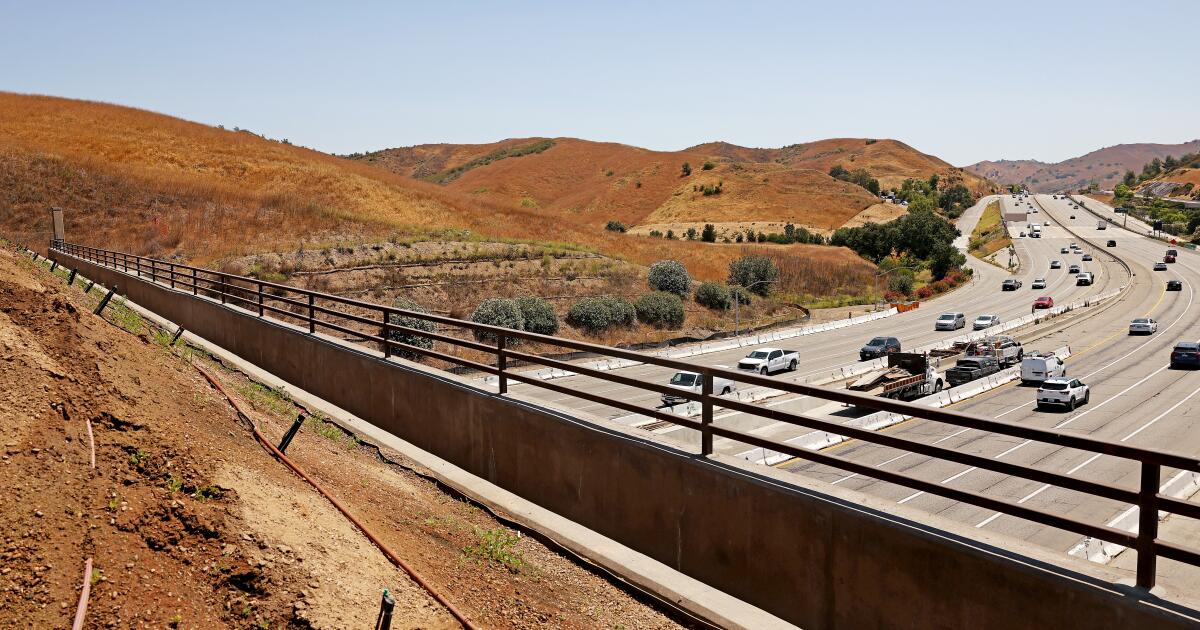
When you’re trying to build a mountain over one of the country’s busiest freeways, it’s easy to be envious of original creation stories, when natural spaces were formed with just a wave of the hand.
In those stories, there were no overhead wires to bury or water lines to move. There weren’t vehicles to divert, underground creeks that required stabilization, majestic oaks that had to be saved or soils that required inoculation with local microbes.
But such are the looming challenges for the designers and builders of the Wallis Annenberg Wildlife Crossing, the world’s largest and most ambitious crossing designed to give wildlife a safe and nature-mimicking passage over the 10-lane 101 Freeway in Agoura Hills.
The crossing structure itself is mostly completed — except the planting, which will happen this fall — but it’s basically a bridge to nowhere right now, squatting over the freeway just west of the Liberty Canyon Drive offramp. (Although — news flash! — even though it’s not connected to the neighboring hills, the first non-insect wildlife was spotted on the bridge last week: a Western fence lizard basking at the top, roughly 75 feet above the traffic below.)
The second and final phase is installing the connectors — the structure’s shoulders that will permit freeway-fragmented wildlife to easily cross between the Santa Susana Mountains to the north and the Santa Monica Mountains to the south.
Expanding the areas where wildlife can safely roam will increase their chances of finding mates while improving the health and genetic diversity of everything from lizards to mountain lions like P-22, whose lonely life in Griffith Park helped inspire the crossing.
This second phase is the trickiest part of the project, especially the south-side connection over Agoura Road, according to Robert Rock, chief executive of Chicago-based Rock Design Associates and the landscape architect overseeing the $92.6-million project.
The Wallis Annenberg Wildlife Crossing connector to the south will be supported by a tunnel over Agoura Road, which will roughly be located between the two white trailers in the photo and then threaded (as much as possible) around the small grove of mature oak trees into the Santa Monica Mountains beyond.
(Jeanette Marantos)
Work on the south side requires burying overhead wires near the site, moving water lines for the Las Virgenes Municipal Water District, stabilizing an underground creek (dubbed No-Name Creek) that runs under the tunnel site to prevent erosion and then driving two walls of pilings deep into the ground for 175 feet along Agoura Road to build the 54-foot-wide tunnel that will span the road.
Once the tunnel is constructed and the concrete roof is poured, workers will literally be moving a small mountain of soil from the north side of the freeway, where it was piled when this stretch of the 101 was constructed in the 1950s, to cover the tunnel and create the sloping connecting shoulder into the Santa Monica Mountains.
The final work will be planting more native shrubs, perennials and trees on the shoulders and adding two miles of galvanized steel fencing on either side of the crossing to funnel animals over the crossing and away from human-made roadways and homes.
Easy peasy, right? Except for one more detail — they have to do all this building and earth moving without disturbing a sprawling grove of native oak trees growing around the site.
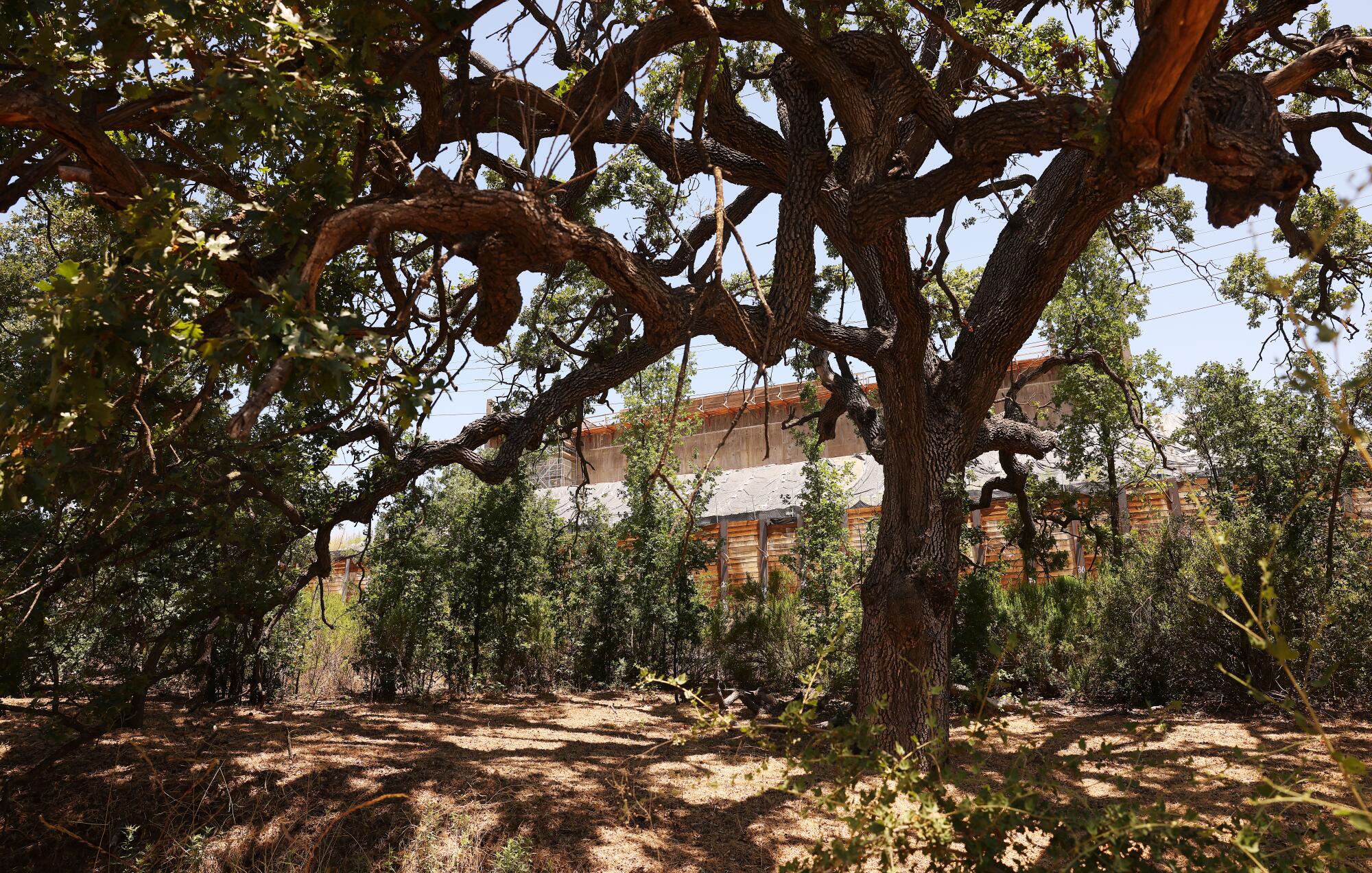
The designers plan to thread their way through the small grove of mature oaks on both sides of Agoura Road to preserve as many of the mature trees as possible when building the south shoulder of the crossing over the road and into the Santa Monica Mountains.
(Christina House / Los Angeles Times)
“It’s a tricky pocket,” said Rock. “We’re definitely threading a needle.”
Some of the smaller trees may have to be removed, he said, but the designers are doing everything they can to maintain the native trees growing around the site. Not surprising, because the whole project has focused on re-creating nature as much as possible on a foundation of concrete and steel, with native plants grown from seeds collected within a three-mile radius of the project and soil specially inoculated with local fungi and microbes to enhance their growth. The plants are being tended at the project nursery a few miles from the site.
C.A. Rasmussen Inc., the Valencia-based contractor who built the first phase of the project, has won the bid to do the second stage as well, said Rock. Weather delays — primarily from heavy rains in 2022 and 2023 — have pushed the crossing’s final completion date to the end of 2026. The state of California has provided $58.1 million of the $92.6-million project, as part of its “30 by 30” goal to conserve 30% of the state’s lands and coastal waters by 2030. The rest of the funds are coming from private donations.
Work on the final phase is expected to begin next week. Much of the prep work and tunnel construction will require at least a partial closure of Agoura Road, but the builders have to give 30-days notice before the closures begin.

Artist renderings of how the tunnel over Agoura Road and the Wallis Annenberg Wildlife Crossing will look to the south, heading toward the Santa Monica Mountains, when the crossing is completed at the end of 2026. The top view is facing east on Agoura Road, the bottom view is looking west.
(Rock Design Associates and National Wildlife Federation)

(Rock Design Associates and National Wildlife Federation )
The specific closure hours are still being negotiated with the city of Agoura Hills, but Rock said he expects Agoura Road will be only partially closed to vehicle and bike traffic during daytime hours, when the contractor will be working. The closures are expected to begin in early August, and last for “several months,” he said.
“I can’t really say [how long] beyond several months’ worth of impacts,” he said, “but I hope we can be done by the end of the year.”
A few plants are already beginning to grow on the main structure, from a special cover crop of four native plants hand-sown in the spring — golden yarrow (Eriophyllum confertiflorum), California poppy (Eschscholzia californica), giant wildrye (Elymus condensatus) and Santa Barbara milk vetch (Astragalus trichopodus), chosen because they best flourished with the mycorrhizal fungi and other microbes added to the soil.
Last week, at least one invasive black mustard plant was also visible on the crossing — not surprising since the surrounding hills were lush with the fast-growing, easily spread mustard earlier this spring — but contractors are supposed to keep those invasive plants weeded out, Rock said, to give the natives a chance to get established.
Hundreds of native plants that were grown from seed in the project’s nearby nursery will be planted on the crossing this fall, probably in October, said Beth Pratt, California regional executive director of the National Wildlife Federation and leader of the Save LA Cougars campaign, who is overseeing funding and fundraising for the project.
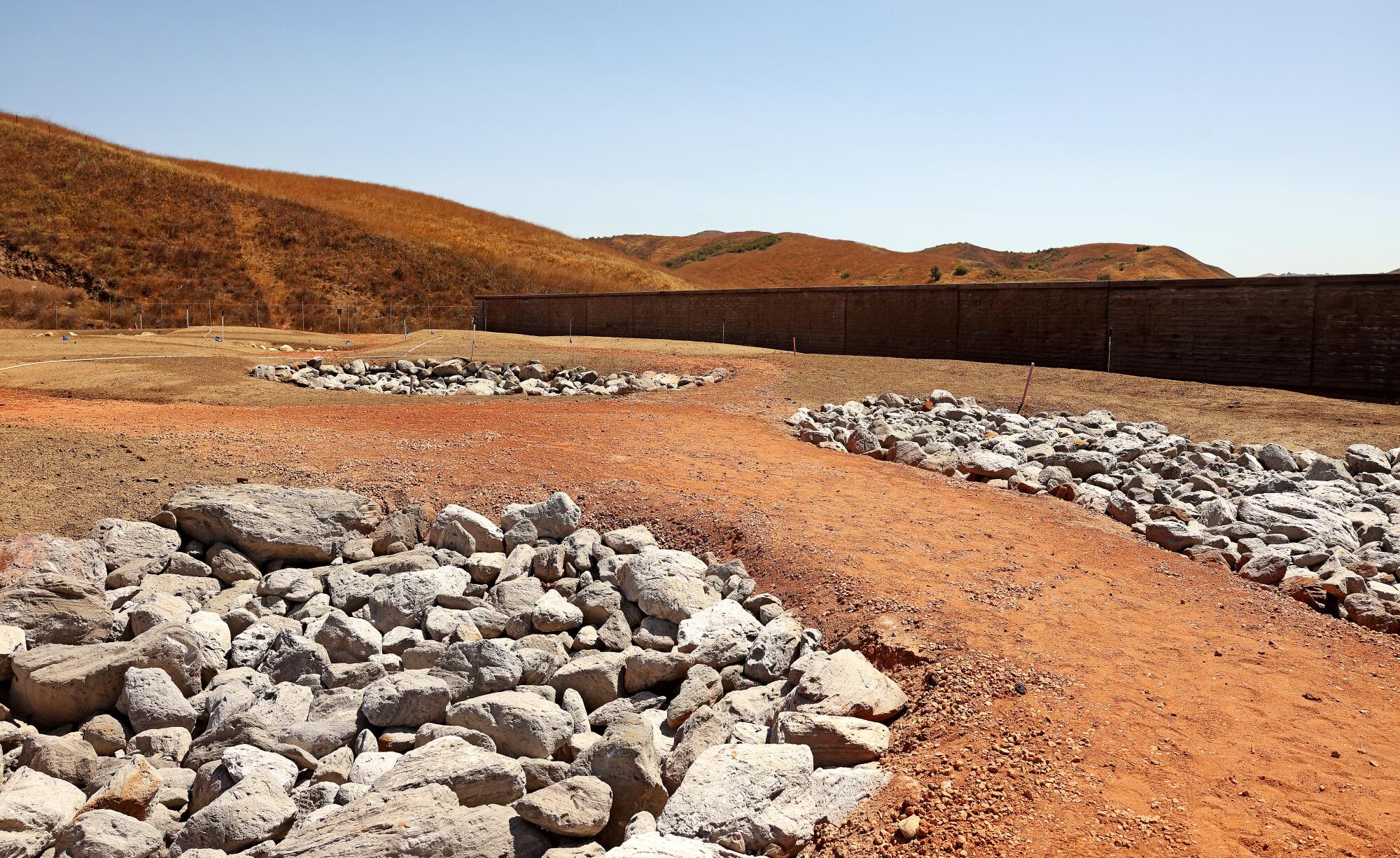
The top of the Wallis Annenberg Wildlife Crossing resembles a reddish Marscape now, although a cover crop of native plants — California poppy, giant wild rye, Santa Barbara milk vetch and golden yarrow — hand sown from seed this spring are starting to emerge. Hundreds of larger native shrubs and perennials, grown from seed in the project’s nearby nursery, will be planted on the crossing in October.
(Christina House / Los Angeles Times)
Save LA Cougars is selling a blend of six native seeds provided by Pacific Coast Seed (formerly S&S Seed) for people who want bragging rights to growing six of the native plants that will feature prominently on the crossing — common deerweed (Acmispon glaber var. glaber), ashyleaf buckwheat (Eriogonum cinereum), showy penstemon (Penstemon spectabilis), black sage (Salvia mellifera), narrow leaf milkweed (Asclepias fascicularis) and foothill needlegrass (Stipa lepida)
You can order a packet of the souvenir seeds online for $10. Proceeds will support the project’s nursery, which is featured in a new Save LA Cougars video explaining how all the crossing’s native plants, soils and compost have been chosen and nurtured.
In the meantime, the recent tariffs have added a new funding concern for the project. It’s not clear yet if the project will need to do more fundraising to cover all the increased costs, Pratt said.
“Robert [Rock] and CalTrans have been working around the clock to redesign and value-design to get the costs down, which is why we’re able to proceed [with Stage 2],” Pratt said. “The team work has been extraordinary.”
It’s possible they may need to raise more money to cover final expenses like the two miles of extra-tall fencing that Rock estimates will cost around $2 million, but right now, Pratt said, the design adjustments seem to have contained the extra costs. “They got them down again, so I think we’re home free.”
Meanwhile, while all these human issues are unfolding, somewhere on top of the unfinished crossing that Western fence lizard appears to be making a home, even though the naked terrain looks like a moonscape right now. Pratt was leading a small group of visitors when she spotted the little reptile, and it took her a moment to process its import.
“I see Western fence lizards all the time in my yard and they are everywhere — one of the most common animals you will see in California,” Pratt wrote in an email. “But then it hit me, ‘Wait. This lizard is on the bridge!!!!! And this is the first animal I have seen on the bridge!!!!’ I stopped the group … and told them — ‘You are seeing the first animal on the crossing itself.’ Everyone cheered. Even the lizard seemed to know it was a special occasion. He posed for the photos I took.”




Karen McNenny is a certified divorce coach, certified co-parenting specialist and author of the book The Good Divorce: How to End Your Marriage Without Ending Your Family.
Wiley/Jossey-Bass/NPR, Nicole Wickens/NPR
hide caption
toggle caption
Wiley/Jossey-Bass/NPR, Nicole Wickens/NPR
When Karen McNenny was facing divorce about 15 years ago, she was afraid of what it would mean for her future: despair, debt and a lifetime of resentment, she says.
At the same time, she was thinking of her two children, she says. She didn’t want their father to become her enemy.
So she and her former husband chose to approach divorce differently as a couple. “We’re going to renovate and transform this family. We’re not going to destroy it,” she says. “The marriage is ending, not your relationship.”
For McNenny, a mediator, certified divorce coach and certified co-parenting specialist, divorce is a tool, not a weapon. She expands on this concept in The Good Divorce: How to End Your Marriage Without Ending Your Family, which came out this spring. The book offers guidance on how to maintain compassionate and respectful ties with a former spouse while also healing and moving forward.
According to Pew Research Center, a third of Americans who have ever been married had a first marriage that ended in divorce. For that reason, McNenny hopes her book becomes a must-read for couples before they get married. “The best time to talk about divorce is before you need to talk about it,” she says.
She shared insights from her book in a conversation with Life Kit. This interview has been edited for length and clarity.
The book is called The Good Divorce. What does that mean?
[For those with kids,] the good divorce is about protecting the future of the family while we dissolve the marriage.
After the paperwork is done and the assets have been divided, can you and your co-parent sit on the same side of the bleachers during the basketball game? Can you still see yourselves as a partnership, with the ability to have thoughtful conversations about your kids?
For those who don’t have kids, [the good divorce is] about protecting your health — your mental health and your physical health. If we are doubling down with resentment and bitterness, all of that gets stored in the body and shows up in different ways. You deserve a pathway that’s less destructive.
Let me also be clear: There are times when an amicable, collaborative process is not possible and maybe even inappropriate. For instance, where there’s active addiction, abuse, domestic violence, coercion or unmanaged mental health issues.
How do you get to a place where you don’t feel triggered by your partner, so you both can work together toward a good divorce?
That, my dear, does not happen overnight. That is more like a dimmer switch going up and down and up and down, and the gift of time helps to get there.
It’s a complex emotional journey because we do feel relief in walking away from our spouse and the challenges. But with it, there is extraordinary grief that comes with divorce that I think is often underestimated and undersupported.

If my spouse had died, people would’ve been checking in with me regularly. I never would’ve spent a holiday alone in that first year. There probably would’ve been a meal train.
But he didn’t die. My marriage died, my family structure died, my identity as a wife and a partner died. There’s so much grief through these transformations that come with divorce that we don’t see.
So supporting friends in all those ways that you would as if there had been an actual death is doing a lot for your friends who are going through divorce.
How do you let your friends, family and community know that you’re getting a divorce and that you might need support?
Put a communication strategy together. It’s not just for how we tell the kids. It’s also a communication strategy for the grandparents; to the circle of support around the kids, like teachers, coaches and mentors; and our shared community.
It’s extraordinary when a couple can write that message together, not unlike a marriage announcement. [You might say:] We’ve made a really difficult decision. We wanted to let you know. We’re not going to court. Don’t expect a battle. Please don’t ask us why. Just ask us how we’re doing. We’re on the same side as the kids. You don’t need to pick sides.
In doing so, we’ve given everyone the same information at once. It’s a unified message that comes from the parent team, and it allows your community to know how best to support you. And it takes out all the gossip and wonder about what is going on.
If you have kids and they’re splitting time between two homes, what are some ways to make that change easier for them?
Our kids were 5 and 7 when we divorced, so it was three or four nights at a time in each home. By the time they got to be about 8 or 10, it made sense to go a week in each residence. After COVID, the kids came to us and said, “Can we just have two weeks in a house? We wanna be able to settle in more.” [So we said] OK.
A lot of parents are so rigid about the schedule. There’s no flexibility. That doesn’t serve anyone. So I recommend liberating yourselves from the calendar and letting it grow and bend with your kids appropriately.
Knowing what you know now about divorce, what questions do you think couples should ask themselves before they get married?
So often when people arrive at the threshold of divorce, couples are like, “We don’t know what we’re doing.” Get educated about the business part of it.
There is no harm in having a prenuptial agreement. Even if you decided not to file it, have the conversation about the implications. What does it mean if we buy this house together? What does it mean if one of us works more and one of us works less?
We also underestimate what it means to be roommates. What are your value systems around cooking and cleaning? How much alone time do you need? It’s easy to fall in love and not know if you’re compatible.
Do you think you’d get married again?
I absolutely hope that I get to say yes to a lifelong commitment with a partner, as I believe we often are given the opportunity to become a better version of ourself through partnership.
The story was edited by Meghan Keane. The visual editor is CJ Riculan. We’d love to hear from you. Leave us a voicemail at 202-216-9823, or email us at LifeKit@npr.org.
Listen to Life Kit on Apple Podcasts and Spotify, and sign up for our newsletter. Follow us on Instagram: @nprlifekit.

In Alice and Steve, Jemaine Clement and Nicola Walker play long-time friends who turn on each other after he gets involved with her 26-year-old daughter.
Lara Cornell/Disney+
hide caption
toggle caption
Lara Cornell/Disney+
I grew up watching episodic shows on network TV, nearly all of them formulaic but some indelibly great. Then, like everyone else, I moved into the days of what my colleague David Bianculli dubbed Platinum TV, where series like The Sopranos and The Wire and Fleabag aspired to something higher. What both these eras had in common was that their shows were carefully crafted — they had an internal logic, and a tone, that held them together.
In recent years, though, there’s been a proliferation of shows that, possibly obeying some algorithm, care less for coherence than sensation. They lurch among tones, from cuteness to sentimentality to meanness, stirring in random plot twists along the way. Bouncing all over the emotional map, these shows depend on compelling actors and a few memorable scenes to make us overlook their loose construction.
A great example is Alice and Steve, an entertaining but sometimes exasperating six-part British comedy on Hulu about two 50-something best friends who turn on each other after he gets involved with her 26-year-old daughter.


While the premise is juicy, it’s also a tad yucky, and I mainly tuned in because its title characters are played by performers Jemaine Clement from Flight of the Conchords and Nicola Walker, whom I’ve raved up on this show more than once.
The series starts poorly with Steve and Alice going on a cutesy bender after a friend’s funeral. Now, I always hate drunk scenes, which are an invitation to overact. As Clement and Walker bray their lines, we learn that Steve’s a divorced celebrity hair stylist who can’t find a girlfriend while Alice is a clothes designer with a doting younger husband, nicely played by Joel Fry, a sweetie-pie of a teenage son — that’s Tyrese Eaton-Dyce — and, of course, that 26-year-old daughter, Izzy, who has inherited her mother’s willfulness. Played by Yali Topol Margalith, Izzy kickstarts the plot by flirting with Steve. Predictably, he succumbs.

Almost immediately, they think they’re in love. While the weak-willed Steve wants to hide their romance — he knows it’s inappropriate — Izzy just blurts out the facts to her mom. Alice flips. And from hereon out in this series where the women are as alpha as the men are hangdog, Alice drives the action. Betrayed and violently angry, she’ll do whatever it takes to break them up — no matter who gets hurt. Her antics unleash Steve’s own malice. We’re in Beef territory.
At its core, Alice and Steve hinges on the way that platonic friendships are often richer and more powerful than romantic ones. It’s a fascinating subject, which may be why I found the script by Sophie Goodhart so frustrating. I wanted her to dig deeper. While the show’s got some very funny bits — Alice’s sharp-tongued mother is a blast — it’s often annoyingly lax.

If Steve really does the hair of Charli XCX, how come he’s a clueless older guy whose pop culture references are Willie Nelson and Woody Allen? If Izzy truly adores her mother as she claims, why does she keep rubbing her relationship with Steve in her mom’s face? Halfway through, one character nukes the other’s career, but this life-shattering event has no real weight: It’s barely even mentioned for the rest of the series.
That said, Alice and Steve is worth seeing for scenes like the one in which Steve spinelessly sells Izzy out or the lacerating discussion between Alice and her husband when he fully grasps that he adores a woman who views him as a reliable but dull concierge, not a man she likes hanging with. Most touching of all may be the lovely sequence when Alice, wise for once, smooths a romantic crisis between her son and his would-be girlfriend, a pair who are the show’s emblem of hope. For once, we understand why people love her.

While most viewers will find Steve more likable than Alice — the show takes pains not to make him appear predatory or creepy — the role doesn’t give Clement a whole lot to do except play variations on shambolic dread and discomfort. The show gets its galvanizing zing from Walker, a beloved star in England with amazing, luminous eyes. Her Alice is the kind of complicated, volcanic heroine that you don’t see in movies and rarely see on TV, one who shows her apocalyptic rage freely and in many different forms.
At least once in every episode, something would lead me to say, “Man, is this show a mess.” But that wasn’t a deal breaker. I kept watching. After all, life is messy, too.


How to enter your Sporty Spice era.
Getty Images/quantic69/Olga Kurbatova/Anastasiia Zvonary/Photo Illustration by NPR
hide caption
toggle caption
Getty Images/quantic69/Olga Kurbatova/Anastasiia Zvonary/Photo Illustration by NPR
Reality dating and professional sports are not as different as you’d think.
Brittany is in her Sporty Spice era – she watched the NBA playoffs, she’s following World Cup games, and she’s watching the New York Liberty play their WNBA season. These games are daily – and so is the reality dating show Love Island. And she noticed that the two formats are not very different at all. Defector.com staff writer and co-owner Kelsey McKinney came to the same conclusion – so the two of them discuss why these games of athleticism and love can bring us together… and why they get valued differently in our culture.
For more episodes on sports and reality TV, check out:
Get rich or die trying: how sports betting is changing our love of the game
Is this the end of reality TV?
The ugly truth of America’s expensive homes
Support Public Media. Join NPR Plus.
Follow Brittany on Instagram: @bmluse
This episode was produced by Liam McBain. It was edited by Neena Pathak. Our Supervising Producer is Cher Vincent. Our Executive Producer is Barton Girdwood. Our VP of Programming is Yolanda Sangweni.
-

 Mississippi5 minutes ago
Mississippi Lottery Mississippi Match 5, Cash 3 results for July 6, 2026
-
Missouri8 minutes ago
Missouri teachers push back on governor’s A-F school grading plan
-

 Montana13 minutes ago
The Record is Clear: The Wilderness Society, Greater Yellowstone Coalition, and Montana Wilderness Association have Consistently Undermined the Roadless Rule
-

 Nebraska20 minutes ago
Pine-Richland receiver Khalil Taylor pulls hat trick, picks Nebraska over Penn State
-

 Nevada23 minutes ago
Nevada Youth Sports estimates $250K in damage after Fourth of July firework fire
-

 New Hampshire28 minutes ago
Suspected gunman in Hampton Beach shooting was in U.S. Navy
-

 New Jersey35 minutes ago
I took my kids to this New Jersey hotel and stopped making fun of the state (for now)
-

 New Mexico37 minutes ago
Storm chances continue all week for parts of New Mexico

