Politics
Trump admin secures pledge from 75% of health insurers in bid to improve patient care


NEWYou can now listen to Fox News articles!
Roughly three-quarters of the nation’s health insurance providers signed a series of commitments this week in an effort to improve patient care by reducing bureaucratic hurdles caused by insurance companies’ prior-authorization requirements.
Director of the Centers for Medicare and Medicaid Services, Dr. Mehmet Oz, alongside Health and Human Services Secretary, Robert F. Kennedy Jr., announced the new voluntary pledge from a cadre of insurance providers, who cover roughly 75% of the population, during a press conference Monday. The new commitments are aimed at speeding up and reducing prior-authorization processes used by insurers, a process that has been long-maligned for unnecessarily delaying patient care and other bureaucratic hurdles negatively impacting patients.
“The pledge is not a mandate. It’s not a bill, a rule. This is not legislated. This is a opportunity for industry to show itself,” Oz said Monday. “But by the fact that three-quarters of the patients in the country are already covered by participants in this pledge, it’s a good start and the response has been overwhelming.”
A NEW LAW IN THIS STATE BANS AUTOMATED INSURANCE CLAIM DENIALS
Health insurance companies representing roughly 75% of patients in the U.S. signed an industry-led pledge this week aimed at improving patient care through streamlining the long-maligned prior-authorization process used by insurance companies to ensure patients are receiving appropriate care. (Getty Images; AP; iStock)
Prior-authorization is a process that requires providers to obtain approval from a patient’s insurance provider before that provider can offer certain treatments or services. Essentially, the process seeks to ensure patients are getting the right solution for a particular problem.
However, according to Oz, the process has led to doctors being forced to spend enormous amounts of man-power to satisfy prior-authorization requirements from insurers. He noted during Monday’s press conference that, on average, physicians have to spend 12 hours a week dealing with these requirements, which they see about 40 of per week.
“It frustrates doctors. It sometimes results in care that is significantly delayed. It erodes public trust in the healthcare system. It’s something we can’t tolerate,” Oz insisted.
DR. OZ SAYS TAXPAYERS FOOTING $14 BILLION BILL FOR MEDICAID FRAUD WHILE ELIGIBLE PATIENTS STRUGGLE FOR CARE
Dr. Mehmet Oz, the director of the Centers for Medicare and Medicaid Services, said during a press conference Monday announcing the new industry-led pledge, that the new commitments will significantly improve patient access to care. (Anna Moneymaker/Getty Images)
The pledge has been adopted by some of the nation’s largest insurance providers, including United Healthcare, Cigna, Humana, Blue Cross & Blue Shield, Aetna and many more. While the industry-led commitments aim to improve care for patients, it could potentially eat into their profits as well if patients start seeking care more often.
The commitments from insurers cemented this week include taking active steps to implement a common standardized process for electronic prior-authorization through the development of standardized submission requirements to support faster turnaround time. The goal is for the new framework to be operational by Jan. 1, 2027.
Another part of the pledge includes a commitment from individual insurance plans to implement certain reductions in its use of medical prior-authorization by Jan. 1, 2026. On that date, if patients switch insurance providers during the course of treatment, their new plan must honor their existing prior-authorization approvals for 90-days while the patient transitions.
DR. OZ UNPACKS POSSIBLE WORK REQUIREMENTS FOR MEDICAID
Prior-authorization is a long-criticized process that critics have argued blocks patients’ access to care. (iStock)
Transparency is also a key part of the new commitments from insurance providers. Health plans enjoined with the commitments will pledge to provide clear and easy-to-understand explanations of prior-authorization determinations, including guidance for appeals. The commitment also states that by 2027, 80% of electronic prior-authorization approvals from companies will be answered in real-time.
Oz, during the Monday press conference, compared the industry-led pledge to the Bible, saying, “The meek shall inherit the earth.”
“I always grew up thinking ‘meek’ meant weak, but that’s not what meek means. ‘Meek’ means you have a sharp sword, a sword that could do real damage to people around you, but you decide, electively, to sheathe that sword and put it away for a while, so you can do goods, so you can do important things where once in a while we have to get together, even if we’re competitors, and agree,” Oz said Monday.
“That’s what these insurance companies and hospital systems have done,” he continued. “They have agreed to sheathe their swords to be meek for a while, to come up with a better solution to a problem that plagues us all.”


NEWYou can now listen to Fox News articles!
President Donald Trump said Tuesday he plans to lift U.S. sanctions on Turkey and signaled he is prepared to move forward with the long-stalled sale of F-35 stealth fighter jets, marking a dramatic reversal in U.S. policy toward the NATO ally years after Ankara was expelled from the program for its purchase of a Russian missile defense system.
Speaking alongside Turkish President Recep Tayyip Erdoğan during a bilateral meeting at the NATO summit in Ankara, Turkey, Tuesday, Trump said his administration would remove sanctions imposed on Turkey’s defense sector.
“I can tell you we’re going to be taking the sanctions off, OK?” Trump said. “I don’t want him to waste his time answering that question. It’s time. We don’t sanction friends.”
TRUMP BETS ON FORMER NATO TROUBLEMAKER AS TURKEY’S STRATEGIC VALUE SURGES
Turkish President Recep Tayyip Erdogan welcomes US President Donald Trump at Ankara Airport, who is paying an official visit to Turkey ahead of the 36th NATO Heads of State and Government Summit in Ankara, Turkey, on July 07, 2026. (Dogukan Keskinkilic/Pool via REUTERS)
Asked whether he would sell F-35 fighter jets to Turkey despite existing legal restrictions tied to Ankara’s purchase of the Russian-made S-400 air defense system, Trump indicated he was open to doing so.
“Many people, including the people sitting right here thinks why wouldn’t we do that?” Trump said. “Turkey has been in many ways much more loyal than other countries that we think would be loyal.”
Pressed on concerns about Turkey’s continued possession of the S-400, Trump dismissed them.
“I have no concerns about anything.”
The remarks represent Trump’s clearest indication yet that he intends to restore defense ties with Turkey, building on months of efforts to revive military cooperation with one of NATO’s largest armed forces after years of strained relations.
Turkey was removed from the multinational F-35 program in 2019 after taking delivery of the Russian-made S-400 air defense system, prompting Washington to argue that operating the Kremlin-built system alongside America’s most advanced stealth fighter could expose sensitive U.S. technology. Congress subsequently imposed sanctions under the Countering America’s Adversaries Through Sanctions Act, or CAATSA.
‘WRITTEN IN OUR DNA’: POLISH PILOTS WHO REMEMBER SOVIET RULE PREPARE FOR AMERICA’S MOST LETHAL FIGHTER JET
Congress long has been one of the biggest obstacles to restoring Turkey’s access to the F-35, with bipartisan lawmakers arguing that Ankara should not receive America’s most advanced fighter aircraft while it continues to possess the Russian-made S-400 air defense system and pursues policies they say run counter to U.S. interests.
A U.S. airmen watches an Air Force F-35 Lightning II joint strike fighter aircraft approach for the first time on July 14, 2011 at Eglin Air Force Base in Florida. (Samuel King Jr./U.S. Air Force)
Beyond political opposition, the Trump administration also faces legal hurdles.
While the president has authority over sanctions policy, Congress enacted additional restrictions after Turkey’s purchase of the S-400. Section 1245 of the fiscal year 2020 National Defense Authorization Act bars the transfer of F-35 aircraft to Turkey unless the executive branch certifies that Ankara has met statutory requirements related to the Russian missile system.
In recent days, a bipartisan group of House lawmakers urged Trump not to move forward with an F-35 sale, arguing that doing so without satisfying those legal requirements would violate U.S. law and undermine national security.
Lawmakers also have warned that Turkey’s continued possession of the S-400, support for Hamas and tensions with fellow NATO allies Greece and Cyprus raise broader concerns about restoring Ankara’s access to the stealth fighter.
Russian S-400 missile air defence systems are seen before the military parade to commemorate the 75th anniversary of the battle of Stalingrad in World War Two, in the city of Volgograd, Russia February 2, 2018. REUTERS/Tatyana Maleyeva – UP1EE220T3A2B
CLICK HERE TO DOWNLOAD THE FOX NEWS APP
The Pentagon has maintained that the S-400’s sophisticated radar could collect data on the F-35’s radar signature and electronic profile during routine operations, potentially allowing Russia to better detect and defeat the aircraft in a future conflict if that information were shared with Moscow.
When the Trump administration removed Turkey from the F-35 program in 2019, the White House said “the F-35 cannot coexist with a Russian intelligence collection platform that will be used to learn about its advanced capabilities.”
Pentagon acquisition chief Ellen Lord similarly warned at the time that allowing Turkey to operate both systems would jeopardize the long-term security of the F-35 program because “much of the F-35’s strength lies in its stealth capabilities.”
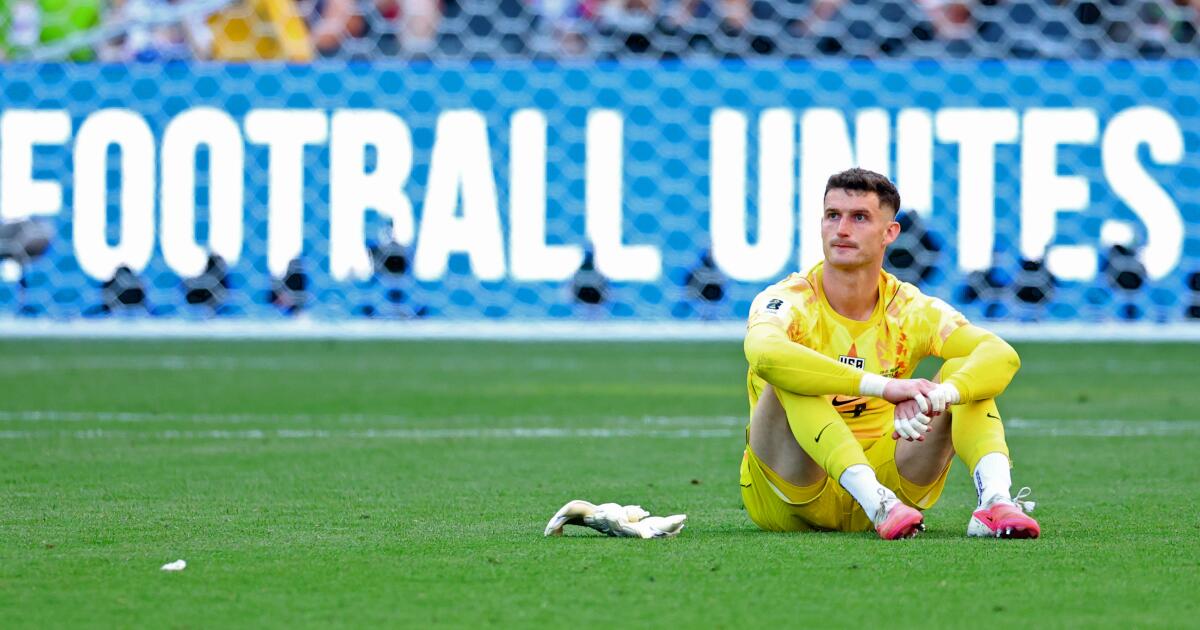
SEATTLE — Is everybody happy now? You good, Mr. President?
Put our boys in a blender, President Trump did, with those phone calls to FIFA President Gianni Infantino. Messed with their mojo by politicking to get American striker Folarin Balogun’s red card rescinded.
We’ll have to check VAR, but it might be the first time Trump succeeded at having a decision overturned.
Probably because this time what he sought to overturn — discipline stemming from Balogun’s accidental contact in the United States’ victory over Bosnia and Herzegovina — actually was unjust. Balogun should not have received a red card.
The problem is, having our President butt in here was a joke. Unfunny and out of bounds, offsides, an own goal — all of the things.
It put the U.S. team at the center of a geopolitical maelstrom, which is exactly what they did not need in the hours before the biggest match of their lives and the biggest match in the history of the U.S. men’s soccer program.
Some 40 or 50 million viewers were expected to tune in; how many of them watched for the first time? And what sort of impression did Monday’s 4-1 blunder-filled meltdown against Belgium make? That we stink at soccer — still?
If you were one of them, please, believe your soccer-fan friends when they tell you the Americans played much better in previous matches.
But so much for a magical run. On their home turf, the Americans pulled up lame before the finish line (aka, for the U.S. team’s purposes, its first quarterfinals since 2002).
To their credit, after the debacle, members of the U.S. team didn’t complain about anything being rigged. They didn’t use the distraction as an excuse. And they didn’t point fingers at anyone — anyone at all.
U.S. striker Folarin Balogun (20) walks to the locker room at halftime against Belgium in the World Cup on Monday at Lumen Field in Seattle.
(Allen J. Schaben / Los Angeles Times)
“We’re playing on home soil,” defender Chris Richards said. “So the only pressure we put on ourselves is to perform for our country, and ultimately didn’t feel the way we wanted to today. But I don’t think the antics of the last 24 hours had anything to do with it.”
No, they said the “debate,” or “outside noise” or “political manipulation” — as Tim Ream, Alex Freeman and coach Mauricio Pochettino described what others are calling “Balogate” — were not to blame for the gut-punch that answered the question: Why not us?
Because the U.S. is not yet good enough to beat the world’s great teams. Especially not when their pregame preparation includes having to try to block out an international uproar.
To have any hope against the Belgians in the round of 16 — a matchup between FIFA’s Nos. 9- and 17-ranked sides — the Americans needed to be going full-tilt, to be focused and ferocious and probably also a little bit lucky.
Instead, they looked shook, rattled. And they got rolled.
They were the worst version of themselves at the worst time, which was so weird from a team that had been on its front foot from the first whistle against Paraguay.
Not Monday. Against Belgium, they were on their heels from the outset. Heavy touches, slow afoot, playing like they had the weight of the World Cup on their shoulders.
And all that White House maddening meddling — for what?
Balogun started and played most of the match, but it could just as well have been reserve striker Ricardo Pepi. Or you or me, Balogun was that ineffective.
His play of the day came postmatch, when he approached Belgian coach Rudi Garcia and the two had a respectful exchange. A real diplomat, that Brooklyn-born, Britain-raised American by birthright.

This loss was a real team effort, of course. Christian Pulisic came off in the 59th minute after twisting his right ankle — leaving this World Cup without a goal in the four matches he appeared.
Matt Freese, the Harvard-educated starting goalkeeper, had a brain cramp of epic proportions when he stepped outside of the box and failed to corral a ball. Belgium’s Charles De Ketelaere kicked it loose and set up Hans Vanaken, whose shot traveled behind Ream for an easy score that made it 3-1 in the 57th minute.
There was a lot of poor decision-making with this match, on and off the pitch.
In the end, Trump’s appeal to Infantino did more harm than good. But what if some good could come from it?
Hey, FIFA, what about giving teams a process to appeal cards, like our American athletes in the NBA, NFL and MLB have?
Offering a suggestion box wouldn’t be opening Pandora’s box, not if it were a transparent and regular part of the game that would, hopefully, offer increasingly fair outcomes in a tournament where every match is so monumental — as our President recognized, much too enthusiastically.

U.S. coach Mauricio Pochettino waves to the crown after a 4-1 loss to Belgium at the World Cup on Monday.
(Allen J. Schaben / Los Angeles Times)
Prosecutors on Monday began laying out their case against the man accused of murdering Charlie Kirk. It was the first day of a weeklong preliminary hearing that will determine whether or not there is enough evidence against the accused killer to stand trial.
-

 Seattle, WA5 minutes ago
Disappointment on the field, but momentum on the streets
-

 San Diego, CA8 minutes ago
Community Calendar: La Jolla meetings and more, July 9-17
-

 Milwaukee, WI13 minutes ago
Opinion: Milwaukee teachers have more to give. Let’s give them the chance. | Milwaukee Neighborhood News Service
-

 Atlanta, GA20 minutes ago
Maryland kidnapping suspect taken into custody in Georgia
-

 Minneapolis, MN22 minutes ago
Man sentenced to federal prison for armed robberies of St. Paul bank, Minneapolis Walgreens
-

 Indianapolis, IN28 minutes ago
Advocates say new public camping ban criminalizes homelessness
-

 Pittsburg, PA35 minutes ago
Allegheny County park with 200-year-old trees joins network of
-

 Augusta, GA38 minutes ago
Local service members get more chances to expand their education

