Connect with us

News

Japan scraps US meeting after Washington demands more defence spending

Published

on

Japan scraps US meeting after Washington demands more defence spending

Unlock the White House Watch newsletter for free

Japan has cancelled a top-level meeting with the US after the Trump administration abruptly told Tokyo to spend more on defence, sparking anger in Washington’s closest Asian ally.

US secretary of state Marco Rubio and defence secretary Pete Hegseth were due to meet Japan’s defence minister Gen Nakatani and foreign minister Takeshi Iwaya in Washington on July 1 for annual security talks known as the “2+2”.

But Tokyo scrapped the meeting after the US asked Japan to boost defence spending to 3.5 per cent, higher than its earlier request of 3 per cent, according to three people familiar with the matter, including two officials in Tokyo.

Advertisement

The new, higher demand was made in recent weeks by Elbridge Colby, the third-most senior official at the Pentagon, and sparked anger in Tokyo.

The tension over security issues comes as the allies hold tough trade talks after President Donald Trump in April imposed “reciprocal” tariffs on Japan.

One senior Japanese official said the decision to cancel the July 1 meeting was also related to the July 20 Upper House elections where the ruling Liberal Democratic party is expected to suffer a loss of seats.

Christopher Johnstone, a former senior US government Japan expert, said Tokyo viewed 2+2 meetings as a “very high priority” because they provided “politically valuable opportunities to showcase the strength of the US-Japan alliance”. He said postponing the meeting until after the Japanese election signalled “significant unease in Tokyo about the state of the bilateral relationship and its outlook”.

“Tokyo appears to have concluded that the political risk of a meeting before the election was higher than the potential gain — a pretty extraordinary assessment, if true,” said Johnstone, partner at The Asia Group, a consultancy.

Advertisement

The friction between Washington and Tokyo comes as the US puts pressure on European and Asian allies to boost defence spending.

Speaking at the IISS Shangri-La Dialogue defence forum in Singapore last month, Hegseth urged Asia-Pacific allies to follow the “newfound example” of Europeans pledging to spend more and cited the threats in the region from China and North Korea.

“The US is now playing hardball with allies in the Asia-Pacific,” said one defence official.

Colby has been at the forefront of that push. In his US Senate confirmation hearing in March, his calls for Tokyo to increase defence spending drew a rebuke from Prime Minister Shigeru Ishiba, who said Tokyo would decide its own budget.

“The Trump administration’s inconsistent and unrealistic message on its expectations for allied defence spending levels in Asia risks backfiring and undermining those officials and experts who are most supportive of the United States in some key foreign capitals,” said Zack Cooper, an Asia security expert at the American Enterprise Institute.

Advertisement

Colby has taken other positions that have raised anxiety among US allies. The Financial Times recently revealed that he was conducting a review of Aukus, the landmark security agreement between the US, UK and Australia designed to help Canberra procure a fleet of nuclear-powered submarines.

The FT also reported in May that he had told European countries that they should focus their militaries on the Euro-Atlantic region and less on the Asia-Pacific. The stance marked a shift from the Biden administration’s push to involve European allies in Asia to send a unified message of deterrence to China.

In another example of the shift, the Trump administration is not pushing Nato allies to reference the Indo-Pacific in the communiqué at the alliance’s summit in The Hague next week.

At the 2024 summit, members said the Indo-Pacific was “important for Nato”. But three people familiar with the draft of the communiqué that will be released next week said it did not mention the region.

Former president Joe Biden had invested heavily in securing the language, arguing that the European and Indo-Pacific theatres were linked.

Advertisement

Japan’s defence ministry did not comment on whether the talks had been cancelled, and said no decision had been made on the timing of the next meeting. The state department and Pentagon did not comment.


News

DOJ warns of criminal charges for state election officials if noncitizens vote

Published

on

DOJ warns of criminal charges for state election officials if noncitizens vote

The Justice Department sent letters warning election officials in all 50 states and the District of Columbia that they could face criminal prosecution over noncitizen voting, a spokesperson for the Justice Department confirmed Tuesday.

The letters, signed by Assistant Attorney General Harmeet Dhillon, who heads up the department’s Civil Rights Division, give states five days to explain how they will comply with federal voter eligibility laws and how they will maintain “clean voter lists.”

Advertisement

“The Department sent these letters to all 50 states and the District of Columbia, asking for voluntary compliance in a timely manner with their obligations under federal law to ensure only citizens vote in federal elections,” a Justice Department spokesperson said in a statement.

Noncitizen voting in federal elections is extremely rare, but Trump and his administration have falsely portrayed it as a widespread issue.

Michigan Secretary of State Jocelyn Benson, Nevada Secretary of State Francisco Aguilar and Utah Lt. Gov. Deidre Henderson are among those who said they received the letters from the Justice Department.

The letters say state election officers “could be criminally prosecuted for aiding and abetting” noncitizen voting. They further specify that any election officer who knowingly retains noncitizens on a statewide voting registration list or who facilitates noncitizens’ receiving and casting ballots could be subject to criminal liability.

“An intentional act that is aimed at diluting the votes of citizens could also constitute a violation” of federal law, the letters said.

Advertisement

Henderson wrote on social media that the threats constitute “truly bizarre behavior.”

“Got another love letter this morning from the DOJ sprinkled throughout with threats of criminal prosecution,” she wrote. “I’m sure I’m not the only chief election officer of a state who is being targeted for following state and federal laws by resisting DOJ’s demands for private voter data that have thus far been ruled illegal by at least a dozen courts.”

The letters are the latest move in the Justice Department’s campaign to assert more federal control over state elections.

While some states have complied with the administration’s demands that they hand over voter roll data, the Justice Department has sued 30 states and Washington, D.C., for resisting. So far, 11 different federal courts have dismissed the Justice Department’s efforts to seize voter rolls.

Advertisement
Continue Reading

News

Reigning champion Argentina escapes with remarkable World Cup victory over Egypt

Published

on

Reigning champion Argentina escapes with remarkable World Cup victory over Egypt

Lionel Messi #10 of Argentina celebrates scoring his team’s second goal during their World Cup match against Egypt in Atlanta on Tuesday.

Elsa/Getty Images


hide caption


toggle caption

Advertisement

Elsa/Getty Images

They looked beaten. And out. Argentina, the defending World Cup champion and No. 1-ranked team, was down 2-0 late against Egypt.

Then, in a span of 13 remarkable minutes, Argentina scored not once, not twice, but three times, capping a comeback for the ages and leaving Egypt stunned and shellshocked.

For much of the game in Atlanta, Egypt was in control, hobbling Argentina early. The Egyptian attack began almost immediately with a stunning header goal delivered by Yasser Ibrahim in the 15th minute. After that, Egypt’s defense closed ranks, making it practically impossible for Argentina to equalize.

Advertisement

It was downhill from there for the Argentines: team captain Lionel Messi failed to convert a penalty kick, and in the 67th minute, Egypt got a second goal from Mostafa Ziko (after an earlier Egyptian goal had been disallowed after a video review). It looked like Argentina was finished. On the brink of elimination.

But no one told the Argentine players that.

In the 79th minute, Lionel Messi began doing his thing. He fired a cross near the Egyptian goal, and Cristian Romero headed it in. Messi was not done. Four minutes later, he powered a shot past the Egyptian keeper. It was his eighth goal of this tournament, the most of any player. The score was 2-2.

Then, in stoppage time, yet another Argentina header and another goal, this time from Enzo Fernandez.

“This is the World Cup for you,” said Messi after the game. “It wasn’t easy to come back from two goals down. But as I always say, this group never gives up. We always try to fight until the end.”

Advertisement
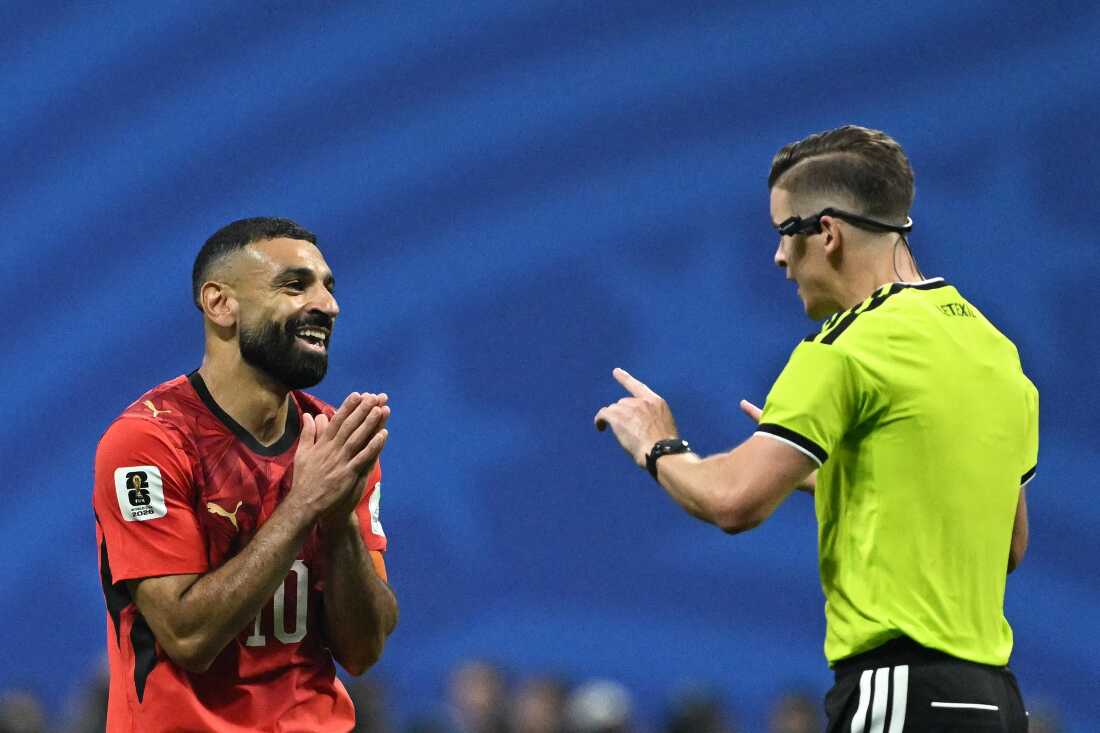
French referee François Letexier speaks with Egypt forward Mohamed Salah during the World Cup Round of 16 match between Argentina and Egypt in Atlanta.

French referee François Letexier speaks with Egypt forward Mohamed Salah during the World Cup Round of 16 match between Argentina and Egypt in Atlanta.

Roberto Schmidt/AFP via Getty Images


hide caption


toggle caption

Roberto Schmidt/AFP via Getty Images

Advertisement

Afterward, Egypt coach Hossam Hassan complained about the French referee and the officiating. “I am not convinced. I am not convinced with this outcome. I’m not convinced with the way things unfolded during this match,” said Hassan in a post-match news conference. “We have been treated unfairly today. We have suffered injustice.”

“We would have deserved to earn this win, but we are leaving with honor, with pride, regardless of this defeat,” said Hossan.

African soccer teams have been the stars of this World Cup. Morocco has yet to lose a game. Cape Verde qualified for the first time in its history and stymied Spain, Uruguay and Saudi Arabia. Argentina barely beat them in a nail-biter of a match.

Continue Reading

News

Top Senate Democrats push Trump-affiliated companies for answers about IRS settlement

Published

on

Top Senate Democrats push Trump-affiliated companies for answers about IRS settlement

Top Senate Democrats are pushing for answers on whether a provision in a controversial settlement agreement between President Trump and his own administration applies to companies co-founded by or affiliated with the Trump family.

As part of a deal struck in May by the Justice Department to resolve a lawsuit brought by Mr. Trump, the Internal Revenue Service is permanently barred from pursuing claims against Mr. Trump, his oldest sons Don Jr. and Eric, and the Trump Organization based on prior tax returns.

In a one-page document signed by Acting Attorney General Todd Blanche and dated May 19, the Justice Department said the defendants in the president’s lawsuit — the IRS and the Treasury Department — are “FOREVER BARRED and PRECLUDED” from “prosecuting or pursuing, any and all claims” arising from tax returns filed before the settlement took effect. Blanche also wrote that the settlement applies to “parties including trusts, parent, sister, or related companies, affiliates, and subsidiaries.”

Now, Senators Elizabeth Warren of Massachusetts, Senate Minority Leader Chuck Schumer of New York, and Ranking Member of the Senate Finance Committee Ron Wyden of Oregon are pushing 11 businesses and organizations with ties to the Trump family to get answers for the “significant questions” the settlement raises relating to the tax audit provision, and whether the companies are included in the deal.

“Under the guise of a so-called legal settlement, the Trump administration has attempted to decree that the President, his family, and their entire business empire — potentially including entities with even the vaguest ‘affiliation’ to the family — are to face zero consequences if they have committed a range of financial crimes or misdeeds — regardless of the severity of the violation,” the senators wrote in letters transmitted to the companies Monday night. 

Advertisement

The letters were sent to mining company Kaz Resources, defense firm Powerus, cryptocurrency companies World Liberty Financial and American Bitcoin, robotics startup Foundation Future Industries, investment firm 1789 Capital, private aviation company Tag Air, and prediction markets Polymarket and Kalshi. 

All of the companies either were founded by Mr. Trump and his two adult sons, or list members of the Trump family as advisers, board members, or partial owners. Donald Trump Jr. sits on Polymarket’s advisory board and 1789 Capital, where he’s a partner, has invested in Polymarket. Days before Mr. Trump took office for his second term, Kalshi also announced Trump Jr. would be a strategic adviser.

The Democrats, who are in the minority, lack subpoena power, so Mr. Trump, his children and his companies can’t be forced to answer the questions posed by the senators.

According to recent financial disclosures, the president earned more than a billion dollars from cryptocurrency ventures alone last year, including from his meme coin business and World Liberty Financial, his family’s cryptocurrency firm. 

Separately, the senators also asked the Trump Organization in a separate letter if it believes it has “immunity from all audits, civil penalties or federal prosecution” for any crimes that could have occurred before the settlement.

Advertisement

Trump Media and Technology Group, which is majority owned by a trust that lists Mr. Trump as the sole beneficiary and operates the Truth Social platform he uses daily, also received a letter from the Democratic senators.

“The public deserves transparency about the scope of this get-out-of-jail free card for Trump-aligned businesses, and about whether you intend to rely on this settlement as a free pass for any possible violations of the law,” the senators continued in their letter, which also seeks any communications that executives at the companies have had with the Justice Department and White House leading up to or after the settlement was signed.

The settlement was announced months after Mr. Trump and two of his sons and the Trump Organization accused the IRS and Treasury Department of unlawfully allowing a government contractor to leak tax returns to media outlets in 2020. 

In a statement, a Justice Department spokesperson said “the IRS routinely provides releases as part of resolving taxpayer reviews and audits. This settlement follows that same standard practice.” 

The spokesperson did not provide specific information about which companies are covered by the audit provision, or whether the Trump Organization and Trump family are the only entities covered by that addendum. 

Advertisement

Continue Reading
Advertisement

Trending