Connect with us

News

European leaders travel to Kyiv in push for 30-day ceasefire

Published

on

European leaders travel to Kyiv in push for 30-day ceasefire

Stay informed with free updates

The leaders of France, Germany, Poland and the UK travelled to Kyiv on Saturday amid renewed international calls for Russia to agree to a lasting ceasefire and engage in peace talks.

The visit aims to show western solidarity with President Volodymyr Zelenskyy after Russia’s Vladimir Putin hosted the leaders of China and Brazil at Moscow’s Victory Day parade celebrating 80 years since the end of the second world war.

Germany’s new chancellor Friedrich Merz joined French President Emmanuel Macron and British and Polish prime ministers Sir Keir Starmer and Donald Tusk in the Ukrainian capital — the quartet’s first trip since Merz became chancellor earlier this month.

Advertisement
The leaders with Zelenskyy in Kyiv © via REUTERS

In a joint statement issued ahead of the visit, the leaders called for a 30-day ceasefire to invigorate US-led negotiations aimed at ending the war.

“We, the leaders of France, Germany, Poland, the United Kingdom will stand in Kyiv in solidarity with Ukraine against Russia’s barbaric and illegal full-scale invasion,” they said, adding that they fully support US President Donald Trump’s calls for a peace deal and urged Russia “to stop obstructing efforts to secure an enduring peace”.

“We are clear the bloodshed must end, Russia must stop its illegal invasion, and Ukraine must be able to prosper as a safe, secure and sovereign nation within its internationally recognised borders for generations to come.”

Zelenskyy said on Friday that Ukraine remained ready for “a reliable and lasting ceasefire for at least 30 days”.

António Costa, president of the European Council, who represents the bloc’s 27 national leaders, said the participants in Saturday’s meeting agreed to “strongly support the US and Ukraine’s unconditional 30-day ceasefire proposal, which could pave the way for meaningful peace talks”.

Advertisement

“We are prepared to impose additional sanctions if Russia fails to uphold the ceasefire,” Costa said, adding that Brussels would “continue to leverage EU instruments for future military and security guarantees”.

Trump’s proposed 30-day ceasefire has previously been backed by Kyiv but Putin never agreed to it. The Russian leader has pledged to pause attacks over holidays and on energy infrastructure in Ukraine, but his forces have continued to strike civilian areas in almost every region of the country in recent months.

Ballistic missiles and drones struck Kyiv earlier this week, killing a mother and son. That attack came two weeks after another on Ukraine’s capital that killed 12 and injured more than 80.

The European leaders said they were prepared to support talks between Ukraine and Russia and explore how a ceasefire could be implemented to “prepare for a full peace deal”. 

Xi with Putin in Moscow on Friday’s Victory anniversary
(L-R) Chinese President Xi Jinping with President Putin in Moscow during Friday’s Victory Day anniversary © Yuri Kochetkov/EPA/Shutterstock

People familiar with the leaders’ agenda on Saturday told the Financial Times that the US, Europe and Ukraine are close to finalising a plan for an initial 30-day unconditional ceasefire that would see them impose harsh new sanctions on Russia if the Kremlin refused to go along and continue its full-blown war.

The EU on Friday called for “a full, unconditional ceasefire of at least 30 days” saying that it was up to Russia “to show its willingness to achieve peace”. The statement was issued by the bloc’s chief diplomat Kaja Kallas and was backed by all its 27 members, including Hungary and Slovakia who had previously refused to sign off on such statements.

Advertisement

EU foreign ministers from some 20 nations on Friday travelled to the western Ukrainian city of Lviv where they declared their support for a special tribunal to prosecute senior Russian officials for war crimes carried out by Moscow’s forces during the war. The court will be established under a joint agreement between Ukraine and the Council of Europe, the continent’s top human rights body.

Separately on Friday, the UK announced new sanctions on Russia’s “shadow fleet” of vessels used to shuttle oil around the world while avoiding restrictions imposed by western nations after Putin launched his full-scale invasion of Ukraine in February 2022.

“Every step that limits the Kremlin’s ability to fund its war brings peace closer. The UK is once again demonstrating a leadership approach,” Zelenskyy said on Friday, thanking Starmer.

“If Russia keeps dragging out the war, we’ll need stronger sanctions,” Zelenskyy said. “Especially if they break the ceasefire when it finally happens.”

During their visit on Saturday, the leaders honoured Ukrainian soldiers killed in the war and paid their respects at Kyiv’s symbolic Independence Square.

Advertisement

Other European counterparts will later join virtually to discuss plans for a coalition that would support Ukraine’s air, land and maritime defences, and help rebuild its military after any peace agreement and ensure its long-term security.

Additional reporting by Lucy Fisher in London and Henry Foy in Warsaw
News

Supreme Court financial disclosures reveal how their books add to their income

Published

on

Supreme Court financial disclosures reveal how their books add to their income

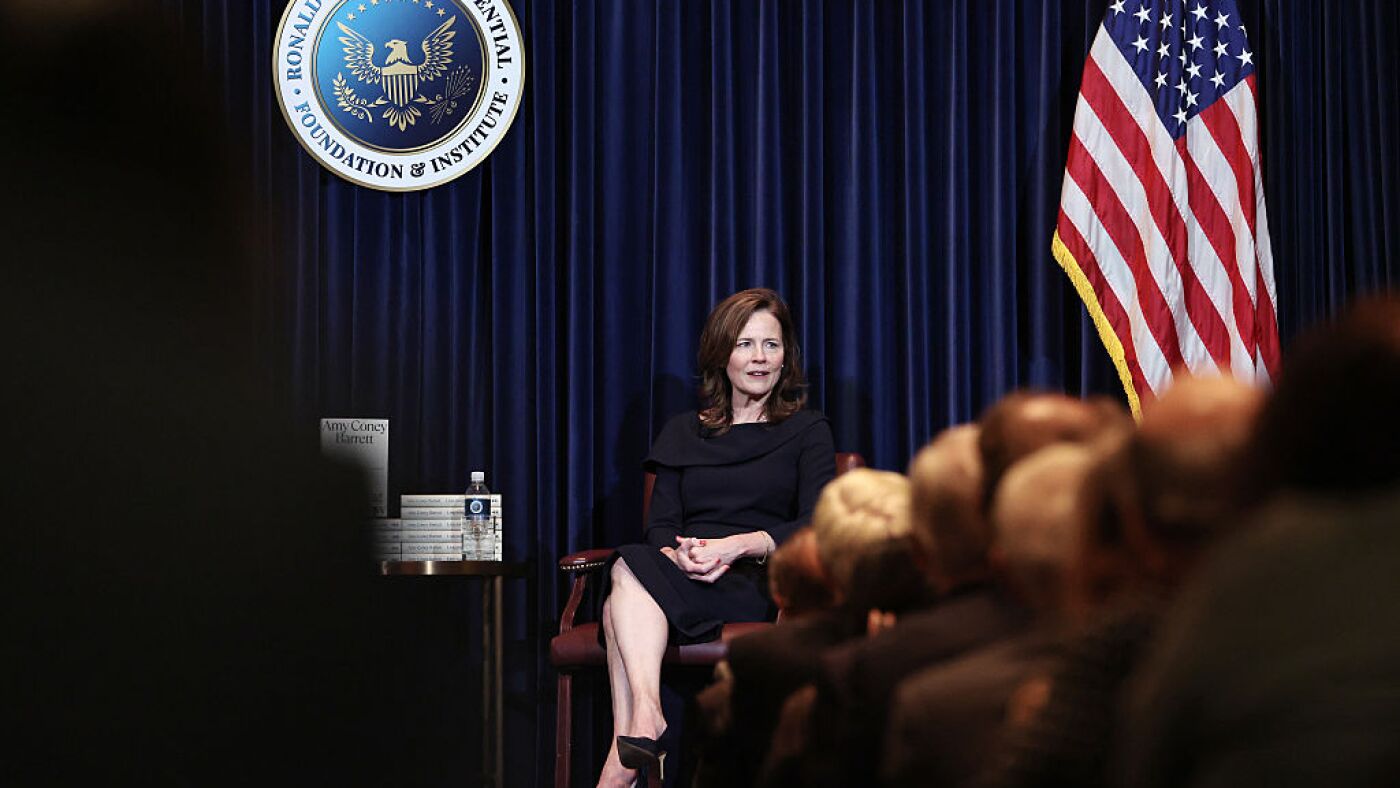
Supreme Court Justice Amy Coney Barrett speaks at the Reagan Library on Sept. 9, 2025, in Simi Valley, Calif. Barrett discussed and signed copies of her new book, Listening to the Law: Reflections on the Court and Constitution.

Mario Tama/Getty Images


hide caption


toggle caption

Advertisement

Mario Tama/Getty Images

Even as the Supreme Court was handing down one legal thunderbolt after another last week, the justices were quietly releasing their annual financial reports. Justice Samuel Alito was the only sitting justice to request an extension, which he has done for 15 years. The disclosures do not give a complete account of the justices’ total income and wealth, but they give insights into their concertgoing, guest professorships and even their involvement in youth sports.

In addition to their salaries, much of the justices’ reported income came from their book deals. Justice Ketanji Brown Jackson led the pack earning more than $1.1 million last year for a total of roughly $4 million since her memoir, Lovely One, was published in 2024.

Justices Sonia Sotomayor, Neil Gorsuch, Amy Coney Barrett and retired Justice Anthony Kennedy also reported income from published books. Earnings from their books ranged from $849,000 for Barrett, to $300,000 for Gorsuch and $88,000 for Sotomayor, whose books include her 2013 autobiography and five children’s books. Justice Clarence Thomas, who previously earned $1.5 million for his 2007 memoir, listed no publisher payments last year, and Justice Brett Kavanaugh, one of 13 co-authors of a 2016 legal treatise, also received no payments last year. Kavanaugh is said to be working on a memoir but he listed no payments for the anticipated book. Alito does have a book coming out in the fall, but with his financial report still outstanding, there is no data on how much he was paid for the work in 2025.

Advertisement

The only two sitting justices who have not written books are Chief Justice John Roberts and Justice Elena Kagan.

Many justices also earned income from teaching at law schools. Roberts reported income from New England Law, located in Boston, and Gorsuch reported teaching income from George Mason University in Virginia. Thomas taught classes at Catholic University in Washington, D.C., and Barrett and Kavanaugh taught at Notre Dame Law School. Barrett graduated from the school and began teaching there 23 years ago; Kavanaugh has family connections to Notre Dame.

Continue Reading

News

Manhattan Building’s Columns Buckled Beneath New Addition, Images Show

Published

on

Manhattan Building’s Columns Buckled Beneath New Addition, Images Show

At least two structural columns buckled and failed in a 37-story office tower in Midtown Manhattan on Tuesday, prompting evacuations of nearby streets and buildings. While city officials asserted that the tower was in no danger of collapsing completely, outside engineers said further failures in the structure could not be ruled out.

A pair of columns that failed completely were part of the tower’s existing structure. A New York Times review of images and videos from inside the building has found that several floors were added atop these columns.

Advertisement

City officials said in a news conference on Tuesday that the building was continuing to move, while they simultaneously assured the city that the building would not suffer “total collapse.” “The way this building is constructed, it’s a steel-frame building,” John Esposito, a chief in the Fire Department in New York, said at the afternoon news conference. “So, it would not be a total collapse. It would be more of a localized collapse.” Still, he said, “that remains our concern, that it’s moved.”

Advertisement

Engineers said that the movement itself was cause for concern. In a properly designed steel building, they said, loads should redistribute quickly to surviving structural supports if columns failed.

Joe DiPompeo, a former president of the Structural Engineering Institute at the American Society of Civil Engineers, said that if the structure had been overloaded, he would expect any movement “to happen very quickly,” rather than gradually.

“Generally when a column buckles, it’s a sudden failure,” Mr. DiPompeo said. He said that a full collapse remained unlikely given the redundancies built into the building codes.

Advertisement

Engineers often refer to the most dangerous possibility as a progressive collapse, a process in which structures near the initial failure become overstressed and also fail, potentially bringing down the building if the sequence continues. While unlikely, it cannot be ruled out, Mr. DiPompeo said.

Footage recorded from inside the building shows at least two structural columns appear to have failed completely, Mr. DiPompeo said. Other nonstructural, interior walls — or at least the metal “studs” that were in place to hold them up — also appear to have deformed.

Advertisement

“The only way that really happens is if the floor above them dropped. It looks like the floor above could have dropped a foot or two, which is obviously not a good situation,” Mr. DiPompeo said.

@fernando40tiktok.commarc via Storyful

Advertisement

Advertisement

Image from @fernando40tiktok.commarc via Storyful

Advertisement

Image from @Bogs4NY via X

Advertisement

The 37-story building is in the process of being converted from office space into residential units. Four new floors and a large vertical portion were added onto the existing building in recent months. The vertical portion consists of a stack of over a dozen new floors cantilevered out over the existing building below.

Engineers said that there was nothing inherently wrong with adding residential floors or the cantilevered section above the columns that failed, as long as the original structure and the modifications had properly accounted for the added weight and wind loads.

“The cantilever alone doesn’t change anything,” Mr. DiPompeo said, but it does put additional load on the columns underneath — a factor that should have been reflected in the design.

Advertisement

Nathan Berman, managing principal and founder of MetroLoft, the developer overseeing the conversion, said on Tuesday that “this incident is nothing more than a typical construction mishap.”

He said two columns near the northwest corner of the tower had bent under the weight of additions to the building above, most likely because those columns had not been properly reinforced, though he said an investigation would determine the cause. The rest of the columns, he said, “picked up the weight.” He estimated the affected floors above the failed columns had sagged by a maximum of four inches.

Advertisement

Mr. Berman said that he expected the problems to be fixed and the project to be completed with, at most, a slight delay.

On Tuesday evening, installation of temporary shoring was set to begin shortly, in order to help stabilize the 20th and 21st floors of the building.

Advertisement
Continue Reading

News

DOJ warns of criminal charges for state election officials if noncitizens vote

Published

on

DOJ warns of criminal charges for state election officials if noncitizens vote

The Justice Department sent letters warning election officials in all 50 states and the District of Columbia that they could face criminal prosecution over noncitizen voting, a spokesperson for the Justice Department confirmed Tuesday.

The letters, signed by Assistant Attorney General Harmeet Dhillon, who heads up the department’s Civil Rights Division, give states five days to explain how they will comply with federal voter eligibility laws and how they will maintain “clean voter lists.”

Advertisement

“The Department sent these letters to all 50 states and the District of Columbia, asking for voluntary compliance in a timely manner with their obligations under federal law to ensure only citizens vote in federal elections,” a Justice Department spokesperson said in a statement.

Noncitizen voting in federal elections is extremely rare, but Trump and his administration have falsely portrayed it as a widespread issue.

Michigan Secretary of State Jocelyn Benson, Nevada Secretary of State Francisco Aguilar and Utah Lt. Gov. Deidre Henderson are among those who said they received the letters from the Justice Department.

The letters say state election officers “could be criminally prosecuted for aiding and abetting” noncitizen voting. They further specify that any election officer who knowingly retains noncitizens on a statewide voting registration list or who facilitates noncitizens’ receiving and casting ballots could be subject to criminal liability.

“An intentional act that is aimed at diluting the votes of citizens could also constitute a violation” of federal law, the letters said.

Advertisement

Henderson wrote on social media that the threats constitute “truly bizarre behavior.”

“Got another love letter this morning from the DOJ sprinkled throughout with threats of criminal prosecution,” she wrote. “I’m sure I’m not the only chief election officer of a state who is being targeted for following state and federal laws by resisting DOJ’s demands for private voter data that have thus far been ruled illegal by at least a dozen courts.”

The letters are the latest move in the Justice Department’s campaign to assert more federal control over state elections.

While some states have complied with the administration’s demands that they hand over voter roll data, the Justice Department has sued 30 states and Washington, D.C., for resisting. So far, 11 different federal courts have dismissed the Justice Department’s efforts to seize voter rolls.

Advertisement
Continue Reading
Advertisement

Trending