News
Maps: Where Do Federal Employees Work in America?


Federal agencies began unveiling their plans this week to further reduce their staffs in mass firings, as demanded by the Trump administration and billionaire Elon Musk. Tens of thousands of federal employees have already accepted buyouts or been fired or laid off.
These maps are based on newly available data from payroll records and offer a glimpse of the federal government’s 2.3 million or so civilian workers in March 2024, before the recent cuts. They show employees based in every state and in thousands of cities and small towns across the country, far beyond Washington, D.C.
Veterans Affairs
The Department of Veterans Affairs — the largest agency in the federal civilian work force outside of the Department of Defense — employed more than 480,000 people as of March of last year. Its employees include physicians and nurses at the agency’s network of medical centers, as well as staff members who help veterans access a wide range of benefits. The Trump administration has pledged to eliminate up to 80,000 jobs.
Internal Revenue Service

Tax examiners and customer service representatives employed by the Internal Revenue Service report to regional offices across the country, including major centers in Memphis; Austin, Texas; and Ogden, Utah. The Trump administration has slashed its federal work force — once totaling nearly 100,000 — by 13 percent, and it could lose up to a third of its staff because of further buyouts and resignations.
Smithsonian Institution
The Smithsonian Institution’s staff comprises museum curators, archivists, animal keepers and security guards who work at its museums and research centers.
Health and Human Services
The Department of Health and Human Services employed more than 90,000 people in March of last year before the Trump administration dismissed about 24 percent of its work force. The department consists of thousands of scientists, public health officials, researchers, and food and drug inspectors working on a vast array of health-related concerns.
Agriculture
At the Natural Resources Conservation Service, soil conservation experts are distributed widely across the country to support the agriculture industry. The Forest Service, which manages about 193 million acres of public lands, employs wildland firefighters, archeologists and wildlife biologists stationed primarily in rural areas of the country.
Social Security Administration
The Trump administration’s cuts have already caused staffing shortages at field offices across the country, where remaining employees are facing longer lines and anxious recipients. The agency had more than 59,000 staff members as of March of last year.
Commerce
The Commerce Department encompasses a group of distinct bureaus that conduct research, forecast weather and gather data in locations across the country.
The U.S. Census Bureau is headquartered in Suitland, Md., and also maintains a significant presence in Jeffersonville, Ind., where it has its main processing center for mail and surveys. The National Institute of Standards and Technology’s staff of engineers, physicists and chemists is primarily based in Gaithersburg, Md., and Boulder, Colo.
Interior
The Interior Department maintains a far-flung work force that staffs national parks, works with Native American tribes, manages the agency’s vast lands and conducts research.
The department manages over 400 million acres of federal lands, primarily under the National Park Service and the Bureau of Land Management. These bureaus employ scientists, researchers, technical staff members and park rangers across their portfolio of lands.
NASA
NASA’s highly specialized work force is composed of engineers, astrophysicists and planetary scientists distributed across several major centers across the country, such as the Johnson Space Center in Houston, Texas, and the Kennedy Space Center in Florida. The agency had more than 18,000 employees as of March of last year.
Homeland Security
The Department of Homeland Security is one of the largest agencies by total employment with more than 222,000 employees as of March of last year. It does not reveal the specific locations of staff members in many of its more high-profile subagencies like Immigration and Customs Enforcement and Customs and Border Patrol. That said, several of the department’s other subagencies offer a window into how the nation’s security and safety apparatus is distributed across the country.
Energy
The Department of Energy’s work force is distributed across a network of field offices and laboratories across the country, such as Los Alamos and Oak Ridge. The department’s staff of chemical engineers, nuclear experts and computer scientists is divided into groups like the National Nuclear Security Administration and the Energy Information Administration.
Transportation
The Transportation Department encompasses a group of agencies that sets regulations for the aviation industry, railroads, highways and public transit. The Federal Aviation Administration, by far the largest agency within Transportation, with more than 45,000 employees as of March of last year, has employees at almost every airport in the United States, as well as technical operations in Oklahoma City and Atlantic City, N.J.
Securities and Exchange Commission
The Securities and Exchange Commission’s offices are concentrated in urban areas with a significant financial services sector, like New York, San Francisco and Chicago. The agency employs lawyers, accountants and compliance experts whose mandate is to regulate the securities industry.
About the data
Data shown in the maps is from the Office of Personnel Management and reflects employees whose locations were available in federal government payroll records as of March 2024. The data does not show federal government contractors. The records also do not include employees of the Postal Service, intelligence agencies, or several other excluded agencies.
Locations shown for workers are based on federal duty stations, which are used across the federal government to standardize location data. About 1.2 million records in the O.P.M. data included valid duty stations codes; the remaining portion, about 880,000 records, had redacted locations. Agencies like the Department of Defense, Department of Justice and Homeland Security did not share precise locations for most staff members.
Records with valid codes were matched to locations based on data from the U.S. Board on Geographic Names. About 40,000 were not able to be matched, so they were joined to duty stations data from O.P.M. and then geocoded to the city or county level.
The maps show agencies and subagencies for which we were able to locate over 75 percent of its U.S.-based staff, based on the March 2024 O.P.M. data. The maps do not show employees who are based outside of the 50 states and Washington, D.C.
Numbers in the text of the article that reflect the total size of agencies and subagencies are from FedScope data as of March 2024.



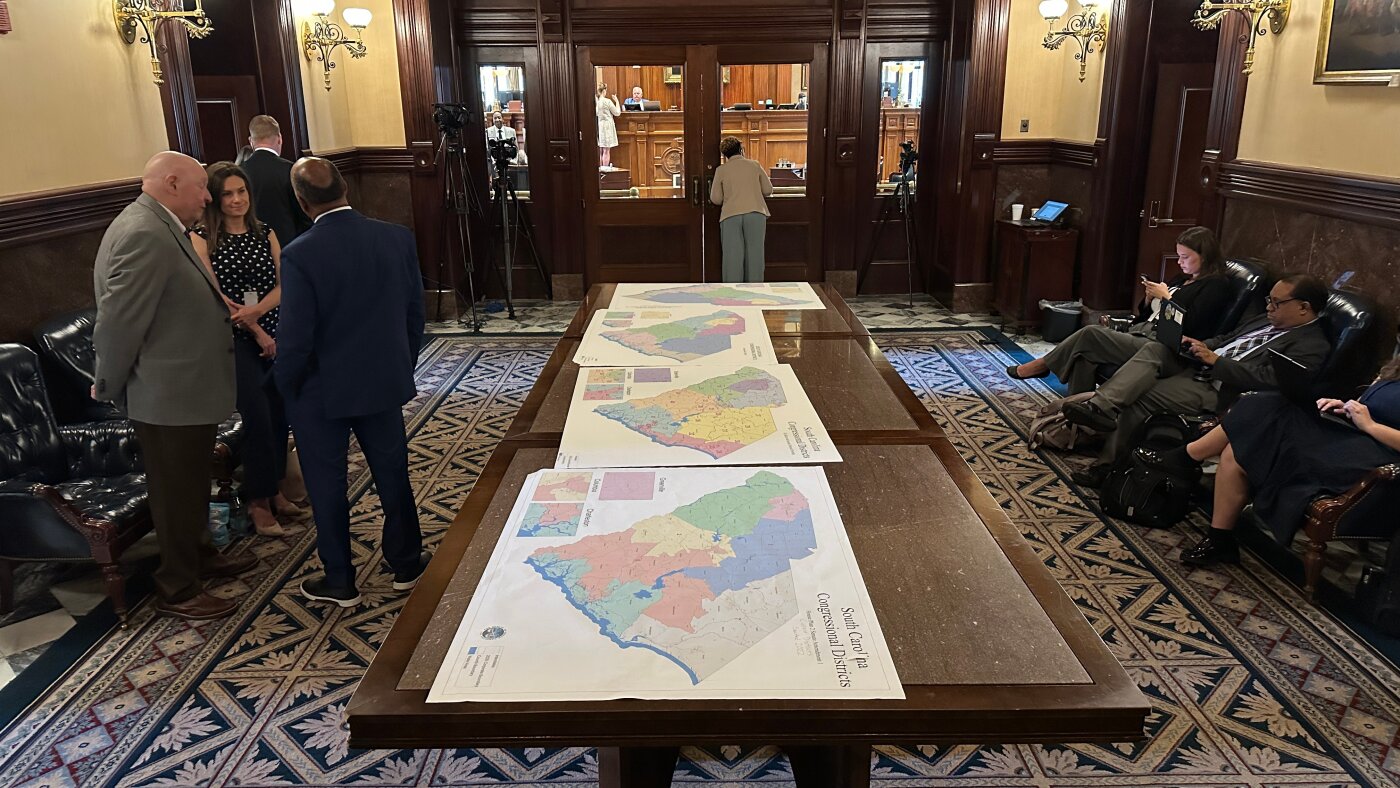
Maps for new congressional districts in South Carolina are shown in the South Carolina Senate antechamber on Friday.
Jeffrey Collins/AP
hide caption
toggle caption
Jeffrey Collins/AP
South Carolina lawmakers dealt President Trump’s national redistricting effort a blow Tuesday when the state Senate voted against redistricting there after three weeks of rushed hearings and long debate.
Trump had been pushing state Republicans to redraw voting lines so they could flip a seat currently held by Democratic Rep. Jim Clyburn. It would have made all the state’s seven congressional districts lean Republican and it would have extended the GOP lead in the national redistricting race, already netting them around nine more seats in the U.S. House.
Early voting in the June 9 primary had started Tuesday morning and was one factor some Republican senators cited for opposing the redistricting, which had dragged on through weeks of on-and-off debate.
A move to bring the bill to a vote failed in the Senate when 12 Republicans joined 12 Democrats on a key procedural vote to block the 26 votes needed to end debate and bring up a vote on the bill. A second procedural vote fell even more short.
The state senate is not up for election this year
Several Republicans moved to the opposition saying that changing the map could disenfranchise some voters. Around 26,000 cast ballots within the first several hours of polls opening, putting Tuesday on track to break early primary voting records.
Republican state Sen. Richard Cash echoed that concern from the floor Tuesday and said time had run out.
“Voting has begun, it is time to conclude the matter,” Cash said. “I know there’s going to be a lot of anger and frustration that we did not get the job done. I get it. Many of us are also frustrated and disappointed at what is a very unsatisfying outcome.”
Unlike members of the House, senators are not up for reelection this year and that could give them some insulation from pressure from Trump, who generated primary challenges against Republicans elsewhere for opposing redistricting.
Earlier Tuesday, Clyburn cast his ballot early in Orangeburg, a city 45 miles southeast of Columbia, and told reporters he was set to run in whatever district they draw him into. “I am embarrassed that so many people in our legislature will allow strangers in Washington to tell them what to do, when to do it, and how to do it,” Clyburn said.
Trump and Republicans still hold an advantage in the redistricting battle
Overall, Trump and the Republicans have gained in the unprecedented, mid-decade redistricting push he started. Republicans hold just a few-seats advantage in the House and the party in the White House usually loses seats in midterms. Usually, states redistrict at the start of the decade after the census count.
Redistricting across the country has given Republicans an advantage in about 15 more seats to the Democrats’ six That would net the Republicans about nine seats, while some court challenges remain that could alter that figure.
Trump got Texas Republicans to redistrict last summer. California Democrats, backed by a public vote, countered that. But since then it’s been mostly Republicans’ gains as they control more legislatures and many Democratic-led states are constrained by laws against gerrymandering.
South Carolina Senate Majority Leader Shane Massey, who fielded several calls from Trump, was one of those Republicans opposing the redistricting. He said that unlike other southern states that rushed to redistrict, South Carolina’s districts did not fall under a recent Supreme Court ruling weakening voting rights for minorities.
Also on Tuesday, a federal court temporarily blocked the redistricting plan Alabama lawmakers had approved to flip a Democratic-held seat there. The court ruling is expected to be challenged at the U.S. Supreme Court,which has earlier backed the redistricting plan.

Pope Leo XIV has been a major global critic of immigration crackdowns and war, staking out a moral agenda that has at times challenged the political leadership of his home country.
Now Leo, the first pope from the United States, has added to that list artificial intelligence, taking on American power brokers of another kind — this time in Silicon Valley.
Leo’s papal document, titled “Magnifica Humanitas,” or “Magnificent Humanity,” and made public on Monday, is the defining theological statement so far of his young papacy, and the most significant moral intervention on AI to date from a religious leader. It also is an effort to inject Catholic moral values into a famously secular, and significantly American, industry that is transforming the world at lightning speed.
“Crucial questions impose themselves on our conscience and can no longer be avoided: Where are we going? Toward what goal do we wish to orient ourselves? What direction should we choose as a people and as a human community?” Leo wrote.
Leo specifically called for AI to be “disarmed,” similar to the church’s support for nuclear disarmament, meaning “freed from logics that turn it into an instrument of domination, exclusion and death,” he explained in a speech at the Vatican.
The document’s release in the synod hall was styled as a branded launch event, with bright yellow banners and a splashy introductory video, produced with EWTN, an American Catholic network with global reach.
Seated three seats away from the pope on the dais was a high-powered A.I. pioneer, Christopher Olah, a co-founder of the American company Anthropic. The Vatican’s invitation to such a business executive was a rarity. It signaled an attempt to expand Leo’s influence, and his priority on dialogue even among unlikely partners, presenting a friendly posture alongside an ostensible adversary.
For Leo, the way forward must involve collaboration, said Cardinal Blase Cupich of Chicago, Leo’s hometown, who sat in the front row.
“I think that openness on the part of Mr. Olah, as well as the Holy Father, can be the bridge by which all that can happen,” he said in an interview on his way out of the synod hall. “There is a need for the wisdom that the church’s tradition can bring to this discussion of how to use AI in a way that preserves human dignity.”
But Mr. Olah’s presence also underscored that significant power lies not only with governments, but “with major economic and technological actors,” as Leo noted, and that the Vatican is prioritizing these relationships in an almost official diplomatic capacity.
Leo opened his remarks with a special thank you to Mr. Olah, almost as if he were a head of state. “In turn, in the name of the church I accept your invitation to walk together to listen and to speak and together to find the way for humanity in this time of artificial intelligence,” Leo said.
The Vatican is acutely aware of technology’s power to upend existing political and religious order. The invention of the printing press in the 15th-century famously preceded the rise of nation-states, and the Protestant Reformation, remaking the power of the Catholic church.
The Vatican has been an instrumental force over the last decade in generating a global conversation about the value of the human in the AI age.
Church leaders under Pope Francis regularly held meetings called the “Minerva Dialogues” with technology leaders to discuss AI developments. Pope Francis met with the Group of 7 leaders in 2024 and urged regulation, and also called for the banning of lethal, autonomous weapons.
Leo’s document, called an encyclical, is in many ways a culmination of that effort.
“At key moments in history, the Church is called to decipher the ‘new things’ in the light of the Gospel and the dignity of the human being,” Leo said on Monday. “Today we find ourselves facing a transformation of similar magnitude, with perhaps even greater consequences. “
A moral critique of AI has been growing within some religious communities in the past few years. The effort to elevate a broader discussion has grown more urgent as the technology’s impact for war and on children becomes more pressing. Powerful companies including Anthropic are on a path to becoming trillion-dollar ones.
“When such power is concentrated in the hands of a few, it tends to become opaque and evade public oversight, increasing the risk of distorted forms of development that give rise to new dependencies, exclusions, manipulations and inequalities,” Leo wrote.
With this document, Leo is offering a way for efforts to congeal into a united movement to defend what he describes as human flourishing.
Catholic universities in the U.S., including Georgetown and Santa Clara, have taken significant steps to advance the conversation about AI and Catholic moral values in academic and public circles.
The University of Notre Dame received a $50 million grant from the Lilly Endowment in December to develop faith-based ethical frameworks for AI through its Institute for Ethics and the Common Good.
Meghan Sullivan, the director of that institute, said she often hears a concerning view when she meets with AI developers in Silicon Valley — “that only a few hundred people on earth actually matter right now: the ones building frontier models and the politicians powerful enough to regulate them.”
“This encyclical is a direct rebuttal to that worldview,” she said. “The Church is insisting, as it has for 2,000 years, that the people of Wichita and South Bend and Nairobi and Manila are not bit players in someone else’s technological revolution.
“I think that we are seeing with Pope Leo in this encyclical, finally an institution that’s powerful enough to stand up for those ideas.”
The document has a particularly American appeal. Leo specifically references the United States Conference of Catholic Bishops — the only national conference to get a callout — in a section about caring for young people facing job insecurity. He quotes J. R. R. Tolkien’s “The Return of the King,” a novel beloved by many in America, particularly young men.
How effective Leo’s efforts will be, and how much impact a papal treatise can have even in Catholic circles, remains to be seen.
Societies like the United States once held constitutional conventions to have robust public conversations about such critical topics, noted Ron Ivey, a longtime writer and research fellow with Harvard University’s Human Flourishing Program.
Too often the prevailing narrative is that humans have no choice but to accept the widespread required use of AI, he said.
“We need to have a public conversation, in our libraries, in our civil society, whatever is still strong in that area,” he said. “Why are we building this thing, and who is it for, and how do we make it work for our flourishing?”

The US military carried out “self-defense” strikes in southern Iran against targets including boats attempting to lay mines and missile launch sites, Fox News reported on Tuesday.
“US forces conducted self-defense strikes in southern Iran today to protect our troops from threats posed by Iranian forces,” US Central Command (CENTCOM) spokesperson Capt. Tim Hawkins said.
“US Central Command continues to defend our forces while using restraint during the ongoing ceasefire,” he added.
Two Iranian boats were spotted laying mines in the Strait of Hormuz, reported Fox News, citing a senior US official. Forces also responded after a missile site had targeted US warplanes, said the official.
He also confirmed that the US struck a surface-to-air missile (SAM) site in Bandar Abbas, following reports of explosions in the city by Iranian media.
Other explosions were reported close to Sirik and Jask, located near the strait.
The official told Fox News that the strikes were “defensive,” while two additional sources said that the strikes do not indicate that the ceasefire with Iran is over.
Explosions were heard on Monday in various regions across the Strait of Hormuz, according to Fox.
The official said that the US strikes were “over for now.”
-

 Wisconsin41 seconds ago
New Wisconsin initiative launches to help students prepare for life after graduation
-

 West Virginia7 minutes ago
Man catches 71-pound blue catfish, breaking West Virginia record
-

 Wyoming13 minutes ago
Pete Fox announces candidacy for Wyoming House District 56
-

 Crypto19 minutes ago
Amid a scam crackdown, crypto giants keep fueling bitcoin ATMs – ICIJ
-

 Finance25 minutes ago
Care New England eliminates 30+ positions, citing financial strain
-

 Fitness31 minutes ago
At 55, Zoe Ball relies on NEAT exercise to stay fit without the gym – here’s how to make it work
-

 Movie Reviews43 minutes ago
‘Madame’ Review: A Working-Class Frenchwoman Looks After a Saudi Prince’s Mistress in This Smart and Nuanced Debut
-

 World55 minutes ago
Enhanced Group Shares Tumble After PED-Friendly Opener

