Connect with us

News

Judge contends Nazis got more due process than Trump deportees did

Published

on

Judge contends Nazis got more due process than Trump deportees did

In this handout photo provided by the Salvadoran government, members of the Salvadorian army stand guard at CECOT on March 16, 2025 in Tecoluca, El Salvador. The Trump administration deported alleged members of Tren de Aragua gang and others to El Salvador.

Handout/Salvadoran government via Getty Images


hide caption

toggle caption

Advertisement

Handout/Salvadoran government via Getty Images

The Trump administration received pointed questions from a judge over how it’s implementing a rarely-used wartime law to deport Venezuelans suspected of being Tren de Aragua gang members.

A president last invoked the Alien Enemies Act after the attack on Pearl Harbor, designating Japanese, German and Italian nationals as “alien enemies” during World War II.

“Nazis got better treatment under the Alien Enemies Act than what has happened here,” D.C. Circuit Court of Appeals Judge Patricia Millett said during a hearing at the court on Monday. “And they had hearing boards before they were removed.”

Advertisement

“People weren’t given notice, they weren’t told where they were going,” she said about the removal of Venezuelans and others to El Salvador earlier this month.

Lawyers with the Justice Department are asking the appeals court in Washington to overturn a temporary restraining order blocking deportations under the act put in place by district court Judge James Boasberg. A ruling to lift the temporary pause on deportations, or keep it in place, is likely to prompt an appeal to the U.S. Supreme Court.

The fight over the rarely used wartime power has become central to Trump’s immigration crackdown agenda and his efforts to stretch the power of the executive branch.

The panel of three judges did not deliver a decision from the bench but could do so in the coming days.

Judge Millett appeared sympathetic to the arguments of immigrants rights groups who sought to block immediate deportations, but it is unclear which way Judge Karen Henderson, a George W. Bush appointee, was leaning.

Advertisement

According to court documents, if the judge lifts the pause, some 258 people would likely be placed in removal proceedings under the Alien Enemies Act for being alleged members of Tren de Aragua.

DOJ says pause was “enormous intrusion” on president’s power

Justice Department lawyers argued that Boasberg’s order to pause removals under the act is an “unprecedented and enormous intrusion” on the president’s power and that this type of “second-guessing” could potentially hurt the United States’ current and future deals with other countries. The U.S. has negotiated with El Salvador and other countries to take in deportees.

Drew Ensign, the government attorney leading the case, received pointed questions about how it could work for people detained or even removed under the Alien Enemies Act to bring up individual petitions to contest allegations they are members of the Tren de Aragua, a Venezuelan gang.

“The problem here is that they are challenging implementation of the proclamation in a way that never gave anyone a chance to say, ‘I’m not covered,” Millett, an appointee of former President Barack Obama, said. She said prior cases clearly show the government needs to give people that due process.

Due process “can’t be an unlawful intrusion of the president’s powers. The president has to comply with the constitution and laws like everybody else,” she said.

Advertisement

Judge Justin Walker, who was appointed by Trump in 2020, was sympathetic to the government’s argument that those who are currently detained under the Alien Enemies Act should contest their arrests through a habeas petition, which is how someone can legally argue they are being unlawfully detained.

Walker suggested that the plaintiffs, represented by the American Civil Liberties Union and Democracy Forward, should have filed in Texas as opposed to in D.C. The five Venezuelan plaintiffs that first filed the lawsuit are held in Texas, even though their lawyers argued that they now are also representing hundreds of people potentially subject to the act nationwide.

Still, Ensign said that should the judges side with the government and lift the pause on deportations, the government would not have a limitation and not be required to provide notice for those deported under the Alien Enemies Act.

Lower DC court keeps pause on deportations in place

Earlier in the day, Boasberg issued an order to keep in place his 14-day pause on the administration’s ability to deport anyone under the act.

Boasberg denied the government’s attempt to vacate his temporary restraining order, noting that immigrant rights groups were likely to win the argument in court that the men deported to El Salvador should have gotten individualized hearings to determine whether the act applied to them.

Advertisement

“Because the named Plaintiffs dispute that they are members of Tren de Aragua, they may not be deported until a court has been able to decide the merits of their challenge,” Boasberg wrote in his order. “Nor may any members of the provisionally certified class be removed until they have been given the opportunity to challenge their designations as well.”

Boasberg said the pause on the flights does not prevent the government from making arrests, or even deporting those it suspects of being members of Tren de Aragua.

He gave the immigrant rights groups until Wednesday to file a preliminary injunction, which could pave the way for an even longer court-ordered pause on the use of the wartime powers.

Boasberg also direct Trump’s cabinet secretaries to decide by Tuesday whether they were going to invoke a privilege that would allow them to not disclose information about the deportation flights.

Boasberg and the DOJ went back and forth over whether the administration ignored the judge’s order to not use the act to send 137 Venezuelans to El Salvador on March 15.

Advertisement

News

Former Olympian pleads not guilty in reflecting pool vandalism charges

Published

on

Former Olympian pleads not guilty in reflecting pool vandalism charges

Former U.S. Olympian David Hearn (left) walks with his attorney Norman Eisen to speak to reporters and protesters gathered after his arraignment at the Superior Court of the District of Columbia in Washington, D.C. on Thursday.

Finn Gomez/Getty Images


hide caption


toggle caption

Advertisement

Finn Gomez/Getty Images

Former U.S. Olympic canoeist David Hearn pleaded not guilty to damaging the Lincoln Memorial Reflecting Pool in D.C. Superior Court Thursday morning.

Federal prosecutors charged Hearn with a single count of destruction of property causing more than $1,000 in damage to the pool.

Hearn has previously claimed, which his attorneys repeated during a short press conference outside the court, that he simply touched the water in the pool out of curiosity.

Advertisement

The Trump administration had just completed a $14 million renovation of the pool.

But shortly after the work finished, peeling paint and algae gathered in the water. The remodel has been largely criticized as a massive failure and waste of taxpayer dollars.

Superior Court Judge Carmen McLean released Hearn on his own recognizance. His next hearing is scheduled for Aug. 5.

Norm Eisen, one of Hearn’s attorneys, spoke to reporters outside of court following the hearing. He said the administration is using Hearn as a “scapegoat … for their own failures.”

“It is not a crime to touch the reflecting pool, to touch water in the United States of America,” he said.

Advertisement

Prosecutors say there is a host of evidence against Hearn.

This is a developing story.

Continue Reading

News

Three more people charged with damaging Reflecting Pool after Trump’s multimillion-dollar restoration | CNN Politics

Published

on

Three more people charged with damaging Reflecting Pool after Trump’s multimillion-dollar restoration | CNN Politics

Three more people have been criminally charged with destruction of property at the Lincoln Memorial Reflecting Pool.

Officers say they detained Cameron Thiers, Sophie Dennison-Gibby and Justin Carreno one Saturday afternoon in June and described in court documents witnessing them peeling and removing pieces of blue paint from the Reflecting Pool.

One officer “witnessed Carreno reach down into the reflecting pool and pull up a piece of the blue paint,” according to the court documents.

The officer who detained Dennison-Gibby “found 1 additional piece of the reflecting pool liner” in her purse, the documents said.

All three incidents were recorded on the officers’ body worn cameras, they said in the court documents.

Advertisement

Several “partnering law enforcement agencies assigned to the Reflecting Pool” working with US Park Police were involved in detaining the two men and one woman — including officers from Texas, Oklahoma, Montana and California.

One of the officers said in court documents that Thiers “admitted to removing a piece of blue sealant from the Reflecting Pool and still had it in his hand when I made contact with him.”

The three defendants were arraigned in court Wednesday and pleaded not guilty to the misdemeanor charges of destruction of property with a value less than $1,000. The judge ordered them to stay away from the Reflecting Pool.

Lawyers for Thiers and Dennison-Gibby declined to comment. CNN has reached out to Carreno’s attorney.

If found guilty of destruction of property, the defendants could be fined up to $1,000 and face a maximum of 180 days behind bars.

Advertisement

The New York Times first reported that three additional people had been charged with damaging the Reflecting Pool.

President Donald Trump has repeatedly claimed that vandals caused major damage to the pool by gashing the lining after his administration spent more than $14 million on renovations, though he has not provided evidence to support that claim. The officers who charged Carreno, Thiers and Dennison-Gibby did not accuse them of gashing the lining.

Former Olympic canoeist David Hearn was indicted by a grand jury in Washington, DC, last week for allegedly damaging the Reflecting Pool. Hearn — unlike Carreno, Thiers and Dennison-Gibby – was charged with destruction of property with a value of more than $1,000 which carries a maximum penalty of 10 years in prison, if convicted. He is set to be arraigned in court Thursday.

Crews began draining the Reflecting Pool over the weekend to make repairs, according to Interior Secretary Doug Burgum, for the second time in three months.

The move comes after weeks of problems – algae blooms, green-hued water, a chipping bottom and the administration’s allegations of vandalism – that have plagued the iconic landmark, making its woes the subject of national interest.

Advertisement
Continue Reading

News

Supreme Court financial disclosures reveal how their books add to their income

Published

on

Supreme Court financial disclosures reveal how their books add to their income

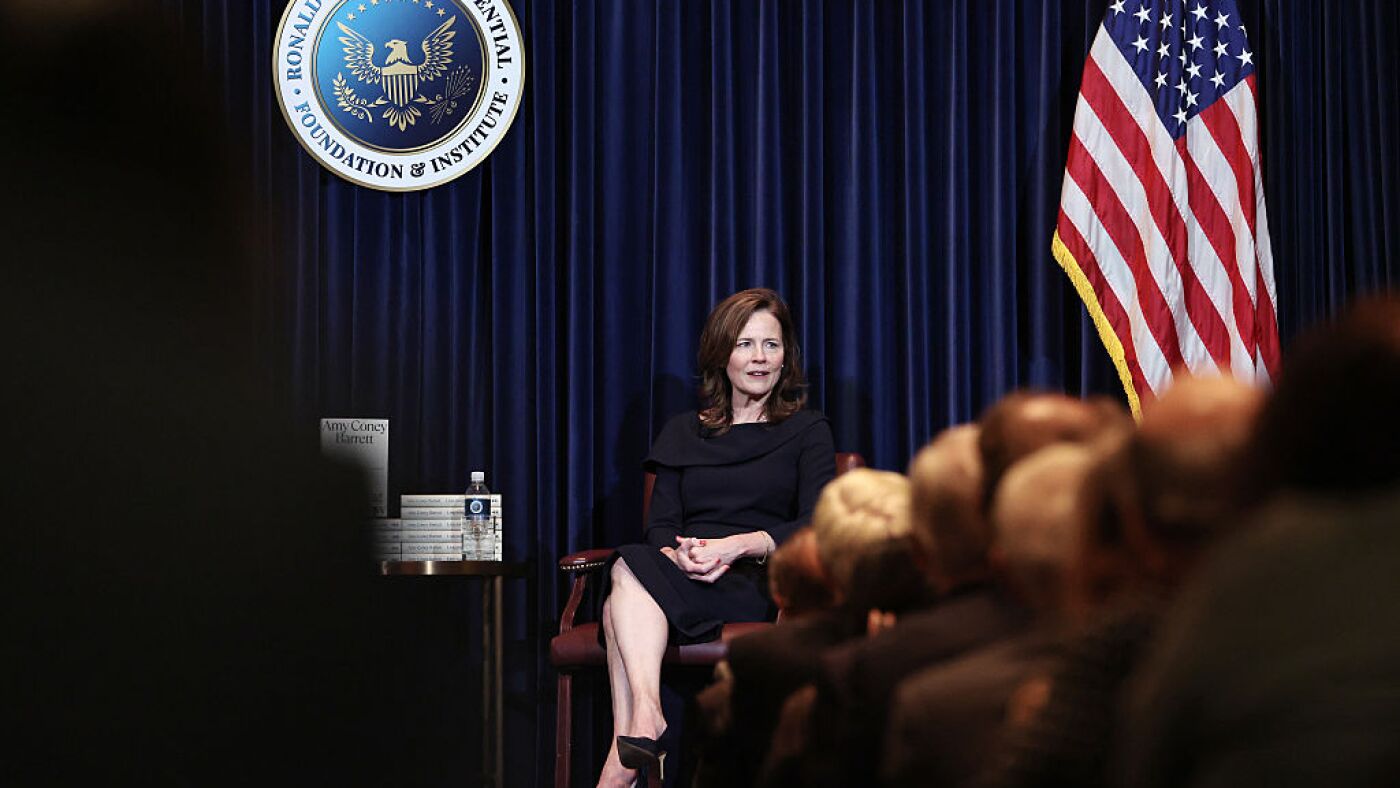
Supreme Court Justice Amy Coney Barrett speaks at the Reagan Library on Sept. 9, 2025, in Simi Valley, Calif. Barrett discussed and signed copies of her new book, Listening to the Law: Reflections on the Court and Constitution.

Mario Tama/Getty Images


hide caption


toggle caption

Advertisement

Mario Tama/Getty Images

Even as the Supreme Court was handing down one legal thunderbolt after another last week, the justices were quietly releasing their annual financial reports. Justice Samuel Alito was the only sitting justice to request an extension, which he has done for 15 years. The disclosures do not give a complete account of the justices’ total income and wealth, but they give insights into their concertgoing, guest professorships and even their involvement in youth sports.

In addition to their salaries, much of the justices’ reported income came from their book deals. Justice Ketanji Brown Jackson led the pack earning more than $1.1 million last year for a total of roughly $4 million since her memoir, Lovely One, was published in 2024.

Justices Sonia Sotomayor, Neil Gorsuch, Amy Coney Barrett and retired Justice Anthony Kennedy also reported income from published books. Earnings from their books ranged from $849,000 for Barrett, to $300,000 for Gorsuch and $88,000 for Sotomayor, whose books include her 2013 autobiography and five children’s books. Justice Clarence Thomas, who previously earned $1.5 million for his 2007 memoir, listed no publisher payments last year, and Justice Brett Kavanaugh, one of 13 co-authors of a 2016 legal treatise, also received no payments last year. Kavanaugh is said to be working on a memoir but he listed no payments for the anticipated book. Alito does have a book coming out in the fall, but with his financial report still outstanding, there is no data on how much he was paid for the work in 2025.

Advertisement

The only two sitting justices who have not written books are Chief Justice John Roberts and Justice Elena Kagan.

Many justices also earned income from teaching at law schools. Roberts reported income from New England Law, located in Boston, and Gorsuch reported teaching income from George Mason University in Virginia. Thomas taught classes at Catholic University in Washington, D.C., and Barrett and Kavanaugh taught at Notre Dame Law School. Barrett graduated from the school and began teaching there 23 years ago; Kavanaugh has family connections to Notre Dame.

Continue Reading
Advertisement

Trending