Connect with us

News

Trump’s Ending of Hunter Biden’s Security Detail Raises Questions About Who Gets Protection

Published

on

Trump’s Ending of Hunter Biden’s Security Detail Raises Questions About Who Gets Protection

Former Vice President Kamala Harris has Secret Service protection, at least for a few more months.

Chelsea Clinton does not have a Secret Service detail anymore, though her father, former President Bill Clinton and his wife, Hillary Clinton, do.

All of President Trump’s family members currently have protection, including his grandchildren.

And while former President Joseph R. Biden Jr. and his wife are by law allowed to have protection for the rest of their lives, their adult children had it only for a few months. After leaving office, Mr. Biden issued an executive order that extended the protection to them, but Mr. Trump revoked their detail in a pique on Monday.

The controversies and Mr. Trump’s announcement have thrust the subject of security for public figures into the headlines. But they also raise questions: Who gets Secret Service protection? For how long? Who makes those decisions? How much is it costing the taxpayers?

Advertisement

Here are the ins and outs of government protection.

The Secret Service is statutorily required to protect certain people, including the sitting president, vice president and their families.

In the case of both Mr. Biden and Mr. Trump, their family members made up a majority of people with Secret Service protection details during their respective administrations. Both men are grandfathers and have large families that have been under protection. Mr. Trump has five children and 10 grandchildren. Mr. Biden’s two children and seven grandchildren also had details while he was president.

The agency is required to protect former presidents and their spouses for life, and children of past presidents retain their Secret Service details until they turn 16.

In addition, visiting heads of states and their spouses receive protection details. So do major candidates for president and vice president and their spouses beginning 120 days before the general election.

Advertisement

A president can also assign Secret Service protection through executive orders, meaning the president can add or remove the detail by fiat.

While president, Mr. Biden extended the protective detail for Mr. Trump’s youngest son, Barron, after he turned 16, according to an official familiar with the arrangement who was not authorized to speak about the matter and spoke on the condition of anonymity.

And before he left office, Mr. Biden also extended the protective detail for his vice president, Kamala Harris, for at least six months, the official said. Because the law does not require protection for former vice presidents, Mr. Trump could choose to end the security detail for Ms. Harris.

Toward the end of his term, Mr. Biden issued an executive order extending security details for his children, Hunter and Ashley, for six months. Mr. Trump did the same for his five children at the end of his first term.

But Mr. Trump abruptly ended the protection for the Biden siblings on Monday, speeding up a process that was already set to happen.

Advertisement

On social media on Monday, Mr. Trump wrote that Hunter Biden had an 18-person protective detail providing security while he was on vacation in South Africa.

“Please be advised that, effective immediately, Hunter Biden will no longer receive Secret Service protection,” Mr. Trump wrote. “Likewise, Ashley Biden who has 13 agents will be taken off the list.”

For security reasons, the Secret Service would not say how agents are transitioning out of protecting former President Biden’s children. The agency does routine security assessments of the people it protects, but it would not discuss the threats facing Hunter and Ashley Biden.

Anthony Guglielmi, a spokesman for the Secret Service, said on Monday evening: “We are aware of the president’s decision to terminate protection for Hunter and Ashley Biden. The Secret Service will comply and is actively working with the protective details and the White House to ensure compliance as soon as possible.”

A representative for the Biden family declined to comment Monday.

Advertisement

The number of people under Secret Service protection fluctuates, and the complete list of people is not made public for security reasons.

The list grew to 54 from around 26 after the Sept. 11 attacks, according to a former official familiar with the protective details at that time. The official spoke on condition of anonymity to discuss information that is not routinely publicized.

During the first Trump administration, 42 people had Secret Service protection. That number dropped to around 36 while Mr. Biden was in office. Currently, the Secret Service has protection details for 43 people.

Hunter Biden’s travels raised questions about the taxpayer cost and necessity of a large entourage when the Secret Service is struggling with staffing and retention, former agency officials said.

“During a time where resource constraints are difficult in the Service, this is something that he just deemed as no longer the extension of a courtesy,” Ronald Layton, a 26-year veteran of the Secret Service who led divisions with oversight of protection, said of the president’s decision. Mr. Layton said cutting the protection details short was “common sense.”

Advertisement

While the agency does not break down the cost of protective details for each person it is assigned, the Secret Service’s total budget in 2024 for its protection-specific mission was nearly $1.5 billion, according to data from the Congressional Research Service. In 2019, which was not a presidential election year, the budget for the protection-specific mission was nearly $970 million.

Resources at the agency have been stretched thin after years of staffing shortages and the grueling 2024 presidential campaign season, which called for more protection for candidates than in any previous campaign cycle, partly because of the number of candidates who received protection and threats against Mr. Trump.

This came into stark focus after the attempted assassination of Mr. Trump last summer. The Secret Service was broadly criticized for its security failures at an outdoor campaign rally in Butler, Pa., where a would-be assassin was able to climb onto a building and shoot Mr. Trump.

Despite the legitimate questions of cost for protecting so many people, the sudden announcement of the cessation of protection for Hunter Biden, coupled with Mr. Trump’s fixation on the former president and his only living son, raised immediate questions about whether this move was the latest stop on the president’s revenge tour.

It prolonged Mr. Trump’s controversial pattern of using the power to assign or dismiss security details in ways that highlight his personal grievances and potentially expose his perceived enemies to peril — part of a retribution pledge that he has effectively carried out since his return to the Oval Office.

Advertisement

Within hours of taking office, Mr. Trump removed the security detail of John R. Bolton, one of his former national security advisers. Mr. Trump fired Mr. Bolton in 2019, and Mr. Bolton later wrote a book critical of Mr. Trump.

Mr. Trump also pulled the protection for Mike Pompeo, one of his former secretaries of state, and a former aide, Brian Hook. Mr. Trump did this even though Mr. Bolton, Mr. Pompeo and Mr. Hook remain under threat because of actions they took during Mr. Trump’s first term.

As president, Mr. Biden gave Secret Service protection to Mr. Bolton, and later Mr. Pompeo and Mr. Hook, because of Iranian threats. Mr. Bolton and other officials from Mr. Trump’s first term, including the president, have faced continued threats for their involvement in an airstrike that killed Qassim Suleimani, a top Iranian general, in January 2020. In 2022, the Justice Department charged a man with plotting to assassinate Mr. Bolton.

When Mr. Trump pulled the protection details for Mr. Bolton and the other two former advisers, two Republican senators — Tom Cotton of Arkansas, who is the chairman of the Intelligence Committee, and Lindsey Graham of South Carolina — urged him to reconsider.

“Politics should not come into this in any way,” Jason Russell, a former Secret Service agent, said in an interview with CNN on Tuesday. “It’s an unfortunate reality.”

Advertisement

“In this case, it seems like a retribution or some kind of political gamesmanship to take protection away,” Mr. Russell said. “But the Secret Service really shouldn’t be used in this manner. It should be always a threat-based decision.”

Mr. Trump also stripped the government-funded security detail for Dr. Anthony S. Fauci days after his return to office. Dr. Fauci did not have a Secret Service detail, but he continued to have taxpayer-paid security after he left the government in 2022. Initially, federal marshals protected him, and later he had a private contractor whose fees were paid by the government. Conservatives widely criticized Dr. Fauci because of his role guiding the country through the coronavirus pandemic, and he had a contentious relationship with Mr. Trump.

Mr. Trump’s announcement on Monday did more than eliminate Hunter Biden’s detail; it also told the public where he was, potentially putting him at risk.

The vacation was not exactly a state secret, however, as The New York Post had published an opinion essay on Saturday about his travels.

“We are in a very unstable security environment where there has been a lot of political violence,” said Representative Jamie Raskin of Maryland, the top Democrat on the House Judiciary Committee. “Decisions about the extension of Secret Service protection should be made with discretion so people are not exposed to any added risks.”

Advertisement

Minho Kim contributed reporting.

News

Former Olympian pleads not guilty in reflecting pool vandalism charges

Published

on

Former Olympian pleads not guilty in reflecting pool vandalism charges

Former U.S. Olympian David Hearn (left) walks with his attorney Norman Eisen to speak to reporters and protesters gathered after his arraignment at the Superior Court of the District of Columbia in Washington, D.C. on Thursday.

Finn Gomez/Getty Images


hide caption


toggle caption

Advertisement

Finn Gomez/Getty Images

Former U.S. Olympic canoeist David Hearn pleaded not guilty to damaging the Lincoln Memorial Reflecting Pool in D.C. Superior Court Thursday morning.

Federal prosecutors charged Hearn with a single count of destruction of property causing more than $1,000 in damage to the pool.

Hearn has previously claimed, which his attorneys repeated during a short press conference outside the court, that he simply touched the water in the pool out of curiosity.

Advertisement

The Trump administration had just completed a $14 million renovation of the pool.

But shortly after the work finished, peeling paint and algae gathered in the water. The remodel has been largely criticized as a massive failure and waste of taxpayer dollars.

Superior Court Judge Carmen McLean released Hearn on his own recognizance. His next hearing is scheduled for Aug. 5.

Norm Eisen, one of Hearn’s attorneys, spoke to reporters outside of court following the hearing. He said the administration is using Hearn as a “scapegoat … for their own failures.”

“It is not a crime to touch the reflecting pool, to touch water in the United States of America,” he said.

Advertisement

Prosecutors say there is a host of evidence against Hearn.

This is a developing story.

Continue Reading

News

Three more people charged with damaging Reflecting Pool after Trump’s multimillion-dollar restoration | CNN Politics

Published

on

Three more people charged with damaging Reflecting Pool after Trump’s multimillion-dollar restoration | CNN Politics

Three more people have been criminally charged with destruction of property at the Lincoln Memorial Reflecting Pool.

Officers say they detained Cameron Thiers, Sophie Dennison-Gibby and Justin Carreno one Saturday afternoon in June and described in court documents witnessing them peeling and removing pieces of blue paint from the Reflecting Pool.

One officer “witnessed Carreno reach down into the reflecting pool and pull up a piece of the blue paint,” according to the court documents.

The officer who detained Dennison-Gibby “found 1 additional piece of the reflecting pool liner” in her purse, the documents said.

All three incidents were recorded on the officers’ body worn cameras, they said in the court documents.

Advertisement

Several “partnering law enforcement agencies assigned to the Reflecting Pool” working with US Park Police were involved in detaining the two men and one woman — including officers from Texas, Oklahoma, Montana and California.

One of the officers said in court documents that Thiers “admitted to removing a piece of blue sealant from the Reflecting Pool and still had it in his hand when I made contact with him.”

The three defendants were arraigned in court Wednesday and pleaded not guilty to the misdemeanor charges of destruction of property with a value less than $1,000. The judge ordered them to stay away from the Reflecting Pool.

Lawyers for Thiers and Dennison-Gibby declined to comment. CNN has reached out to Carreno’s attorney.

If found guilty of destruction of property, the defendants could be fined up to $1,000 and face a maximum of 180 days behind bars.

Advertisement

The New York Times first reported that three additional people had been charged with damaging the Reflecting Pool.

President Donald Trump has repeatedly claimed that vandals caused major damage to the pool by gashing the lining after his administration spent more than $14 million on renovations, though he has not provided evidence to support that claim. The officers who charged Carreno, Thiers and Dennison-Gibby did not accuse them of gashing the lining.

Former Olympic canoeist David Hearn was indicted by a grand jury in Washington, DC, last week for allegedly damaging the Reflecting Pool. Hearn — unlike Carreno, Thiers and Dennison-Gibby – was charged with destruction of property with a value of more than $1,000 which carries a maximum penalty of 10 years in prison, if convicted. He is set to be arraigned in court Thursday.

Crews began draining the Reflecting Pool over the weekend to make repairs, according to Interior Secretary Doug Burgum, for the second time in three months.

The move comes after weeks of problems – algae blooms, green-hued water, a chipping bottom and the administration’s allegations of vandalism – that have plagued the iconic landmark, making its woes the subject of national interest.
Advertisement
Continue Reading

News

Supreme Court financial disclosures reveal how their books add to their income

Published

on

Supreme Court financial disclosures reveal how their books add to their income

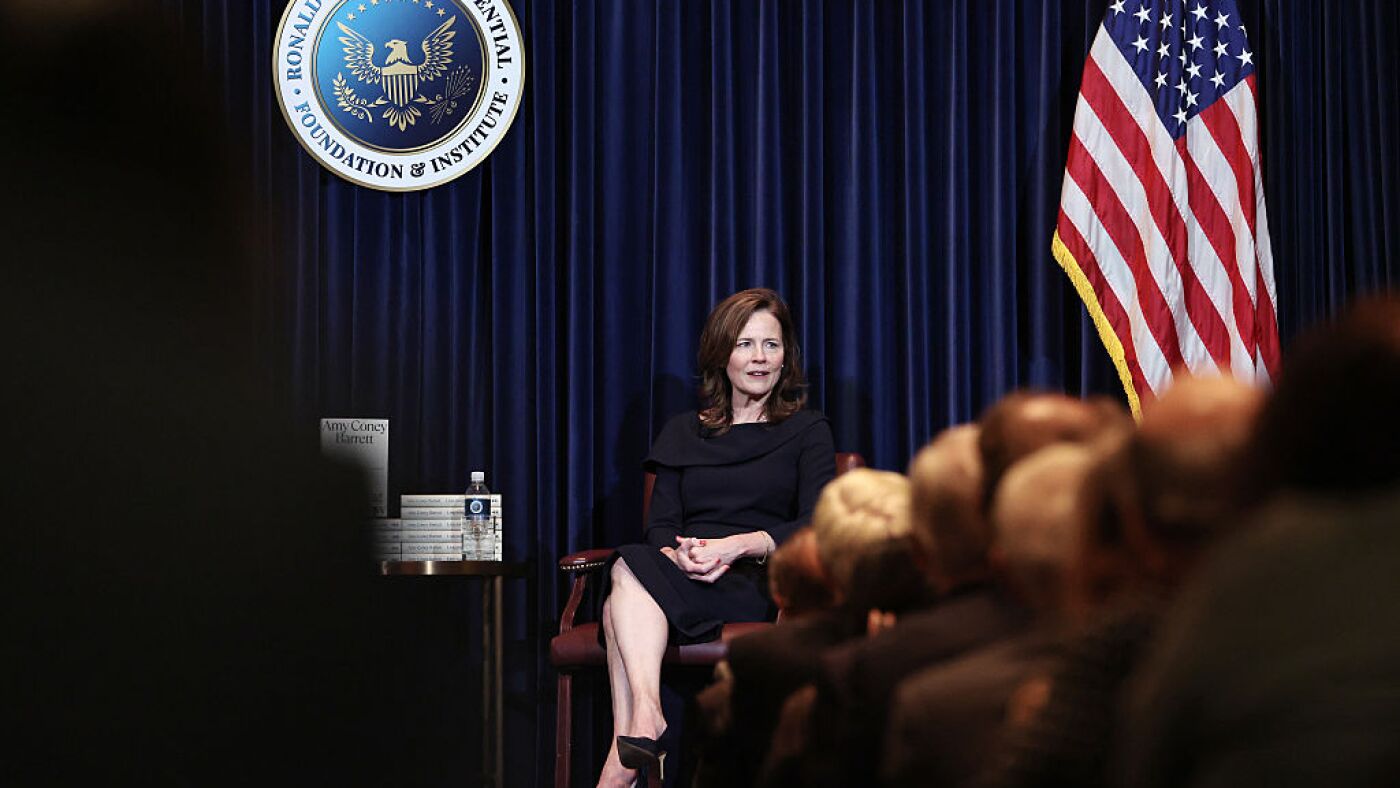
Supreme Court Justice Amy Coney Barrett speaks at the Reagan Library on Sept. 9, 2025, in Simi Valley, Calif. Barrett discussed and signed copies of her new book, Listening to the Law: Reflections on the Court and Constitution.

Mario Tama/Getty Images


hide caption


toggle caption

Advertisement

Mario Tama/Getty Images

Even as the Supreme Court was handing down one legal thunderbolt after another last week, the justices were quietly releasing their annual financial reports. Justice Samuel Alito was the only sitting justice to request an extension, which he has done for 15 years. The disclosures do not give a complete account of the justices’ total income and wealth, but they give insights into their concertgoing, guest professorships and even their involvement in youth sports.

In addition to their salaries, much of the justices’ reported income came from their book deals. Justice Ketanji Brown Jackson led the pack earning more than $1.1 million last year for a total of roughly $4 million since her memoir, Lovely One, was published in 2024.

Justices Sonia Sotomayor, Neil Gorsuch, Amy Coney Barrett and retired Justice Anthony Kennedy also reported income from published books. Earnings from their books ranged from $849,000 for Barrett, to $300,000 for Gorsuch and $88,000 for Sotomayor, whose books include her 2013 autobiography and five children’s books. Justice Clarence Thomas, who previously earned $1.5 million for his 2007 memoir, listed no publisher payments last year, and Justice Brett Kavanaugh, one of 13 co-authors of a 2016 legal treatise, also received no payments last year. Kavanaugh is said to be working on a memoir but he listed no payments for the anticipated book. Alito does have a book coming out in the fall, but with his financial report still outstanding, there is no data on how much he was paid for the work in 2025.

Advertisement

The only two sitting justices who have not written books are Chief Justice John Roberts and Justice Elena Kagan.

Many justices also earned income from teaching at law schools. Roberts reported income from New England Law, located in Boston, and Gorsuch reported teaching income from George Mason University in Virginia. Thomas taught classes at Catholic University in Washington, D.C., and Barrett and Kavanaugh taught at Notre Dame Law School. Barrett graduated from the school and began teaching there 23 years ago; Kavanaugh has family connections to Notre Dame.

Continue Reading
Advertisement

Trending