Lifestyle
These images, that light. In Hollywood with Paz de la Huerta

“I am technically a princess,” says Paz de la Huerta over lunch at the Chateau Marmont — her castle, if you recall her appearance in Lana Del Rey’s “Video Games.” Born in New York City to Judith Bruce and Spanish aristocrat Ricardo Ignacio de la Huerta, Duke of Mandas y Villanueva, De la Huerta doesn’t hold an official title. Born to nobility; ultimately powerless.
Yet in New York’s SoHo, where her family settled in the 1980s, she was royalty of another kind. Larry Gagosian lived above the family, and when they moved to Tribeca, Miramax — the distribution and production company founded by brothers Bob and Harvey Weinstein — rented the apartment next door. De la Huerta attended Saint Ann’s in Brooklyn with Lena Dunham and Jemima Kirke. At school, she met designer Zac Posen and became an early muse. She babysat Lexi Jones, daughter of David Bowie and Iman, and appeared in a film nominated for best picture at the 2000 Academy Awards — all before turning 21. Paz de la Huerta is a real downtown princess.

Paz wears her own Dolce & Gabbana dress, stylist’s own vintage Louboutin shoes.
She now sits comfortably inside the courtyard of the Chateau, 13 years after “Video Games” made iconic the TMZ footage of her stumbling away from a Golden Globes after-party hosted at the hotel. At the time, she was working on HBO’s “Boardwalk Empire,” and the incident almost got her fired. Clear-eyed and steady today, she finishes her earlier thought while piling salt on her arancini: “It’s forbidden for the aristocracy to speak to the press. But in my case, I had no choice.”
Let’s begin with that night at the Chateau. Writer Jay Bulger’s infamous 2010 profile for New York magazine described her as someone who “excels at creating, and causing, drama.” An understandable reputation, given that was the year De la Huerta alleges Harvey Weinstein stalked and assaulted her. In 2011, she approached a journalist about the alleged assault. “Somehow,” she says, “Weinstein learned I had spoken out right before that night.”
At the time, De la Huerta was taking Suboxone for opioid withdrawal. Mixing it with alcohol can be fatal, yet drinks kept appearing in her hands. “There’s the back door for drunk celebrities,” she says, pointing behind me as a waiter approaches, then turns away. That night, she was kicked out the front, where paparazzi awaited. For a while, the scene tarnished her credibility.


Friends told me to brace myself for the petulant movie star, the diva. What I find is a woman early to our date, eager to talk. Her long, Modigliani face has softened over time, more beautiful than in pictures. A scoop neckline and string of pearls frame her often-photographed bust. Her dress, with banded sheer sleeves and an embroidered bodice, recalls Adjani in “Queen Margot,” but the thigh-high slit makes it distinctly Paz. The look flirts with the 15th-century-inspired French Gothic arches behind her. She orders another arancini, covering it with so much salt it spills onto the phone next to her plate.
When she recounts her life, De la Huerta speaks openly, often repeating details. Sometimes she lunges forward to emphasize, shaking the four-top wicker table, giving the impression that hardly anyone has believed her. Sexual assault is discredited when details fumble, as if memory isn’t elastic and unreliable. But De la Huerta’s timeline is always the same. She punctuates stories with smoke breaks, ignoring the poor air quality, and taking them frequently.

Los Angeles is burning, a tragedy so vast it renders Didion’s prose on the Santa Ana winds unhelpful. The images I saw from New York were apocalyptic, the GoFundMe links constant. In Hollywood, it feels as though nothing has happened. I assumed De la Huerta’s latest duo show with Jaxon Demme at the gallery Spy Projects would be canceled. Yet, here we are.
De la Huerta has flown into town from an undisclosed location. In 2021, she ran away from her father in Madrid, ditched her lawyer, and flew to Los Angeles to retrieve her Weinstein settlement. She then rented a farmhouse “near Paris,” as her artist bio states. She operates from a private Instagram and Proton email. “If I stayed in America,” she says, “I would’ve gone bankrupt.” Her paintings, like Francisco Goya’s “Black Paintings,” were created in exile, the two artists centuries apart and finally free from the Spanish aristocracy. De la Huerta’s bright palette recalls Marc Chagall, the painter who fled to New York when the Nazis invaded France.
On Instagram, she posts in a constant finsta-like stream — long captions of horrors she has faced mixed with past shoots and aspirational images. On Oct. 10, 2024, De la Huerta posted a black-and-white still of Helena Christensen in a 1992 Revlon commercial. The caption reads: “I want to take photos like this. I have some photo shoots coming up, but I am feeling the need for some glamour in my life, and I am looking for a modeling manager.” I’m lucky to know many talented photographers, so I messaged her to say I could be of service. Sebastian Acero was set to photograph, Fern Cerezo to style, and Sonny Molina to bless the hair.

It was through photography that I discovered De la Huerta — her brazen sexiness, often captured in Purple magazine, collided with my adolescence. I gazed at her the way she looks at Helena Christensen. Frequently photographed by Terry Richardson for Purple, she asserts that he was never inappropriate with her. That’s her truth, though it may not reflect another’s experience. (Richardson has faced accusations of sexual assault as recently as 2023; he denies all claims of non-consensual sex.)
The list of photographers who have shot De la Huerta reads like the greatest hits of the turn of last century: Terry Richardson, Tina Barney, Nan Goldin, Juergen Teller, Mario Sorrenti, Bruce Weber. De la Huerta has lived a life of pictures, and when everything was lost, it was the pictures that remained.
Around age 6, her parents split. Her father, described by De la Huerta as drunk and abusive — claims that he has denied — moved back to Spain. De la Huerta moved with her mother from SoHo to 311 Greenwich St. in Tribeca. In Barney’s portrait “The Lipstick” (1999), we see a teenage De la Huerta as the punky Lolita applying rouge in her bedroom as her mother looks on. Behind Judith Bruce, a French door is slightly ajar. That door, De la Huerta alleges, connected their apartment, 3C, to 3B, rented out by her mother to Miramax.

Paz wears her own jewelry, stylist’s top and bottom, stylist’s own vintage Louboutin shoes. Rocky wears Primrose Vintage LA top and overalls.

In 1998, Billy Hopkins, a casting director from Miramax, approached De la Huerta and her mother on the street in front of their apartment about a role in “The Cider House Rules.” A complaint filed in Los Angeles by De la Huerta and her then-lawyer Aaron Filler in 2019 states: “Miramax selected their next-door neighbor — 13-year-old Paz De La Huerta — to star in Cider House Rules, so it is indisputable that senior executives at Miramax — almost certainly Harvey Weinstein — were well aware of Paz.” In the same complaint, De la Huerta alleges a series of intimidations and assaults that she said took place in 2010 and 2011 between her and Weinstein. These alleged events would take place years after they met on the set of “The Cider House Rules.” Last year, Weinstein’s 2020 rape conviction was overturned by New York’s highest court — a case built on multiple testimonies and allegations. De la Huerta has since been organizing a GoFundMe to restart her case against him. “It is crucial that someone big takes this story on, someone my family can’t pay off,” says De la Huerta, “someone like Amal Clooney.”
When Luis Bobadilla, one of the muses of our team, picks me up from Union Station, Madonna’s “Live to Tell” — De la Huerta’s exhibition title at Spy Projects — plays. The synchronicities in L.A. keep accumulating, and I’ll learn this is even more true around De la Huerta. A devout Catholic, the artist makes paintings that are heavy with sporadic, jagged symbolism. Larry Gagosian sold Basquiat upstairs while De la Huerta was a baby below, and her work sometimes has the effect of childlike depictions of what she learned by osmosis.
The narrative of her 10-painting offering is as follows: A princess is cursed with never receiving the love she’s given. A butterfly breaks the curse, providing her with a baby girl, born with the love the princess badly needed. Think of Sarah, the conspiracy daughter of Jesus and Mary Magdalene. Jaxon Demme’s sculptures in the gallery’s center are princesses encased in chrome and wire, still waiting for the butterfly to arrive and the suffering to end.
“Which is your favorite?” De la Huerta asks me at the opening. I point to the large painting in the middle that bears the phrase: I thought I had to grieve you. Words spoken by a therapist who encouraged her to paint as a way to heal. “I thought I had to grieve you,” he’d say after long stretches of silence from De la Huerta — instances when she’d be committed and recommitted to mental hospitals.

Paz wears Swarovski jewelry, stylist’s own dress tailored by Bontha, underwear tailored by Bontha, stylist’s own vintage Louboutin shoes. Rocky wears stylist’s own top, shorts and belt.
Inside the painting is a rendering of Kenny the Tiger, the famous inbred white Bengal. “That’s what they do in the royal family,” she says, pointing. “Incest.”
This story is hard to tell: It’s her story — uniquely, terribly hers.
In 2020, De la Huerta traveled to Spain for what would be the last time, to screen “Puppy Love,” a film that won her awards but still hasn’t had a wide release. She hadn’t seen her father in a decade, so she booked a hotel near him in Madrid. Her friend Miguel Morillo later recounted the night in an email: he, a mutual friend and De la Huerta spent the evening in Madrid, talking about movies and life before ending the night with a sleepover at her hotel. In the middle of the night, someone began banging on the door — “Paz, open the door,” a man’s voice demanded. De la Huerta said it was her father. Frightened, de la Huerta pleaded with him to come back later, then asked her friends to leave.

At the opening, all is well. A cooler full of beer below a cheese table signals where I am: the show of an early-career painter. De la Huerta is drinking only the cameras and eyes that are on her. On this night, she is Rita Hayworth. The day before, I’d encountered a hardened grace reserved by life for a select few. What I see on this night is the spell of hair and makeup; I mean this as glamour, a way to make others see what you want them to see. On her private Instagram, she posts long captions about reversing the aging process, and tonight, I watch her do it.
In attendance is De la Huerta’s friend Marilyn Manson; sexual and domestic violence charges against him had just been dropped earlier that day. She insists on his innocence more than once, and my stomach turns. I want to believe her as I do everything I’ve written above, but I can’t. I’ve seen women speak against Manson with the same urgency and detail that De la Huerta has shown me.
Why do we believe some people and not others? During #MeToo, I dated someone who lost their Condé Nast job over similar accusations. I chose to believe their innocence. I cannot ask De la Huerta to turn her back on her friend, just as she cannot ask me to turn my ear from Evan Rachel Wood’s testimony against Manson. Whenever he comes up, I change the subject.
These images, that light. The reason we’re in Hollywood is to make pictures. A month prior, on Zoom, De la Huerta told me and photographer Sebastian Acero that this would work best if it felt like a movie. She set three characters: Whore, Mother and the Ghost of Marilyn Monroe. Through fashion, hair and makeup, she would direct herself into three viable paths her life could’ve taken. We begin with Monroe and end on Whore. When I told her the order, she smiled: “So, we’re starting at the end.”
In the final completed role of her life, Marilyn Monroe plays divorcée Roslyn Taber in “The Misfits” (1961). In it, Clark Gable asks her, “Why are you so sad? You’re the saddest girl I’ve ever met.” As a child, Monroe went to the movies to project dreams of a father onto Gable. Knowing everything we do about Monroe — and how much is still unknown — the film’s penultimate scene is grating. Gable and his crew of men tie up a distressed horse while an equally distressed Monroe watches. She runs, screaming at them, at the camera, at the world: “Horse killers! Killers! Murderers! You’re liars! All of you, liars! You’re only happy when you can see something die!” The scene unsettles Monroe fans, knowing it was her husband, writer Arthur Miller, who perhaps plagiarized her intimate words for the screen.

As Linda in Gaspar Noé’s “Enter the Void” (2009), De la Huerta delivers a scene that evokes a similar feeling for me, that feeling that the actor’s reality is braiding with the film. Linda, a dancer at a club called Sex Money Power, is working when she learns her drug-dealing brother has died. His spirit hovers over the entire film, witnessing the wreckage of his absence. Linda, left without her only friend, crumbles when the person who gave her brother up tries to apologize. She can only scream: “I don’t wanna be here, I don’t wanna be here with these evil f–ing people! They’re f–ing evil!” A video on De la Huerta’s private profile, posted on Jan. 12, shows her being driven around in a van. Laughing, she says, “Gaspar was right — my memoir should be a comedy. But I’m angry with Gaspar because he hasn’t written a statement against my father.”
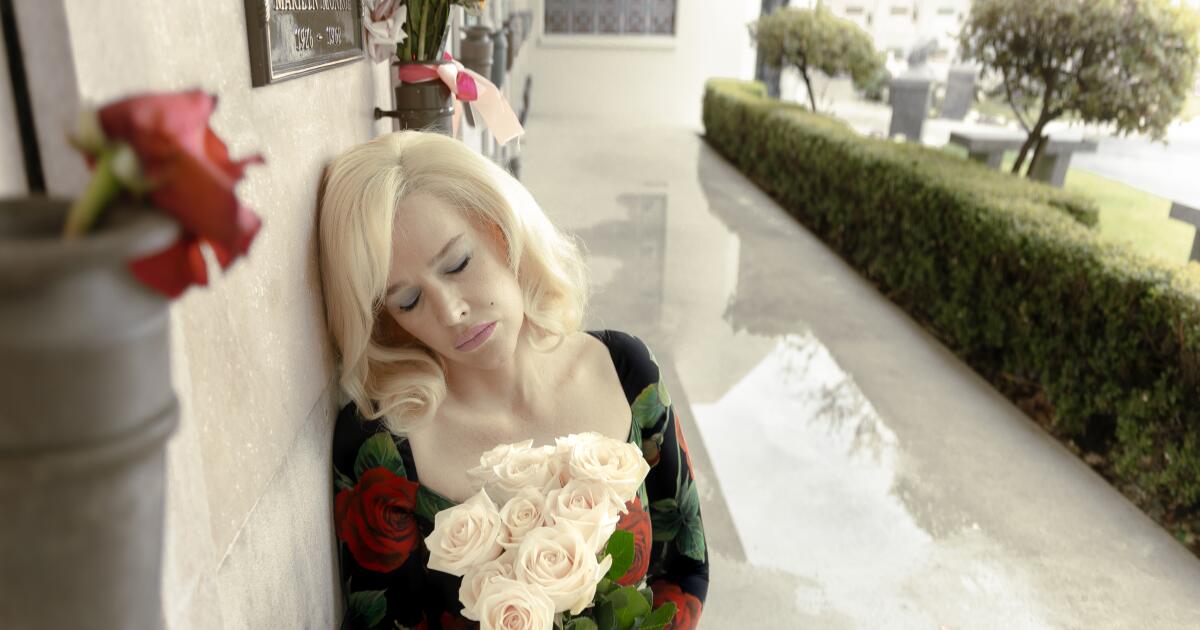
For the ghost of Monroe, De la Huerta insisted on wearing a red rose-printed Dolce & Gabbana dress she bought herself as a birthday gift years ago. She says it was the dress she wore during a near-death experience. In the great purge of her old life, this dress is something she decided to keep, because it protected her. She wants to wear it at Monroe’s grave, because she says it could’ve been her. What does she mean? “The dead actress,” she puts it simply.

Paz wears her own jewelry, stylist’s own top, bottom and tights.
The night before our fitting, I dream my father is staring at me menacingly in a loud club. I am begging my friends to leave, but they can’t hear me over the music.
When it’s finally time to see the Dolce & Gabbana dress at our fitting, I tell her about the dream. I ask for more details about the night her dress saved her. De la Huerta says she was taken out to dinner by the people who manage her father’s money, on the occasion of her birthday, and felt something terrible was imminent. Later that night, in a club, she begged strangers to help her hide. No one listened. My dream connection goes ignored as her focus zeroes in on the dress zipping up. Our patient stylist, Fern Cerezo, does their best, but the zipper won’t close — the gap is too wide.
“I’ll be thinner in the morning, but don’t worry, I won’t make myself throw up.”
Should I be worried about that?
The next morning, after the “Misfits” wig goes on and makeup artist Kennedy’s Warhol paint is stamped, I watch over Cerezo’s shoulder as De la Huerta steps into the dress. The zipper goes up with ease.
It’s raining on the drive to Westwood Memorial Park, where Monroe is buried. At first, I take it as a good sign — then I’m told of mudslides. We Google Monroe’s favorite music and settle on Ella Fitzgerald. De la Huerta requests “Love for Sale,” a song learned back when she hoped to become a lounge singer. She turns around from the front seat and counts Fitzgerald’s different loves from the chorus: old love, new love, every love but true love.
She plays it on repeat at the grave. We hand her the white roses she requested — “It’s customary” — and watch in whispers. “Quiet!” De la Huerta shimmies toward Monroe in homage. More lipstick goes on, and she kisses the name plaque. On her knees, she bows, splaying her arm in praise. Marilyn Monroe, the guardian angel of all working girls. A saint whose image still works and sells in smoke shops, tourist traps and museums.
A family tries to visit the grave but instead watches De la Huerta perform from across the street. The rain stops and the sun comes out on schedule for the next look.

Paz wears Manolo Blahnik shoes, talent’s own jewelry, stylist’s own bottom, tights and gloves.
Monroe experienced three miscarriages in her lifetime; De la Huerta has lost two children. Her desire for motherhood is evident — not just in conversation but in the narrative arc of her show at Spy Projects. For our photo shoot, she requested a child to act out a maternal scene with her.
Fortunately, our head producer, Palma Villalobos, had a connection: Rocky Mosse, age 8. For this look, De la Huerta is referencing “Domestic Bliss,” Angelina Jolie’s 2005 editorial with Steven Klein for W Magazine. We are lucky to have Justin Bontha — tailor to Rihanna and Madonna — on set to tweak a caftan that Cerezo crafted from polka dot fabric.
By the pool, De la Huerta is playful with Rocky, and this time, the audience is allowed to make noise. Our laughter emboldens her. “You’ve got to sleep for 15 days, Rocky!” Because it’s almost “Mommy and Daddy day.” Rocky stamps his foot in giggly indignation. If he does his homework, she says, he doesn’t get to eat. If he doesn’t do it, he gets candy.
She plays bad mommy like a John Waters muse; I think we need to see De la Huerta in a comedy. She nicknames her scene-mate “Rocko” in a Long Island accent from 1985. Rocky protests this new name. De la Huerta accuses him of hating her. All is said with an air toward entertaining us, but something else hovers over the interaction.
Back in the makeup chair, robe on, she thinks out loud while her lipstick is being wiped off: “I don’t know what I’d do with a son, you know? I’m so feminine.” Some of us AMABs on set joke that our mothers said the same.
We’re back at the Hollywood Roosevelt Hotel, where De la Huerta is staying and Monroe once lived as a model. The doorman is very friendly and asks if there’s a party going on. “It used to be a party place,” says De la Huerta, lighting her first indoor cigarette of the shoot. At the fitting, I had asked if she was in a smoking room. She laughed, then mocked me as she blew out the window. “Is this a smoking room?”


Her best friend James Orlando has been her right hand the entire shoot, a quiet and supportive presence. It was Orlando who paid for the Iboga, the West African psychedelic De la Huerta credits with rewiring her brain, allowing her to live without a pill in her body.
Orlando met De la Huerta on set for a Bullett Magazine shoot in August 2010. In a video interview for the issue, an off-screen voice asks her, “What was your first acting experience that did not involve a camera or a stage?” She lists a few things — playing dress-up with her sister, negotiating with her father, and learning how to manipulate him to get what she wanted. If it was a dress she wanted, she’d do “anything and everything to get it.”
Behind the camera, something about her answer unsettled Orlando. Maybe it was that moment, or maybe it was the way De la Huerta walked around naked at the Bullett offices, but his judgment was already forming.
In 2007, De la Huerta directed a short film called “Pupa, Papa, Puta.” The tongue-twister translates to “Doll, Dad, Whore.” The creator of the film’s lead, a doll, is a violent man. It’s only when the doll shatters that she can come alive in the form of De la Huerta, her own self-directed star, naked in broad daylight, sweeping up the pieces.
At the Hollywood Roosevelt, she’s channeling Anouk Aimée in “Lola” (1961), her current style icon, and whom she believes she most resembles. She’s energized, still speaking in the Long Island accent from earlier, lighting cigarettes constantly.
As we set up for the next shot, room service delivers a bottle of wine. To be clear, De la Huerta has never claimed sobriety. Orlando advises her not to drink on camera, as any good friend should. Through the lens of harm reduction, a glass of wine seems benign, certainly less harmful than opiates. But the details of excessive drinking that she attributes to anxiety and depression in her 2019 complaint against Weinstein ring in my ears. If you believe her — and I do, completely — it’s hard not to think about.
De la Huerta calls herself a method actor, and watching her now, I don’t see someone with a drinking problem. I see an artist doing what artists do: opening the wound, peering into it, and extracting what she can.

Cerezo dresses De la Huerta in a white petticoat and matching corset until she tosses off the top and demands total silence. To keep talking among ourselves, we hide in the bathroom, where I spray her perfume — Queen Nzinga by Marissa Zappas — on my wrist. From outside, I hear De la Huerta giving Sebastian Acero a striptease to “Nutshell” by Alice in Chains. Jerry Cantrell’s guitar weeps on the track for Layne Staley, who died of an overdose at 34. No matter how much of De la Huerta’s story you believe, it’s a miracle she has lived to tell it. Her 40th birthday was this past fall, a benchmark that might make an actor nervous, but De la Huerta still dreams, wishing to sell paintings, make films and star in fashion campaigns. At one point, she tells us she’ll fly us out to dress her for a future wedding, wherever it is that she lives.
We try one more look, but she vetoes it. The shoot is over. Sonny Molina quickly throws De la Huerta’s hair up for a dinner date she’s late for. Once dressed, she pulls me over to share a secret. It leaves me unsure of what to do or how to forget it. She says it’s something to keep in mind, you know, “as you write my story.”
Devan Díaz is a writer from Queens, N.Y.

Creative direction by Devan Díaz
Photography by Sebastian Acero
Styling by Fern Cerezo
Production Palma Villalobos
Hair Sonny Molina
Makeup Kennedy
Child model Rocky Mosse
Production assistant Luis Bobadilla
Hair assistant Kalia White Smith


Lonnie Bunch III is the 14th Secretary of the Smithsonian. He’s pictured above in September 2017.
J. Scott Applewhite/AP
hide caption
toggle caption
J. Scott Applewhite/AP
In a memo addressed to staffers sent Tuesday, the secretary of the Smithsonian, Lonnie G. Bunch III, defended the institution after the White House issued a 162-page report that characterizes the National Museum of American History as a place which has become “subject to institutional capture by a radical, activist ideology that is fundamentally opposed to telling the noble, honest story of the great country we know and love.”
In his email, which NPR has obtained, Bunch wrote in part: “While there will always be room for improvement, this report is not a fair characterization of the work and totality of the National Museum of American History. At the Smithsonian, our work is driven by scholarship, accuracy and an uncompromising commitment to tell the fullness of America’s story. As public servants and the keepers of this institution, we are charged with helping a nation find understanding, hope and clarity and as part of that duty, we are dedicated to excellence, reflection and growth.”

He continued: “We remain focused on what grounds us: a steadfast commitment to scholarship, nonpartisanship, independence, accuracy and integrity. For nearly 180 years, the Smithsonian has worked alongside partners across government — from the White House to Congress to our governing Board of Regents — guided by our enduring mission to increase and diffuse knowledge. That purpose remains: to pursue knowledge with rigor and to serve the American public with clarity and care.”
The White House report was issued on July 4 by the Domestic Policy Council under the title “Saving America’s Story: How Ideological Capture at the Smithsonian Institution’s National Museum of American History Erases Our Heritage.”

The council faults the National Museum of American History on a multitude of fronts, saying it underemphasized the Founding Fathers and early colonial and Revolutionary history; was not sufficiently celebratory of the country’s 250th anniversary; and that it engaged in “anti-white,” “illegal alien” and transgender activism.
It also accuses the museum of trying to “indoctrinate” teachers and students through its exhibitions, programming and teaching resources.
In the report, the council also specifically criticizes museum director Anthea Hartig, who has led the National Museum of American History since 2019 and is concurrently the president of the Organization of American Historians, calling her “an activist advancing an ideological agenda contradictory to the museum’s founding purpose of fostering patriotism.”

The Trump administration has made the Smithsonian museums one of its primary targets in its efforts to reshape cultural narratives to align with its viewpoints. In August 2025, the White House requested a “comprehensive internal review” of eight Smithsonian museums, including the National Museum of American History, following an executive order issued by President Trump in March 2025 in which he called for the removal of “improper ideology” from the Smithsonian’s offerings.
According to the Smithsonian’s charter, all of its 21 museums, 14 education and research centers, and the National Zoo are meant to be run independently of the federal government. The Smithsonian is overseen by Bunch and a board of regents, which includes Vice President Vance, Supreme Court Chief Justice John Roberts and other members appointed by Congress.
In an interview with NBC’s Meet the Press on Sunday, Bunch spoke about the Smithsonian’s 250th anniversary special exhibition at the Smithsonian Castle, which is called “American Aspirations.”
He told NBC: “It’s really important for people to understand that America is much an ideal as it is a place, that it’s a series of aspirations that have really shaped who this country is. And so for me, what is so powerful is to say, ‘Let us honor the words of Thomas Jefferson and the founders, but let us use those to challenge us to be better.’”
Jennifer Vanasco edited this story.

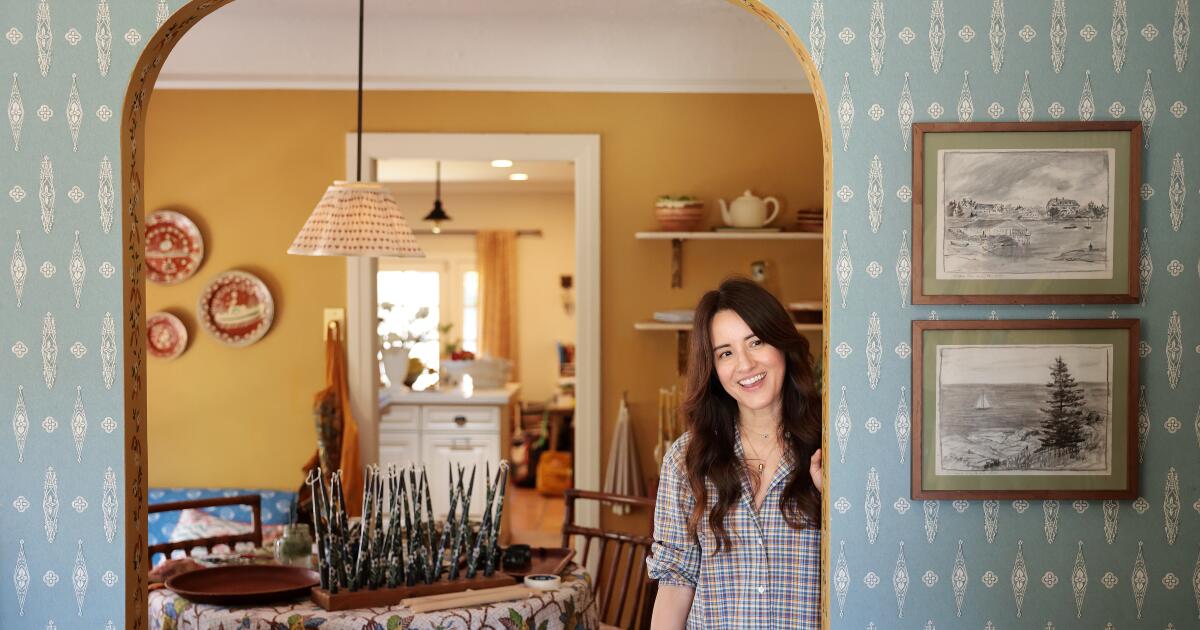
It was after the death of her son, Laith, that Esme Saleh decided to become a folk artist.
She had always been creative, experimenting with watercolors and learning to sew and embroider at a young age.
“I had a creative inkling,” she said, “but I never pursued it.”
Everything changed on Aug. 17, 2013.
In this series, we highlight independent makers and artists, from glassblowers to fiber artists, who are creating original products in and around Los Angeles.
When Saleh was nine months pregnant, she woke up with stomach pains and presumed she was in labor. She and her husband, Nasim, immediately went to the hospital, where doctors checked her and put the baby on a heart monitor. Saleh’s blood pressure was high, however, and the baby’s heart rate kept dropping. After about an hour, his heartbeat stopped. Doctors rushed her in for an emergency C-section, but it was too late. Laith did not survive.
Saleh lost a tremendous amount of blood and developed postpartum HELLP syndrome, a dangerous form of preeclampsia, but doctors were able to stabilize her.
When she woke up, the first thing she asked was, “How’s my baby?”

After losing her son in 2013, Esme Saleh left her job as a television producer. Since then, she has sold her hand-painted candles to local designers in Los Angeles and to LVMH in Paris.
“Aug. 17, 2013, was the most difficult day of my life, and Aug. 22 was the second most difficult, the day we drove home with an empty car seat,” she said of her and her husband’s new reality.
They named their son Laith Finn Saleh.
“His first name means ‘lion’ in Arabic. His middle name is an ode to Huckleberry Finn — sharp wit, kind heart, strong moral compass — all the attributes he’s imparted on us in spirit,” said Saleh, 45.
After such a devastating loss, she found it difficult to trust the world again. “It was hard to trust anything,” she said. “The medical system. Myself. It made me realize the fragility of bringing anything to life. We take so much for granted.”
So after years of working as a television producer, Saleh left broadcast journalism and leaned into her creative spirit.
She grew up in San Diego. Her mother was raised on a farm in Mexico, and her father moved from Tijuana to Los Angeles to be near her mother, who started working for a family in Sherman Oaks at 16. They eventually settled in San Diego, where Saleh’s father, now a church deacon, worked as a car salesman.


“The word Mystic has also become a driving force of what this journey means to me,” Saleh says. “A magical, otherworldly journey that has led me to some beautiful friendships, projects and unlimited well of curiosity. When I paint each pair of candles, it feels like I’m imparting a piece of that magic.”
“He always wanted to be a weatherman on TV,” she said, explaining how he hoped to get his big break on television by doing a weather report from the car lot.
Saleh wanted to be a broadcast journalist as her father had. After graduating from San Diego State, she interned in the sports department at CBS affiliate KFMB-TV although she didn’t know much about sports. She enjoyed sharing information with people, learned how to write plays of the week and felt she had found the right career.
But during a summer class at Mesa College, she started to think journalism might not be for her.


Saleh’s home is filled with her artwork. “My home expresses a lot of the things that I do,” she says. “If it works here, then I feel like I can put it out in the world.”
“I’m an empath — a sensitive soul — so when I was reading news about death and destruction, my eyes could not lie,” she said. Her professor told her, “This may not be your thing.” But when she arranged flowers on camera, she really came alive. She decided to work behind the scenes as a producer.
Her professor helped her get her first network news job in 2003, and she moved to Los Angeles, working on hard news and entertainment coverage.
After losing Laith a decade later, she couldn’t keep doing red-carpet interviews and acting like everything was fine. “It all felt so different, superficial and hard,” she said. “I felt like there was a bigger purpose out there for me. It’s in the small things that we find the big things.”
She started by painting folk art-inspired invitations for a friend’s baby shower. She painted delicate flowers, oranges and leaves on glass, leather and even lampshades. She created a logo. “I was just trying to say yes to things that were really scary,” she said. “Laith gave me the courage to do that.”

“I was just trying to get out of hole,” Saleh says of taking up painting after her son died.
Her first son, she said, became “a catalyst for painting.”
Then, at the first Thanksgiving during the COVID-19 pandemic when people could gather again, she had a light-bulb moment. “I was setting the table and didn’t have flowers or anything to add to decorate, so I thought, ‘I have these candles. I’m going to paint them and make them fancy,’ ” she said.
Her guests were impressed.
As time went on, painting taper candles helped her find joy again, and others noticed too.
“The one thing I hear when people pick up a pair of my candles is, ‘This makes me so happy. It makes me feel like there’s life here,’ ” she said.
1

2

3

1. Saleh sometimes leads painting workshops where participants can decorate items like ornaments and lampshades.
2. Leather napkin rings Saleh has painted for Nathan Turner. 3. Saleh’s hand-painted candles retail for approximately $42 to $50.
One of the hardest parts of losing a child “is that you’re not just grieving the person, you’re grieving the future you imagined with them,” said Chicago-based grief specialist Carla Harvey. “A lifetime of love suddenly has nowhere to go. Creating art doesn’t erase grief, but it can become a way to carry it.”
Saleh created her brand Mystic by Esme in 2021, but it took her some time before she could gather the courage to try to sell them.
When she brought a shoebox full of samples to Nickey Kehoe, the L.A. store agreed to carry her candles. “I was beside myself,” Saleh said.
“Her candles were absolutely beautiful, and she had a fantastic spirit that made selling them a no-brainer,” said interior designer Todd Nickey, co-founder of Nickey Kehoe.

Saleh gets a surprise kiss from her dog Olive while painting candles at her dining room table.
Saleh viewed her new side project as a way to earn extra money for piano lessons for her 11-year-old son Linus, who is an entrepreneur like his mother. “I felt proud painting the candles while he was in lessons in the next room,” she said. “It became this circular economy, and it led to bigger opportunities for me.”
Last year, luxury conglomerate LVMH commissioned Saleh to paint 465 pairs of candles, or 930 candles in total, for its Chaumet jewelry brand. The collection was unveiled at an elaborate event at the Abbaye des Vaux de Cernay, just outside Paris.
“It was fun,” Saleh said about the process, which took six months from conception to delivery. “I felt like I was dressing my candles up for a party.”
Always a hard worker, which she attributes to being a first-generation child of immigrant parents, Saleh has now created a candle collection for Pierce and Ward in Los Feliz, leather napkin holders for interior designer Nathan Turner and pomegranate wrapping paper for Olive Ateliers. The candles retail between $42 to $50 for a pair, and recently, she developed a handsome pewter candle shaver that will be released in the winter.

Her dining room can sometimes feel like “an assembly line,” Saleh says.

Saleh holds a pair of candles she has embellished with florals.
Occasionally, she leads painting workshops, and she loves helping others tap into their creativity. The most meaningful one for her was an ornament workshop attended by several victims of the 2025 Los Angeles wildfires. “Without saying anything, we understood each other,” she said. “I understood that they were trying to create memories.”
Saleh knows what it means for things not to last — “impermanence,” she calls it — whether it is homes, candles or life itself.
She paints every day in the art-filled dining room of her home (unless it’s Little League season), surrounded by her family, candles and her two dogs, Lennon and Olive. ”Painting is like meditation,” she said. “You can sit in your dining room and tune everything out and just be in the moment.”

Even the family’s summer bucket list receives an artistic flourish.

An arch inside Saleh’s home receives a personalized touch.
She knows painting candles isn’t new, but she believes her motivation and the care she puts into each candle makes them special beyond their looks.
She has learned to look at the world that way, that painting in her dining room has offered her healing and joy, that she can trust herself and her body, that continuing to be inspired by her two boys — “one in spirit and the other here on Earth” — means that Laith will always be with her.
Many people think healing means moving on, said grief specialist Harvey, but “it’s really about finding ways to move forward while keeping the people we love woven into our lives. That’s what I see in her candles, not an ending, but an ongoing relationship with her son.”
“I feel like my son is channeling through this medium,” Saleh said, her voice breaking as she painted a taper. “He’s whispering to me, ‘Mom, this is your path.’ That has been my driving force. We’re going to grow this together.”
Lifestyle
Terry Tempest Williams on why women with big ideas get labeled ‘crazy’ : Wild Card with Rachel Martin

A note from Wild Card host Rachel Martin: I met Terry Tempest Williams about 25 years ago at a writer’s conference in Yosemite Valley. I was a young reporter who was there to do a story about how literature was addressing climate change and she made such a huge impression on me. I had never heard someone talk about the natural world the way Terry did and she had a spiritual depth I hadn’t encountered in my life at that point.
To this day, Terry’s writing always reorients me towards what is good, what is beautiful, and what is true. Her newest book is called “The Glorians.”
-

 World4 minutes ago
Hoops Players’ Win Tops Big Day in NCAA Eligibility Litigation
-

 Health29 minutes ago
3 Best Peptides for Weight Loss—and the Viral One Doctors Say To Skip
-
Lifestyle44 minutes ago
Smithsonian chief emphasizes ‘accuracy and integrity’ after White House report
-

 Technology56 minutes ago
Microsoft’s carbon emissions went up 25 percent last year
-

 World59 minutes ago
Jailed Catholic woman’s hunger strike highlights Iran religious persecution — US demands action
-

 Politics1 hour ago
Israel shares intelligence warning Iran plotted new assassination attempt against Trump: report
-

 Health1 hour ago
Parasitic infection causing ‘explosive’ stomach illness exceeds 1,000 cases in northern state
-

 Sports1 hour ago
London descends into disorder as Morocco fans flood streets after World Cup elimination by France

