Business
Opinion: California ruled with great jobs and boom times. What happened?

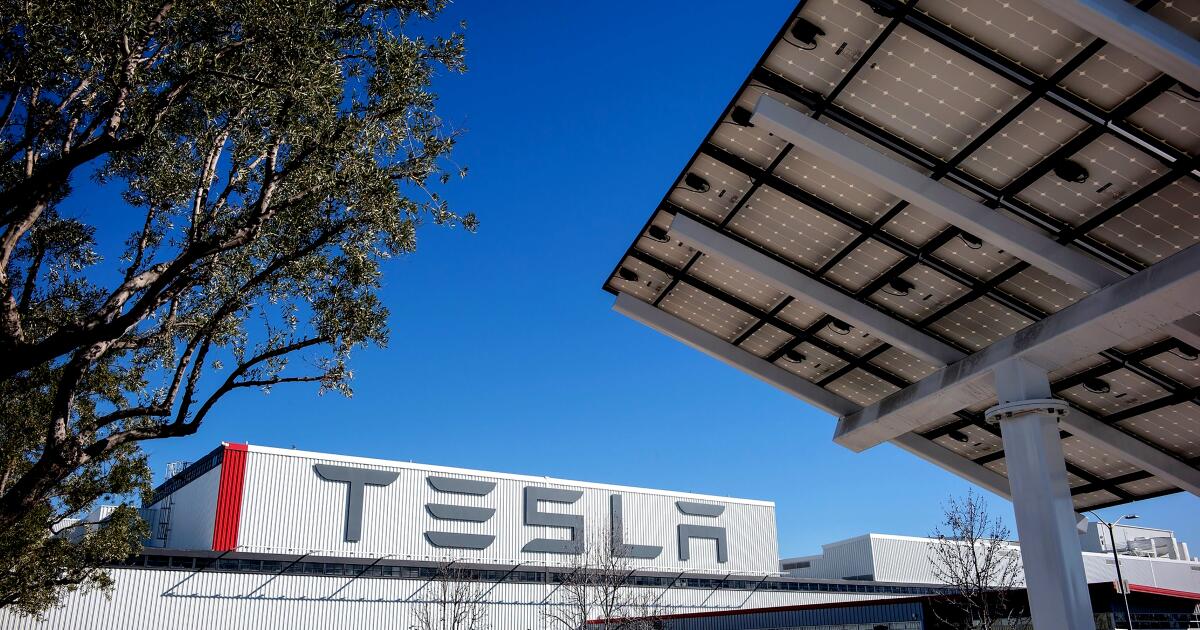
Gov. Gavin Newsom’s constant reminders that California’s economy ”leads the nation” as well as being a model for social justice are delusional. To be sure, California has a huge GDP, paced largely by high real estate prices and the stock value of a handful of tech companies, but it is not widely seen as a place for class mobility, and it is slowly ceding its dominance, even in tech-related industries.
In contemporary California, home to four of the world’s seven most valued tech firms, tech bros and real estate speculators occupy what Lenin called “the commanding heights,” while the reality on the ground is far less ethereal. The view from where most Californians reside is revealed in a new study sponsored by Chapman University: “Is California Losing Its Mojo?,” by business professors Marshall Toplansky (Chapman) and Kenneth Murphy (UC Irvine).
Historically, the report notes, California has outpaced the rest of the country in terms of the growth of its goods and services. However, that pace of GDP growth in the state has dropped significantly since 2022, with the measure now lagging when compared with other states. The distribution of jobs and wealth is even more worrisome.
California has been a particularly poor bet for blue-collar professions, such as manufacturing, the traditional path to upward mobility for minorities and non-college educated people. Bureau of Labor Statistics data, analyzed by Lightcast, shows California has lagged far behind places like Utah, Nevada, Texas and Arizona over a decade.
The Chapman paper acknowledges that the state has experienced enough job growth to keep unemployment levels low, but as the report details, most new jobs in California aren’t concentrated in high-wage sectors. Over the last 10 years, 62% of jobs added in California were in lower-than-average paying industries, versus 51.6% for the nation as a whole. In the last three years, the situation worsened, with 78.1% of all jobs added in California coming from lower-than-average paying industries, versus 61% for the nation as a whole.
In a state with high living costs, a dearth of well-paying jobs seems likely to bear responsibility for the state’s out-migration rate and its poverty rate, which the Census Bureau calculates, in its most comprehensive estimate, as 15.4%, one of the highest in the nation. California may be home to a lot of billionaires, but it also is home to nearly 30% of the country’s homeless.
Of course, not everyone has suffered. Besides tech billionaires, who is doing well in California? Older homeowners, for one, whose bottom line has risen as home values increased dramatically. Government workers have also thrived.
Census Bureau data highlighted in the Chapman report show that California public sector job growth over the last decade has been growing at about the same pace as jobs overall in California, but the average annual pay for those government jobs was almost double that of private sector jobs. In other words, the road to the middle class comes not from private employment but from jobs that are funded by taxpayers.
In the past, California cities including San Francisco, San Jose and San Diego all ranked in the top 10 among hubs for “advanced industry” employment — where there’s high investment in R&D and a high percentage of STEM roles. But since 2020, only San Jose remains in the top 25 metro areas for growth in such employment. Today the emerging hot spots are often east of the Sierra: Austin, Texas; Nashville; Indianapolis; Salt Lake City; and Phoenix.
Can California get its mojo back? After all, many of the state’s assets — research universities, leading tech firms and the lifestyle appeal — have not disappeared.
First, Newsom and other state cheerleaders have to stop using the size of the economy as a cover for real problems. Whatever the state’s strengths, as the Chapman report puts it, low-wage jobs overtaking advanced industry work is not sustainable.
The Biden administration emphasized bringing manufacturing back to the U.S., and President-elect Donald Trump promises to do the same, but California misses out on opportunities due to the costs associated with its regulatory regimes.
Consider technologies largely developed and embraced by California, such as EVs and the batteries that run them. Jobs in those manufacturing industries overwhelmingly fall to red states, largely a reflection of such things as easier permitting rules, lower energy costs and less intrusive labor regulations.
Remarkably, Newsom, who feuds with Elon Musk and has taken on the role of the national anti-Trump, has promised that if the next administration in Washington eliminates the federal $7,500 buyer EV tax credits, California will step in with state rebates for the vehicles — with reportedly one exception, Teslas, which happen to be the dominant American brand and the only EVs made in California. The plant in Fremont employs thousands in good manufacturing jobs.
And that’s hardly the end of the self-destructive politicking.
One “advanced industry” where California, and in particular Southern California, still has a leg up is aerospace, and its corollary, defense. The state remains well in the lead in terms of aerospace-related employment, and innovative new firms, such as Anduril in Orange County, seem primed to take advantage of Trump’s emphasis on military spending. In his first term, he increased the defense budget to historic highs.
But is California’s Democratic leadership on board?
Once again, the state’s relations with Musk, Trump “first buddy” and the world’s preeminent space pioneer, would indicate just the opposite. Musk, upset at a California law that allows schools to keep parents in the dark when their children identify as LGBTQ+, decided to move SpaceX’s headquarters from Hawthorne to Texas this year. And just weeks ago, the California Coastal Commission denied SpaceX’s request to increase its rocket launches from Vandenberg Air Force Base; reportedly after commissioners discussed his political views before they voted on the issue. Even Newsom objected.
This is not the way to build a truly inclusive and healthy economy. Gavin Newsom can talk all he wants about California’s bounty, but the road the state’s Democrats have set for us has been profoundly regressive.
Joel Kotkin is a contributing writer to Opinion, the presidential fellow for urban futures at Chapman University and senior research fellow at the Civitas Institute at the University of Texas, Austin.

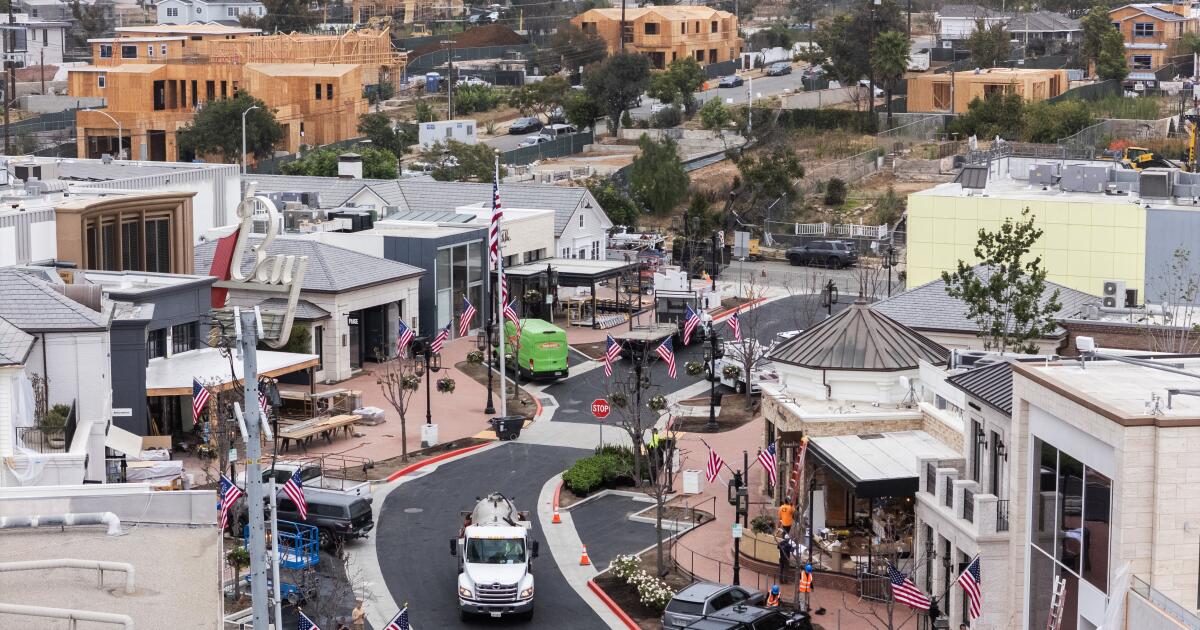
The luxury shopping center in Pacific Palisades will reopen next month after more than $100 million in renovations forced by the January 2025 wildfire that devastated the Los Angeles neighborhood.
Palisades Village will reopen Aug. 15, owner Rick Caruso announced Wednesday. The outdoor center survived the blaze that destroyed homes and other businesses but needed refurbishment to eliminate contaminants that the fire could have spread.
Crews are putting finishing touches on mall buildings after tearing them down to the studs, treating the wood and rebuilding the walls, Caruso said.
“Everybody’s working, and stores are moving their products in,” he said. “It’s a really cool feeling that people have really locked arms and are working together.”
An electrician installs lighting for a restaurant at Rick Caruso’s Palisades Village on Thursday. The shopping center is scheduled to reopen mid-August.
(Myung J. Chun / Los Angeles Times)
Pacific Palisades resident Allison Polhill, who is rebuilding the home of 30 years that her family lost in the blaze, said she is “thrilled” at the prospect of returning to the mall she used to frequent. Its comeback is a boost for the community, she said.
“Every single step that we make to reopen our commercial corridors is going to bring more people back into the Palisades,” said Polhill, who expects to move back into her home at the end of August.
A total of 6,822 structures were destroyed in the Palisades fire, including more than 5,500 residences and 100 commercial businesses, according to the California Department of Forestry and Fire Protection.
Caruso previously attributed the mall’s survival to the hard work of private firefighters and the fire-resistant materials used in the mall’s construction.
The $200-million shopping and dining center opened in 2018 with a movie theater and a roster of upmarket tenants, including Erewhon, which may be the only grocer in the heart of the fire-ravaged neighborhood when it opens.
Caruso’s company was able to fill the mall with tenants despite the long shutdown.
Palisades Village is 99% leased, with the majority of tenants returning, said Jackie Levy, chief financial and revenue officer. Nearly one-third of the shops and restaurants are new to the property.
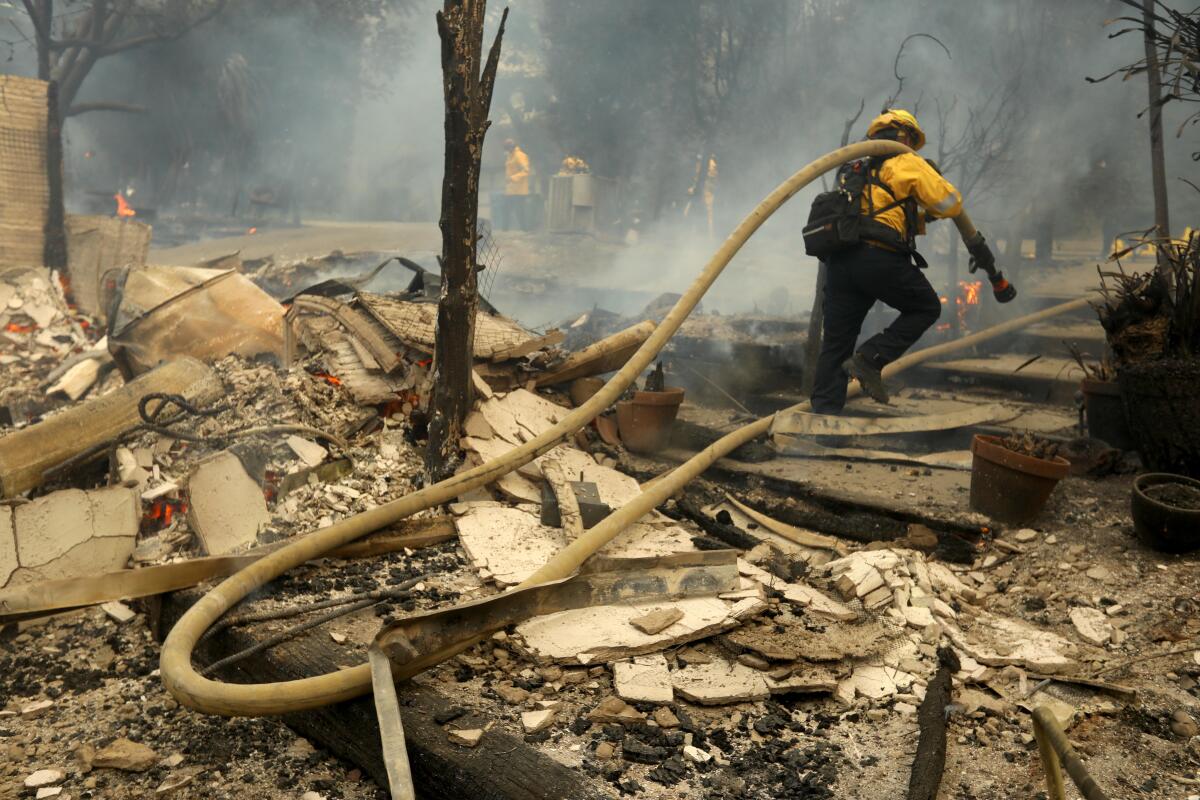
A firefighter carries a hose back to his rig while walking through a destroyed home from the Palisades fire in Pacific Palisades on Jan. 7, 2025.
(Genaro Molina / Los Angeles Times)
Last year, Pacific Palisades-based fashion designer Elyse Walker said she would reopen her eponymous store in Palisades Village after losing her 25-year flagship location on Antioch Street to the inferno.
Other neighborhood shops destroyed in the fire that are reopening at the mall include K Bakery and Loomey’s Toys, which caters to children up to age 12 and used to be across the street from Palisades Elementary Charter School.
“It’s been a journey and I’m excited because I wasn’t sure that there was going to be a place to come back to,” said toy store owner Amanda Rastegar. “Hopefully we can bring some of that magic back.”
Rastegar’s home in the Palisades survived but was damaged by the fire. The family returned about eight weeks ago. Her last memory of the fire was a burning supermarket.
“I just couldn’t wrap my brain around what was happening,” she said. “By the time I left, Gelson’s was on fire.”
Among the returning tenants is Angelini Ristorante & Bar. Well-known Los Angeles chef Gino Angelini said he will be in the kitchen next month for a return of the Italian restaurant.
“We won’t do a big celebrity open,” he said. “We want to have a very soft opening and see our customers come back.”

Construction takes place at Rick Caruso’s Palisades Village on Thursday. The shopping center is scheduled to reopen mid-August.
(Myung J. Chun / Los Angeles Times)
An elaborate celebration would not feel “correct for me,” Angelini said, because the devastation has been “very sad” for so many.
Other new tenants include local chef Nancy Silverton, who has agreed to move in with a new Italian steakhouse called Spacca Tutto. Women’s activewear retailer LESET will open its first West Coast location.
Caruso said he is optimistic that customers will return to the center, even though many Pacific Palisades residents are still dispersed. One tracking system estimated that about 30% of the Village’s customer base was impacted by the fire, he said.
“That means 70% did not get impacted, so there’s a lot of customers still left out there,” Caruso said. Historically, the center drew customers from as far away as Beverly Hills and Calabasas, as well as Malibu, Brentwood and Santa Monica.
He also hopes many will be inspired to visit the revived mall.
“I believe in the goodness of people and I believe that people are going to want to support the Palisades,” he said. “They’re going to want to be there and support the businesses that have had the courage and the heart to reopen.”

Walmart is rapidly expanding its network of electric vehicle chargers designed for customers to use while they shop.
The network could help fill gaps in EV infrastructure in states with greater need for chargers. Walmart, which has more than 5,000 locations in the U.S. and hundreds in California, says more than 90% of Americans live within 10 miles of one of its stores.
The chargers also offer an incentive for customers to choose Walmart — Walmart Plus members will receive a 10% discount off an average price of $0.46 per kilowatt-hour of energy at the company’s chargers.
Walmart chargers are already available at more than 75 locations in 17 states, with Texas boasting the most charging stations, followed by Florida and Arizona.
Matthew Nelson, Walmart’s director of energy policy, said last week on LinkedIn that the network will soon reach 29 states, including California.
“We are delivering on the promise of affordable, reliable and convenient charging,” Nelson said in his post.
According to Walmart’s website, six charging stations are coming to California soon, though the company did not offer a specific timeline.
The chargers will be installed at stores in Antelope, Brea, Fresno, Stockton, Suisun City and Vallejo.
Most charging sites in California will include eight to 16 fast-charging stalls, said Walmart spokesperson Kelsey Bohl.
The company first announced plans in April 2023 to install its own EV chargers at Walmart and Sam’s Club stores, with a goal of installing thousands of chargers by 2030. Partnering with ABB E-Mobility and Alpitronic, it added 25 new charging sites this past May and six more in June.
“Walmart is building a leading retail-integrated EV fast-charging network, focused on delivering an affordable, reliable and convenient charging experience where customers already shop,” Bohl said in an emailed statement. “Customers can charge while they shop, access stations through the Walmart app they already use, and benefit from affordable pricing.”
The charging stations already available include 612 individual charging stalls using 400-kilowatt chargers. Each stall has a dual charging cord with both Combined Charging System and North American Charging Standard connectors. The standard connectors, designed by Tesla, are smaller and lighter than the combined systems.
The primary way to pay for the chargers is through the Walmart app, but the company is also experimenting with built-in credit card readers to allow those without the app to use the stations.
Customers can check charger availability on the Walmart app. The company said the chargers will be available 24 hours a day.

Robotaxis could be turning into robocops.
A self-driving Waymo reported two teens to San Mateo, Calif., police on Monday after they were found drinking alcohol and shooting toy guns in the back of the vehicle.
According to a social media post from the San Mateo Police Department, officers detained two 15-year-olds after the Waymo they were riding in contacted the department and stopped in a parking lot until law enforcement arrived.
“Parents do you know where your teens are?” the San Mateo Police Department wrote on Facebook following the incident. “Waymo does!”
Officers removed both teens from the vehicle and determined they were using toy guns to shoot Orbeez out the windows. Orbeez are small, water-absorbing beads sold at toy stores.
“Toy guns, water guns, and BB guns all pose real dangers, especially to an untrained eye,” the Police Department said. “The simple handling of them can cause fear in [passersby].” “
A video posted on Facebook shows at least five officers and a police dog responding to the scene and approaching the Waymo with their weapons raised.
Waymo did not immediately respond to a request for comment.
Waymo vehicles have internal cameras and microphones that may be used in an emergency or to “promote safety and security,” according to Waymo’s online support page.
The cameras are also used to ensure the vehicles are clean and to help find lost items, according to the support page.
The company said it does not use facial recognition or other biometric identification technologies to identify individuals.
“In more urgent circumstances, support may access live video during a trip,” the Waymo page said.
The San Mateo Police Department’s Facebook post has garnered nearly 60 comments, with one user accusing Waymo of “snitching.”
“At least they got a designated driver?!” one user commented.
-

 South Dakota2 minutes ago
South Dakota man faces abuse charges after authorities called to NW Iowa casino
-

 Tennessee5 minutes ago
Data centers driving up Tennessee power bills, report finds
-

 Texas10 minutes ago
Family demands investigation after US man killed by ICE agent in Texas
-

 Utah17 minutes ago
Turn your miles into meals
-

 Vermont20 minutes ago
Poll: Most young Vermonters say they’re likely to leave state amid affordability concerns – VTDigger
-

 Virginia25 minutes ago
MEOC Organization hosts annual summer picnic for Southwest Virginia seniors
-

 Washington32 minutes ago
Future uncertain for site of former Mount Washington church destroyed in massive fire
-

 Wisconsin35 minutes ago
South Milwaukee, Wisconsin, officials in standoff with homeowner over year-round skeleton display

