South-Carolina
The Minute After: South Carolina


Thoughts on an 87-71 win against the Gamecocks:
Three games in the books for the Hoosiers. Three double-digit victories recorded.
Yet, it’s clear this team has a lot of room to grow. The consistency from possession to possession isn’t there yet, and the unfamiliarity of all the new faces despite the talent bump shows. The defense turns up in spurts. So does the offense. You waited for Indiana to go up 20-plus in this game and its bench to get playing time to close it out. But the Hoosiers couldn’t throw the knockout blow. The Gamecocks hung around and pulled within single digits at nine with 5:32 to go, their first time that close since the 2:39 mark of the first half.
But Indiana never let them get any closer. As South Carolina fouled — sometimes intentionally, sometimes not — Indiana was masterful at the line to shut the door. The Hoosiers went 14-of-14 on free throws over the final 5:18 of the contest. That included four makes from Oumar Ballo, a career 56.5 percent free-throw shooter entering today’s game. In a foul-heavy contest, Indiana hit 27-of-33 (81.8 percent) from the charity stripe.
Despite 87 points (a scoring output it bested just twice all of last season) and a double-digit victory, Mike Woodson voiced plenty of displeasure after the game.
On his offense: “We scored 87 points and I don’t know how we got there because I just didn’t think we played good offense tonight even though we made shots from the 3-point line.”
Woodson offered this when pressed to go deeper on his assessment: “Just better movement offensively. We did it in spurts and when we did it in spurts it looked pretty good, the ball movement from side to side, getting easy looks. But then we got stagnant. We went up 15 points. From that point on we didn’t play very well from an offensive standpoint.”
On his defense against the drive: “I said this in the locker room after the game. We got to get better at defending off the bounce.”
On his defense against the 3-point shot: “When guys are making 3s you can sit and shake your head. My thing is you’re not close enough if [the opponent is] able to just catch and shoot the basketball. We gotta get better in that area.”
Still, there was plenty to like in this one. Myles Rice played more in control and added a scoring punch. The Washington State transfer made South Carolina pay for its drop coverage against him in high ball-screen action in the first half, as he dropped in jumpers with the Gamecocks’ big sagging. Rice also got hot from deep, hitting 3-of-4 in the first 20 minutes. He had 17 at half and 23 for the game, leading all scorers. His backcourt mate, Kanaan Carlyle, had his best offensive outing as a Hoosier and continues to show doggedness on defense. Carlyle went 5-of-9 from the field and 2-of-5 from deep for 12 points.
The Stanford transfer threw down an impressive alley-oop from Rice in transition and had an unconventional 3-pointer from halfcourt that was intended as a lob to Mackenzie Mgbako. Mgbako continues to fill it up (17 points, 5-of-8 from the field, 1-of-2 from 3-point range, 6-of-7 from the line). Ballo pulled down 13 boards, including three on the offensive end to help keep possessions alive. Trey Galloway again provided a spark off the bench (11 points, two assists). The Hoosiers also shot 8-of-17 (47.1 percent) from deep and completely neutralized Collin Murray-Boyles (two points, fouled out), who had been on a tear to start the season.
The fact that there’s this much to pick apart in a 16-point victory against a solid high-major opponent ranked No. 60 on KenPom entering the game shows just how high Indiana’s ceiling is this season.
And with the Battle 4 Atlantis on deck, the Hoosiers could get a shot at showing what they can do against even better competition.
Filed to: South Carolina Gamecocks



USA TODAY 250th anniversary travel guides and American stories
USA TODAY marks America’s 250th with travel guides, culture, history, and local stories.
As the nation prepares for its 250th anniversary, one of the efforts underway is America’s Time Capsule.
The time capsule project is led by America250 and meant to bring together carefully selected artifacts and documents from all 50 states, five U.S. territories, the District of Columbia, and each branch of the federal government.
This national project is designed to capture the story of the United States at this historic 250th birthday, according to America250.
Here’s what South Carolina contributed to the national project.
What did South Carolina put in the America250 time capsule?
South Carolina is marking the nation’s 250th anniversary by contributing two historic items to the national America’s Time Capsule project, according to America250.
As part of the SouthCarolina250, which is the state’s initiative for the U.S.’s 250th celebration, commemoration effort, the state has provided a commemorative challenge coin and an official SC250 lapel pin.
Both will be buried inside the capsule on July 4, along with items from other states. And it is set to be reopened 250 years later in 2276.
Where will the Americ250 time capsule be buried?
The ceremonial burial of America’s Time Capsule is set to take place at Independence National Historical Park, located at 599 Market Street in Philadelphia, Pennsylvania, on July 4, according to america250.org.
What else is in America’s 250th anniversary time capsule
As America’s 250th anniversary approaches, the national time capsule has been filled with items meant to capture the character and diversity of the country in this moment.
The collection spans a range of items, from archival letters and state proclamations to student work from the America’s Field Trip contest, uncirculated currency, and even pieces of national sports memorabilia.
Time capsule engineered to last centuries
As planners work to ensure America’s Time Capsule endures for the next two and a half centuries, engineers and archivists have focused heavily on long‑term preservation.
The capsule itself is a cylinder‑shaped stainless‑steel vessel, precision‑designed by the National Institute of Standards and Technology in partnership with archival scientists at the Library of Congress, according to the Institute.
Travis Jacque Rose is the trending news reporter for the Greenville News, part of the USA TODAY Network. Reach him at trose@gannett.com.

In Laurens County, a dual-sided historic marker stands next to a mailbox off the side of the road. The name Jonathan Downs was commemorated on one side, while the other side was signed with the story of Lindley’s Fort in the American Revolution.
The Battle of Fort Lindley took place July 15, 1776, some 1,800 feet away from the modern-day historic marker. Private farmland now sits where the battle ensued, but physical pieces of history and oral retellings of the battle have continued to propel the story in Laurens County lore.
Loyalists to the British crown and Cherokee citizens planned an attack on a group stationed at the fort. The Little River Regiment used the fort as their base. Loyalist Capt. David Fanning described the scene as a “fort built with logs” in his autobiographical retelling of the Revolutionary War.
Cherokee land had continually been encroached on, which pushed members of the tribe to retaliate.
The loyalists who joined in the attack were dressed as Native Americans. They – along with other South Carolina backcountry loyalists – were referred to as Scopholites. The group took action at midnight for what became a two-hour fight in one of the first conflicts of the Cherokee War of 1776.
Historian Durant Ashmore said the crux of the battle was a clash of culture and a fundamental lack of understanding among the groups.
“One thing that has been very important to understand is the conflicts between cultures – the misunderstandings between cultures – and the deadly consequences that can result from that,” he said.
Luis-Alfredo Garcia
/
South Carolina Public Radio
Troops at the fort had at first not believed word of the upcoming attack when informed by a group of soldiers, according to a pension application of Matthew Brown, who was a 16-year-old boy stationed at a fort about 20 miles away from Fort Lindley. The men were drunk from a night of indulging in rum, which Ashmore said was a common occurrence during the war.
“The Little River Regiment did not believe them. They actually even leveled their guns at them, saying, ‘Who’s telling you such lies as this?’” he said.
Maj. Downs, however, prepped the troops for defense. Downs was a previous member of the First Provincial Congress, Second Provincial Congress, and South Carolina General Assembly.
A sizable chunk of the Patriot troops had already experienced fighting Cherokee citizens during the Anglo-Cherokee War that lasted from about 1758-1761. Soldiers at Fort Lindley responded to the attack by sending out troops in lines of 10. Eventually, the loyalists and Cherokee citizens retreated.
The patriot victory boosted local morale and belief in their cause, but for some unscathed loyalists and Cherokee citizens, the aftermath’s impact trumped the actual battle loss in consequences.
The morning after the battle, troops from the fort found about 30 horses at a campsite. One saddlebag contained the commission papers of Capt. James Lindley. Lindley was a staunch loyalist and the eponymous owner of Fort Lindley.
Six months prior to the battle, he had been captured at the Battle of Great Cane Break. Lindley had promised to not take up arms against patriot forces again, or he would face death. Although he was not captured in the midnight battle, he did succumb to patriot troops at the Battle of Kettle Creek and was hanged for breaking his parole.
As for the Cherokee citizens, their land was further encroached upon and people killed; about 2,000 were killed during the Cherokee War of 1776.
Ashmore said the consequences from escalating conflict were terrible.
“Patriots gathered together with the idea of a plan, the goal of eliminating the Cherokees. Genocide,” he said. “That’s what was preached to the backcountry settlers along with the ability to make their own decisions. A primary motivating factor in the American Revolution is the right of self-determination.”
Luis-Alfredo Garcia
/
South Carolina Public Radio
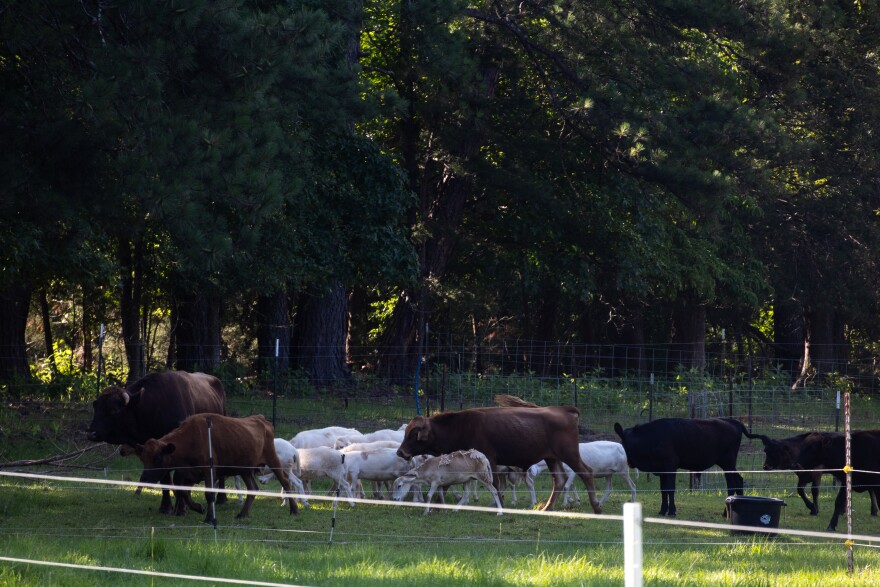
Now, private land with cows and sheep sits on the area where the fort once stood. Ashmore said he gives tours just during the winter to avoid the risk of ticks. The area where trenches once helped shield soldiers are still visible.
Some remnants from the fort now reside at the Laurens County Museum in the city of Laurens’ downtown area. The objects, although not individually labeled, will be part of an upcoming opening collection.

Luis-Alfredo Garcia
/
South Carolina Public Radio
Museum docent Julia Sermons said being informed of local history helps shape modern decisions.
“You have to know where you’re coming from to know where you’re going,” she said.
Ashmore, too, saw the same value.
“We are all in the middle of this,” he said. “This history – the important role that South Carolina played in the Revolution.”
An estimated 14 battles took place in Laurens County, according to Ashmore. He has been keeping track of local history for about 6 years. He said the county has set a 50-year plan to help with future record keeping.

Luis-Alfredo Garcia
/
South Carolina Public Radio

Video of SCHSL 5A Division 1 Upper State track and field championships
Here’s video of some of the action from the SCHSL Class 5A Division 1 Upper State boys and girls track and field championships held May 8 at Dorman.
Riley Vaughn of Spartanburg girls Track and Field was named the 2025-26 South Carolina girls Gatorade Player of the Year.
Vaughn won the shot put and discus events at the Class 5A-D1 state championships. She nailed a 13.1 meters on the shot and 41.77 meters on the discus. Her 14.41 in the shot at the region meet was the state’s best for 2026.
The 5-foot-10 junior helped lead Spartaburg to a fifth-place team finish. Vaughn had also competed on the national stage after taking third place in the shot put event at the Under Armour Nationals.
“Unbeaten in the discus throw on home state soil this year, Vaughn achieved success in both throws, but really sparkled in the shot put circle,” PrepCalTrack editor, Rich Gonzalez, said. “Her season-best there was the state’s top mark in the event in seven years and moved her to No. 4 on South Carolina’s all-time list.”
Vaughn is now part of an elite group of athletes who have won the prestigious award, including four-time Olympic gold medalist Sydney McLaughlin, five-time Olympic medalist Sanya Richards, and 11-time Olympic medalist Allyson Felix.
Vaughn was also named to the Greenville News’ All-Upstate First Team in girls’ Track and Field for the second consecutive season.
Kamryn Jackson covers high school and college sports for the Spartanburg Herald-Journal, Greenville News, Anderson Independent Mail, and the USA TODAY Network. Please email her at KEJackson@gannett.com and follow her on X @KamxJack (formerly Twitter).
-

 Miami, FL7 minutes ago
Helping Venezuela: State Department deploys Miami-Dade search-and-rescue team
-

 Boston, MA10 minutes ago
Photos: Norway takes on France in high-powered World Cup matchup in Foxborough – The Boston Globe
-

 Denver, CO15 minutes ago
Denver Transplant Games sets Guinness World Record for mos living donors, recipients in one place at one time
-

 Seattle, WA22 minutes ago
How to watch Egypt vs. Iran World Cup match in Seattle
-

 San Diego, CA25 minutes ago
Sharp Coronado Hospital Holds Meet-and-Greet With NASCAR San Diego Weekend
-

 Milwaukee, WI30 minutes ago
Brewers Are Making a Mistake With Andrew Vaughn’s Playing Time
-

 Atlanta, GA37 minutes ago
Chef’s Tableware brings affordable ceramics to Atlanta’s chefs and home cooks
-

 Minneapolis, MN40 minutes ago
Affordable senior housing revived at 600 Main St. SE

