Massachusetts
High winds making house fires difficult to extinguish in Massachusetts


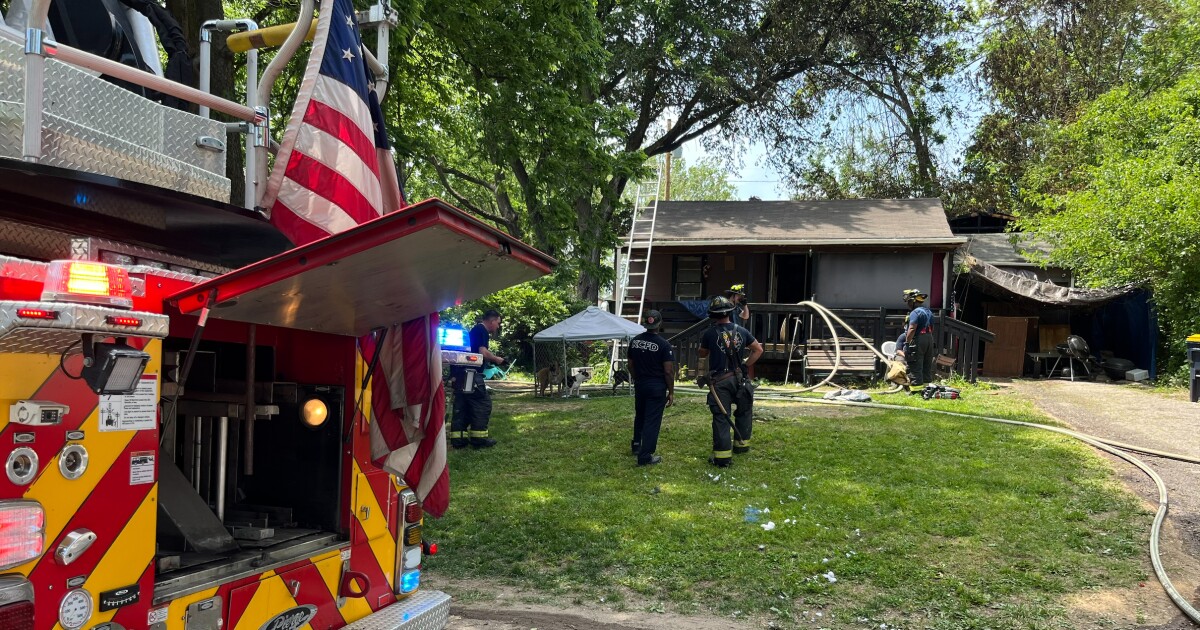
MARSHFIELD – Fire crews in Massachusetts are not just dealing with brush fires in these dry and windy conditions, but two house fires had them scrambling to prevent the flames from spreading to neighboring homes.
Marshfield fire
“The whole sky was covered with black smoke, didn’t know what was happening,” said George Haldoupis, a neighbor who saw the flames quickly spread at a home on Sheridan Drive in Marshfield. “I came out and we saw that house was totally engulfed in flames, it didn’t take long.”
Firefighters from several communities continually poured water on the home and surrounding houses in a neighborhood filled with trees and dried leaves.
“[The wind] was just like a blow torch, it just took off in one direction to the other,” said Marshfield Acting Fire Chief Mike Laselva. “As soon as it caught whatever fire was going, it quickly accelerated it.”
Mara Cronin’s home next door had enough damage to the roof to displace her for now. Fire crews were also able to rescue her three cats hiding under a bed. “Thank god nobody’s hurt, everyone’s OK. We just rescued our three cats so everyone’s fine and we’ll rebuild and we’ll be back,” said Cronin.
Dorchester fire
With only charred remains of the Marshfield home, it was a similar scene on Weyanoke Street in Dorchester as flames quickly engulfed an old Victorian.
“It was quite a bit of smoke in the area. But we couldn’t really figure out where it was. And then we saw the roof literally catch on fire and it looked like a giant candlestick,” said neighbor Dan DeChristoforo.
Six residents were displaced in two units, along with pets. The issue here not just wind but also access. Boston Deputy Fire Chief Scott Malone said rear exits were not only blocked but nailed shut. Dominic Lopez was left screaming from a second floor window to be rescued.
“Within a minute or something like that and then I opened up the window and they were pretty much there,” said Lopez.
“You push security versus safety sometimes,” said Malone. “In this particular case it almost cost someone a life. But thank god we got here in time and that person is saved.”
There were no serious injuries in both fires, but one Boston firefighter had to be treated for neck burns.





It’s not just great white sharks that are taking stripers from fishermen these days.
Porbeagle sharks — which stick around the Bay State all year — have been spotted several times in the last week chomping on striped bass that fishermen caught.
Those on a recent whale watch off the Cape even got a front-row seat to the action.
“We hope you lunge after your Fourth of July hot dog like this porbeagle going after a striped bass on our Provincetown whale watch yesterday!” Captain John Boats posted.
“It was incredible to see this top predator in its element in this National Geographic moment,” Captain John Boats added. “Our naturalist said it may have even been his favorite whale watch he has ever been on… Thanks to MA Sharks for your support and for showing us how to ID different shark species!”
MA Sharks is run by shark researcher John Chisholm, who on the day before July 4th received four different reports of porbeagle sharks taking striped bass.
“It was a busy day for porbeagle shark sightings yesterday,” Chisholm posted. “This is one of four reports we received yesterday of them taking striped bass from the N Shore to Nantucket. If you have an encounter like this, please let me know.”
Meanwhile over the holiday weekend, great white sharks were spotted all across the region.
In Cape Cod Bay, an 8-foot white shark was seen about two miles west of Wellfleet’s Jeremy Point.
On the South Shore, a dead seal with shark bites was found along Rexhame Beach in Marshfield.
And up on the North Shore, a small white shark was spotted about five miles off Marblehead.
Then much farther north, a beach was closed to swimming in Maine after a report of two sharks near Reid State Park.
“Swimming areas currently have been cleared,” the Maine town of Georgetown posted Sunday morning. “Be safe, stay alert, and enjoy Georgetown.”
A couple hours later, the swimming area at Reid was reopened.
“If you are in or on the water, please stay alert,” the town added.
White sharks come to the region every summer and fall to hunt for seals close to shore.
Before heading into the water, Chisholm urges people to review shark safety guidelines, including: be aware that sharks hunt for seals in shallow water; stay close to shore where rescuers can reach you; don’t isolate yourself; avoid areas where seals are present; avoid areas where schools of fish are visible; avoid murky or low-visibility water; limit splashing; and follow all signage and flag warnings at beaches and instructions of the lifeguards.
Chisholm also encourages beachgoers to use the Atlantic White Shark Conservancy’s Sharktivity app to view shark activity, get shark alerts and report sightings.
Massachusetts
Wrong-way driving is becoming more common and deadly in Mass. The state is racing to prevent it. – The Boston Globe

In each of the last two years, the state issued more than 500 citations to drivers on state highways, the Massachusetts Turnpike, and the Boston Harbor tunnels, a Globe analysis of state data found. And 2026 is on track to outpace those figures, with the state already logging nearly 270 citations by late June.
Wrong-way crashes tend to be at least 12 times deadlier than other car accidents, studies show, and their causes are frustratingly difficult to pin down to a single source.
Now state officials are rushing to implement a new $75 million program that includes a constellation of cameras, new road signs, and infrastructure improvements designed to prevent wrong-way collisions.
Massachusetts supercharged the effort after the death of state Trooper Kevin Trainor spurred calls for stronger action, including from Governor Maura Healey, said Jonathan Gulliver, a state undersecretary of transportation.
Gulliver said the Massachusetts Department of Transportation now expects to mount 430 detection cameras by the end of 2027. The system notifies wrong-way drivers with an audible alarm, flashing signs, and a spotlight, then pings law enforcement if a driver does not turn around.
The installation underway builds off a smaller pilot program at 16 Massachusetts locations that flagged roughly 300 wrong-way incidents since 2022.
“I’m not sure that [wrong-way crashes] happened more or less years ago, but I am certain we didn’t hear about them as much when they did,” Gulliver said.
In all, wrong-way crashes are among the “most preventable” roadway accidents but difficult to eliminate because they cannot be tracked cleanly to one source, said AAA spokesperson Mark Schieldrop.
Persistent speeding, distracting and impaired driving, and an aging population of drivers confused behind the wheel are the leading contributors to wrong-way citations, experts said. Nationally, six in 10 wrong-way crashes involve an alcohol-impaired driver.
And the dark of night can’t take all the blame, either: nearly 45 percent of crashes in Massachusetts occurred during daylight hours.
And though a wrong-way incident can be as simple as sliding into the unintended lane on a ramp, a single mistake against the flow of traffic is often dangerous.
In Massachusetts, at least 135 people have died in 5,506 wrong-way crashes on Massachusetts roads since 2018, according to AAA. That includes 22 deaths in 2025, the most in a single year during that time frame.
State officials here are focusing first on divided highways, where high-speed crashes can be especially deadly. MassDOT has identified 100 high-risk spots for wrong-way detection cameras, which include crash-prone intersections already equipped with cameras in Danvers, Auburn, Braintree, Fall River, and Wheatley.
Roughly 70 other roads at risk for wrong-way crashes may require larger reconstruction projects down the line, Gulliver said.
State leaders also intend to install clearer “wrong way” and “do not enter” signage, improved pavement markings, directional arrows, and better lighting at highway ramps and interchanges.
Legislation tucked into the state’s $63 billion budget plan, sent to the governor’s desk Wednesday, also proposes a study to improve roadway safety for drivers over 70, an expansion of law enforcement training, and completion of an analysis of documented incidents of wrong-way driving.
At a press conference following a vote on the budget amendment, Nicole Dailey lauded the efforts to address the issue after her son Christopher Dailey, an 18‑year‑old Gloucester High School graduate and hockey team captain, died in a wrong-way crash on Route 128 last summer.
“I don’t want any other community to have to go through this,” said Dailey. “It’s . . . senseless.”
Across the country, fatal wrong-way crashes doubled in the decade after 2014. Recent crashes in Massachusetts have involved drivers under the influence or allegedly fleeing the State Police, but many incidents can be traced back to disorientation and poor signage. Winding roads and complicated overpasses — specific to the older infrastructure and circuitous traffic patterns in Massachusetts — can add to the problem, Gulliver said.
In response, state officials sourced detection technology from TAPCO, a Wisconsin-based transportation product company. The cameras, mounted on street light signals, use artificial intelligence and heat detection to identify wrong-way drivers and differentiate them from pedestrians, birds, and other hazards, Gulliver said.
The software-based system costs $20,000 per camera to install, less than half the $70,000 price tag associated with cameras in the previous state pilot program. Those cameras use “loop detection” to manually identify wrong-way drivers, using wiring in the roads that recognizes passing vehicles above.
An average of two wrong-way cameras are installed each week. Some have proved to be fruitful immediately.
At the intersection of Routes 128 and 35 in Danvers, where officials connected a camera on June 16, “the same day we activated it, we caught a wrong-way driver,” Gulliver said.
In the next few years, state officials also hope to have a system that automatically pings roadside message boards and GPS systems to notify drivers about wrong-way vehicles.
Still, Massachusetts is moving more slowly than other states.
Rhode Island — a “leader” in wrong-way crash detection, Gulliver said — did not have a single wrong-way driving death in the decade after it began its analysis of collision hotspots at 200 ramps statewide in 2015. Ultimately, additional wrong-way signs, lower to the ground and with flashing lights, worked in tandem with other low-cost measures to warn over 1,000 vehicles that they need to turn around, state data show.

Eva Zymaris, a spokesperson for the Connecticut Department of Transportation, said the installation of cameras bore similar results in that state, with 237 out of 400 planned locations operational to date.
Illuminated wrong-way signs flash when a driver is going the wrong way and pings two highway operations centers. That avoids the need for 911 calls that can otherwise pour in after an accident has already happened, Zymaris said.
In 2022, before the $81 million system was installed, 23 people died from wrong-way crashes in Connecticut. Preliminary data show there were four deaths in 2025.
“Seconds count here,” Zymaris said. “To be able to expedite that response time is huge to prevent crashes and fatalities.”
Now Vermont and Maine are also ramping up prevention efforts, after the number of wrong-way deaths rose in both states. And nationwide, states such as Ohio and Florida implemented detection technology roughly a decade ago. Nevada adopted harsher penalties for wrong-way driving in 2025.
Wrong-way crashes, typically the fault of an individual driver, can rarely be solved otherwise, said Peter Savolainen, a Michigan State University professor who studies road user behavior.
“A lot of times drivers don’t know until it’s too late that they’re going the wrong way,” he said. “So all states can do — and are doing — is try to make it more difficult for people to make that incorrect decision.”
Samantha J. Gross of the Globe staff contributed to this report.
Diti Kohli can be reached at diti.kohli@globe.com. Follow her @ditikohli_. Scooty Nickerson can be reached at scooty.nickerson@globe.com.

A motorcyclist was seriously hurt in a crash with another vehicle on July Fourth in Groton, Massachusetts.
The Groton Fire Department says the collision occurred around 8:34 a.m. Saturday in the area of Old Ayer Road and Boston Road (Route 119).
The motorcyclist, a man in his 40s, suffered a significant lower-body injury. He was taken by ambulance to a landing zone at the fire station on Farmers Row, then flown by a medical helicopter to UMass Memorial Medical Center in Worcester. His condition wasn’t immediately available.
The driver of the passenger vehicle reported no injuries, officials added.
It’s unclear what caused the crash. An investigation by the Groton Police Department is ongoing.
-

 Texas6 minutes ago
Supreme Court won’t block Texas from enforcing a law requiring age verification for app downloads
-

 Utah14 minutes ago
Memphis Grizzlies vs Utah Jazz Jul 6, 2026 Game Summary
-
Vermont21 minutes ago
VT Lottery Powerball, Gimme 5 results for July 6, 2026
-

 Virginia24 minutes ago
Virginia man charged with murder in crash that killed family of 4 on I-75 in Oakland County
-

 Wisconsin39 minutes ago
Wisconsin DOT begins $6.87M I-41 ramp deck overlay upgrades in Brown County Tuesday
-

 West Virginia44 minutes ago
11 Marshall student athletes suing NCAA over new rule – WV MetroNews
-

 Wyoming51 minutes ago
Election Q&A: Qwenton Eagle Oviatt for Wyoming secretary of state
-

 Crypto54 minutes ago
An Easy-to-Miss Radio Traffic Jam Is Behind Many Home WiFi Slowdowns

