Virginia
Virginia law at center of voter rolls controversy was once a bipartisan issue – WTOP News


The Virginia law allowing election officials to remove people from voter rolls if they are listed as noncitizens has led to controversy during this election cycle, but it was once a politically neutral issue.
The Virginia law allowing election officials to remove people from voter rolls if they are listed as noncitizens has led to controversy during this election cycle, but it was once a politically neutral issue.
John Aughenbaugh, a political science professor at Virginia Commonwealth University, said the law was championed by Ken Cuccinelli, who was then a Republican state senator and later became attorney general.
It was signed into law in 2006 by Democratic Gov. Tim Kaine.
“It was basically a bipartisan measure,” Aughenbaugh said.
Even though the law has been on the books for nearly 20 years, this is the first time it has become so contentious.
“In part, the reason why it became an issue is that the Biden administration became very skeptical of states purging their voter rolls in the aftermath of what Georgia did after the 2020 presidential election,” Aughenbaugh said.
A sweeping rewrite of Georgia’s election rules was signed into law in 2021 by Republican Gov. Brian Kemp, making numerous changes to how elections are administered, including adding a new photo ID requirement for voting absentee by mail.
Republican supporters said the law was needed to restore confidence in Georgia’s elections. But Democrats said it would restrict voting access, especially for voters of color.
“President Biden gave an infamous speech where he said that his Justice Department would not allow states like Georgia to reinstitute Jim Crow laws,” Aughenbaugh said. “This has been a point of emphasis for the Biden administration.”
The Justice Department filed a suit against Virginia earlier this month, arguing that making large-scale changes to voter rolls within 90 days of an election was against federal regulations.
Republican Gov. Glenn Youngkin and his administration took the case all the way to the Supreme Court, which ultimately sided with Youngkin on Wednesday.
Aughenbaugh said Youngkin’s administration “didn’t do anything unusual” in implementing the law.
What was unusual, according to Aughenbaugh, was Youngkin publicly drawing attention to the law and issuing an executive order “codifying” it exactly 90 days before this year’s election.
“If it wasn’t issued as an executive order and it didn’t get publicized, then perhaps it wouldn’t have caught the attention of the Biden administration,” Aughenbaugh said.
Aughenbaugh said state lawmakers could potentially make changes to the law, like having it paused within 90 days of an election, in order to prevent such a controversy in the future.
“I think the General Assembly should give some consideration to revising the law to avoid this kind of conflict,” Aughenbaugh said. “This is completely unnecessary.”
Get breaking news and daily headlines delivered to your email inbox by signing up here.
© 2024 WTOP. All Rights Reserved. This website is not intended for users located within the European Economic Area.



RICHMOND, Va. — Jerrod Buford first picked up a paintbrush as a kid, never imagining that same creative outlet would carry him through his darkest days in prison.
Buford, who grew up in Williamsburg, was convicted and arrested as a young man and spent almost a decade behind bars. During that time, he struggled deeply.
“Turning to drugs and alcohol to kind of shadow over emotions,” Buford said. “Looking for acceptance, approval. Not just from my parents, but from friends, from, you name it. I mean, I tried to commit suicide, I don’t even know how many times,” Buford said.
WTVR
It was inside prison walls that art became more than a hobby.
“Throughout my prison time, I learned, the freedom that I desired, I’ve always had it. I got, I found it, in a box,” Buford said.
More than three years after his release, Buford continues to advocate for art as a tool for healing. He describes his work as a gift he feels called to share.
“I received a blessing from God that just allowed me to display what he’s given me,” Buford said.
For Buford, creating art is also a way of processing his past.
“That’s what art has done for me. It’s given me the ability to look at parts of my life, all parts of my life, and find the good and the negative, learn from the negative,” Buford said.
He shares his story and artwork with a wide audience through social media, including live sessions on TikTok, and holds art classes with new communities.
The Story Cafe
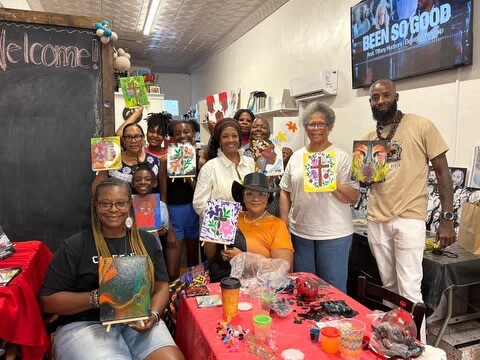
Buford said his mission is to help others find their own path toward healing — whatever form that takes.
“What I strive to do is guide this person to just create, man. Don’t care what people think about your creation, you just need to get it out,” Buford said. “Whether it’s with art, addressing your mental health, getting your life right — just do it.”
CBS 6 is committed to sharing community voices on this important topic. Email your thoughts to the CBS 6 Newsroom.
📲: CONNECT WITH US
Blue Sky | Facebook | Instagram | X | Threads | TikTok | YouTube

This story was initially reported by a journalist and has been converted to this platform with the assistance of AI. Our editorial team verifies all reporting on all platforms for fairness and accuracy. To learn more about how we use AI in our newsroom, click here.

Lovingston, VA (7News) — Good Morning Washington interviews Amanda Beckwith of Virginia Distillery Company- one of the contributing distilleries to the Virginia Spirits Board’s 250th Celebration Trio Pack, a special, exclusive release created to commemorate America’s upcoming 250th anniversary. This limited-edition package features a curated collection of a rum, a gin, and a whiskey, all crafted from scratch by distillers in Virginia to celebrate the rich history and current state of distilling within the Commonwealth.
Beckwith elaborates on VA Distillery Company’s role in the project, noting her focus on Virginia-grown grain to make the bottle of unique whiskey that is included in the Trio Pack. It is also worth noting that the Trio Packs themselves were bottled and produced right here at Virginia Distilling Company!
American single malts are the newest official category of American whiskey, distilled from one grain and from a single distillery. Virginia Distillery Co specializes in this new category of whiskey and crafted their contribution to the Trio Pack with this very specialty. Given the limited remaining availability of the Trio Pack, its historical value and collectible nature, the message it loud and clear encouraging viewers to grab a pack before they are all gone!
BE THE FIRST TO COMMENT
21+ Please drink responsibly, this content is sponsored by Virginia Distillery Company.


Powerball, Mega Millions jackpots: What to know in case you win
Here’s what to know in case you win the Powerball or Mega Millions jackpot.
Just the FAQs, USA TODAY
The Virginia Lottery offers multiple draw games for those aiming to win big.
Here’s a look at June 24, 2026, results for each game:
Powerball
Powerball drawings are held Monday, Wednesday and Saturday at 11 p.m.
13-14-16-21-38, Powerball: 14, Power Play: 2
Check Powerball payouts and previous drawings here.
Saturday, June 27, 2026
Pick 3
DAY drawing at 1:59 p.m. NIGHT drawing at 11 p.m. each day.
Night: 3-1-5, FB: 8
Day: 7-8-8, FB: 4
Check Pick 3 payouts and previous drawings here.
Pick 4
DAY drawing at 1:59 p.m. NIGHT drawing at 11 p.m. each day.
Night: 4-7-2-1, FB: 7
Day: 7-3-4-6, FB: 3
Check Pick 4 payouts and previous drawings here.
Pick 5
DAY drawing at 1:59 p.m. NIGHT drawing at 11 p.m. each day.
Night: 7-5-2-6-9, FB: 0
Day: 6-9-4-0-7, FB: 0
Check Pick 5 payouts and previous drawings here.
Cash Pop
Drawing times: Coffee Break 9 a.m.; Lunch Break 12 p.m.; Rush Hour 5 p.m.; Prime Time 9 p.m.; After Hours 11:59 p.m.
Coffee Break: 12
After Hours: 08
Prime Time: 13
Rush Hour: 01
Lunch Break: 14
Check Cash Pop payouts and previous drawings here.
Cash 5
Drawing every day at 11 p.m.
09-12-15-24-43
Check Cash 5 payouts and previous drawings here.
Bank a Million
Bank a Million draws are held every Wednesday and Saturday at 11 p.m.
18-21-25-33-36-39, Bonus: 13
Check Bank a Million payouts and previous drawings here.
Millionaire for Life
Drawing everyday at 11:15 p.m.
03-04-10-36-37, Bonus: 05
Check Millionaire for Life payouts and previous drawings here.
Feeling lucky? Explore the latest lottery news & results
This results page was generated automatically using information from TinBu and a template written and reviewed by a Center for Community Journalism (CCJ) editor. You can send feedback using this form.
-

 Los Angeles, Ca16 minutes ago
Woman ambushed, violently attacked by robber in downtown Long Beach
-

 Detroit, MI34 minutes ago
Where to watch Houston Astros vs Detroit Tigers: TV channel, start time, streaming for June 26
-
San Francisco, CA46 minutes ago
I own a Turkish Restaurant in San Francisco. Turkey’s World Cup match here has changed my business.
-

 Dallas, TX49 minutes ago
Australia advances at World Cup, how to buy Australia soccer tickets
-

 Miami, FL54 minutes ago
2 detained after police pursuit ends with bailout, neighborhood search in NW Miami-Dade – WSVN 7News | Miami News, Weather, Sports | Fort Lauderdale
-

 Boston, MA1 hour ago
Delta flight returns to Logan after smoke scare in cockpit – Boston News, Weather, Sports | WHDH 7News
-

 Denver, CO1 hour ago
Pat Surtain II Gets More Bad News Amid Broncos’ Uncertainty
-

 Seattle, WA1 hour ago
The World Cup 2026 Pride Match between Egypt and Iran that Seattle hopes can ‘unite football community’


