Sports
Tales from the college football sidelines: The ‘ridiculously fun’ life as a ball boy


It was one of the biggest moments in Georgia football history. Players were celebrating. Fans were delirious.
But Bennett Vest had a job to do.
Yes, for all intents and purposes, the game was over when Ohio State kicker Noah Ruggles missed a 50-yard field goal attempt with only eight seconds remaining in the 2022 College Football Playoff semifinal at the Peach Bowl.
But the game wasn’t actually over.
So Vest, situated on the Ohio State sideline, weaved through the maze of dejected Buckeyes and completed his final task: delivering the game ball to the official. Moments later, quarterback Stetson Bennett took one final snap to send Georgia to the national championship game.
Welcome to life as a ball boy.
“Though we may not have a direct impact on the game,” said Vest, who served as a student manager for the Bulldogs as an undergraduate, “we can certainly mess it up.”
It’s an important if largely unseen job that requires timing, quick instincts, athleticism and — as one equipment manager put it — “maturity.”
But it’s also wildly fun, according to those who have done it. And there’s no other gig like it in college football.
“I’m never gonna look at a game the same,” said Ben Shirley, a former manager at Clemson who is now on the equipment staff at UNLV.
“Like, any sport ever again, after doing this.”
College football programs employ anywhere from 12 to 25 student managers, typically undergraduates who work for a stipend. Duties during the week range from practice setup to equipment prep to laundry to … well, anything required to keep the operation running smoothly.
On game day, as many as six managers serve as ball boys — two or three on each sideline. The job requirement is simple: If the game ball is thrown out of bounds or knocked out of play, make sure the officials have a replacement as quickly as possible.
“Kids love it. It’s just exciting for them and there’s really never a better seat in the house because you’re right where the play is, you’re right where the ball is,” said Luke Wyatt, the former head equipment manager at Vanderbilt. “The managers would always politic to see if they could be the ball boy that weekend.”
But working the opposing sidelines comes with more responsibility, as well.
“Over the years, I always tried to put the most mature guys on the (other) side because they’re not gonna run their mouths,” Wyatt said. “You always have to let them know: ‘Don’t interact with the players. When we don’t have the ball, step back out of the way. Don’t get in the way of the coaches coaching the game, or the officials.’”
Former Auburn ball boy Jake Longenecker did his best to behave. But he sometimes couldn’t help himself during his time with the Tigers in the mid-2010s.
“I was kind of a little s—,” he said. “I always found ways to be a smart-ass, I’ll tell you that much.”
Longenecker typically stayed busy when Auburn was on offense. But he had plenty of time for tomfoolery when the Tigers were on defense and the opposing team was responsible for running balls.
“(The opponent is) signaling in plays and I was always aware of where I was standing and sometimes I would try to, on purpose, stand in front of the people calling in the plays,” said Longenecker, the son of two Auburn graduates and a lifelong fan of the program. “They would never like that. They would shove you out of the way and I’d be like, ‘Yeah, I know what I’m doing. I know what I’m doing. So go for it.’”
Scott Cochran, the former strength and conditioning coach at Alabama and special teams coordinator at Georgia, had a similar sense of humor. When Auburn played the Crimson Tide, Cochran would often punch the ball out of Longenecker’s hands.
“And he would just be like, ‘Ball security!’” said Longenecker, who works in marketing at James Madison. “He was just joking. (But) it didn’t hurt any less. … I was like, ‘Man, he really works out.’”
Some head coaches enjoy interacting with the opposing team’s ball boys. Others ignore them.
“You’ll get into conversations with coaches on the visiting team sideline,” said Bradley “Spider” Caldwell, a former equipment manager for three decades at Penn State. “Like, (former Ohio State coach) John Cooper one time, he leaned over to one of my managers and he says, ‘Who’s that No. 24 out there?’ So the manager told him who he was. He was a defensive back. (Cooper) says, ‘Yeah, that kid’s not very good. Tell Joe (Paterno) that kid’s not very good.’”
Auburn coach Hugh Freeze doesn’t get into deep conversations with ball boys but likes to thank them for the job they do and will often take a jab about their head coach’s “awful” golf game. Arkansas coach Sam Pittman said ball boys are “always good kids” and bring “special meaning” to the game. But he likes to jokingly tell them before the game starts to “stay the hell out of my way.” San Jose State’s Ken Niumatalolo loves to say hello and ask them about their majors.
And when Clemson hosted Louisiana Tech in 2022, Shirley remembers Bulldogs coach Sonny Cumbie jokingly asking him what plays the Tigers were about to run after they built a double-digit lead in the second half.
“He said it in a way that I could tell that he knew I didn’t actually know. So I just said we were running it, like as a joke,” Shirley said. “And then he actually yelled out to his team that it was a run, also as a joke kind of thing. It was pretty funny.”
Vanderbilt coach Clark Lea said there have been a couple of instances when an opposing ball boy has gotten chippy on the sidelines, although that seems to be the exception and not the norm.
“It’s one of those things that may not always make sense, but it’s how we do business,” he said, referring to the oddity of having a couple of representatives from the opponent on your sideline. “Most times when there is or has been (an issue) it resolves pretty quickly.”
Missouri coach Eli Drinkwitz said opposing ball boys can be distracting, but he always tries to be respectful. Ole Miss coach Lane Kiffin said he doesn’t really notice them.
Both coaches used to be ball boys themselves — Drinkwitz starting as a freshman in high school and Kiffin manning the sidelines as a teenager when his father, Monte, coached linebackers for the New York Jets and Minnesota Vikings.
“It was actually a really cool experience,” Kiffin said. “We had to be on the other sidelines for half the game and — I was just telling this story the other day — Mike Ditka’s over there and Jim Harbaugh and Walter Payton.
“I always wanted to come up with a system because I could hear (the opposing team’s) plays over there, but my dad would be on the other sidelines coaching defense for the other team, for the Vikings. And I always thought, ‘I wonder if you could come up with a system where if I heard the play I could tell him the plays somehow.’”
When Steve Spurrier was the coach at Florida, one of Wyatt’s Vanderbilt ball boys asked the Head Ball Coach if he could have his visor.
“He said, ‘Kid, you’ve got a lot of balls. But no. You can’t have my visor,’” Wyatt recalled. “That was really funny.”
At the 2023 Gator Bowl, a Kentucky player offered to exchange his jersey for Shirley’s Clemson pullover.
“I was thinking about that the entire time, the entire game. Like how funny would it be if I came back (to the Clemson bus) with a (Kentucky) jersey?” Shirley said.
One of Wyatt’s favorite memories is from an away game at Ole Miss years ago.
“I was really short on help that day, so I had … one of our policemen running balls — not in uniform, but he was an off-duty policeman,” Wyatt said. “Well, he’s a great big guy. He was like 6-5, 300-plus pounds. So before the game, the officials always meet with the ball boys. They have a meeting to tell them how they want things done.
“Well, he looks up and he goes, ‘OK. You’re the oldest and the largest ball boy I’ve ever seen.’ And James is the guy that’s doing it. He goes, ‘Well look here, ref, don’t start no s— and there won’t be any.’ So it’s a grown man running balls telling the referee that. The referee got a real good kick out of it.”
Nowadays, all teams have their own ball boys working both sidelines, regardless of whether they’re home or away. But in Caldwell’s early days at Penn State, the home team often provided managers to run balls for both teams.
Such was the case in the fall of 1989 when Penn State traveled to upstate New York.
“So we’re playing Syracuse and it’s right before halftime and we’re driving. We’re in field goal range,” Caldwell said. “But we had a little bit more time on the clock and so coach Paterno wanted to get a little bit closer to make it a short kick.”
The Nittany Lions put one more play in — a 5-yard hitch from quarterback Tony Sacca to the tight end. But Sacca threw an interception. Paterno was not pleased.
“He’s yelling at the quarterback, ‘Why did you throw that ball?!’” Caldwell said, imitating Paterno’s distinct voice. “(Sacca) was notorious for excuses. So he’s like, ‘Coach, the football was wet.’”
Caldwell didn’t see the interception. He left the sidelines a few minutes earlier to prepare the locker room for halftime. So when Paterno stormed over to Caldwell in the locker room and demanded answers — specifically, why the football was wet — Caldwell was caught off guard.
“I said, ‘Well, the Syracuse managers are running the footballs,’” Caldwell said. “(Paterno said), ‘What do you mean the Syracuse managers are running the footballs? You’ve gotta get somebody on those. We can’t have that.’ I’m like, ‘OK, Coach, OK.’ And the whole team’s in there now. They’re getting ready to do halftime adjustments and Joe storms out of the room and all of the team’s looking at me and the coaches are standing there and one of the coaches says, ‘Football? Wet? How can a football be wet when we’re playing inside the Carrier Dome?’
“I never even thought about it. So I’m looking over at Sacca like, ‘I’m gonna kill you, you son of a gun.’”
Since that game, Penn State has traveled with eight managers (up from six), with two designated to run balls on the other team’s sideline.
“To (Sacca’s) defense, I guess our center was a sweater,” Caldwell said, laughing. “He did sweat a lot and it was pretty hot in the Carrier Dome … (but) I beg to differ.”
Ball boys may not be blue-chip recruits, but don’t underestimate their athleticism — and fearlessness. This crew is scrappy.
Longenecker, a former high school linebacker, went viral during Auburn’s 2014 game against Arkansas when he somehow kept pace with Tigers wide receiver Melvin Ray on a 49-yard touchdown reception.
Longenecker found out during a weather delay later that afternoon that a clip of his “exploits” had already amassed 4 million views on Vine, the former social media platform. ESPN tweeted out the play, as well.
“Melvin and I had a chuckle about it. I think I did, like, one interview at the time and they asked me why my high school coach never put me at running back,” Longenecker said. “I was like, ‘Because I was slow.’ And I meant it. I still am. It was something that looked good on camera there for like 10 yards.”
Frankie Grizzle-Malgrat, better known as “Red Lightning,” is arguably the most famous ball boy in college football history. He first went viral in the early 2010s when TV cameras caught him sprinting down the sidelines to celebrate a Florida State touchdown.
The man. The myth. The legend.@FSUFootball‘s Red Lightning ⚡️⚡️ pic.twitter.com/76foBPRfk9
— ACC Network (@accnetwork) June 27, 2020
But he may be remembered more fondly for never backing down when he sensed a Florida State player needed his help.
“When someone messes with your brother, you go to their aid,” Grizzle-Malgrat said. “And you don’t really think about the consequences. … You just hope for the best.”
Grizzle-Malgrat is 5 foot 8 … with shoes on. But when former FSU quarterback Jameis Winston threw an interception against Oklahoma State in 2014 and found himself surrounded by Cowboys players — one of whom hit him in the face mask — Grizzle-Malgrat muscled his way in to defend his guy and helped pull the All-American QB out of the tussle.
“I’m a lot, lot smaller than a bunch of them dudes, but you don’t think about it,” Grizzle-Malgrat said, adding that his biggest fear was always getting his glasses broken. “Oklahoma State, one of the big defensive linemen, he elbowed me in the back of the head.”
Similarly, he was there to help Winston up when the quarterback took a late hit against Duke in the 2013 ACC Championship Game.
“Just know that I’m there for you and I’m there to help you up,” Grizzle-Malgrat said. “I’ve got your back.”
Niumatalolo can remember one of his 5-foot-9 ball boys at Navy jumping into a skirmish to help a player in a bowl game on the opposite sideline.
“I said, ‘What happened over there? Did you get in the fight?’ He said, ‘No, Coach, I had to jump in there and try to save so-and-so,’” Niumatalolo said. “I said, ‘Good for you, man! You’re standing in for our players?’ These are small, tiny kids jumping in there trying to fight.”
During Wyatt’s time at Vanderbilt, the Commodores actually needed help from law enforcement on a trip to Arkansas.
“One of my ball boys comes across the field and tells me, ‘Hey, I’ve got a problem. Their strength coach is grabbing me and pushing me around, saying I’m in the coach’s way and all that,’” Wyatt said. “So we had to get the state trooper to remove the strength coach from Arkansas’ sideline.”
And sometimes, there’s even drama between the home and visiting ball boys.
“We were playing at UT (in 2005) and we won the game on a basically last-minute touchdown,” Wyatt said. “We had the ball that won the game for our quarterback (Jay Cutler). We were gonna keep it. And the (Tennessee) ball boy tried to take it and our ball boy ran across the back of the end zone and tackled him. It was pretty funny.”
For as serious as the job can be, it’s ultimately the fun memories that ball boys take with them.
Vest, now in his second year of law school at Samford, had an unforgettable conversation with a group of Ohio State defensive linemen in the second half of the 2022 Peach Bowl, right as the game was coming down to the wire.
“They were asking where all the girls were at,” he said, laughing.
Grizzle-Malgrat, who is now an equipment manager for Florida State’s softball and soccer teams, was at a bar in Virginia Beach for his cousin’s birthday in 2019 when a group of locals recognized him. Even 10 years later, he still fields autograph and photo requests in the grocery store or at a restaurant.
Vest recalls a different sort of interaction with fans at Tennessee.
“In Knoxville in 2021, we even had fans moon us from the stands,” he said.
As Longenecker said, the job isn’t always glamorous. It’s often thankless work that involves long hours filled with laundry, unpredictable weather and endless little tasks.
“(But) I’m alive. I’m healthy. And I’m happy. So I wouldn’t change it for anything in the world,” he said.
Perhaps Dan Leben, a former Vanderbilt manager, summed it up best.
“It is,” he said, “a ridiculously fun thing to do.”
(Illustration: Eamonn Dalton / The Athletic; Photos: Clemson Athletics, Dannie Walls / Icon Sportswire via Getty Images, Georgia Athletics)



Sports
Pirates star pitcher makes unfortunate history after being taken out in middle of perfect game bid

NEWYou can now listen to Fox News articles!
Jared Jones was flirting with Major League Baseball history on Wednesday night — he got it, but it was not what he originally envisioned.
The Pittsburgh Pirates pitcher retired the first 18 batters he faced, but he was taken out in the middle of his perfect game bid after six innings.
Now, the Pirates certainly have their reasons — the 24-year-old Jones hasn’t thrown more than 81 pitches in eight starts since returning May 20 after missing all of last season while undergoing ulnar collateral ligament internal brace surgery on May 21, 2025. He was yanked with 77 pitches and likely would have needed more than 100 pitches to record the 25th perfect game in MLB history.
Jared Jones of the Pittsburgh Pirates pitches during the first inning against the Atlanta Braves at PNC Park on July 8, 2026, in Pittsburgh, Pennsylvania. (Photo by Joe Sargent/Getty Images)
However, Jones left the game after getting zero run support, so when the Atlanta Braves tacked on three runs late for a 3-0 victory, Jones instead found himself in the wrong chapter of the history books.
According to Opta Stats, Jones became the first pitcher in the modern era (since 1920) to pitch at least six perfect innings and not record a win.
“It does suck. Something’s cool coming on, but I’m on what? My eighth start off of surgery? I completely understand it, and it is what it is,” Jones told reporters after the game.
Pittsburgh Pirates starting pitcher Jared Jones (17) makes his way to the field to warm up before pitching against the Atlanta Braves at PNC Park. (Charles LeClaire/Imagn Images)
JUSTIN VERLANDER ANNOUNCES HE WILL RETIRE AFTER THIS SEASON: ‘I’VE REALIZED THAT TIME HAS COME’
Jones said he didn’t entertain attempting to complete the perfect game.
“Not with the pitch count,” he said. “Not really ever expecting to go nine right now, so that was never in my head.”
Joey Bart, traded to the Braves from the Pirates on June 18, followed a double by Mike Yastrzemski with a 422-foot, two-run homer to left-center field off a slider from Dennis Santana. Drake Baldwin added an RBI single to center in the ninth for good measure.
It was the second time in less than a week that a pitcher was taken out of the game with a perfect bid through six innings — the Miami Marlins took Eury Perez out after seven innings in which he had 92 pitches. Perez, too, is in the midst of returning from injury and has surprisingly found himself right in the postseason mix.
He was pulled for Lake Bachar to start the eighth, and the Marlins allowed eight runs to the Athletics in the final two innings, but held on to win 9-8.
Jared Jones (17) of the Pittsburgh Pirates delivers a pitch during a MLB game against the Cincinnati Reds on June 27, 2026, at PNC Park in Pittsburgh, Pennsylvania. (Joe Robbins/Icon Sportswire via Getty Images)
CLICK HERE TO DOWNLOAD THE FOX NEWS APP
The Pirates are 4.0 games out of the final wild card spot, which is held by the Marlins.
The Associated Press contributed to this report.
Follow Fox News Digital’s sports coverage on X, and subscribe to the Fox News Sports Huddle newsletter.
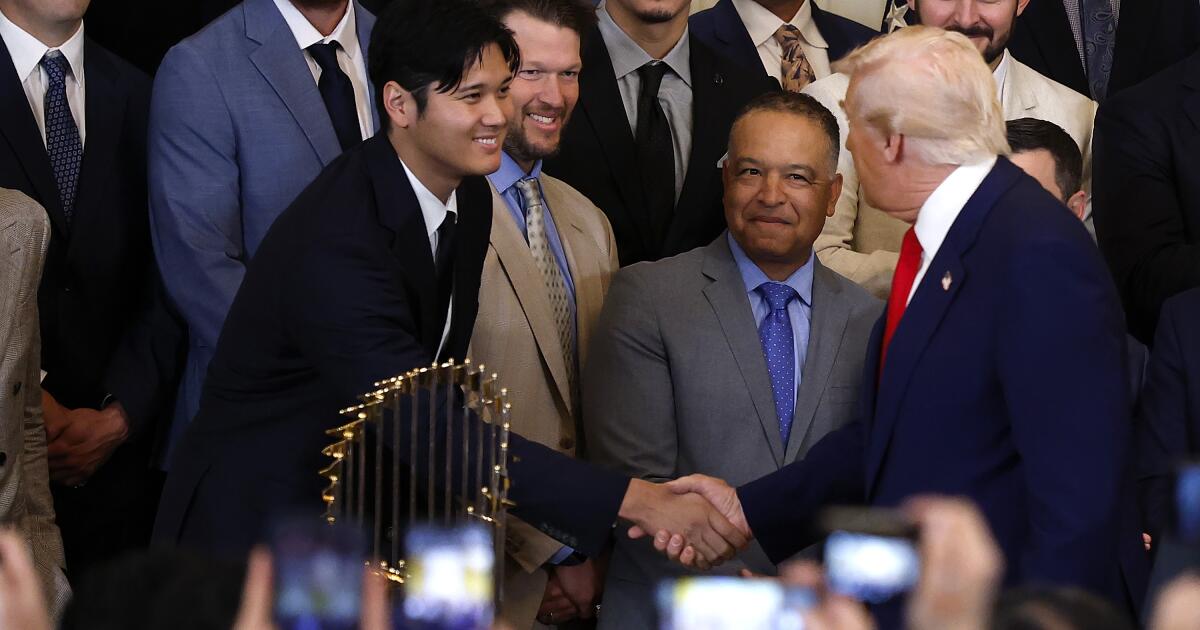
WASHINGTON — The Dodgers are scheduled to visit the White House on July 23 to celebrate their latest World Series title.
“President Trump is excited to welcome the Los Angeles Dodgers BACK to the White House to celebrate their World Series championship!,” White House spokesperson Taylor Rogers said in a statement to The Times.
The date falls on a scheduled off day in the middle of a nine-game East Coast road trip for the Dodgers. The team will play three games in Philadelphia against the Phillies July 20-22 before ending the trip with a three-game series against the New York Mets July 24 to 26.
The visit continues a tradition from the Dodgers’ two previous World Series championships. They were hosted by President Biden in 2021 and President Trump in April 2025.
After the Dodgers claimed their second consecutive World Series title with a dramatic Game 7 victory over the Toronto Blue Jays, a visit to the White House was planned, but it wasn’t until Thursday that a date was officially booked and confirmed.
Questions swirled around whether players would decline the visit this year after it did not happen during a scheduled visit to Washington in April.
Kiké Hernández said in 2018 he was unsure he would have gone had the Dodgers won the World Series the previous year. Mookie Betts said he was undecided and needed to talk it over with his family when last year’s visit was announced. After winning his first World Series with the Boston Red Sox in 2018, Betts skipped their trip to the White House the following year during Trump’s first term.
Both players, along with every returning member of the 2024 team who was with the team during its road trip, participated in the visit. The only notable absence was first baseman Freddie Freeman, who remained in Los Angeles to nurse an ankle injury.
Manager Dave Roberts, who indicated in comments to The Times in 2019 he might not go to the White House if Trump was president, also participated in last year’s ceremony.
Asked at the Dodgers’ fan festival in January about the possibility of returning to the White House, Roberts told The Times’ Bill Shaikin: “For me, I stand by: I’m a baseball manager. That’s my job.”
“I was raised — by a man who served our country for 30 years — to respect the highest office in our country,” Roberts said. “For me, it doesn’t matter who is in the office, I’m going to go to the White House. I’ve never tried to be political. … For me, I am going to continue to try to do what tradition says and not try to make political statements, because I am not a politician.”
Clayton Kershaw, who retired after last season but was on Team USA for this year’s World Baseball Classic, told The Times in the spring that he was aware Dodgers fans are split over whether the team should visit the White House again this year, but he said he is looking forward to it.
“I went when President Biden was in office. I’m going to go when President Trump is in office,” Kershaw said. “To me, it’s just about getting to go to the White House. You don’t get that opportunity every day, so I’m excited to go.”
Times deputy sports editor Ed Guzman contributed to this report.

NEWYou can now listen to Fox News articles!
All eyes were on Caitlin Clark on Wednesday night as she made her anticipated return from injury in a road matchup in Los Angeles.
But instead of a triumphant comeback, the Fever spent the entire night chasing the Sparks as Clark’s rough return fueled a 106-92 rout.
The superstar never found a groove, looking completely out of sync in her return from a back injury.
STEPHANIE WHITE GIVES CAITLIN CLARK STATUS UPDATE AHEAD OF FEVER-SPARKS, BUT HER NEXT MOVE RAISES QUESTIONS
Caitlin Clark huddles with teammates as the Indiana Fever battle the Sparks. (Photo by Katelyn Mulcahy/Getty Images) ((Photo by Katelyn Mulcahy/Getty Images))
Much of that disjointed performance falls squarely on head coach Stephanie White, who kept Clark on a ridiculously tight leash by limiting her to just 16 minutes. The stop-and-go approach could have sabotaged any chance for the phenom to establish a rhythm.
Clark finished with just 9 points, 4 rebounds and 3 assists. Her minus-16 plus-minus told the story.
The Los Angeles Sparks were severely shorthanded, taking the floor without stars Kelsey Plum and Cameron Brink.
MERCURY’S NOW-DELETED SOCIAL MEDIA POST MOCKING CAITLIN CLARK DRAWS SCRUTINY AFTER STAR’S INJURY
Yet while a depleted Sparks roster played to win, Indiana spent the night over-managing its biggest asset.
With Clark on a minutes restriction and Aliyah Boston out of the lineup, Kelsey Mitchell was forced to shoulder the entire offensive burden.
Mitchell did her part, pouring in 29 points while shooting 5-of-9 from beyond the arc.
Caitlin Clark orchestrates the Fever offense as Indiana battles the Los Angeles Sparks in primetime action. (Photo by Katelyn Mulcahy/Getty Images) ((Photo by Katelyn Mulcahy/Getty Images))
But one hot hand couldn’t stop an efficient LA squad.
The Sparks shot 45% from three-point range, going 9-of-20 from deep to cruise to the 106-92 victory.
White’s next move is to sit Clark against the Mercury on Thursday while Boston returns.
CLICK HERE TO DOWNLOAD THE FOX NEWS APP
After Wednesday’s loss to a shorthanded Sparks team, it’s fair to question whether Indiana’s cautious approach is working. The Fever dropped to 12-9.
Caitlin Clark and Dearica Hamby face off as Fever and Sparks battle at Crypto.com Arena in Los Angeles. (Photo by Tyler Ross/NBAE via Getty Images) ((Photo by Tyler Ross/NBAE via Getty Images))
Send us your thoughts: alejandro.avila@outkick.com / Follow along on X: @alejandroaveela
-

 Arkansas17 seconds ago
Dino Fest brings interactive experiences, lifelike dinosaurs and reptiles to Arkansas July
-

 California3 minutes ago
Southern California police vow to quash planned ‘takeover’ event following recent chaos
-

 Colorado8 minutes ago
Body found in western Colorado believed to have been eaten by bear
-

 Connecticut15 minutes ago
CBIA BizCast: Snapshot of Connecticut’s Economy » CBIA
-

 Delaware18 minutes ago
Delaware will collab with 2 Chainz, years after huge event canceled
-

 Florida23 minutes ago
Florida Airport Officially Renamed After Trump. Here’s What to Know
-

 Georgia30 minutes ago
West Nile infections starting to raise concerns in Georgia
-

 Hawaii33 minutes ago
First 5 Hawaii is a comprehensive online resource that helps families with young children find and connect to state and federal programs and services.

