Washington, D.C
A Tale of Two National Days


WASHINGTON, D.C.—Last Monday, I arrived at the fortress-like Chinese Embassy complex in Washington to the blare of protesters’ megaphones, a common sound outside the embassy. Running late from a meeting, I passed through a metal detector, then scurried through the atrium down to a packed ballroom in the subterranean level of the embassy. There, Chinese Ambassador to the United States Xie Feng was delivering a speech to mark China’s National Day before a sea of suits and military uniforms flecked with the occasional festive qipao.
Two days later and about a mile south, I ambled up a driveway—no security check in sight—to the 18-acre Twin Oaks estate, which serves as Taiwan’s de facto embassy in Washington. I passed a rock garden shaped like the island before arriving to watch Taipei’s representative in Washington, Alexander Tah-ray Yui, give his own National Day speech from the portico of the estate’s 19th-century Georgian-style mansion. Rain briefly threatened, but Yui’s gamble panned out—guests gathered on the rolling lawns below, and he delivered his remarks under the open skies.
Every fall, Washington goes through this ritual—celebrating two National Days, one for the People’s Republic of China (PRC) and the other for the Republic of China (Taiwan), while maintaining a “One China” policy and opposing Taiwanese independence. For U.S. diplomats and experts working on cross-strait relations, carefully executing such mental gymnastics is part of the job description, but even for the nimble, the stretch of holidays can trigger some cognitive dissonance.
The Twin Oaks reception was held a week before the official holiday in Taiwan—standard practice, although the Taipei Economic and Cultural Representative Office gave no official explanation for the gap in scheduling when asked about it. Under U.S. policy, Taiwan is not allowed to have a formal diplomatic presence in Washington, so every move that its unofficial representatives make here is closely scrutinized by Beijing, which maintains that Taiwan is part of its territory.
The National Day holiday itself has been the subject of debate in Taiwan. Also referred to as Double Ten Day, it honors the 1911 Wuchang Uprising in China that led to the fall of the Qing Dynasty and founding of the Republic of China. The Kuomintang (KMT) party governed mainland China intermittently over the following decades until it was forced to retreat to Taiwan after the Chinese Civil War and the 1949 founding of the People’s Republic of China.
But last year, former Taiwanese President Ma Ying-jeou of the KMT—currently the opposition party and the one that holds closer ties to Beijing—criticized the ruling Democratic Progressive Party (DPP) for using the phrase “Taiwan National Day” to describe the holiday, arguing that it is unnecessarily provocative.
This year, the holiday season has been laced with extra tension. In the lead-up to Oct. 10, President William Lai of the DPP, who took office in May, made remarks that angered Beijing. Lai pointed out that the Republic of China was marking its 113th anniversary, while the PRC was celebrating its 75th. “Therefore, in terms of age, it is absolutely impossible for the People’s Republic of China to become the ‘motherland’ of the Republic of China’s people. On the contrary, the Republic of China may be the motherland of the people of the People’s Republic of China who are over 75 years old,” he said on Oct. 5.
And in his speech on the Oct. 10 holiday itself, Lai reiterated a statement he made during his inaugural address, which also drew outrage from Beijing.
“The Republic of China and the People’s Republic of China are not subordinate to each other. On this land, democracy and freedom are growing and thriving. The People’s Republic of China has no right to represent Taiwan,” he said.
But Lai also told the audience that Taiwan was willing to work with China on issues such as climate change and maintaining peace, which analysts said signaled his desire not to upend relations.
Nonetheless, Taiwan is bracing for potential fallout after the holiday. Taiwanese officials told Reuters earlier this week that China may respond to Lai’s speech with military exercises around Taiwan, as occurred after his May speech.
Back in Washington, the two National Day events at the Chinese Embassy and Twin Oaks reflected the fragile state of relations between the United States, China, and Taiwan.
In his roughly 20-minute speech at the Chinese Embassy event, Xie—the Chinese ambassador—described the PRC’s 75-year history as a triumph of economic development before turning his attention to the U.S.-China relationship. By his account, Washington fundamentally misunderstands Beijing’s intentions.
“We have no strategy to overtake or replace the United States, no intention to overthrow the existing order or dominate, and no interest in geopolitical rivalry or a Game of Thrones,” he said. Unlike other instances when Chinese officials have outright rejected the framing of the U.S.-China relationship as a competition, Xie said that while some competition is natural, it shouldn’t dominate the relationship.
He also made a case for the benefits to the United States of integration between the two economies—Teslas rolling off the assembly line at the company’s Shanghai gigafactory and Starbucks opening a new store in China every nine hours. And he listed some of the areas where the United States and China have been able to make some tentative progress together over the past year—climate change; fentanyl control; student exchanges; and critically, the return of the giant pandas to U.S. zoos (including two reportedly coming to D.C. soon).
But Xie also issued several warnings. Referring to the reopening of U.S.-China relations under former U.S. President Richard Nixon, he said, “Today, the relationship is again at a new starting point. History surges onward like a mighty river, but it is the choices made at critical junctures that shape the course.” Taiwan is the “first and foremost red line” in the U.S.-China relationship, he said, adding that “condoning ‘Taiwan independence’ would only invite disaster to oneself.” Finally, he said that a trade or tech war would be a “double-edged sword” that would harm the United States, too.
Following Xie on the stage was Daniel Kritenbrink, the U.S. assistant secretary of state for East Asia and Pacific affairs. He first congratulated China on its anniversary before joking that he was in the “unenviable position” of having 60 seconds to respond to a 20-minute, policy-heavy speech delivered by his “dear friend” Xie.
“I think perhaps this is not the appropriate occasion for me to engage in a rebuttal of some of the points that Ambassador Xie made,” he said, leaving a palpable tension in the stuffy ballroom air. He went on to recite the Biden administration China policy mantra—“invest, align, compete”—and, when possible, cooperate.
But China had the last word, or rather, a Chinese opera singer did. He had his own unenviable task: delivering the famous closing aria from Giacomo Puccini’s Turandot against the backdrop of hundreds of people chattering about Xie and Kritenbrink’s remarks. He may not have been Pavarotti, but he nobly persevered, crescendoing to the booming final line “Vincero, vincero!”—Italian for “I will be victorious.”
Two days later at Twin Oaks, Yui used his speech to thank the United States for its support of Taiwan, militarily and otherwise, and underline the bipartisan nature of that support.
“It is rock solid, but I think with a lot of room to grow still,” he said of the partnership. U.S. congressional support for Taiwan “shows the aggressor we are not alone,” he added. Yui had reason to be pleased; the United States recently approved its largest-ever military aid package to Taiwan—$567 million in weapons to be delivered from U.S. stockpiles.
Yui also echoed language that Lai used in his May inauguration address, saying, “We are not subordinate to the authoritarian communist Chinese regime as they claim it to be.”
As is traditional, an official from the American Institute of Taiwan (AIT), the United States’ de facto embassy in Taipei, followed Yui. Ingrid Larson, the managing director of AIT, kept her speech short—no longer than Kritenbrink’s—and light, remarking on the long-standing U.S. support for Taiwan and their shared values. It was a script designed not to test any red lines.
At both events, the geopolitical dance was followed by a hearty helping of regional delicacies. At the Chinese Embassy, that included D.C. restaurateur and former Chinese Embassy chef Peter Chang’s famous Peking duck, which your vegetarian correspondent politely declined, to the dismay of her Chinese hosts.
Fried rice and mushrooms were a perfectly fine pairing, though, to observe the zoo of U.S.-China relations. The National Day event serves as one of the rare moments these days where the many U.S. government departments that deal with China—from the National Security Council to the Departments of Defense, Commerce, Energy, and so on—all interact with their Chinese counterparts.
I wouldn’t go as far as to describe the feeling as hopeful, but there was something reassuring about the fact that despite all the tensions in the relationship, both countries’ officials can still gather under one roof and tuck into some well-glazed duck together.
At the Taiwanese event, every edible and drinkable item was designed to remind attendees of Taiwan’s unique identity—and its global support. One could sample steaming noodles from Tainan, pork-filled buns and mahi-mahi from Taiwan, copious rolls from sushi boats—a nod to Taiwan’s Japanese colonial period—and, somewhat puzzlingly, even American Thanksgiving-style fare from a buffet featuring casseroles and green beans.
To showcase its remaining 12 official allies, the event also featured Paraguayan dancers in flouncy yellow dresses, hot sauce from Belize, coffee from Guatemala, and beer from the Czech Republic. (While not an official Taiwanese ally, Prague has shown strong support for Taiwan in recent years).
Even the ice cubes in the drinks sent a message—a small Taiwanese flag was embedded in each cube. As I chatted with Taiwanese contacts, I quietly worried about the implications of my cocktail melting in the heat.
While fewer high level U.S. officials were in attendance at Twin Oaks, the hosts made up for it with large TV screens positioned around the main tent, like billboards for Taiwan’s U.S. support. Each screen shuffled through letters from members of Congress congratulating Taiwan on its National Day. A video message from Rep. John Moolenaar—the chairman of the House select committee on the Chinese Communist Party—also played on loop throughout the event.
As I wandered back down the driveway at the end of the evening, I wondered what the two National Day celebrations might look like next year. If former U.S. President Donald Trump wins the upcoming presidential election, he has threatened to launch a new trade war against China and shake up U.S.-Taiwan relations. But even under an administration headed by current Vice President Kamala Harris, relations are likely to remain fragile as the United States continues to ratchet up its tech restrictions against China and China continues its gray-zone and military actions in the South China Sea and Taiwan Strait.
Before leaving Twin Oaks for the night, I took a final sip of my Taiwanese whiskey sample to savor the moment of relative calm.

Washington, D.C
DC will pay $50,000 to man detained while protesting guard patrol with ‘Star Wars’ song, record says

WASHINGTON (AP) — The District of Columbia has agreed to pay $50,000 to settle a lawsuit filed by a resident who accused police officers of illegally detaining him for following an Ohio National Guard patrol while playing Darth Vader’s theme song from “Star Wars” on his cellphone, according to a document released Monday.
The plaintiff, Sam O’Hara, sued the district, four Metropolitan Police Department officers and a guard member from Ohio over what he says was his act of protest against President Donald Trump’s federal law enforcement surge in Washington, D.C.
A court filing on Thursday disclosed the settlement but didn’t specify any monetary terms. The amount is included in a copy of the settlement agreement that D.C. Attorney General Brian L. Schwalb’s office provided to The Associated Press.
The $50,000 settlement includes attorney’s fees and costs. O’Hara is represented by the American Civil Liberties Union of the District of Columbia. In an email on Friday, an ACLU spokesperson referred to the settlement’s financial terms as “a significant amount” that O’Hara “is pleased with” but said they weren’t disclosing the dollar figure to protect his privacy.
O’Hara, an artist who works in the hospitality industry, agreed to drop his claims against the district and the MPD officers within three business days of receiving the settlement payment. The settlement isn’t an admission of wrongdoing by the district, the agreement says.
O’Hara’s settlement with the district doesn’t resolve his related claims against an Ohio National Guard member, Sgt. Devon Beck, who has asked a judge to dismiss O’Hara’s claims against him.
O’Hara sued the district in October, claiming police officers violated his First Amendment rights to free speech and his Fourth Amendment rights against unreasonable seizures and excessive force.
O’Hara played “The Imperial March” theme from “Star Wars” on his phone as he followed several National Guard troops down a public street on Sept. 11, 2025. One of the troops summoned police officers, who stopped O’Hara and kept him handcuffed for 15 to 20 minutes before releasing him without charges, according to the lawsuit.
Trump’s ongoing deployment of guard members in Washington began last August after the Republican president issued an executive order declaring a crime emergency in the nation’s capital. The surge inflamed tensions with residents of the heavily Democratic district. Hundreds of guard members remain deployed in the district nearly a year later, with no clear end in sight.

US President Donald Trump escalated his criticism of Democratic mayoral nominee Janeese Lewis George, describing her as a “communist” and warning that her policy agenda could negatively affect Washington, DC, ahead of the city’s November mayoral election. Trump made the remarks on his Truth Social platform, placing crime, immigration and policing at the center of his criticism.Trump attacks Democratic agenda
In his statement, Trump claimed George supports measures including reducing prison populations, expanding sanctuary city policies, opposing Immigration and Customs Enforcement (ICE), restoring cashless bail, cutting police funding and resisting anti-crime initiatives. He argued that such proposals would weaken public safety in the US capital and reverse recent improvements.
George becomes favorite after primary victory
Janeese Lewis George secured the Democratic nomination earlier this month after winning the party’s mayoral primary in Washington, DC. Given the city’s strong Democratic voting base, her victory has positioned her as the leading candidate to succeed outgoing Mayor Muriel Bowser in the November general election.
Trump vows to protect Washington
Trump insisted that his administration would not allow Washington, DC, to be “destroyed,” arguing that the city has become significantly safer through crime reduction efforts and urban renewal projects. He also announced that he intends to meet with George, while describing the US capital as “again a Safe and Prestigious Community.”
Repeating his criticism, Trump said: “Many people, including myself, have worked long and hard to get it there, and we will not let it be destroyed by a Communist adherent who has no intention to, MAKE WASHINGTON GREAT AGAIN!”
Berk Kutay Gokmen
28 June 2026•Update: 28 June 2026
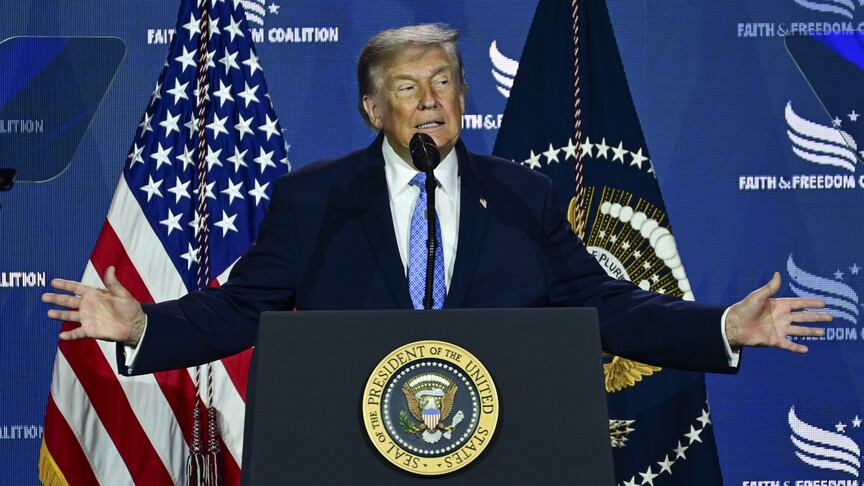
US President Donald Trump on Sunday criticized Democratic mayoral nominee Janeese Lewis George, calling her a “communist” and attacking her policy positions ahead of Washington, DC’s mayoral election.
“Janeese Lewis George, the Communist who is almost certainly going to be elected Mayor of Washington, D.C., has stated that she wants to empty the prisons, make D.C. a Sanctuary City, oppose ICE, welcome Criminal Illegal Aliens back into our beloved Capital, resist Anti-Crime Crackdowns, Defund the Police, continue and expand Cashless Bail, and so many other Capital destroying ‘things’,” Trump wrote on his Truth Social platform.
George won the Democratic primary for mayor of Washington, DC, earlier this month, securing her party’s nomination in the heavily Democratic city and becoming the likely successor to outgoing Mayor Muriel Bowser after the November general election.
Trump said he would not allow Washington, DC, to be “destroyed.”
“In the end, it will never work out, nor will I let it even have a chance because I have worked too hard to make Washington, D.C., the Envy of the World, with almost No Crime, and a Beautification process that has been second to none,” he said.
Trump also said he would “meet with Janeese Lewis George,” adding that Washington, DC, is “again a Safe and Prestigious Community.”
“Many people, including myself, have worked long and hard to get it there, and we will not let it be destroyed by a Communist adherent who has no intention to, MAKE WASHINGTON GREAT AGAIN!” he added.
-

 Fitness2 minutes ago
This unspectacular full-body exercise could be the secret to long-term fitness
-

 Movie Reviews14 minutes ago
‘The Invite’ Movie Review – Spotlight Report
-

 World28 minutes ago
Russia's ruling party runs Ukraine war veteran among lead candidates for September election
-
Politics37 minutes ago
Supreme Court Expands Presidential Powers to Fire Independent Regulators
-

 Culture1 hour ago
Test Your Knowledge of New York’s Algonquin Round Table
-
 Lifestyle1 hour ago
They were world-class tennis rivals. Now friends, they’ve teamed up against cancer
-

 Technology1 hour ago
T-Mobile is booting customers from its oldest plans
-

 World1 hour ago
Gunman kills 6 at youth welfare facility in suspected child custody dispute: reports

