Entertainment
Review: Sara Porkalob sings her truth in dangerous 'Dragon Lady' at Geffen Playhouse

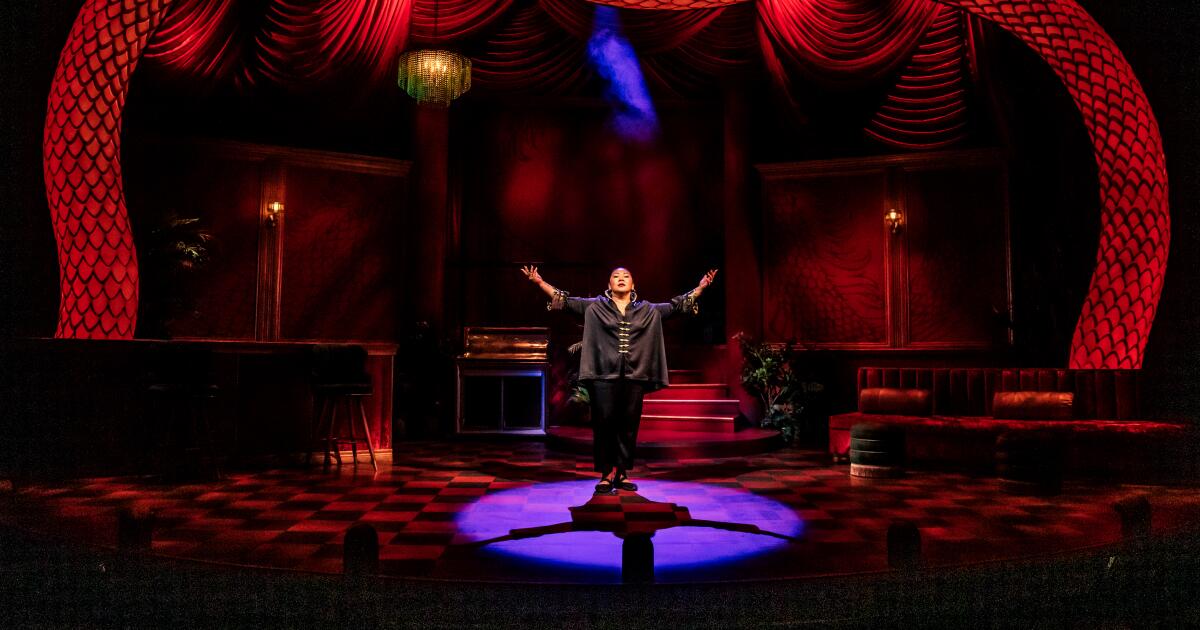
Three generations of women are assembled in Sara Porkalob’s “Dragon Lady,” the first in her three-part series of musicals about what she refers to as her “Filipina American gangster family.” She’s not exaggerating. When baby Maria comes crying home after being bullied by a neighbor, her mother hands her a golf club and tells her to go back over there and kill the kid.
She’s not kidding, either.
The show, which opened Thursday at the Geffen Playhouse’s Gil Cates Theater under the direction of Andrew Russell, takes place on Maria Porkalob Senior’s 60th birthday. She and her daughter Maria have had a strained relationship predating even the golf club incident. Feeling unfairly judged as she approaches her golden years, Maria Sr. decides to share episodes of her harrowing life with her granddaughter Sara. What follows are scenes out of a movie melodrama — helpless poverty, horrific exploitation, routine brushes with violence and near-death escapes — performed under the guise of a karaoke cabaret.
Sara Porkalob’s “Dragon Lady” delves into a family story marked by intergenerational trauma.
(Jeff Lorch)
Sara Porkalob starred in the 2022 Broadway revival of “1776,” directed by Jeffrey L. Page and Diane Paulus and featuring a multiracial cast made up entirely of female, transgender and nonbinary actors. The production was meant to view the musical through a 21st century, post-“Hamilton” lens, but Porkalob caused a stir in theater circles when she openly critiqued the handling of race and gender both in the rehearsal process and in the show itself.
That uncensored fearlessness, while not always appreciated in a team setting, is a valuable attribute in an artist creating her own material. Porkalob isn’t beholden to anything but her pursuit of the truth, which can be a dangerous game when delving into a family story marked by intergenerational trauma.
“Dragon Lady” moves back in time from the state of Washington to the Philippines, where we find Maria Sr. as a young girl, trying to survive the brutal murder of her father by a notorious gang. Working in the Red Dragon, a Manila nightclub owned by gangsters, Maria starts off as a cleaner, but as she matures into an attractive young woman she is promoted to singer. Promoted is a dubious choice of words, because the entertainers at the Red Dragon are expected to do whatever it takes to satisfy the customers.
Before she even knows what love is, Maria is swept off the stage by the boss of a ruling gang and impregnated. The story of her fight to keep her first daughter, whom she names Maria Elena, after herself, “her bittersweet joy,” represents the climax of the first half of “Dragon Lady.” Maria Sr., in many ways still a child herself, sings to her daughter, “I wish I could tell you that you are no child of pain / But you have my blood in your veins … / And trouble’s a family trait,” a haunting refrain that echoes turbulently throughout the generations.
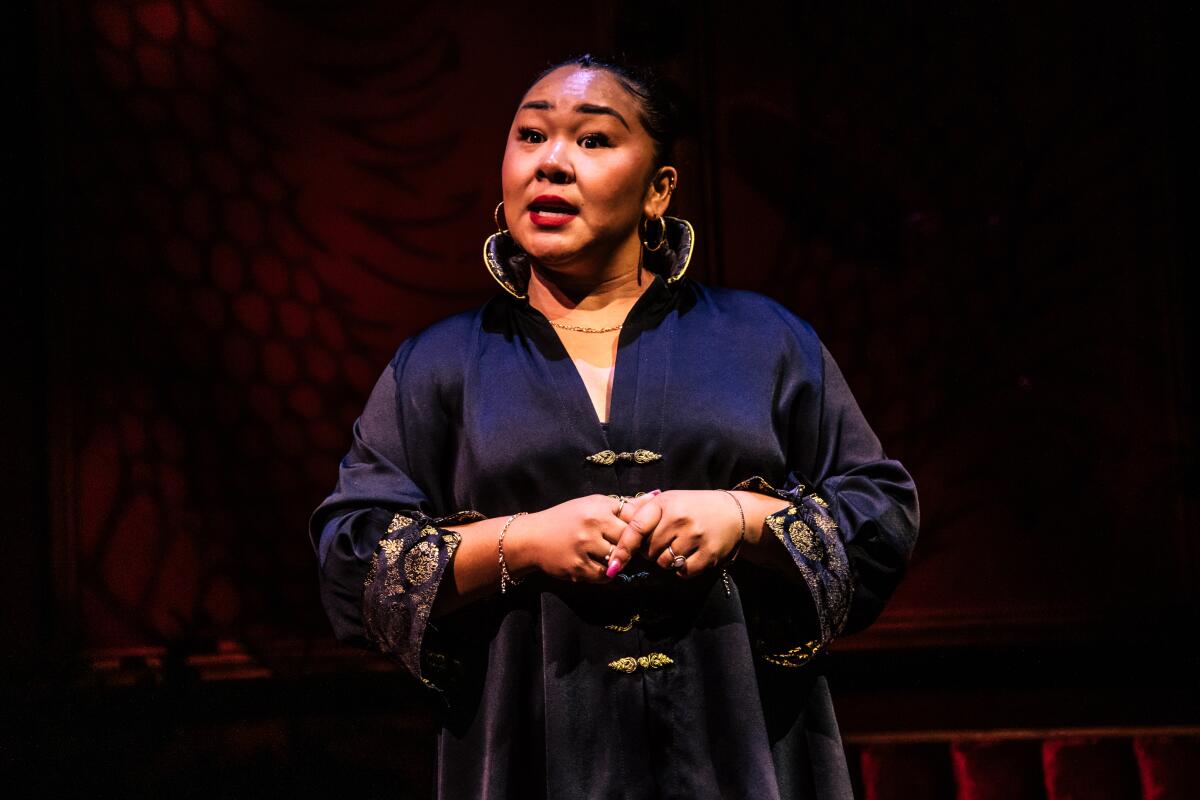
Sara Porkalob tells her family’s story in “Dragon Lady.”
(Jeff Lorch)
The second half of “Dragon Lady” tells baby Maria’s side of the story. She’s 13 years old when we encounter her back in Washington, after Maria Sr. has moved to the U.S. with an American navy man who fell under her spell at the nightclub. He married her and gave her his last name, but this marital lifeline doesn’t have enough elasticity to withstand Maria Sr.’s past. As the eldest child, young Maria has no choice but to take over the childcare duties of her four younger siblings as her mother desperately tries to earn a living while simultaneously doing everything in her power to attract a new breadwinner for her family.
Porkalob is a vivid actor, but the dizzying array of squeaky children in the second half can make it hard to keep the story straight. Even so, the general picture of a mother’s absence and a daughter’s understandable resentment at having had to pick up the maternal slack in penurious conditions comes through loud and clear. At times there isn’t a single jar of baby food in the house, forcing Maria’s siblings to go out and beg for food donations. This scene seems plucked out of Charles Dickens, but we’re in the Pacific Northwest with a Filipino family and far removed from Victorian consciousness.
Porkalob doesn’t take sides in the conflict between her grandmother and mother. She gives both women their due, providing sufficient context to prevent us from jumping to judgment too quickly. There’s a mischievous element to Porkalob’s storytelling morality that is a direct result of Maria Sr.’s presence. Firing up her jukebox karaoke machine, this newly turned 60-year-old raps by way of introduction, “But I ain’t never killed a man that didn’t deserve it.” Words that we will see come true — at least if we are to credit her account, something her first-born daughter is less apt to do.
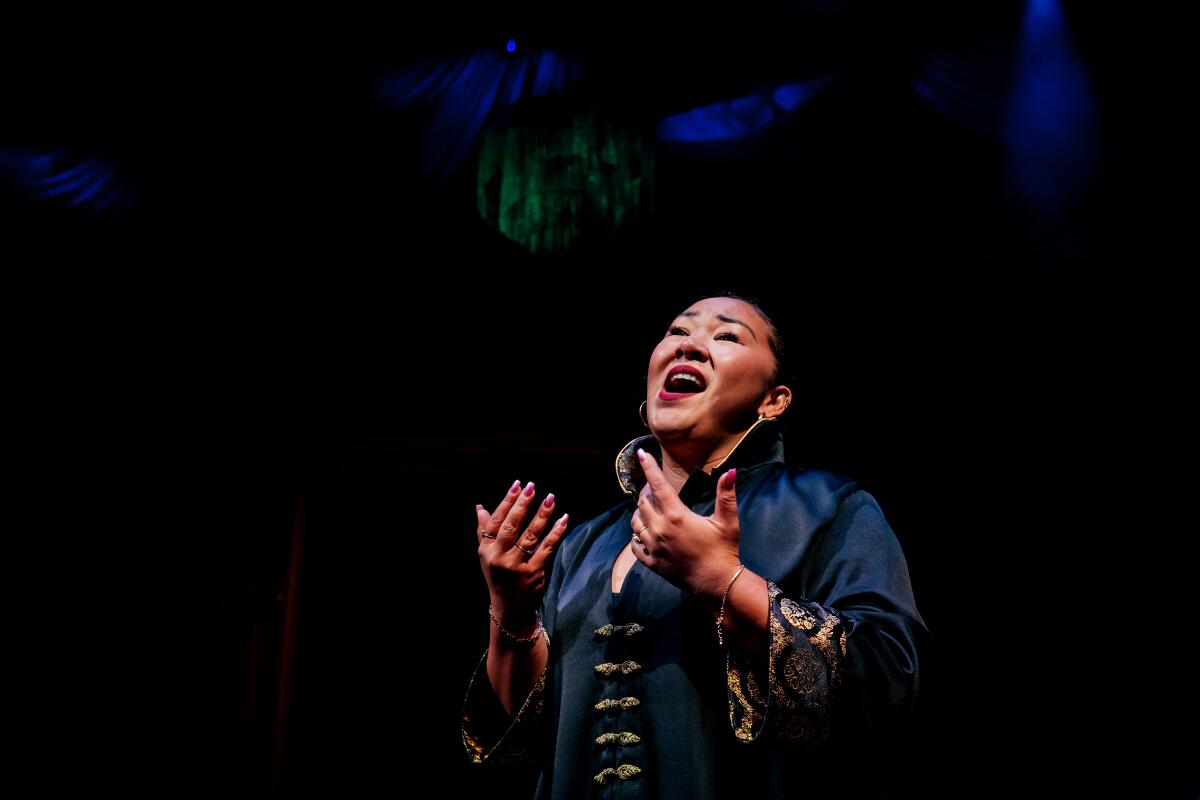
Sara Porkalob wrote “Dragon Lady” about her family.
(Jeff Lorch)
“Dragon Lady” works best as a one-person musical. Porkalob shares the stage with three extraordinary musicians (Pete Irving, Jimmy Austin and Mickey Stylin) who largely appear in the shadows of an inset space on the fabulous, garish red nightclub set by Randy Wong-Westbrooke. But she performs all the characters herself, and when she launches into song with her exquisite voice, moving from a range of high bell-like clarity to dusky lowdown in both original material by Irving and tweaked standards, the show is most fully alive.
When “Dragon Lady” becomes more of a conventional solo piece after intermission, a showcase for Porkalob to flex her versatility as an actor, the effect isn’t quite as powerful. One of the issues is that the tale being spun raises more plot questions than can be answered in the allotted time. Details and consequences are breezed over or ignored entirely, making “Dragon Lady” seem sketchy in places. When Porkalob is singing, however, the audience is too rapt to worry about a full narrative accounting.
Part 1 of the Dragon Cycle may not have found its ideal balance between music and drama, but Porkalob leaves a potent theatrical impression. Her family’s immigrant story must be exceedingly painful to relive, but it’s also clearly empowering. And not only for her but also for theatergoers who might feel that their own unsanitized histories couldn’t stand scrutiny on a public stage. “Dragon Lady” gives permission for the marginalized and the morally messy to belt out their complicated truths.
‘Dragon Lady’
Where: Gil Cates Theater at Geffen Playhouse,10886 Le Conte Ave., L.A.
When: 8 p.m. Wednesday-Friday, 3 and 8 p.m. Saturday, and 2 and 7 p.m. Sunday. Ends Oct. 6.
Tickets: $45-$139
Contact: (310) 208-2028 or geffenplayhouse.org
Running time: 1 hour, 50 minutes (including one intermission)



It’s summer blockbuster movie season and there have been a lot of new releases from many of the biggest studios and directors. Some of the biggest titles include “Supergirl”, “Disclosure Day”, and “Toy Story 5.”
GBH’s Morning Edition guest host Tori Bedford spoke with GBH correspondent and film critic Sarah G. Vincent, along with GBH’s Callie Crossley, an avid cinephile and host of Under the Radar with Callie Crossley, for their take on some of the season’s biggest releases. What follows is a lightly edited transcript.
SUPERGIRL
Tori Bedford: So one of the biggest movies to hit theaters lately has been the next installment in James Gunn’s new DC Universe, “Supergirl”, starring Millie Alcock. Sarah, let’s start with you. What did you think?
Sarah G. Vincent: I actually loved it. It’s the first summer movie where I didn’t have any disclaimers of “I liked it but…” I was very invested in the storyline because if someone hurt my fluffy baby, I would run around the universe and try to save him. Also, I like that it was like a superhero movie with a woman where she didn’t become a surrogate mother, where she wasn’t sexualized, where she was dealing with real emotion. The real emotion really hit me. I love the backstory. It was gorgeous. I understand that it’s a lot of jokey jokes.
Bedford: What do you mean jokey jokes?
Vincent: On the present day storyline where she’s helping Ruthye, they do try to keep it light because they’re dealing with a lot of heavy issues, and so there are a lot of like flippant jokes and one-liners and everything. And I didn’t mind that because this is still a blockbuster and I think that a blockbuster does need to have some like mass appeal. I’m not going for a Bergman film, right?
Bedford: Yeah, it’s summer. Like, chill out.
Vincent: Right.
Bedford: What’d you think, Callie?
Callie Crossley: I am the “but” — I liked it except some of the themes were so heavy, even though presented in an entertaining way. So, don’t take me wrong. You should see it. It’s a popcorn movie. But I was like, “OK…”
Bedford: You wanted more jokey jokes.
Crossley: Well, it was just to me, I looked at it and I thought, “Epstein Files” because we have a plot of young girls being trafficked to an island of crazy men. So that’s what came to me. But then I thought, I guess I’m just— I live in news, so this is what I would think of. But I can understand in the moment why it was there, but I’m not sure it resolved itself for me in the best way possible that sort of made it maybe not so uncomfortable about it. Now, she is great, Millie Alcock as Supergirl, and I loved her backstory. I really enjoyed that part. And there are some cameos from Superman. So you really get to see the difference between the two of them and why there is a difference, because now you know the backstory.
Bedford: I love their relationship, where he’s like, “This is why Krypto is not well-behaved” and she’s all disorganized.
DISCLOSURE DAY
Bedford: All right, next up — I can’t wait to talk about this. Steven Spielberg is back with an alien mystery thriller, “Disclosure Day.” This man is obsessed with aliens.
Callie, let’s start with you. What’d you think?
Crossley: I went because it’s Steven Spielberg, and I wanted everything. So again, this is a popcorn movie, and out of the gate, you are really on a ride, and you’re like, “What’s happening?” So, I would say the first part of the movie, you’re just caught up in trying to understand where he’s going with it, and it’s a lot of action, and it’s Spielberg-esque in that way. And that John Williams score is fabulous. What I had a problem with was the end of it. I’m going to use the word unimaginative because I am not giving away the plot, so no spoilers here, It’s unimaginative in how he resolves it because I think it’s old-fashioned in both how he presents some of the folk, and also in the methodology of how he wants to get the word out. So that sort of threw me off and I’m thinking, “That’s not a word I use with Steven Spielberg. I should not be using unimaginative.” I still say you should see it, but those are my thoughts.
Vincent: At 2.5 hours, I would say, I warned you. So as an action movie where people are being chased, like the bad guys are chasing the good guys, it’s a great movie. As a movie where it takes an alternate sort of sci-fi approach to the idea of possession and what it would look like, terrific. Actually, a really provocative, wonderful idea. Emily Blunt does a wonderful job.
Crossley: Fabulous.
Bedford: She’s great in the movie.
Vincent: I think she owns the movie, and if the movie was just about her character, I would probably give it like closer to a 90 than where I landed, which was probably in the 70s.
Bedford: I was just going to say … I got out of this, and I thought, “Am I stupid? Or was this really dumb?” It was fun though.
Crossley: This is not a Spielberg movie you’re going to remember, I say.
Vincent: No, yeah, you’re not.
Crossley: And there’s a lot of reviewers saying it’s fabulous. And I’m like, were we at the same place?
Bedford: Am I dumb?
Crossley: But still, it’s a popcorn movie. Got some really good stuff in there you could enjoy.
TOY STORY 5
Bedford: All right, finally: Woody, Buzz, and all their friends are back again for “Toy Story 5,” and this one is taking on big tech as a teaching tablet enters the toy box. Sarah, what’d you think?
Vincent: I loved it. It’s my favorite Toy Story. And I would say that what I loved about this movie is when you go to movies, usually technology is the bad guy, period. And this movie is much more nuanced. And no one is really the bad guy. It presents the pros and cons of everything. And it’s about authentic relationships and it shows how in the past, a relationship without technology was fraught, in retrospect, with problems for Jesse, with the trauma she endured by losing her person. Now in the present with their new human basically having this crisis of “how do I make friends?” So I think it shows the universal problem of how you make authentic relationships, and the technology is only showing how that problem persists. It embodies now, but it’s always been a problem.
Crossley: I think it’s brilliantly done in this way. It doesn’t demonize all the folks that usually get demonized. The tech gets demonized. Sometimes the parents get demonized. That did not happen at all. But for me, any story about friendship that’s told authentically is going to get me. And they know how to get you. It’s a really, really important story about finding your tribe, as Sarah said. Now, having said that, it’s still not my favorite. Toy Story 3 is my favorite. And I went back just to say, “Okay, let me just go look at the end of 3 again to see if I had the same response.”
Bedford: Oh, masochist, my God.
Crossley: Well, because I just wanted to see. I looked at my computer, watched only the end, and sobbed yet again.
Bedford: I know, that’s all I’ve got to say about this franchise. How much more crying do you want me to do?
Crossley: I misted up at the end of this. I did not sob, as I scared the children in 3 before in the theater. But this time I did mist up because really, they know how to get you. It’s so worth seeing.
GBH Daily

Controversial AI actor Tilly Norwood will star in her first movie, a comedy drama called “Misaligned.”
The film portrays Tilly as an AI being with “no real body” and lived experience but with access to everyone else’s, according to Particle 6, the London-based company behind Norwood.
Norwood drew intense ire from many Hollywood actors last year, when an executive behind her creation said Norwood would soon be signed to a talent agency. Some actors worried that AI characters trained on human likenesses without permission or compensation could one day replace them in movies and shows.
Particle 6 emphasized that the movie is a “hybrid production” with film and TV professionals working with AI specialists.
“Our ambition with Tilly Norwood has always been to show the creative industry what is possible with AI at any one point in time,” said Eline van der Velden, Particle 6 chief executive in a statement. der Velden said the film will help traditional filmmakers “upskill and transition to a world where AI will play an increasingly important part.”
“We remain passionate about helping people develop AI skills that will ensure they – and the industry – continue to thrive,” der Velden said.
In “Misaligned,” the plot progresses when Tilly is later convinced by a rogue bot to ignore her guardrails and start developing ambitions of her own, which make her more human and famous, and “Tilly begins to develop shame that her very being has been built on the whole of humanity,” Particle 6 said.
“The film will absolutely be funny, chaotic and self-aware — very Tilly,” van der Velden said in a statement. “But underneath it, there’s something deeper about identity, performance, and our very human fears around AI. And yes, art will most definitely be imitating life.”
AI remains a controversial topic in Hollywood, as many people in the entertainment industry are preparing themselves for the way the technology will change jobs and the way things are done. AI companies have touted how their tools could lower the cost and the amount of time it takes to produce visual effects . Meanwhile, writers and actors have expressed worries about their work being misused to train AI models.
“They are taking our professional members’ work that has been created, sometimes over generations, without permission, without compensation and without acknowledgment, building something new,” SAG-AFTRA President Sean Astin said last year regarding the controversy surrounding Tilly Norwood.
“But the truth is, it’s not new. It manipulates something that already exists, so the conceit that it isn’t harming actors — because it is its own new thing — ignores the fundamental truth that it is taking something that doesn’t belong to them,” Astin said.
SAG-AFTRA did not immediately return a request for comment on Tilly’s first movie.
The union has been advocating for more AI protections for actors, recently approving a contract with major studios in which producers agreed to “a principle strongly favoring human performances” and that producers would only use a synthetic if it “brings significant additional value to the motion picture.” If a producer decided to use a synthetic in a role that could be done by a human, they would need to notify the union and bargain in good faith.
SAG-AFTRA is also supporting the NO FAKES Act, a federal bill that would give individuals the authorization to use their own voice and likeness in digital replicas and creates a way to hold bad actors liable.

The Fetus, 2025.
Directed by Joe Lam.
Starring Bill Moseley, Lauren LaVera, Julian Curtis, Evan Towell, and Ariel Yasmine.
SYNOPSIS:
A couple become pregnant with a half-human, half-demonic fetus with a thirst for blood-and must uncover its terrifying origins before it’s too late.

In The Fetus, Alessa (Lauren LaVera) discovers she has accidentally gotten pregnant by her boyfriend Chris (Julian Curtis), but instead of this being a cause for celebration Alessa tells Chris that they must visit her father Maddox (Bill Moseley) instead of going to a hospital as Maddox insisted she do that if she ever got pregnant. Chris has his own reasons for not wanting a baby and goes along with her, but Maddox is not an easy man to get to know as he is blind and suffering from PTSD as a result of being in Vietnam.
However, there are bigger stakes here than just trying to impress your girlfriend’s father as it is revealed that Alessa’s baby is the result of a pact Maddox made with a demon decades before, and that his blindness was due to him not sacrificing Alessa to that demon. Now he has a second chance to appease the demon with the vampiric tentacle monster that keeps appearing to suck the blood of anyone who isn’t kin, and Chris has to step up and decide whether he wants to be a father or not.

Or something like that, as The Fetus is a little confused by its own mythology. Taking its cue from Larry Cohen’s It’s Alive!, The Fetus is a low-budget indie affair that has its star names to thank for lifting it up and out of the bin marked ‘utter nonsense’ and into the realms of watchable nonsense. What’s the difference? Well, there is no way to try and sell it as a serious horror movie as the premise is totally daft, the visuals give it the look of a Megadeth music video from the 1990s and it ties itself up in knots trying to tell us who needs to be sacrificed and why (although neither become very clear by the end of it), but Bill Moseley has made enough of these types of schlocky horror movies to know exactly what he’s doing and how to pitch it, plus Lauren LaVera has enough clout with modern horror audiences to give it some appeal and she proves once again why she is one of the best scream queens of recent times (although she is better than this movie), and so the combination of these two actors gives The Fetus more weight than it would have had if two lesser-known actors were in the roles.
Julian Curtis as Chris also lends an air of comic relief, although when the plot is as silly as it is you cannot help but deliver your lines with that sort of sarcastic smirk on your face (”You can’t get pregnant overnight” – well, she did and no one questions it). He plays off against Bill Moseley very well and, if nothing else, his character is the one that has the biggest arc, and if you wanted to dig deeper and salvage some sort of message about nature versus nurture, what it means to be a father, telling your girlfriend when the condom splits and that type of thing then it is there, but don’t stress too much if you just want to watch vampiric tentacles coming out from between Lauren LaVera’s legs because that is really what everyone is here for rather than social commentary.

The Fetus works because everyone involved knows exactly what kind of movie they are making, and that movie is a low-budget black comedy about a demonic baby with naff-but-passable effects and three lead performers who bounce off each other very well. Going into it expecting The Exorcist or The Omen levels of filmmaking quality is only going to lead to anger and disappointment, and you can’t really be angry at a movie that has a man sticking his you-know-what into a fiery hole in the floor to conceive a baby. Temper your expectations and go into The Fetus prepared to enjoy 84 minutes of diabolical baby B-movie hilarity and you’ll have a good time… maybe.
Flickering Myth Rating – Film: ★ / Movie: ★ ★ ★
Chris Ward
https://www.youtube.com/watch?v=embed/playlist
-

 Crypto4 minutes ago
U.K.’s sanctions on cryptocurrency exchanges signal new focus on illicit digital financing – Compliance Week
-

 Finance12 minutes ago
UK Watchdog Urged to Consider Broader Oversight of AI Financial Firms | PYMNTS.com
-
Fitness15 minutes ago
How ‘exercise snacking’ can help you stay on track in winter
-

 Movie Reviews27 minutes ago
Summer movie reviews: Supergirl, Disclosure Day, and Toy Story 5
-
World35 minutes ago
Wildfire forces Tour de France to ban fans from stage finale as parts of Europe sizzle again
-

 Culture1 hour ago
Try This Quiz on Literary Quotations About American Life
-
 Lifestyle1 hour ago
‘Alice and Steve’ might be a mess — but it’s also too fun to stop watching
-

 Technology1 hour ago
America’s greatest idea is still under threat

