Connect with us

Montana

Montana Ag Network: The state of the current Farm Bill

Published

on

Montana Ag Network: The state of the current Farm Bill

The Agriculture Improvement Act of 2018, more commonly referred to as the Farm Bill, is a crucial safety net for agriculture producers.

“We’ve been pushing for this new Farm Bill for two years now, and so we’re hoping that there’s a light at the end of the tunnel, and we’re pushing that it’s finished by the end of this fiscal year,” explained Boyd Heilig, president of the Montana Grain Growers Association (MGGA).

Half of Montana’s crop production is exported oversees, making the export markets critical to Montana farmers, and why MGGA is seeking additional funding for the foreign market development to be added to the new farm bill.

“The Farm Bill in 2018 was good, there’s nothing wrong with it, but we want some enhancements to crop insurance, that’s our number one priority, and some additional funding for market access programs and foreign market development,” said Heilig.

Advertisement

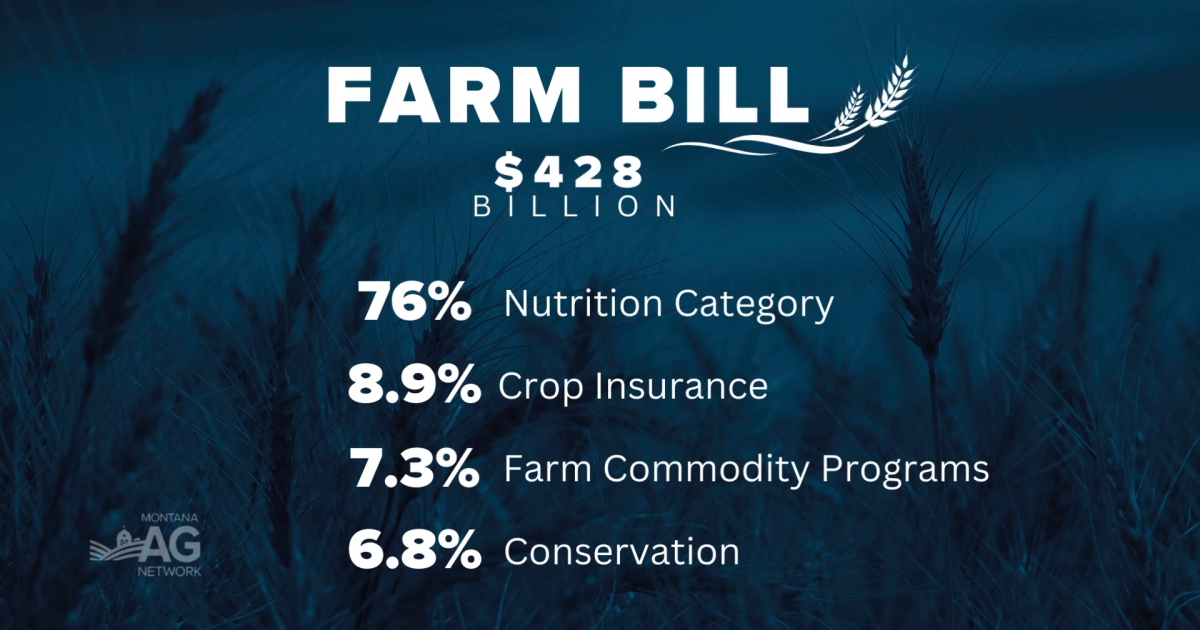
With the current 2018 farm bill, totaling $428 billion over the five years, 76% is in the nutrition category, 8.9% is in crop insurance, 7.3% is in farm commodity programs, and 6.8% is in conservation.

“Each time a Farm Bill is about to expire completely, they throw in an extension because they don’t want to revert back to the program where the farmers get paid what it costs to produce their crops,” said Walter Schweitzer, president of the Montana Farmers Union.

While the fate of the Farm Bill is unknown at this time, Montana farmers are fighting for more funding to protect agriculture production, and with that, national food security.


“Either they’re going to pass some sort of version during the lame duck period, which is between November and the end of January, or they’ll wait until the new president and congress are sworn in to pass a different Farm Bill,” said Schweitzer.

“We know that nothing is going to get done with the Farm Bill until after the election. But we as Montana Grain Growers, we’re pushing to get this farm bill done,” Heilig added.

Advertisement

If another Farm Bill isn’t passed, federal nutrition programs including SNAP are what will be hit the hardest.

In the last Farm Bill, more than 300 billion dollars was allotted for SNAP programs, meaning that funding would no longer be available, taking away those benefits.

“You don’t have one without the other. And the way I see it is we produce these products, this food, these food products, and so if they go into food programs, that’s just a win-win for both of us to give to the needy but use our food that we raised as part of it. And so that’s why it’s always been together, and it hasn’t been separated, so that’s where a lot of the lines are drawn because they don’t want any cuts to SNAP, and the farmers don’t want any cuts to their programs. And so that’s where the typical argument is of the dollars needed, and where do they go,” shared Heilig.

The MGGA has no interest in seeing that happen; they are seeking to keep that funding there, while also allotting more funding to the crop insurance and market access programs.



Source link

Advertisement

Montana

Montana Department of Agriculture focusing on innovation in 2026

Published

on

Montana Department of Agriculture focusing on innovation in 2026


HELENA — You probably have goals and plans for 2026—the Montana Department of Agriculture does too.

“We’re really focusing on innovative agricultural practices,” Montana Department of Agriculture director Jillien Streit said.

It’s no secret that agriculture—farming and ranching—is not easy. There are long days, planning, monitoring crops and livestock, and other challenges beyond farmers’ and ranchers’ control.

(WATCH: Montana Department of Agriculture focusing on innovation in 2026)

Advertisement

Montana Department of Agriculture focusing on innovation in 2026

“We have very low commodity prices across the board,” Streit said. “We still have very high input prices across the board, and we have really high prices when it comes to our equipment, and so, it’s a really tough year.”

But innovation, including new practices, partnerships and technology use, can help navigate some of those challenges.

Advertisement

“We can’t make more time and we can’t make more land, so we need to start putting together innovative practices that help us maximize what our time and land can do,” Streit said.

Practices range from using technology like autonomous tractors and virtual fencing—allowing rangers to contain and move cattle right from their phones—to regenerative farming and ranching.

“It is bringing cattle back into farming operations to be able to work with cover cropping practices to invigorate the soil for new soil health benefits,” Streit said.

The Montana Department of Agriculture is working to help producers learn, share, and collaborate on new ideas to work in their operations.

The department will share stories of practices that work from farms and ranches across the state. Also, within the next year or so, Streit said the department is hoping to roll out technology to help producers collaborate.

Advertisement

“(It’s) providing a communication platform where people can get together and really help each other out by utilizing each other’s assets,” she said.

While not easy, agriculture is still one of Montana’s largest industries, and Streit said innovating and sharing ideas across the state can keep it going long into the future.


Source link

Continue Reading

Montana

Frontier Conference women: MSU-Northern, Montana Western pull upsets to advance to semifinal round

Published

on

Frontier Conference women: MSU-Northern, Montana Western pull upsets to advance to semifinal round


BUTTE — MSU-Northern and Montana Western pulled a pair of upsets Saturday at the Butte Civic Center to wrap up the quarterfinal round of the Frontier Conference women’s basketball postseason tournament.

The fifth-seeded Skylights started the day with a red-hot shooting performance to down No. 4 Rocky Mountain College 82-74. Western, the sixth seed, used a third-quarter surge to defeat No. 3 Carroll College 65-56.

MSU-Northern (17-11) and Western (14-13) now advance to Sunday’s semifinal round, where the Skylights will play No. 1 seed Dakota State at noon and the Bulldogs will face No. 2 Montana Tech at 2:30 p.m.

MSU-Northern 82, Rocky Mountain College 74

Advertisement

MSU-Northern sizzled in the first quarter, making seven 3-pointers to take a double-digit lead, and put together a crucial third-quarter run to get past Rocky and advance to the semifinal round.

Becky Melcher splashed four 3s in the first 10 minutes, and Taya Trottier, Canzas HisBadHorse and Shania Moananu added one apiece as the Skylights built a 29-13 lead. Melcher scored 14 first-quarter points and finished with a game-high 30 on 10-of-19 shooting (7 of 15 from 3-point range). She added 11 rebounds, a blocked shot and three steals to her stat line.

Rocky battled back to tie the game at 36-36 in the second quarter on a Brenna Linse basket, but MSUN responded with consecutive triples from Trottier and Melcher and took a 44-38 lead into halftime. The Bears eventually stole the lead back in the third quarter following a 9-0 run capped be an Isabelle Heggem bucket.

But the Skylights again answered — this time with a 13-2 run to take a 60-51 lead. MSUN led 66-59 going to the fourth and wouldn’t trail the rest of the way. The Skylights trailed for less than two total minutes of the game.

As a team, MSUN made 14 of 26 3s in the game. Ciera Agasiva was 3 for 3 from behind the arc, and Trottier was 2 for 3. Trottier had 18 points, eight rebounds and six assists, while Agasiva had 13 points.

Advertisement

Paige Wasson led Rocky (20-9) with 29 points but was 0 for 10 on 3-point attempts. Heggem had a double-double of 21 points and 12 rebounds.

Montana Western 65, Carroll 56

After neither team led by more than five points in the first half, Western broke open a 25-25 tie game by outscoring Carroll 20-9 in the third quarter.

Bailee Sayler scored 10 points in the quarter, including making two 3-pointers, to help the Bulldogs take control. They led 45-34 going to the fourth, and Carroll wouldn’t get closer than six points the rest of the way.

The Fighting Saints were just 18-of-65 shooting (27.7%) for the game.

Advertisement

Sayler scored an efficient 22 points on 7-of-8 shooting. She was 2 for 3 from 3-point range and 6 for 7 at the free throw line. The Missoula native also had nine rebounds.

Isabella Lund added 16 points for the Bulldogs, and Keke Davis had 11 points and 11 rebounds.

Carroll (19-10) was led by Kenzie Allen with 12 points. Willa Albrecht and Meagan Karstetter scored 11 points apiece for the Saints.


Source link

Advertisement
Continue Reading

Montana

Women who made agriculture work in Montana

Published

on

Women who made agriculture work in Montana


Recently, I was asked to talk about what it is like to be a female rancher.

I was flattered to be asked, but I don’t know the answer.

I do know what it is like to be a human rancher and I know that I admire many women who also are ranchers.

Advertisement

In fact, 36 percent of the farmers and ranchers in the U.S. are women and they manage almost half of America’s ag land.

Globally, we produce more than half of all food.

In Montana, we all benefit from amazing female leaders in agriculture.

If you want to know about improving soil health or the rewards of raising sheep, talk to Linda Poole in Malta.

If you want to learn how to organize a grassroots rancher’s organization and effect meaningful change, talk to Maggie Nutter in Sunburst.

Advertisement

Trina Bradley of Dupuyer will look you in the eye and tell you everything you need to know about the impacts of grizzlies on her ranch life.

Colleen Gustafson, on the Two Med, graciously hosts and educates non-ranchers for months at a time without strangling them, all while maintaining every fence, buying every bull and killing every weed on her ranch.

Adele Stenson of Wibaux and Holly Stoltz of Livingston find innovative solutions to ranching challenges and then — even harder — find ways to share these innovations with hard-headed, independent cusses who want to do it our own way.

In fact, I’ve noticed that often women seek novel innovations to deal with a ranching challenge.

Advertisement

If a man happens to be around, she might even run it past him.

It’s rubber band ranching – stretch with an idea, contract to assess it, then stretch again to implement it.

Long ago, my friend Michelle and I promoted the One Good Cow program at the Montana Stockgrowers Association meeting.

We asked cattle producers to donate one cow to ranchers who had lost so many in blizzards and floods that year.

As we stood on stage in a room full of dour, silent men, I remember finding the one person I knew and asking what he thought.

Advertisement

Just as he would bid at a livestock auction, he barely nodded his approval.

We ended up gathering more than 900 cows from across the nation and giving them to 67 producers.

One Good Cow was a good idea.

Now I don’t seek approval for my ideas so sometimes my rubber band doesn’t contract to assess one before I stretch into action.

That’s how I got myself into producing shelf-stable, ready-to-eat meals made with my beef and lamb.

Advertisement

This is a good idea, too.

I hope.

I wonder if it is easier to ranch as a woman in some ways.

Society pressures men to know all of the answers all of the time, but If I mess up, I try to learn from my mistake and move forward.

When Imposter Syndrome hits or we can’t find a solution to an unsolvable problem – the effects of climate change, commodity markets or competing demands from family – secretly faking it until we make it gets lonely.

Advertisement

The downward spiral of loneliness and the pressure to be perfect can lead to suicide.

Male ranchers kill themselves 3.5 times more often than the general public.

Female ranchers kill themselves, too, just a little less often.

I’m fortunate to have good friends who love me even when I’m far from perfect.

We laugh together, they remind me that I have a few good attributes even when I forget, they tolerate my weirdness and celebrate little successes.

Advertisement

They stave off loneliness.

They know all ranchers try our best, we appreciate a little grace, and a warm fire feels good to our cold fingers.

Lisa Schmidt raises grass-fed beef and lamb at the Graham Ranch near Conrad. Lisa can be reached at L.Schmidt@a-land-of-grass-ranch.com.


Source link

Advertisement
Continue Reading

Trending
