Lifestyle
This is genius: A new graphic novel imagines conversations between Einstein and Kafka

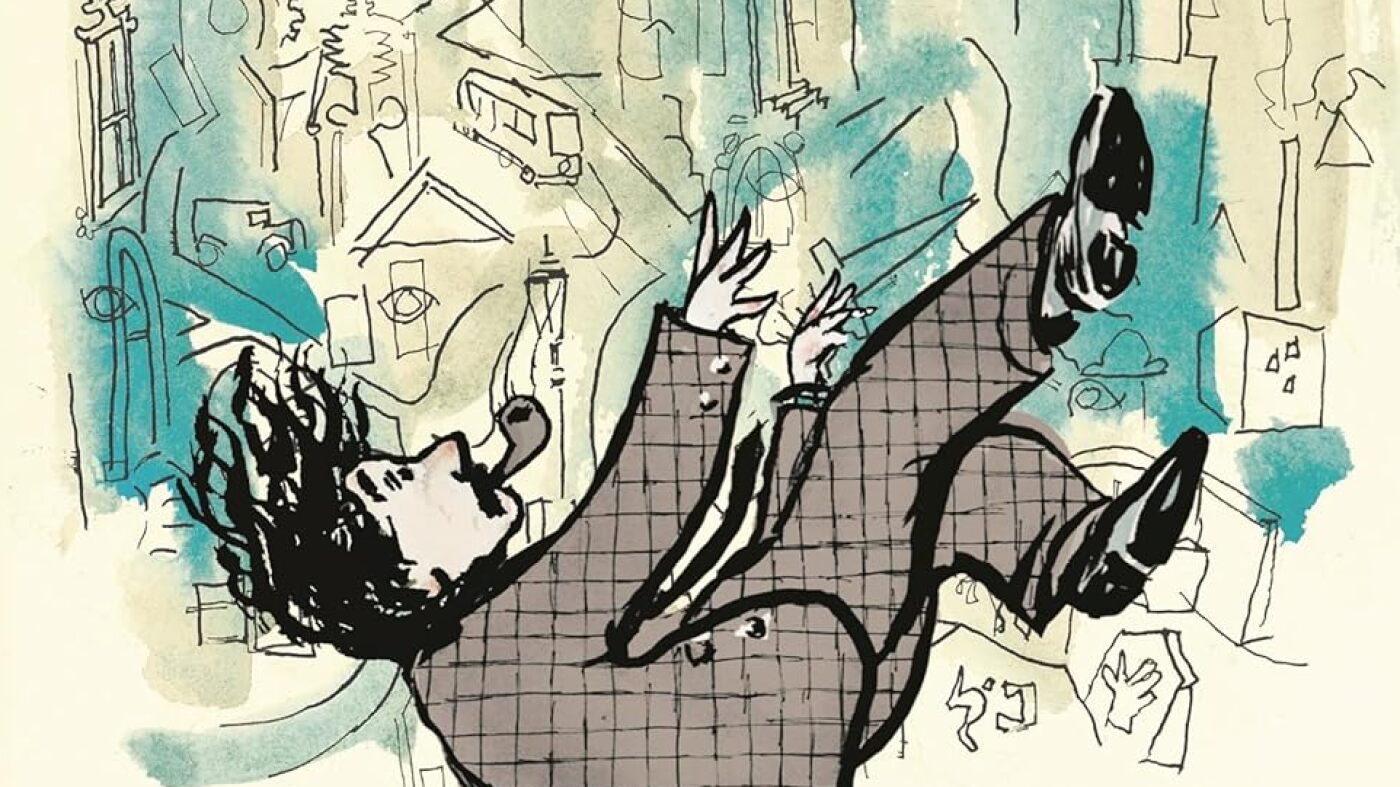
Turns out Albert Einstein and Franz Kafka lived in Prague at the same time and had the same circle of friends. In the new graphic novel, Einstein in Kafkaland, Ken Krimstein puts us in the room with two 20th century geniuses.
Ken Krimstein/Bloomsbury Publishing
hide caption
toggle caption
Ken Krimstein/Bloomsbury Publishing
It’s April 1, 1911, and 32-year-old Albert Einstein — former bureaucrat at the Swiss Patent Office, with a half-decade old doctorate in physics from the University of Zurich — sits in a train car with his two sons and his wife, fellow physicist and mathematician Mileva Marić. They are travelling from Zurich to Prague, where Einstein has landed a job as a full professor in theoretical physics, teaching in the German section of what is now Charles University. He has a few things on his mind, including money troubles, but most critical is his unfinished theory of relativity. When they leave the city 15 months later, Einstein will have cracked the code.
What happens over the course of this long, mysterious year in Prague is the question driving Ken Krimstein’s new graphic novel Einstein in Kafkaland. Part biography, part historical fiction, Krimstein playfully explores the possibilities, building, with footnotes, on a thorough archive of letters, diaries, and other research. The result, a thought-provoking work made up of comics suffused in a gentle mix of aquamarine watercolors, is equal parts joyful and ruminative. (Think: Alice in Wonderland meets The Lives of the Poets meets Krazy Kat.) The full subtitle to the book — How Albert Fell Down the Rabbit Hole and Came Up with the Universe — signals the lavish whimsy that goes a long way towards making this such a delightful, inspiring read.

Throughout, cartoon-Einstein sports his characteristic pipe alongside a signature frizzy head of hair. But it’s his obsessive ruminations that perhaps most effectively signal what has become Einstein-the-character, a culmination of all the gossip, public appearances, private words, and first-hand accounts of one of the best-known scientists to have ever lived. Krimstein pairs Einstein’s story with that of Franz Kafka, who was 28, virtually unpublished, and living with his parents in a house in Prague when Einstein arrived for his short but impactful stay. What binds the two together, in addition to an alleged one-time meeting at a weekly salon, is a complementary preoccupation with getting at the truth — “the true truth” — against all odds, and against many other people’s better judgements. For both, a journey to find this truth, whether in science or literature, is one that will sometimes alienate as painfully as it may ultimately bind them to others.
During Einstein’s time in Prague, a time in which he works out his theory of relativity, Kafka will have his own breakthrough. In one long feverish night he will pen the short story, most often known in English as “The Judgment,” which will launch an unparalleled writing career forever transforming art and literature. Like Einstein’s completed theory of relativity, Kafka, too, will offer the world a new way of thinking. It’s a way of thinking that, our narrator assures us, “we’re all still struggling to catch up to.”

Einstein in Kafkaland: How Albert Fell Down the Rabbit Hole and Came Up With the Universe by Ken Krimstein
Ken Krimstein/Bloomsbury Publishing
hide caption
toggle caption
Ken Krimstein/Bloomsbury Publishing
Despite his title, Krimstein centers his book unevenly, focusing mainly on Einstein, and taking us step by step through the meditations that lead to his discovery. Nonetheless, along the way he also provides readers with glimpses into the life of the perpetually melancholic insomniac insurance clerk, Kafka. We witness, for example, an early morning swimming routine with his best bud — and future literary executor — Max Brod. But what Kafka’s presence in the narrative most crucially enables are imagined conversations between him and Einstein. In these, the two puzzle, and sometimes commiserate, over what it means to see the world differently from everyone else. What happens when you believe so confidently in your own hard-won perceptions that you risk killing the heroes that brought you there?
Krimstein, a well-published cartoonist whose previous work includes another delightful graphic biography, The Three Escapes of Hannah Arendt, luxuriates in intellectual history shoulder to shoulder with juicy biographical details. He depicts Einstein debating with his foe, Max Abraham; taking fantastical trips into a four-dimensional world with Euclid; and walking and talking with Austrian physicist, and dear friend, Paul Ehrenfest. And he exposes, too, scenes of the future Nobel Prize winner in the bath, trying to kill off bedbugs; or engaging with his young children, and wife, in Gedankenexperiments (thought experiments), to help him think through the problems that continually occupy him.
At its heart, Einstein in Kafkaland is the story of ordinary genius. It unwraps the ways in which genius so often arises out of ordinary circumstances. Perhaps even more compellingly, the book tracks how unimaginable discoveries develop following exchanges with others — friends and family, colleagues and nemeses, neighbors and role models. Aberrations aside, works of genius most wholly emerge in dialogue.
Tahneer Oksman is a writer, teacher, and scholar specializing in memoir as well as graphic novels and comics. She lives in Brooklyn, N.Y.



In central London’s Waterloo Place, a life-size statue that emerged overnight in late April has been creating a stir. When I visited a few weeks after it was erected, local authorities had already set up protective barriers around it.
The installation — signed by the famed street artist Banksy — depicts a man in a suit hoisting a flag as he strides over a precipice. As he marches on, the flag blows backward to cover his face, leaving him unaware he’s only a step away from a perilous fall.
Set among grand monuments celebrating Britain’s past, the “flag man” takes on a particular visual irony at a time when the country — and much of the world — is debating its path forward.
Like many viewers there, I found myself wondering whether this statue is Banksy’s warning about the consequences of uncritical nationalism, or simply a reflection on human shortsightedness. Or, perhaps, it is just prompting us to ponder a broader question: What happens when devotion to a symbol prevents us from seeing what lies ahead?
Whatever the message, the work feels remarkably attuned to the current moment.
For more Far-Flung Postcards, click here.
Lifestyle
Wait, it’s a candle? Her beeswax fruit and veggie ones look so real, you’ll want to take a bite
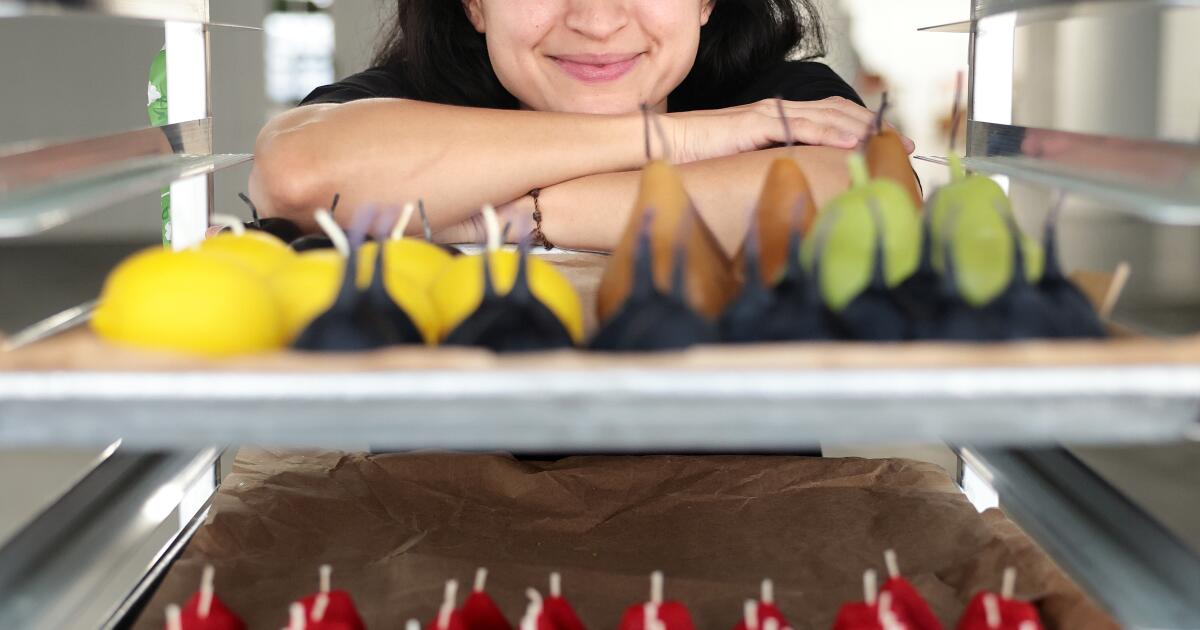
Jessica Gonzalez hustles behind her booth at the recent Renegade Craft Fair, frantically ringing up sales, answering questions and packaging her beeswax candles.
It’s hot on the grounds of the Los Angeles State Historic Park in April, but 35-year-old Gonzalez and her fiancé, Jordan Colindres, keep their cool as a crowd gathers to admire her Happy Organics candle collection, a homage to her family’s produce company in the Central Valley that looks like real fruits and vegetables.
“I love doing in-person events because it’s so fun to see people’s reactions,” she said a few months later. “It makes me feel good to see other people finding joy in my candles. They often say, ‘Oh, that’s really funny.’ And it is funny to have a cherry candle on top of your birthday cake.”

3

1. A staff member pulls a beeswax corn candle, $26, out of its mold at Happy Organics’ studio in downtown Los Angeles. 2. Each Beeswax Mixed Berry Birthday Candles set is cast from real mixed berries — strawberries, raspberries, blackberries, blueberries and cherries. A set of 10 is $30. 3. Bartlett green pears and heirloom tomatoes, $24 to $40.
Judging by the smiles and charmed looks on shoppers’ faces, her produce-inspired candles are less about illuminating rooms and more about sharing the joy she sought when she first started the company in 2018.
In this series, we highlight independent makers and artists, from glassblowers to fiber artists, who are creating original products in and around Los Angeles.
But then, it’s hard not to smile at the playfully elegant Bosc pears, puckered mandarins and green-and-purple asparagus taper candles which range in price from $12 to $40. Some are molded into corn on the cob, celery and rhubarb shapes. Others are made to look like mushrooms, figs, tomatoes and snap peas. The most popular are the small birthday candles shaped like raspberries, cherries and blackberries, packed in molded-pulp baskets just like you’d find at the grocery store or farmers market.

-
Share via
Gonzalez didn’t start out as a designer. The youngest of nine children, she was born in 1991 in Salinas and later moved to Merced, where she grew up on a 10-acre farm. She studied computer science at Mills College, then worked in tech consulting in the Bay Area and eventually became the CTO of an ag-tech company. When her mother, Angela, became ill in 2016, she returned to Merced to be with her family.
When her mom died suddenly soon after she moved home, Gonzalez left the tech industry. “I wasn’t connected with what I was doing,” she said. “I wanted to find something more meaningful; something I loved. I didn’t want my ego to keep me stuck in what I studied in college. I decided to let myself try new hobbies and passions and look for joy again.”
After her mother’s death, she began working with her father, Salvador, and her uncles at the family’s apiary, where they managed more than 30 hives. (Her grandfather was also a beekeeper in Michoacán, Mexico.) Soon, she began selling their raw honey at local farmers markets. In a heartbreaking turn, her father was diagnosed with cancer a year later, so she started making cannabis-infused honey, balms and chocolates to help ease his pain.
When she saw that the beeswax candles, which last significantly longer than paraffin candles, were selling faster than the honey, she decided to focus on making candles from the leftovers from her uncles’ hives.
She was only 25, but it was a turning point. “It was one of those moments where I felt like I needed to change my path,” she said. “I needed to change everything in my life.”

Jessica Gonzalez and her father Salvador on their family farm in Merced. (Gonzalez family)

Gonzalez at Happy Organics’ studio in downtown Los Angeles. (Christina House / Los Angeles Times)
When her father died in 2018, she inherited his bees and started Happy Organics, although she hadn’t planned on starting a business. After experiencing so much loss, making candles became a kind of therapy. “It felt great to work with my hands again, something I thought I’d never have time for,” she said.
Her oldest sister, Sonia Gonzalez, said Gonzalez reminds her a lot of their father, who reinvented himself many times over the years.


The nopal cactus is cast from a real nopal and hand-poured in 100% pure beeswax in the Los Angeles studio.
“He grew up as a village boy in the rural mountains of Michoacán, Mexico, and went on to work in restaurants, cut down Christmas trees and pick strawberries and broccoli in the fields of Salinas,” she wrote in an email. “From there, he started selling produce door-to-door, then at flea markets and eventually built his own produce distribution business from the ground up. As the youngest of nine kids from a working-class family, Jessica’s always been incredibly resourceful, responsible, and amazing at reinventing herself.”
Like a lot of millennials, Gonzalez taught herself how to make candles by watching YouTube videos. She started with hand-dipped tapers, working in the garage on the farm that helped her feel safe and connected to her parents. “It was a really nice environment to try something new and creative,” she said.
Inspired by her family’s produce, she cast real corn, strawberries and cherries in plaster, then made a silicone mold to create copies. Even when using the same mold, color can vary from batch to batch, and how it cools also affects the result. “That’s just how handmade things are,” she said. “There’s always some variation.”

Cherry molds make cherry candles at Happy Organics’ studio in downtown Los Angeles.

A variety of fruit and veggie candles.
When she moved to Los Angeles in 2023 to be with Colindres, her business took off. “L.A. is a great place to grow,” she said. “There’s so much opportunity here. When I go to a farmers market, I never know who I’ll meet.”
She sold her candles in person at craft shows, the Hollywood Farmers’ Market and most recently, during a residency at the P.F. Candle Co. showroom in Echo Park.

2

3

1. A staff member trims the wicks on a pair of carrot birthday candles, $22. 2. Gonzalez passes by shelves of candles at Happy Organics’ studio in downtown Los Angeles. 3. Asparagus taper candles, $30.
“I have a lot of respect for her as a fellow candle maker (making molds is not easy), but getting to know her story more and how her choice of foods and wax is reflective of her family’s history gave it so much meaning,” P.F. Candle Co. founder and creative director Kristen Pumphrey said in an email. “It’s been a tough couple of years for L.A. businesses, so we gotta stick together — there’s this wonderful sense of community hosting a local brand that’s so passionate about their work.”
As her business has expanded, her products are now available at Terrain, Joan’s on Third and the MoMA Design Store in addition to her website. She has also had to source beeswax from other vendors across the country to keep up with demand.
Kimberly Curtis, owner of Hide & Seek Vintage in Studio City, said Gonzalez’s strawberry and cherry birthday candles “flew off the shelves last year” during the holidays. “Our customers love them,” she added.

Gonzalez holds a cabbage candle.
Still, Gonzalez stays connected to her Central Valley roots. Everything she and her small team make in downtown Los Angeles is handmade and “takes time,” she said, describing the steps involved in crafting quality candles. Right now, her favorite is the Nopal Cactus candle, which she made using a clipping from an employee’s yard. While others help her with production, wholesale management and packaging, she focuses on sales, content and all-new product development.
When asked if she has advice for others who want to start their own business, Gonzalez admits she sometimes feels overwhelmed.

In 2013, Gonzalez and her family gathered at their Merced ranch to celebrate her parents’ anniversary.
(Gonzalez family)
“The biggest thing that has gotten me through the toughest spots is my why or my reason for starting,” she said. “I think that has to be really strong. That’s what brought me a lot of comfort when I felt like quitting: going back to the beginning and remembering why I started this.”
For Gonzalez, her reason is always close to her heart. “I wanted to feel connected to my parents in some way,” she said. “This was a good representation of my upbringing.”

The Kennedy Center, the facade of which remains covered with a tarp, is seen in Washington, DC, on June 28, 2026. A US federal judge asked on June 24 for an explanation for why a tarpaulin continues to cover the facade of the Kennedy Center where President Donald Trump’s name was recently removed. District Judge Christopher Cooper gave the board of trustees of the performing arts venue until the end of July to explain “the purpose for and status of the tarp and scaffolding that Defendants have erected on the front portico of the Center.”
ALEX WROBLEWSKI/AFP via Getty Images
hide caption
toggle caption
ALEX WROBLEWSKI/AFP via Getty Images
More than two weeks ago, President Trump’s name was removed from the Kennedy Center facade though it is still covered by a tarp and the legal battle continues.
On Monday, a U.S. Department of Justice filing on behalf of the Kennedy Center included some surprises. The document was submitted in response to issues raised by lawyers for ex-officio board member Rep. Joyce Beatty of Ohio who is suing to remove President Trump’s name from the center and stop its closure for renovations.
Among the revelations, the Kennedy Center admitted that, during a board meeting on December 18, 2025, Beatty had been “muted and prevented from speaking.” It was at that meeting that the board voted to add President Trump’s name to the center. The filing later acknowledges the congresswoman was “prevented from voicing her opposition.”
The John F. Kennedy Center for the Performing Arts is a living memorial to its namesake. The guidelines for how the theatre complex spends federal dollars are very specific. Among other rules, it states that “no additional memorials or plaques shall be designated or installed.” Beatty argues adding Trump’s name runs afoul of those rules and that any change requires approval from Congress.
According to one of Beatty’s filings, “There was no advance notice in the agenda that the Board would be considering a name change,” a statement the Kennedy Center now does not deny. The center admits that, prior to voting, there was “no discussion about potential risks or downsides of the vote to adopt a secondary name for the Center.” Nor was there a board discussion “about any potential conflict of interest that might result from the vote.”
The center’s lawyers previously contended that if Trump’s name were to be removed, it would “lose money from donors who support” him and “impede the Center’s fundraising efforts.”
Closing for renovations
Earlier this year, Trump announced on social media that the Kennedy Center would close for two years for renovations. He wrote that he made the decision after “a one year review” with “Contractors, Musical Experts, Art Institutions, and other Advisors and Consultants.”
But, according to the center’s lawyers, Trump’s announcement “was made without presenting any plans, analyses, timelines, or funding information to his cotrustees and without any Board vote.”
The Kennedy Center has long denied reporting by The Washington Post that ticket sales plummeted after President Trump became the Center’s board chair. In Monday’s legal filing, the Center admits that, by October 2025, “nearly half of the Center’s tickets were going unsold.”
-

 Pittsburg, PA6 minutes ago
Pittsburgh’s Fort Pitt Museum reveals roots of Independence Day
-

 Augusta, GA9 minutes ago
Augusta’s new arena reaches major construction milestone
-
Washington, D.C14 minutes ago
Talking with Ohioans at the Great American State Fair
-

 Cleveland, OH21 minutes ago
Cleveland councilman warns of planned outages coming to city’s west side during high heat
-

 Austin, TX24 minutes ago
Texas court orders porn site to pay $9M bond to unlock domain name
-

 Alabama29 minutes ago
New Alabama school threat law is now in effect. Here’s what families need to know.
-

 Alaska36 minutes ago
Five tribes continue legal battle over controversial IPOP gold mining project near Nome
-

 Arizona39 minutes ago
Arizona still pursuing nuclear energy despite hurdles | Arizona Capitol Times

