Connect with us

Montana

Dual wildfires causing chaos on Montana-Wyoming border

Published

on

Dual wildfires causing chaos on Montana-Wyoming border
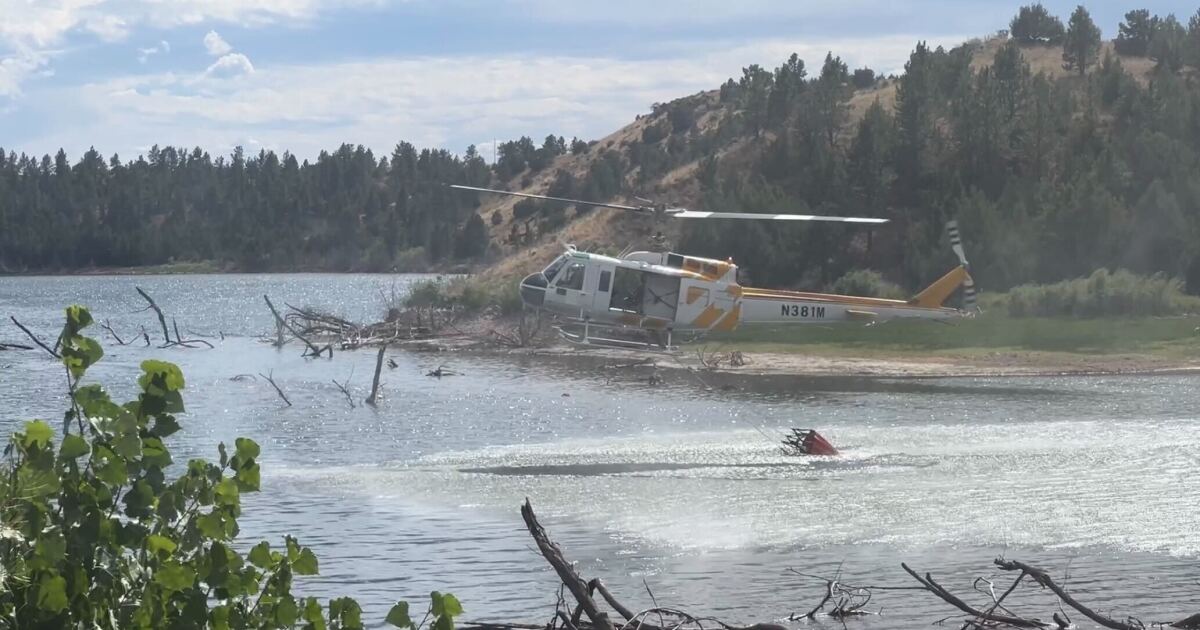

Two major fires are threatening southeast Montana.

The Barber Draw fire sparked Wednesday just northwest of the Tongue River Reservoir and is currently at 8,000 acres in size.

The Remington fire first began in Wyoming but crossed the Montana, Wyoming border Thursday around 6 pm. As of 5:15 p.m. Friday, the fire has burned 128,771 acres. Pre-evacuation orders are still in place for the area south of Ashland to the Rosebud County Line.

The fire has crossed into three different counties: Powder River, Big Horn, and the southern end of Rosebud.

Advertisement

MTN News

Keith Gerber is the operations chief with Montana Department of Natural Resources and Conservation and said they were originally at Tongue Reservoir for the Barber Draw fire, but the Remington fire quickly took precedent.

“We have close to 120 resources up there on the line for the Barber Draw fire, from smoke jumpers to contract engines, hand crews, dozers, blades,” said Gerber. “As of now, we’re setting up camp to support both the Barber Draw incident, our original team assignment, and potentially some operational support logistics for the Remington fire.”

Photo Gallery: Remington fire burns through Wyoming and Montana

The cause of the fire was determined to be lightning due to recent storms.

Advertisement

“Several recent rounds of moisture have come across Montana and thrown down some very abundant lightning with rain,” said Gerber.

As the fire grows, things are not looking positive for their efforts due to hot temperatures and high winds forecasted for Saturday.

“As large as this fire is, it’s not going to go out tomorrow. We’re going to have to get boots on the ground and folks around the perimeter of the fire to make sure it’s not going to move anywhere,” said Gerber.

IMG_9314.jpg

MTN News

The fires have affected many in the area, including the Tongue River Reservoir Marina. This is the third time they had to order evacuations this summer.

Advertisement

“Being our third evacuation now, the worst part of this is the rentals, because a large part of our sales comes from boat rentals and days like today when the boat ramp is closed. We’re talking a significant amount of money that we have to bring back and missed sales as well,” said Ryan Bogers, the marina’s owner.

Bogers said this has significantly impacted their business, especially when they only have 10 days of their season left. They were hoping to be able to open back up on Friday, but due to the increasing Remington fire, that was not possible.

“It’s definitely concerning, especially when you drive and see black spots along the highway,” said Bogers.

The owner even assisted the fire crews on Thursday fighting fires, who had camps set along the reservoir with multiple aircraft pulling water out of the river.

“Right now, we’re just helping the fire crews out the best we can and let them do what they need to do,” said Bogers.

Advertisement

Fire season has taken a toll for many, and as the fire continues to expand, the future of the season is uncertain.

“It’s going to get worse before it gets better,” said Bogers.

Additional reporting from Mack Carmack



Source link

Advertisement

Montana

Geology professor talks about Montana earthquakes

Published

on

Geology professor talks about Montana earthquakes


A 4.2 magnitude earthquake struck near Great Falls on Thursday, briefly rattling residents and raising questions about why earthquakes occur in the region.

The U.S. Geological Survey confirmed that it registered as a 4.2 quake. The quake happened at 12:41 p.m., and was centered about 4.9 miles northeast of Great Falls at a depth of about 13.6 miles.

Brianna Juneau reports – watch the video here:

Advertisement

Geology professor talks about Montana earthquakes

According to geologists, while earthquakes of that size are uncommon in north-central Montana, the area is far from inactive.

“Although earthquakes of that magnitude are quite rare in the Great Falls area, it’s actually a pretty seismically active region in western Montana,” said Andrew Laskowski, an associate professor of structural geology at Montana State University.

Great Falls lies near the Intermountain Seismic Belt, a geologically active zone that stretches through the western United States. Laskowski said that within this belt, scientists record an average of eight to ten earthquakes every day, though most are too small to be felt.

Advertisement

What exactly causes earthquakes in Montana remains a topic of debate among geologists.

Some researchers believe seismic activity here may be influenced by tectonic plate interactions far to the west, near the Pacific Ocean and the Cascade Mountain Range.

Others point to the distant effects of California’s San Andreas Fault, while another theory focuses on differences in the structure of the Earth’s continental crust.

“In the western U.S., and in particular, we see the seismicity really focused on the mountain fronts,” Laskowski said. “Basically, the east side of the Rocky Mountains. That’s where we see changes in things like how thick the continental crust is.”

Laskowski added that resistance deep below the Earth’s surface, possibly involving the mantle beneath the crust, could also contribute to earthquake activity along those mountain fronts.

Advertisement

Most earthquakes in Montana measure below a magnitude of 2.5 to 3, making them nearly imperceptible to people on the surface.

“We live in a very seismically active state, particularly in the west half of the state,” Laskowski said. “We have to be aware that there is always a risk of major earthquakes.”

Experts say earthquake risk generally increases farther west in Montana, especially near Yellowstone, one of the most seismically active regions in the country. While Thursday’s earthquake was noticeable, geologists emphasize that events of that magnitude are rare in the Great Falls area and may not occur again for several years.


EARTHQUAKES IN MONTANA

The Treasure State is in one of the most seismically active regions in the United States. The intermountain seismic belt, which runs through the western third of the state, is where most of the earthquake activity occurs in Montana. The vast majority of the many quakes across the region are very small, rarely felt by people, and cause no damage. There is a team of experts at the Yellowstone Volcano Observatory who keep track of them all; click here to visit the website.

Advertisement

There is also an Earthquake Studies Office on the campus of Montana Tech in Butte. It operates the Montana Regional Seismic Network, a network of 42 permanent seismic stations located throughout western Montana. The website notes: “Although it has been over four decades since the last destructive earthquake in Montana, small earthquakes are common in the region, occurring at an average rate of 7-10 earthquakes per day.”

The website features several interactive maps, including one that shows the 2,395 earthquakes recorded in Montana during 2018 and additional earthquakes in the surrounding region. All but 23 of those quakes registered as less than 3.0, which demonstrates how small and imperceptible the vast majority are.


There have been some notable earthquakes in Montana’s history, including the 7.3 magnitude Hebgen Lake earthquake on August 17, 1959. The earthquake triggered more than 160 new geysers throughout Yellowstone National Park. There were also around 28 fatalities from a rockslide in Madison Canyon.

And on July 6, 2017, one of the strongest earthquakes to hit Montana in decades shook the community of Lincoln northwest of Helena. It was centered 5.5 miles southeast of Lincoln at a depth of about 2.6 miles. People reported feeling the 5.8 magnitude quake across Montana and the northwest, with some reports coming from as far away as Vancouver and Lethbridge, Canada. It caused some minor damage, but no serious injuries.

Advertisement

In January 2026, a 4.2 quake shook several miles northeast of Great Falls; no injuries and no serious damage were reported – click here for details.

The quake happened at 12:41 p.m., and was centered about 4.9 miles northeast of Great Falls at a depth of about 13.6 miles.

MTN News was interviewing Cascade County Sheriff Jesse Slaughter (for an unrelated story) when the earthquake hit – watch the video:

Residents react as earthquake shakes Great Falls

Advertisement

The plains of central and eastern Montana are much less prone to quakes, but there have been a handful of significant ones reported.

According to the USGS, a 5.3 magnitude earthquake struck northeastern Montana on May 15th, 1909.

Several smaller quakes have been recorded in Roosevelt County, including an estimated 4.5 magnitude quake in the town of Froid that resulted in some damage to a grain bin back in 1943.

Although it has been some time since the state has seen a destructive earthquake, small quakes occur several times every day. Click here to learn more about earthquake preparedness.

Advertisement


Source link

Continue Reading

Montana

Montana Lottery Lucky For Life, Big Sky Bonus results for Jan. 29, 2026

Published

on


The Montana Lottery offers multiple draw games for those aiming to win big.

Here’s a look at Jan. 29, 2026, results for each game:

Winning Lucky For Life numbers from Jan. 29 drawing

14-24-25-39-40, Lucky Ball: 17

Check Lucky For Life payouts and previous drawings here.

Advertisement

Winning Big Sky Bonus numbers from Jan. 29 drawing

05-06-19-25, Bonus: 10

Check Big Sky Bonus payouts and previous drawings here.

Feeling lucky? Explore the latest lottery news & results

When are the Montana Lottery drawings held?

  • Powerball: 8:59 p.m. MT on Monday, Wednesday, and Saturday.
  • Mega Millions: 9 p.m. MT on Tuesday and Friday.
  • Lucky For Life: 8:38 p.m. MT daily.
  • Lotto America: 9 p.m. MT on Monday, Wednesday and Saturday.
  • Big Sky Bonus: 7:30 p.m. MT daily.
  • Powerball Double Play: 8:59 p.m. MT on Monday, Wednesday, and Saturday.
  • Montana Cash: 8 p.m. MT on Wednesday and Saturday.

Missed a draw? Peek at the past week’s winning numbers.

Winning lottery numbers are sponsored by Jackpocket, the official digital lottery courier of the USA TODAY Network.

Where can you buy lottery tickets?

Tickets can be purchased in person at gas stations, convenience stores and grocery stores. Some airport terminals may also sell lottery tickets.

Advertisement

You can also order tickets online through Jackpocket, the official digital lottery courier of the USA TODAY Network, in these U.S. states and territories: Arizona, Arkansas, Colorado, Idaho, Maine, Massachusetts, Minnesota, Montana, Nebraska, New Hampshire, New Jersey, New York, Ohio, Oregon, Puerto Rico, Washington D.C., and West Virginia. The Jackpocket app allows you to pick your lottery game and numbers, place your order, see your ticket and collect your winnings all using your phone or home computer.

Jackpocket is the official digital lottery courier of the USA TODAY Network. Gannett may earn revenue for audience referrals to Jackpocket services. GAMBLING PROBLEM? CALL 1-800-GAMBLER, Call 877-8-HOPENY/text HOPENY (467369) (NY). 18+ (19+ in NE, 21+ in AZ). Physically present where Jackpocket operates. Jackpocket is not affiliated with any State Lottery. Eligibility Restrictions apply. Void where prohibited. Terms: jackpocket.com/tos.

This results page was generated automatically using information from TinBu and a template written and reviewed by a Great Falls Tribune editor. You can send feedback using this form.


Source link

Advertisement
Continue Reading

Montana

Shaking felt as magnitude 4.2 earthquake reported near Great Falls, Montana

Published

on

Shaking felt as magnitude 4.2 earthquake reported near Great Falls, Montana


GREAT FALLS, MONTANA – A magnitude 4.2 earthquake shook western Montana on Thursday afternoon, according to information from the U.S. Geological Survey (USGS).

The earthquake occurred at 12:41 p.m. local time roughly 7.45 miles north-northeast of Malmstrom Air Force Base.

Montana eerthquake stats
(FOX Weather)


It was reported to be 6.21 miles below the surface, according to the USGS.

Moderate shaking was felt right near the earthquake in Great Falls, about 11 miles away.

Advertisement
Montana earthquake shaking reports
(FOX Weather)


Light shaking was reported as far north as Shelby, Montana, roughly 85 miles from Great Falls. 

Montana’s capitol city of Helena also reported weak shaking from the quake. 

It’s unclear if any damage occurred as a result of the earthquake.

This is a developing story. Check back for updates.


Source link

Advertisement
Continue Reading
Advertisement

Trending
