News
U.S. women's basketball team defeats France to win eighth straight Olympic gold medal

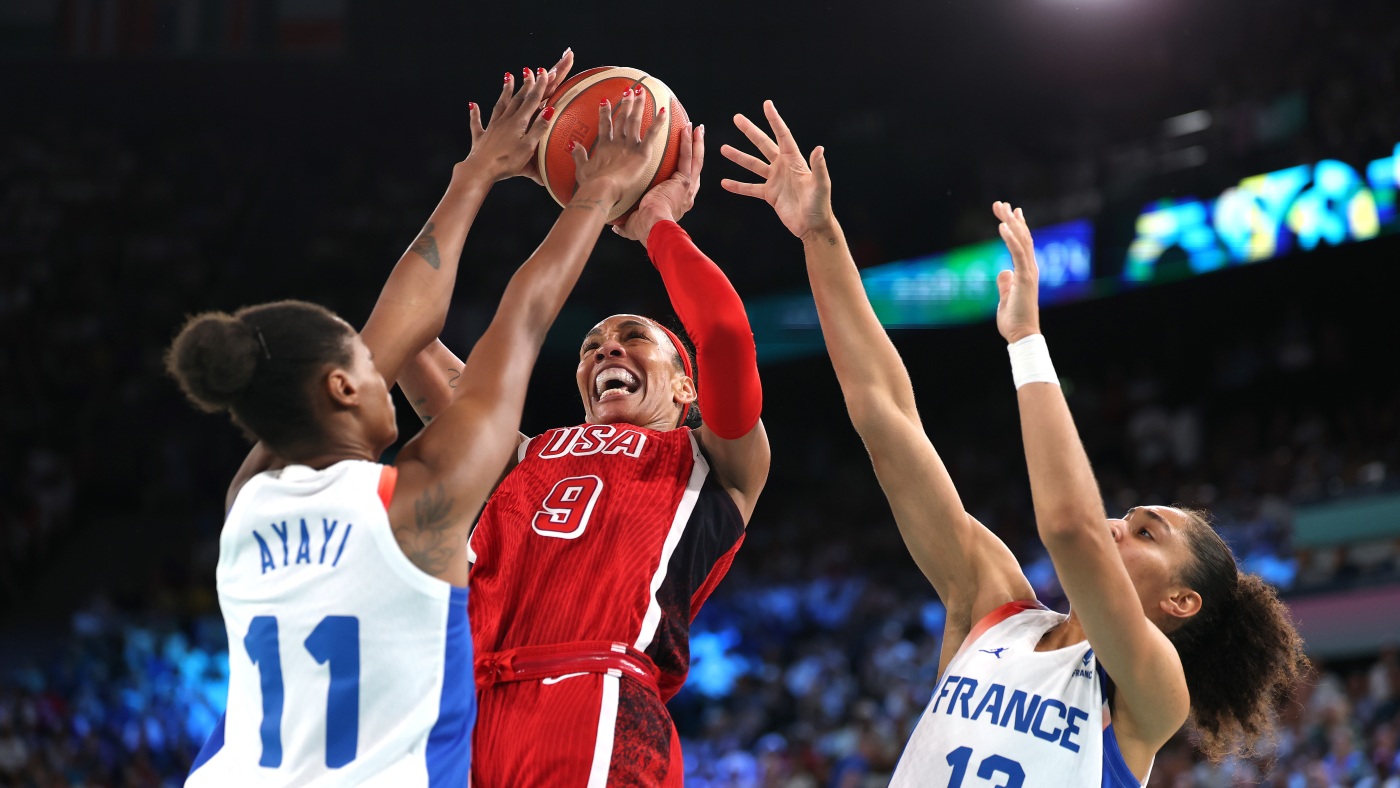
A’Ja Wilson #9 of Team United States shoots between Valeriane Ayayi (L) and Janelle Salaun of Team France during the Women’s Gold Medal game Sunday at the Paris Olympics.
Gregory Shamus/Getty Images
hide caption
toggle caption
Gregory Shamus/Getty Images
NPR is in Paris for the 2024 Summer Olympics. For more of our coverage from the Games head to our latest updates.
PARIS – It wasn’t great basketball. But it didn’t have to be. It was just enough.

Led by A’Ja Wilson, who scored 21 points, the U.S. women’s team beat France on Sunday, 67-66, becoming the first basketball team in Olympic history to win eight consecutive gold medals. The U.S. has now won 61 games in a row at the Summer Games dating back to 1992.
This win didn’t come with the ease with which this team normally plays, with the Americans repeatedly tested by the tenacious French team and a huge pro-French crowd at Bercy Arena. They were treated to a heart-stopping moment with France star Gabby Williams sinking a long-range jumper at the buzzer. But the shot was ruled a two-pointer, not a three, giving the U.S. a one-point win.
“It was a little bit ugly. But no matter what whether it’s good, ugly, whatever we just want to come out on top, and we did that, and we go home with this gold,” Breanna Stewart told reporters afterwards.

Kahleah Copper #7 of Team United States goes up for a basket during the women’s gold medal game between France and the U.S. on Sunday.
Pool/Getty Images
hide caption
toggle caption
Pool/Getty Images
The first half of the game was incredibly disjointed, with the U.S. seeming unable to find any offensive rhythm against a very physical French defense. France briefly took the lead, 25-23 right before halftime, but the U.S. fired back and was able to tie it right before the buzzer, bringing it to a 25-25 tie at the half.
When play resumed, the U.S. did not score until more than three minutes into the quarter. At one point they trailed by as many as ten points.

“We had a hard time getting to our identity of being able to play and transition and score,” said U.S. women’s basketball coach Cheryl Reeve. “We were the two best defensive teams in the tournament, and we both showed that. It was ugly, but it was ugly for a reason. We both made it hard for each other.”
Guard Jackie Young, who has been a key scorer for the U.S team in the quarterfinals and semifinals, fouled out in the fourth quarter. But not before the U.S. rallied with key three-pointers and free throws by Kelsey Plum.
It was France’s first appearance in the Olympic gold medal basketball game since the 2012 Games in London, when the U.S. beat France by 36 points. With Sunday’s loss, France wins the silver medal and Australia claimed bronze by beating Belgium in the third-place game.

France’s Marine Fauthoux reacts after a three point basket during the women’s gold medal basketball game between the United States and host France.
Gregory Shamus/Getty Images
hide caption
toggle caption
Gregory Shamus/Getty Images
Brittney Griner, who was competing internationally for the first time since was freed in a prisoner swap 20 months ago with Russia, said that upon winning, her emotions were “all over the place” during the medal ceremony following the game.
“I was on the podium, flag was going up, as soon as the anthem started tears started coming down my face,” Griner said. “I didn’t think I would be here, like I said before, and then to be here, winning gold for my country, representing when my country fought so hard for me to even be standing here. This gold medal’s gonna hold a special place amongst the other two I was fortunate to win.”
It was a big basketball weekend for the U.S., with both the men’s and women’s basketball teams facing host France for gold medals.
One day earlier the U.S. men’s team held off France, 98-87 to win its fifth-straight Olympic gold. The men’s team went 6-0 in the Paris Games and won gold.

News
“It’s blood money”: Family of exonerated man in Texas yogurt shop murders speaks out after settlement

The widow and the daughter of Maurice Pierce, one of the four men wrongfully accused in the 1991 Texas yogurt shop murders, have confirmed they signed a multimillion-dollar settlement with the city of Austin.
Kimberli and Marisa Pierce spoke with correspondent Erin Moriarty in a new episode of the podcast “48 Hours: Case by Case.” Moriarty has reported on the yogurt shop murders for over 30 years.
Maurice Pierce’s widow Kimberli made clear that their priority has never been financial compensation. “It’s blood money for us. He died for this money,” Kimberli Pierce said. “It’s about the reform and the changes that need to happen, not only in Austin, but apparently across the country.”
They also went into great detail about what they believe happened when Maurice Pierce was shot and killed by police in 2010.
Maurice Pierce was one of four men, along with Michael Scott, Robert Springsteen and Forrest Welborn, who were wrongfully accused in the murders of four teenage girls in Austin on Dec. 6, 1991. Eliza Thomas, Amy Ayers, and sisters Jennifer and Sarah Harbison were tied up, shot and left inside the yogurt shop as it was set ablaze.
The four men were exonerated in February after investigators linked another man, Robert Eugene Brashers, to the killings. The city of Austin subsequently offered a $35 million settlement. Because Maurice Pierce died in 2010, his share of $10 million will go to Kimberli and Marisa Pierce.
Eight days after the killings, 16-year-old Maurice Pierce was arrested at a mall, carrying a .22, the same caliber handgun connected to the crime. Kimberli Pierce said police told Maurice Pierce that his gun was the murder weapon. He responded by mentioning his friend Forrest Welborn. Maurice Pierce was then wired up and sent to speak with Welborn, but investigators ultimately determined that Welborn and the others knew nothing about the murders, and no charges were filed at that time.
Marisa Pierce has said there was no evidence when her father was questioned, “only a detective and a narrative, a narrative so completely false. It feels evil.”
Nearly eight years later, in 1999, all four men were arrested after Scott and Springsteen confessed to the murders. They later recanted, saying they had been coerced. Springsteen and Scott were tried and convicted, but later those convictions were overturned on constitutional grounds. A subsequent DNA test excluded all four men. Maurice Pierce was never convicted but spent three years in jail before his release in 2003.
Kimberli Pierce said her husband came home a hardened man. She believes police continued to harass Maurice and their family after his release. In 2010, Maurice Pierce was stopped for a routine traffic stop, fled on foot, and was shot and killed by an Austin police officer who said Pierce had stabbed him with a knife.
Marisa and Kimberli Pierce told “48 Hours” that they intend to review the circumstances surrounding the night of Maurice Pierce’s death. Marisa Pierce revealed in new, emotional detail that she was on the phone with her father at the time. She believes he panicked and was only trying to get away, not to hurt anyone. She described her father’s last breaths: “And in those last moments, he had just said I’m sorry, I don’t think you’re gonna see me again, and I love you.”
“48 Hours” reached out to the Austin Police Department about the Pierces’ allegations of harassment and their questions about Maurice Pierce’s death in 2010. The police department said they had no additional comment.
For the Pierce family, the settlement is a starting point, not an end point. They have put forward seven proposed reforms they hope the city of Austin will approve, including appointing a child advocate whenever a minor is questioned, prohibiting deceptive interrogation tactics, educating juveniles about their rights and establishing accountability measures to address tunnel vision in police investigations.
In a statement shared with “48 Hours,” the Pierces wrote: “Real justice is not only about acknowledging harm after the fact but about creating safeguards that prevent future families from enduring the same pain.”
This year, Maine nearly became the first state to pass a statewide moratorium on new data centers. But before the law could take effect, supporters of an A.I. data center project in the small town of Jay rallied to fight the ban — and won. So why do residents there want one? We traveled to Jay to find out.

The U.S. Supreme Court
Drew Angerer/AFP via Getty Images
hide caption
toggle caption
Drew Angerer/AFP via Getty Images
The U.S. Supreme Court on Thursday handed the Trump administration a tool that could make it far more difficult for asylum seekers to enter the United States.
Asylum is a form of legal protection available to people fleeing persecution in their home countries if they meet certain criteria. Under U.S. law, an asylum seeker who “arrives in” the U.S. is entitled to apply for asylum and generally cannot be removed from the country until their asylum application is processed.
By a 6-3 vote, the high court ruled that federal law allows the government to stop asylum seekers from physically setting foot in the country, effectively keeping them from applying for asylum.
The Obama administration was the first to try stemming the flow of asylum seekers that way. But the lower courts blocked the policy on grounds that it violated federal law by denying asylum to people who otherwise would have qualified for it, had they been permitted to literally put one foot over the border.
The Trump administration, however, sought to revive the policy, contending that the lower court’s ruling “deprives the Executive Branch of a critical tool for addressing border surges and preventing overcrowding at ports of entry.” And on Thursday, the Supreme Court agreed.
Writing for the majority, Justice Samuel Alito ruled that because asylum seekers are not in the U.S. when they are turned away at the border, they did not “arrive in” the country. Therefore, he continued, the legal protections for asylum seekers have not kicked in.
Writing for the liberal dissenters, Justice Sonia Sotomayor noted that Border Patrol agents speak with all immigrants at legal entry points and speaking with an agent is effectively the first step in “arriving in” the U.S.
-

 Technology7 minutes ago
Of course Meta thinks gambling is the future
-

 World12 minutes ago
Death toll from Venezuela earthquakes rises to at least 589, with thousands reported missing
-

 Politics19 minutes ago
McCarthy says Trump will use ‘everything he can’ to force Senate action on SAVE America Act
-

 Health22 minutes ago
Switching from cigarettes to vapes linked to higher risk of major eye diseases, large study finds
-

 Sports27 minutes ago
2026 World Cup Odds: Which Nations are Favored to Reach Semifinals?
-

 Technology34 minutes ago
World Cup ticket scams target desperate fans
-
Business37 minutes ago
Snap sued by parents of girl who was raped by man she met on Snapchat
-
 Entertainment42 minutes ago
‘The Bear’ at closing time: Ayo Edebiri and Jeremy Allen White reflect on five seasons


